

The Conversation (3)
Oct. 02, 2026 02:00PM PST
|Fact CheckedThis article has been reviewed and updated according to INN's rigorous fact-checking process. Our staff editors verify all articles against information and data from primary sources, reputable publishers and experts.
Explore the week's best-performing Canadian mining stocks on the TSX, TSXV and CSE, and dive into the Canadian news affecting commodities prices and stock markets.
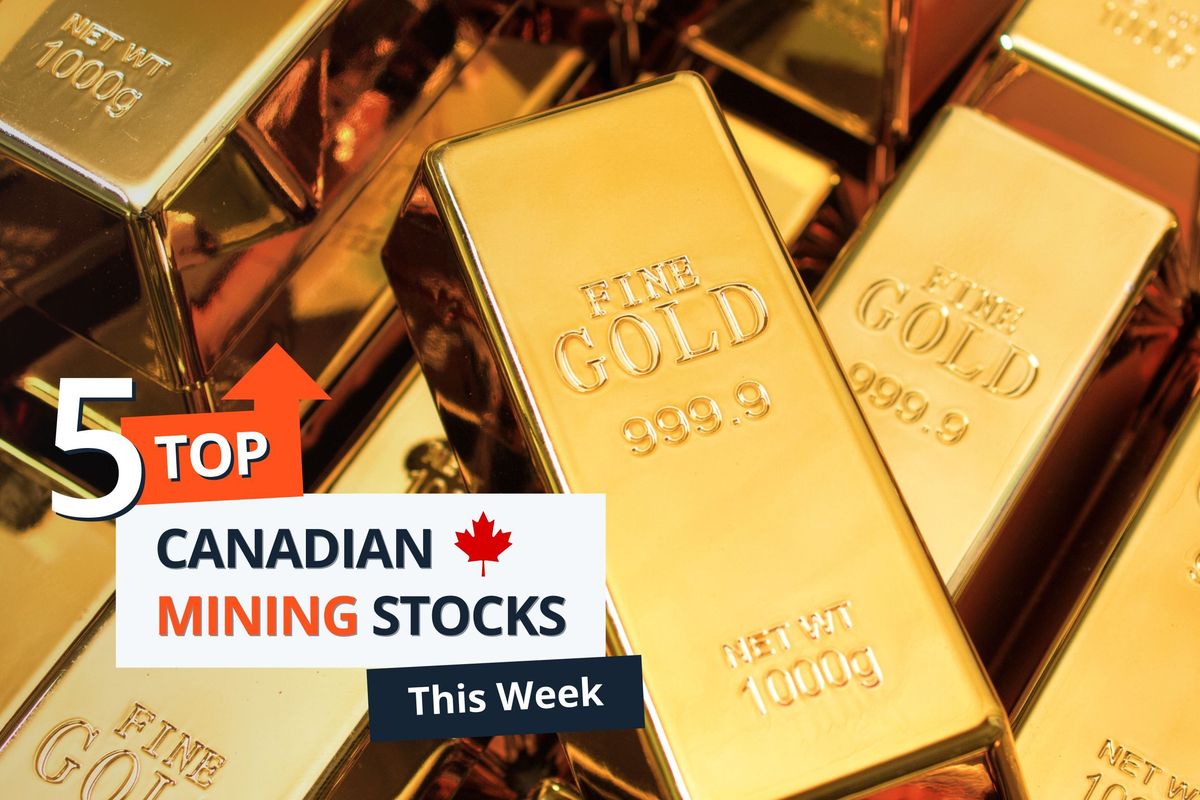
Welcome to the Investing News Network's weekly look at the best-performing Canadian mining stocks on the TSX, TSXV and CSE, starting with a round-up of Canadian news impacting the resource sector.
Statistics Canada released Canada’s gross domestic product by industry data for July on Tuesday (September 29). Overall, Canada’s economic growth stalled, recording no change on a month-to-month basis, after increasing 0.3 percent in June.
The construction and utilities sectors were bright spots, posting increases of 1.3 percent and 1.7 percent, respectively; however, they were offset by decreases in manufacturing and retail trade, which shrank 0.9 percent and 1 percent.
The biggest contributor to the manufacturing drop was a decline in petroleum refining due to unexpected downtime at a refinery.
The declines came before escalations in the trade war between Canada and the US, which saw the US impose tariffs on a host of previously exempted goods at the end of August.
The resource sector also experienced broad declines, and pulled back 0.5 percent overall month-over-month. The oil and gas sector contracted 3 percent led by a 0.7 percent decrease in oil and gas extraction, which was offset by a 0.2 percent increase in the oil sands extraction subsector.
Mining and quarrying also slowed 1 percent, largely driven by a 6.4 percent in potash mining, owed to lower output from Saskatchewan and potash exports slowing. Metals mining was down 1.1 percent, as gold and silver production declined 2.8 percent, which came alongside a drop in exports.
Additionally, a shutdown of Cameco’s Cigar Lake processing plant in Saskatchewan caused disruptions to uranium production in early July.
Offsetting the decreases was a 6.5 percent increase in copper, nickel, lead and zinc mining, and a 3.3 percent increase in iron ore output.
On Friday (October 2), Reuters reported that China was requesting firm copper supply commitments prior to approving a proposed merger between mining giants Teck Resources (TSX:TECK.A,TECK.B,NYSE:TECK) and Anglo American (LSE:AAL,OTCQX:NGLOY).
The report indicates that antitrust regulators have leveraged their power to protect domestic industrial supply in the past. China’s refined copper growth has slowed significantly as global mining output has been disrupted over the past few years.
China’s approval is the last major hurdle to completing the merger, originally announced in September 2025. Once complete, the combined companies will control about 5 percent of global copper supply, which Reuters notes is below the 10 to 15 percent competition threshold.
For more on what’s moving markets this week, check out our top market news round-up.
Markets and commodities react
Canadian equity markets were negative this week.
The S&P/TSX Composite Index (INDEXTSI:OSPTX) lost 0.7 percent over the week to close Friday (October 2) at 35,502.65, while the S&P/TSX Venture Composite Index (INDEXTSI:JX) fell 4.29 percent to 880.57.
The CSE Composite Index (CSE:CSECOMP) shed 7.27 percent to 157.22.
The gold price lost 3.04 percent to close at US$4,145.35 per ounce on Friday at 4:00 p.m. EDT. The silver price was down 5.02 percent at US$60.58 per ounce on Friday.
In base metals, the Comex copper price recorded a 2.91 percent decrease this week to US$6.58 per pond.
The S&P Goldman Sachs Commodities Index (INDEXSP:SPGSCI) fell 1 percent to 730.32
Top Canadian mining stocks this week
How did mining stocks perform against this backdrop?
Take a look at this week’s five best-performing Canadian mining stocks below.
Stocks data for this article was retrieved at 4:00 p.m. EDT on Friday using TradingView's stock screener. Only companies trading on the TSX, TSXV and CSE with market caps greater than C$10 million are included. Mineral companies within the non-energy minerals, energy minerals, process industry and producer manufacturing sectors were considered.
1. 55 North Gold (CSE:FFF)
Weekly gain: 89.19 percent
Market cap: C$12.36 million
Share price: C$0.35
55 North Gold is an exploration company advancing its Last Hope gold project in Northern Manitoba, Canada.
The property consists of 15 claims covering a total land package of 3,513 hectares. Its current resource estimate, published in 2021, outlines an indicated resource of 71,100 ounces of gold from 400,000 metric tons of ore grading 5.41 grams per metric ton (g/t) gold, plus inferred resources of 273,800 ounces from 1.5 million metric tons grading 5.48 g/t gold.
55 North's most recent news release came on July 7, when it released results from its seven hole winter diamond drill program at Last Hope comprising infill and step-out holes. The company said the drilling extended gold mineralization 300 meters beyond the current resource estimate and confirmed that the system remains open along strike and down plunge.
Its highlighted assay results include an interval of 19.42 meters with an average grade of 2.49 g/t gold from 211.58 meters downhole, including 4.5 meters at 5.34 g/t gold. Another hole returned 2.56 meters at 6.91 g/t gold. The company said the new results will support targeting for further drilling ahead of an updated resource estimate.
2. Synergy Metals (CSE:SYN)
Weekly gain: 43.9 percent
Market cap: C$10.69 million
Share price: C$0.59
Synergy Metals is an exploration company advancing its Dale gold property in Ontario, Canada.
The property is located in the Swayze greenstone belt, southwest of Timmins. It consists of 98 unpatented mining claims covering 1,980 hectares. Dale has never been drilled, and no mineral resource has been estimated for the property.
Synergy began trading on the CSE on August 26, after a plan of arrangement that spun the company out of Element79 Gold (CSE:ELEM,OTCQB:ELMGF), which retains about a 30 percent stake. The company added a listing on the Frankfurt Stock Exchange in early September, expanding its reach to European investors.
On September 3, the company began soliciting contractors for its first exploration program at Dale. The program is expected to last around six weeks and will include about 1,000 soil samples, a LiDAR survey, trenching and channel sampling. Results will inform a Phase 2 program, which will include 1,500 meters of drilling.
3. Brutus Mining (CSE:BRU)
Weekly gain: 31.94 percent
Market cap: C$20.22 million
Share price: C$0.95
Brutus Mining is an exploration company advancing its CW copper project in British Columbia, Canada.
The property is located in South-central BC, about 100 kilometers north of Kamloops. It consists of five contiguous mineral claims covering 2,894.56 hectares and hosts five primary targets with copper and gold mineralization.
According to a January 2026 technical report, Brutus holds an option to earn a 100 percent interest in the property by paying the vendor total consideration of C$80,000 cash and 200,000 shares.
The project is in its early stages and does not have a mineral resource estimate.
Brutus Mining recently went public. The company signed a listing agreement with the Canadian Securities Exchange on September 1, with trading commencing on September 10. On September 17, Brutus announced it had engaged Palliser Exploration to carry out a soil sampling survey at CW. The program, consisting of 1,500 samples spaced evenly across the property, is designed to detect mineralization not found in previous programs.
This marks the second week in a row as a top five performer for Brutus after it topped last week's list supported by multiple news releases. On September 21, the company announced two concurrent non-brokered private placements for gross proceeds of up to C$3 million. Brutus plans to use the proceeds for exploration at CW, the evaluation of new projects and working capital. Then, on September 23, Brutus said its shares had also begun trading on the Frankfurt Stock Exchange, giving the company exposure to European investors.
As for this week, on Wednesday (September 30) Brutus announced that it brought on ESGold (CSE:ESAU,OTCQB:ESAUF) CEO and Director Gordon Robb and Geologist Luke van der Meer as company advisors.
4.. ZincX Resources (TSXV:ZNX)
Weekly gain: 31.82 percent
Market cap: C$54.49 million
Share price: C$0.29
ZincX Resources is an exploration company advancing its flagship Akie zinc-lead-silver project in BC, Canada.
The property consists of 46 mineral claims covering a land package of 116 square kilometers within the Kechika Trough and hosts the Cardiac Creek deposit.
A mineral resource estimate included in a June 2018 technical report shows an indicated resource of 22.7 million metric tons of ore grading 8.32 percent zinc for 4.16 billion pounds of contained zinc, 1.61 percent lead for 804 million pounds of lead, and 14.1 g/t silver for 10.3 million ounces.
The most recent news from the Akie property came in late April, when ZincX received a renewal of its surface drilling permit from BC’s Ministry of Energy, Mines and Low Carbon Innovation. The permit is valid until December 31, 2028.
On July 16, the company announced that it had amended a previous option agreement for its Kechika North project with an arm’s length third party, which previously required a C$3 million cash payment to exercise the option for a 100 percent interest.
The third party has now exercised the option under the new terms of the deal, which required a C$1 million payment to do so. It must also make an additional C$1.9 million cash payment if the province formally designates the Kaska conservation area, or earlier if the third party so chooses.
Kechika North formed part of ZincX’s Kechika regional project, a portfolio of properties to the north of Akie. ZincX still owns the Kechika South project, which includes both wholly owned and joint venture properties.
The most recent news came on September 11 when ZincX announced that it closed a non-brokered private placement raising gross proceeds of C$1.82 million. The funds will be used to advance work at the Akie and Kechika projects.
5. Xcite Uranium (CSE:XRI)
Weekly gain: 29.85 percent
Market cap: C$34.84 million
Share price: C$0.435
Xcite Uranium is an explorer focused on projects in Saskatchewan's Athabasca Basin. The company has 12,310 hectares across six project areas within the Beaverlodge district, which surrounds Uranium City.
Its most recent focus has been the 943 hectare Lorado project and the 1,996 hectare Gulch project.
On Monday (September 28), Xcite announced the start of a drill program at the Gulch project consisting of 900 meters of diamond drilling across three holes, targeting conductors and magnetic breaks consistent with radon anomalies. Previously, rock samples from Gulch returned values of 1.6 and 3.75 percent uranium oxide (U3O8) during its 2026 fieldwork program.
Additionally, the company provided an update on drilling at Lorado, noting that three holes have been completed for a total of 1,099 meters. The final hole intersected multiple intervals of radioactivity, with the highest registering 2,281 counts per second over a 0.6 meter width. Lab assays are pending.
FAQs for Canadian mining stocks
What is the difference between the TSX and TSXV?
The TSX, or Toronto Stock Exchange, is used by senior companies with larger market caps, and the TSXV, or TSX Venture Exchange, is used by smaller-cap companies. Companies listed on the TSXV can graduate to the senior exchange.
How many mining companies are listed on the TSX and TSXV?
As of July 2026, 892 mining companies and 68 oil and gas companies are listed on the TSXV, combining for 64 percent of the 1,501 total companies listed on the exchange.
The TSX is home to 182 mining companies and 51 oil and gas companies. The exchange has 2,264 companies listed on it in total.
Together, the TSX and TSXV host around 40 percent of the world’s public mining companies.
How much does it cost to list on the TSXV?
There are a variety of different fees that companies must pay to list on the TSXV, and according to the exchange, they can vary based on the transaction’s nature and complexity.
As of April 2026, the listing fee alone will most likely cost between C$10,000 to C$70,000, and accounting and auditing fees could rack up between C$25,000 and C$100,000. Legal fees are expected to be over C$75,000 and an underwriters’ commission may hit up to 12 percent.
The exchange lists a handful of other fees and expenses companies can expect, including but not limited to security commission and transfer agency fees, investor relations costs and director and officer liability insurance.
These are all just for the initial listing, of course. There are ongoing expenses once companies are trading, such as sustaining fees and additional listing fees, plus the costs associated with filing regular reports.
How do you trade on the TSXV?
Investors can trade on the TSXV the way they would trade stocks on any exchange. This means they can use a stock broker or an individual investment account to buy and sell shares of TSXV-listed companies during the exchange's trading hours.
Don't forget to follow us @INN_Resource for real-time updates!
Securities Disclosure: I, Dean Belder, hold no direct investment interest in any company mentioned in this article.
From Your Site Articles
- Top 3 Canadian Lithium Stocks in 2026 ›
- 5 Best-performing Gold Stocks on the TSX ›
- 5 Best-performing Canadian Uranium Stocks ›
- Top 5 Junior Gold Mining Stocks on the TSXV ›
- 5 Best-performing Copper Stocks on the TSX ›
Related Articles Around the Web
https://x.com/INN_Resource
https://www.linkedin.com/in/deanbelder
dbelder@investingnews.com
Dean has been writing in one form or another since penning stage plays in his youth. He is a graduate of both Emily Carr University and Simon Fraser University, with a BFA in photography and a BA in communications.
As a writer, Dean has traveled throughout BC and the Pacific Northwest covering cultural events, interviewing small business owners and working alongside fellow writers and photographers from publications like Rolling Stone Magazine, Spin and the Georgia Straight.
Dean has a keen interest in investing, and enjoys learning about the mining industry and better understanding the technical aspects of trading. In his spare time, Dean is an avid home chef, ponders the space-time continuum and makes his own cider. On weekends he can be found cycling the Seawall, exploring farmers markets or sampling the city’s local craft breweries.
As a writer, Dean has traveled throughout BC and the Pacific Northwest covering cultural events, interviewing small business owners and working alongside fellow writers and photographers from publications like Rolling Stone Magazine, Spin and the Georgia Straight.
Dean has a keen interest in investing, and enjoys learning about the mining industry and better understanding the technical aspects of trading. In his spare time, Dean is an avid home chef, ponders the space-time continuum and makes his own cider. On weekends he can be found cycling the Seawall, exploring farmers markets or sampling the city’s local craft breweries.
INN Article Notification
Latest News
Outlook Reports world
Featured Gold Investing Stocks

Browse Companies
MARKETS
COMMODITIES
CURRENCIES
Dean has been writing in one form or another since penning stage plays in his youth. He is a graduate of both Emily Carr University and Simon Fraser University, with a BFA in photography and a BA in communications.
As a writer, Dean has traveled throughout BC and the Pacific Northwest covering cultural events, interviewing small business owners and working alongside fellow writers and photographers from publications like Rolling Stone Magazine, Spin and the Georgia Straight.
Dean has a keen interest in investing, and enjoys learning about the mining industry and better understanding the technical aspects of trading. In his spare time, Dean is an avid home chef, ponders the space-time continuum and makes his own cider. On weekends he can be found cycling the Seawall, exploring farmers markets or sampling the city’s local craft breweries.
Learn about our editorial policies.