The Conversation (1)

May. 06, 2026 01:45PM PST
Fact CheckedThis article has been reviewed and updated according to INN's rigorous fact-checking process. Our staff editors verify all articles against information and data from primary sources, reputable publishers and experts.

Itan1409 / Shutterstock
With gold prices surging to new all-time highs at the start of 2026, the top gold-producing countries are set to benefit significantly from a runaway bull market.
After surging more than 80 percent since January 2025, the market's momentum peaked on January 28, when gold reached an all-time high of US$5,589.38.
The underlying trends driving gold in 2025 remain in 2026, including significant interest from central banks, falling interest rates and geopolitical uncertainty driven by the ongoing war between Russia and Ukraine and fresh hostilities in the Middle East between the United States and Iran.
Additionally, since US President Donald Trump took office, his aggressive trade tactics have sent ripples through the global economy, prompting investors to seek safe-haven assets such as gold.
As uncertainty grips the markets, rising gold prices will benefit gold producers and the countries they operate in. So, which countries produce the most gold?
Here, the Investing News Network outlines the top gold producers by country in 2025 using the latest production numbers from the US Geological Survey's 2026 Mineral Commodity Summary.
Global gold production totaled 3,300 metric tons in 2025, up 20 metric tons from 2024, according to the USGS.
While gold is often measured and discussed in troy ounces, the USGS uses metric tons for its gold data, so this article will contain a mix of the two measurements. For perspective, 1 metric ton of gold is equal to 32,151 troy ounces and worth US$145 million at a price of US$4,500 per gold ounce.
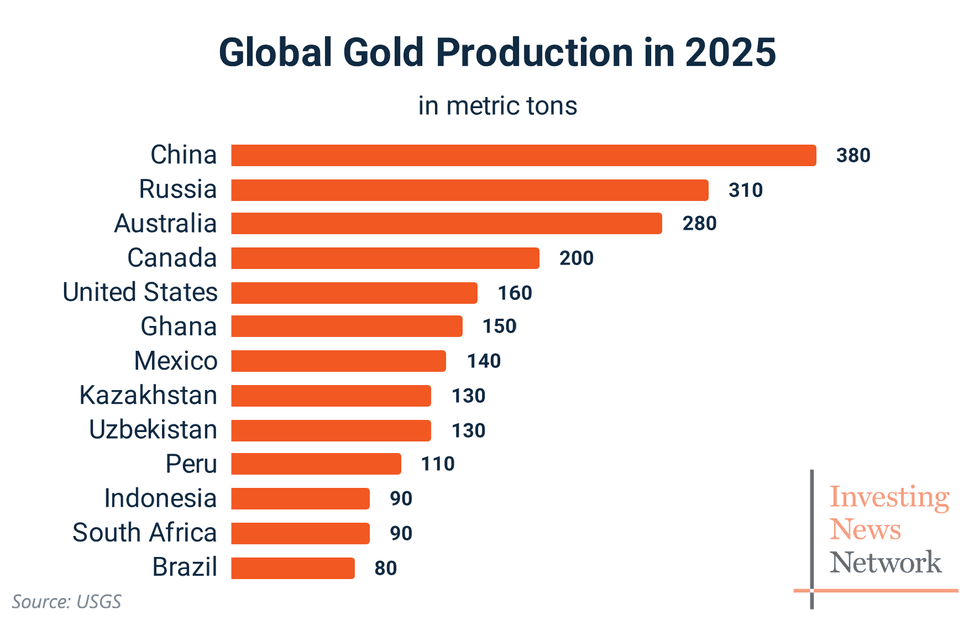
1. China
Gold production: 380 metric tons
China was the world's top gold-mining country in 2025 with output of 380 metric tons.
While China's gold output peaked at 455 metric tons in 2016, it hasn’t dipped below 300 metric tons in more than a decade. This consistent production continues to ensure China's status as the world's top gold producer, a title it first claimed in 2007.
China's gold-mining industry is dominated by state-owned operators, although several are partially publicly traded. One of the country's largest mining companies is Zijin Mining Group (HKEX:2899,SHA:601899,OTCPL:ZIJMF), whose portfolio includes an 84.2 percent stake in the Longnan mine in the Gansu Province. According to its 2025 results, the mine produced 238,170 ounces of gold, with 200,590 attributable to Zijin.
Another significant mining company is China Gold International Resources (TSX:CGG,OTCPL:JINFF), which owns a 96.5 percent stake in the Chang Shan Hao gold mine located in Inner Mongolia. One of China’s largest gold mines, it produced 96,816 ounces of gold in 2025.
China also hosts major gold-smelting operations. Its Belt and Road Initiative has resulted in Chinese companies exploring and developing sites elsewhere in Asia and Africa, subsequently sending raw resources back to China for refinement.
The country is one of the largest consumers of gold in the world, although its gold consumption pulled back slightly to 950.1 metric tons last year on decreasing jewelry demand, according to a report from Reuters.
Meanwhile, China’s central bank was among the largest buyers of the precious metal in 2025, adding 27 metric tons of gold to its coffers during the year to bring its official gold holdings to 2,306 metric tons.
2. Russia
Gold production: 310 metric tons
Gold production from Russia came in at 310 metric tons in 2025, the same as the prior year. The country's output has risen fairly significantly since 2017, when it produced only 255 metric tons of gold.
The US Geological Survey states that Russian gold reserves stand at 12,000 metric tons, making it the second-largest country for reserves after Australia.
Russia has several large gold mines, but none are more prolific than Polyus' (MCX:PLZL) Olimpiada mine in the Ksasnoyarsk Krai region of Siberia. According to the company's most recent data, the mine produced 926,000 ounces of gold in 2025.
Despite high production and reserves, Russian's invasion of Ukraine in 2022 led the London Bullion Market Association to halt trading and remove Russian refiners from its accredited list world markets since the country invaded Ukraine in February 2022. In response, Russian operators have sought out alternative markets, particularly the BRICS nations and other Asian countries like Kazakhstan.
While Russian gold has faced challenges reaching western markets, reports indicate that in Q1 2026 the country sold 21.8 metric tons of gold to its partners to help combat a widening deficit as the war with Ukraine entered its fifth year. At the same time, the government also banned individuals and private entities from exporting over 100 grams in gold bullion in an attempt to prevent capital flight from the country.
3. Australia
Gold production: 280 metric tons
Australian gold production slightly decreased in 2025 to 280 metric tons, down from 284 metric tons the previous year.
In terms of economic impact, gold is one of Australia's most important resources. In December 2025, the country predicted that gold would overtake natural gas to become its second most valuable commodity in the 2025/2026 financial year, forecasting AU$69 billion in gold exports, due to rising prices and higher volumes.
According to government data, Western Australia accounts for the majority of all gold mined in the country and is home to several large gold mines, including Newmont’s (ASX:NEM,NYSE:NEM) Boddington operation, which produced 565,000 ounces of gold in 2025. It also hosts the Tropicana mine, a joint venture between AngloGold Ashanti (NYSE:AU) and Regis Resources (ASX:RRL,OTCPL:RGRNF) that produced 436,000 ounces of gold last year.
The second largest gold-producing state in Australia is New South Wales. It's home to several significant operations, including Newmont's Cadia Valley mine, which produced 385,000 ounces in 2025, and Evolution Mining's (ASX:EVN,OTCPL:CAHPF) Cowal mine, which produced 330,008 ounces in the company's 2025 fiscal year.
Not only is Australia one of the top gold producers, it also holds the world's largest gold reserves, with an estimated 13,000 metric tons. These reserves will ensure the country remains in the top 10 for years to come.
4. Canada
Gold production: 200 metric tons
In 2025, gold production in Canada totaled 200 metric tons, the same output it recorded in 2024.
Ontario and Québec are the largest gold-producing provinces in the country; together, they represent nearly 70 percent of Canada’s gold output, followed by British Columbia and the Yukon.
The Canadian government states that gold is the nation’s most valuable mined commodity, with domestic gold exports surging 33 percent in 2024 to reach a record of C$40.2 billion thanks to high gold prices and central bank demand.
Canada has a number of very large gold mines, the largest of which is Detour Lake in Ontario, followed closely by the Canadian Malartic Complex in Québec. The mines, both owned by Agnico Eagle Mines (TSX:AEM,NYSE:AEM), produced 692,675 and 642,612 ounces of gold in 2025 respectively.
British Columbia's north is home to the Golden Triangle, a resource-rich area that hosts several significant operations, such as the Newmont-owned Brucejack mine, which produced 231,000 ounces in 2025. Outside of the Golden Triangle is the newly opened Blackwater mine owned by Artemis Gold (TSXV:ARTG,OTCQX:ARGTF). Currently in the ramp-up stage, Blackwater produced 192,808 ounces of gold last year and is expected to deliver 265,000 to 290,000 ounces in 2026.
5. United States
Gold production: 160 metric tons
The US produced 160 metric tons of gold in 2025, a drop from 163 metric tons produced in 2024. This continues a trend of production declines that started in 2017, when the US produced 237 metric tons of gold.
According to the US Geological Survey, the top state for production of the yellow metal was Nevada, which accounted for 64 percent of total domestic production, followed by Alaska with 22 percent. The top 25 operations in the country were responsible for 94 percent of American gold output in 2025.
Gold reserves in the US are estimated at 3,000 metric tons.
The largest gold-mining assets in the US are all owned by Nevada Gold Mines, a joint venture between Barrick Gold (TSX:ABX,NYSE:GOLD) and Newmont, and consist of Turquoise Ridge, the Cortez Complex and the Carlin Complex. Between them, the mines produced 2.59 million ounces of gold in 2025.
6. Ghana
Gold production: 150 metric tons
West Africa has a rich history of gold production dating back hundreds of years. Ghana's gold production totaled 150 metric tons in 2025, continuing an upward trend over the last few years. The most substantial gains in its gold output during that time came between 2022 and 2023, when it leaped from 88 to 126 metric tons.
Gold has become an important economic driver for the country, and its most valuable export. In 2025, Ghana's gold exports reached a record US$20 billion compared to US$10.1 billion the prior year. Its export value far exceeded that of cocoa and oil, which totaled US$3.8 billion and US$2.6 billion in 2025 respectively.
The country is home to several highly productive gold mines, including the Ahafo South mine, which produced 734,000 ounces of gold in 2025 under Newmont, and the Tarkwa mine, split 90/10 between Gold Fields (NYSE:GFI)
and the Ghanaian government, with 427,000 ounces.
7. Mexico
Gold Production: 140 metric tons
Mexico’s gold production in 2025 came in at 140 metric tons, matching output from the previous year.
Mexico has a long history of gold mining; in fact, the Spanish colonization of Central America in the early and mid-1500s was largely targeting gold and silver. Today, Mexico is among the global leaders in gold production. Precious metals account for nearly 50 percent of the country’s total metal output.
While much of Mexico's gold mining is controlled by foreign entities, one of the largest operations, the Herradura mine, is owned by Mexico City based Fresnillo (LSE:FRES,OTCPK:FNLPF). Herradura produced 356,097 ounces of gold in 2025, more than half of Fresnillo’s total gold production.
8. Kazakhstan
Gold production: 130 metric tons
Kazakhstan's gold output was 130 metric tons in 2025, remaining stable over the last few years following a period of growth in the country's gold production from just 69 metric tons in 2016.
Kazakhstan’s largest gold-mining operation is the Altyntau Kokshetau mine. While the mine is owned by Kazakhstan-based Kazzinc, mining giant Glencore (LSE:GLEN,OTC Pink:GLCNF) holds a 69.7 percent ownership stake in the company.
In its 2025 production report, Glencore stated that it produced 543,000 ounces of gold across all its Kazakhstan assets, the majority of which came from the Altyntau Kokshetau mine.
SolidCore Resources (AIX:CORE) is one of Kazakhstan's largest producers, with several mines in the country. Its largest asset is the Kyzyl mine, which hosts reserves 2.4 million ounces. In its fiscal year 2025 financial results, the company reported gold equivalent production of 395,000 ounces from its assets, shy of the 420,000 ounces it anticipated at the start of the year.
SolidCore previously operated in Russia as well, but the company was delisted from the LSE and its assets, sanctioned, due to Russia's invasion of Ukraine. It has since divested its Russian operations and focused solely on Kazakhstan, redomiciling in the country in 2023.
9. Uzbekistan
Gold Production: 129 metric tons
Uzbekistan produced 130 metric tons of gold in 2025, nearly on par with the 129 metric tons it produced in 2024.
Operated by Navoi Mining and Metallurgical Company, Uzbekistan's Muruntau gold mine is one of the largest gold operations in the world. Massive deposits of gold were first discovered at the site in the 1950s, and it still holds some of the largest reserves in the world at 4,500 metric tons. The discovery marked the beginning of gold mining in Uzbekistan. The mine produces more than 2.5 million ounces of gold per year and is expected to continue operating into the 2030s.
Following the fall of the Soviet Union in 1991, gold mining in Uzbekistan fell to all-time lows in the mid-1990s. In 2019, the country’s government announced renewed investment into development and exploration. While that hasn't yet been reflected in its annual production, upgrades at Muruntau scheduled to be completed in 2026 are expected to increase its output from 38.5 million to 50 million metric tons of ore per year.
10. Peru
Gold production: 110 metric tons
Peru is a mineral-rich country, known for deposits of copper, silver and gold. In 2025, Peru’s gold production was flat with the prior year’s, with 110 metric tons being extracted.
While Peru’s gold mines may not produce as much gold as some others on this list, some are still significant producers, including Newmont’s Yanacocha mine, which produced 515,000 ounces in 2025, and Pan American Silver’s (TSX:PAAS,NYSE:PAAS) Shahuindo mine, which produced 132,000 ounces.
Peru has spent years working to crack down on illegal mining. While it has had some success, illegal gold operations account for roughly half of all gold produced in Peru. These operations have also wreaked havoc on vast swaths of the Amazon, as mercury used in the production of gold leaches into groundwater and soil.
There are also legal artisanal miners who oppose recent government action to regulate illegal operations. Currently, illegal miners are granted temporary legal status, giving them time to formalize their licenses. These licenses have been disputed by legal artisanal miners and mining companies who say it encourages illegal activities. In November 2025, Peru extended the temporary licenses until the end of 2027.
FAQs for gold investing
How is gold mined?
Gold is mined by several different methods, including: placer mining, hard-rock mining, by-product mining and by processing gold ore. The method a gold-mining company chooses depends upon the size, location, geological model and metallurgy of the deposit in question.
What is the production cost of gold?
The cost of producing gold varies from one miner to the next, and is reported as the all-in sustaining cost (AISC). AISC was first introduced in 2013 by the World Gold Council. Deposit type, energy costs and inflation are the factors that have the largest impact on AISC. The average AISC for the entire gold industry is calculated by averaging the production costs of the largest gold producers. The average AISC fluctuates with changes in energy costs and inflation.
Which nation is the largest owner of gold?
The country with the largest central bank gold reserves is the US, which had 8,133.5 metric tons as of March 2026. Most US central bank gold is held in deep storage in Denver, Fort Knox and West Point.
Don’t forget to follow us @INN_Resource for real-time news updates!
Securities Disclosure: I, Dean Belder, currently hold no direct investment interest in any company mentioned in this article.
From Your Site Articles
- 10 Largest Gold Mines in the World by Production ›
- Top 10 Gold Reserves by Country ›
- Top 10 Gold-mining Companies ›
- Why Do Central Banks Buy Gold? ›
- Top 10 Central Bank Gold Holdings ›
Related Articles Around the Web
https://x.com/INN_Resource
https://www.linkedin.com/in/deanbelder
dbelder@investingnews.com

Featured Gold Investing Stocks

Investor Insight
Heliostar combines production of ~50,000–55,000 oz in 2026 with a pipeline of high-margin development assets in Mexico led by Ana Paula. Supported by operating cash flow from La Colorada and San Agustin, a debt-free balance sheet and strategic expansion into the US with the Goldstrike project in Utah, the company is positioned to scale into a 500,000 oz per year gold producer.
Overview
Heliostar Metals (TSX:HSTR,OTCQX:HSTXF,FRA:RGG1) is an emerging gold producer focused on building a mid-tier, multi-asset production platform, anchored in Mexico and complemented by strategic expansion into the United States.

The company has rapidly transformed from an explorer into a producer through disciplined, value-accretive acquisitions, assembling a 100 percent-owned portfolio of producing mines, advanced development projects and exploration assets. This platform provides both immediate cash flow and long-term scalability.
In 2025, Heliostar produced 34,098 gold equivalent ounces, generated US$47.4 million in mine operating earnings, and ended the year with US$40.6 million in cash and no debt, demonstrating strong execution and financial discipline.
Production is expected to increase to 50,000–55,000 oz in 2026, driven by La Colorada and San Agustin. Development of Ana Paula and Cerro del Gallo supports a clear pathway to 500,000 oz annual production by 2030.

In 2026, Heliostar formed part of the OTCQX’s Best 50 top-performing companies. The company ranked 8th overall, joining 7 other mining companies in the top 10.
Beyond its core Mexican portfolio, the addition of the Goldstrike project in Utah introduces further growth optionality, reinforcing Heliostar’s strategy of acquiring and advancing underexplored assets with strong development potential. With a staged growth strategy, strong margins and an expanding resource base, Heliostar is positioned to evolve into a 500,000 oz per year gold producer by 2030.
Company Highlights
- Growing Production Base: Two producing mines targeting 50,000–55,000 oz of gold in 2026, generating cash flow to fund development.
- Clear Path to Mid-Tier Scale: Staged growth targeting annual production of 500,000 oz by 2030.
- High-Margin Flagship Asset: The Ana Paula PEA outlines 101,000 oz/year production (post ramp-up) with strong economics, including US$1,012M NPV5% and 51.3% IRR at higher gold price assumptions, supporting a 2028 production target.
- Self-Funded Growth Model: Generated US$47.4 million in mine operating earnings (2025) with US$40.6 million in cash and zero debt, reducing reliance on equity dilution.
- Robust Resource Base: Approximately 7.3 Moz measured and indicated gold resources plus ~1.4 Moz inferred, supporting long-term scalability.
- High-Quality Development Pipeline: Cerro del Gallo targeting 86,000 GEO/year at US$1,390 AISC, alongside San Antonio’s production potential.
- Strategic Expansion in the US: Acquisition of the Goldstrike project in Utah adds near-surface oxide potential and long-term growth optionality.
- Strong Institutional Backing: Approximately 53 percent institutional ownership, complemented by high-net-worth investors and management alignment.
Key Projects
Ana Paula (Flagship Development Project)

Ana Paula is a high-grade underground gold project in Guerrero and the cornerstone of Heliostar’s long-term growth strategy.
The November 2025 PEA outlines a 9 year mine life with 101,000 oz/year production, 874,700 oz total output, and strong economics, including a US$1,012M NPV5% and a 51.3 percent IRR, supported by a low AISC of US$1,011/oz.
The project hosts approximately 742,000 oz measured and indicated at 5.4 g/t and 514,000 oz inferred, highlighting its high-grade profile and expansion potential.

With a feasibility study targeted for H1 2027 and construction expected in H2 of the same year, Ana Paula is expected to become the primary driver of Heliostar’s transition to mid-tier production.
The company is targeting production at Ana Paula in 2028.
La Colorada Mine

La Colorada in Sonora is a key cash-flowing asset that underwent a successful turnaround in 2025. The mine hosts reserves of 376,000 ounces of gold grading 0.68 g/t in 17.1 million tonnes of ore.
The mine is expected to produce 20,000–22,300 oz in 2026 at AISC of US$1,775–1,875/oz, supported by a six-year mine life and approximately 286,000 oz total production profile.
Mining at the project’s Veta Madre pit commenced in August 2026, a milestone that the company ties to its plan to secure cash flow through 2027 and 2028 to support construction at Ana Paula.
Ongoing drilling, pit expansions and underground potential provide meaningful upside, reinforcing its role as a core funding engine for development.

San Agustin Mine
San Agustin in Durango is a restarted oxide heap-leach operation providing near-term production growth and cash flow.
2026 guidance targets 30,000–32,700 oz of gold at AISC of US$2,150–2,250/oz, following a low-capital restart funded from the company’s balance sheet.
The asset offers additional upside through oxide expansion and sulphide exploration, supporting potential mine life extension.
Cerro del Gallo Project
Cerro del Gallo is a large-scale gold-silver development project in Guanajuato and a key driver of future production growth.
The 2025 PFS outlines ~86,000 GEO/year over a 15-year mine life at US$1,390 AISC, with strong economics, including US$972 million NPV5% and 59.3 percent IRR at higher gold price assumptions.
The project is expected to play a central role in advancing Heliostar towards the goal of 500,000 oz annual production by 2030.
San Antonio Project
San Antonio is a 100%-owned heap-leach development project offering strong optionality and long-life production potential.
The project hosts approximately 1.74 million ounces of measured and indicated gold and demonstrates attractive optionality, including potential 80,000 oz/year production and low AISC of US$1,063/oz.
As permitting advances, San Antonio represents a key medium-term growth opportunity within the portfolio.
Goldstrike Project (Utah, USA)
Goldstrike is a newly acquired gold project that expands Heliostar’s footprint in the United States and adds exploration and development optionality. The property currently hosts an Indicated resource of 975 kilo ounces at 0.46 g/t of gold.
The project hosts a near-surface oxide gold system with historical production of approximately 209,000 ounces of gold and defined mineralization, offering potential for low-cost, open-pit heap-leach development. Its geological setting and existing dataset provide a strong foundation for resource growth and technical advancement.
Goldstrike complements Heliostar’s acquisition strategy by adding a scalable, underexplored asset outside its core Mexican portfolio, enhancing long-term growth potential.
Drilling is underway at Goldstrike to test the antimony and gold potential of both Antimony Ridge and Antimony Knoll, with results expected towards the end of 2026.
Management Team
Charles Funk – President & CEO
Charles Funk has over 20 years of experience in exploration and business development, including senior roles at Newcrest Mining and OZ Minerals. He led the Panuco discovery for Vizsla Silver, demonstrating strong capability in identifying high-value deposits. At Heliostar, he has driven the company’s transformation into a multi-asset gold producer through disciplined acquisitions. His leadership is focused on building a scalable, mid-tier gold platform.
Gregg Bush – Chief Operating Officer (COO)
Gregg Bush is a proven mine builder with extensive experience in mine development, integration and operations. He previously served as COO of Capstone Mining and held senior leadership roles at Equinox Gold. Bush brings deep expertise in optimizing operating assets and advancing projects into production. He plays a key role in executing Heliostar’s production growth strategy.
Sam Anderson – VP Projects
Sam Anderson has approximately 25 years of experience in mine geology and project development, including 17 years at Newmont. He played a key role in advancing the Merian Mine from resource stage through construction to steady-state production. His expertise spans exploration, resource expansion and project execution. At Heliostar, he leads the advancement of key development assets.
Mike Gingles – VP Corporate Development
Mike Gingles brings more than 35 years of experience in the mining industry, specializing in corporate development and M&A. He played a leadership role in major transactions including Pueblo Viejo and Turquoise Ridge. His expertise includes project evaluation, deal structuring and strategic partnerships. He supports Heliostar’s acquisition-driven growth strategy.
Hernan Dorado – VP Sustainability & Special Projects
Hernan Dorado is a fifth-generation miner with over 20 years of experience in mining operations, particularly in Mexico. He was a founding member of Guanajuato Silver, where he served as COO. His expertise includes permitting, community engagement and sustainability practices. He ensures responsible development across Heliostar’s operations.
Vitalina Lyssoun – Chief Financial Officer (CFO)
Vitalina Lyssoun is a Chartered Professional Accountant (CPA, CA) with more than 16 years of experience in financial management within the resource sector. She has extensive expertise in public company reporting, compliance and internal controls. Prior to joining Heliostar, she led the corporate accounting function at Gatos Silver. Her experience spans multiple international jurisdictions.
Stephen Soock – VP Investor Relations & Development
Stephen Soock has nearly 20 years of experience across mining operations and capital markets. He began his career in technical roles at mine sites before transitioning to equity research, where he spent eight years covering growth-stage mining companies. He is a mining engineer and CFA Charterholder. At Heliostar, he leads investor relations and supports capital markets strategy.
Investor Insight
GoldInxs Mining Corp. (TSXV:INXS, OTCQB: INXGF) provides investors with exposure to early-stage gold-copper exploration in British Columbia, leveraging a portfolio of high-potential projects in Tier 1 jurisdictions, within established gold districts, surrounded by strong regional infrastructure and led by an experienced management team committed to accelerating discovery and delivering shareholder value.
Overview
GoldInxs Mining Corp. is a discovery-focused mineral exploration company dedicated to identifying and advancing high-potential copper-gold assets in proven geological belts. The Company's strategy centers on acquiring overlooked and underexplored projects with large-scale potential, applying modern exploration techniques to rapidly evaluate targets and unlock shareholder value through discovery.
The Company’s. common shares started trading on the TSX Venture Exchange in July 2026 under the symbol INXS, positioning itself to capitalize on favorable copper and gold market fundamentals.
Copper demand is forecasted to grow steadily through 2030, with the global copper market expected to expand to over US$340 billion by 2030, driven by electric vehicles, renewable energy and infrastructure growth.
On the other hand, gold continues to provide a safe-haven hedge against policy risks and market volatility, making GoldInxs’ dual focus on copper and gold particularly compelling for investors.
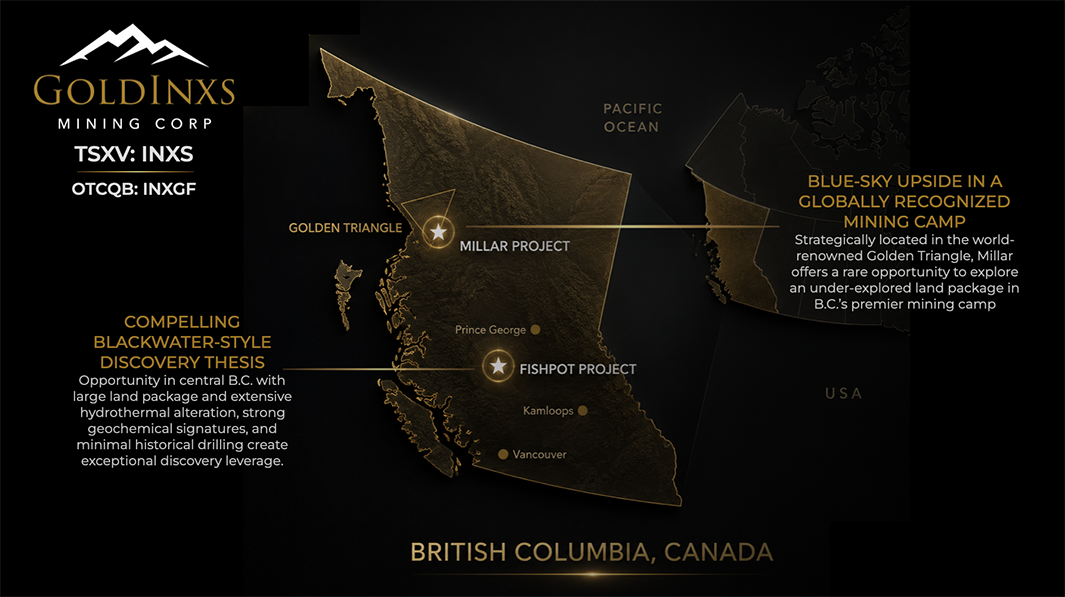
The Company’s portfolio is anchored by two priority projects: the Fishpot Project in central British Columbia, interpreted as an emerging, large epithermal system with strong infrastructure access and jurisdiction quality as well as early indications of blackwater-style mineralization, and the non-core Millar Project in the prolific B.C Golden Triangle, a district renowned for world-class discoveries. While surrounding deposits attracted billions of dollars in investment, Fishpot received only sporadic historical exploration despite widespread hydrothermal alteration and numerous anomalous gold, silver and copper results. Artemis Gold’s Blackwater Mine has announced tripling production with an intended $1.56B investment, which sits only 65 km from the Fishpot property.
Backed by a management team with expertise in exploration, project development and capital markets, GoldInxs is positioned to rapidly advance its assets, deliver near-term exploration catalysts and create shareholder value through discovery and strategic growth.
Company Highlights
- Mining-friendly jurisdiction: Projects are in British Columbia, which ranked second in Canada and 20th globally in the 2025 Fraser Institute investment attractiveness rankings.
- Flagship and district-scale assets: Portfolio is anchored by the flagship Fishpot Project (“Fishpot”) in central B.C., showing strong geological indicators of mineralization, blackwater-style mineralization potential and immense exploration upside potential with only 378 meters of historical drilling. Fishpot is strategically located in the same region as Artemis Gold’s Blackwater Mine and Evolution Mining’s optioned Clisbako property.
- Clear path to 2026 catalysts: GoldInxs secured a drill permit for an upcoming maiden 2,000-metre drill program at Fishpot, near-term exploration programs are designed to define mineralized systems, outline blackwater-style potential and create shareholder value following the completion of a 3D IP survey and drill targeting.
Key Projects
Fishpot Project


The Fishpot Project represents the cornerstone asset within the GoldInxs portfolio. Covering up to 5,500 hectares in Central British Columbia, and located ~95 km north of Quesnel, Fishpot hosts a large hydrothermal alteration system that exhibits many of the geological characteristics observed in major epithermal and intrusion-related gold systems throughout the region. Fishpot encompasses five claim blocks, held under an option to acquire 100 percent subject to a 2 percent NSR, representing a significant exploration opportunity in a highly prospective region.
Fishpot represents a largely untested hydrothermal mineral system where multiple independent exploration datasets, including gold-silver-copper surface geochemistry, alteration and geology, airborne magnetics, 3D IP chargeability/resistivity and identified epithermal-to-potential-porphyry target environments, are converging to define drill targets, despite only 378 metres of historical drilling across two holes.
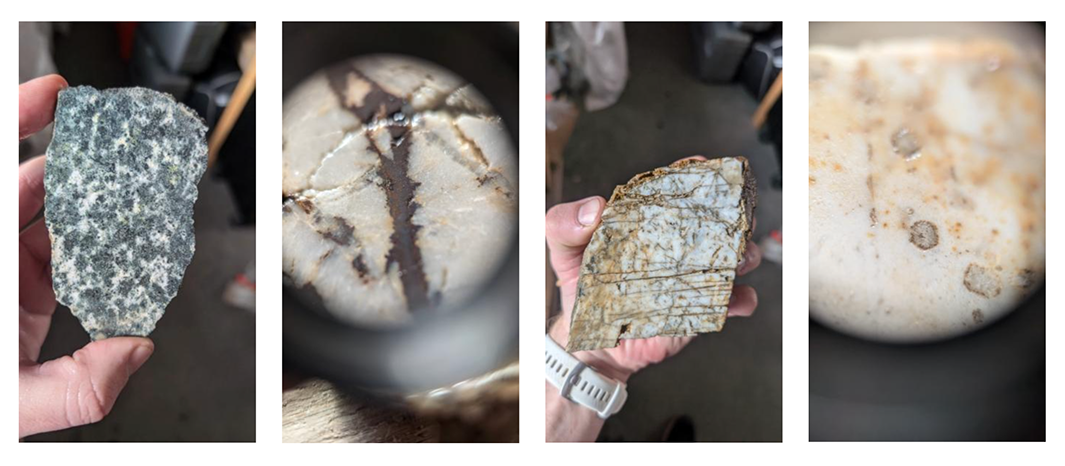
Fishpot is situated within the highly prospective Stikine Terrane and is underlain by Hazelton Group volcanic rocks and intrusive units comparable to those associated with several significant deposits in British Columbia. Extensive quartz-sericite alteration, hydrothermal brecciation, pyrite mineralization and multi-element geochemical anomalies support the interpretation of a robust mineralizing system. Fishpot is strategically positioned near active and historical mining operations, including Artemis Gold’s Blackwater Deposit, Newton Gold Project, Capoose and 3Ts Project, underscoring its large-scale discovery potential. Importantly, based on early-exploration results, Fishpot shares several regional geological characteristics commonly associated with Blackwater-style gold systems, including felsic volcanics, strong alteration, pyrite-rich mineralization and gold-silver geochemical associations. Despite the similarities the Company cannot yet make any formal connections to the surrounding properties, nor can they guarantee that such deposits exist on their ground.
Fishpot Exploration Technology: GoldInxs advanced its Fishpot targeting program by combining a conventional 3D IP survey with emerging Virtual DRILL™ remote-sensing technology as an additional targeting layer, using multiple geological, geochemical and geophysical datasets to refine and prioritize targets ahead of a planned ~2,000-metre drill program.
Fishpot Drill Permit & Expansion: GoldInxs has received the required drilling permits and expanded Fishpot to 5,509 hectares, positioning the Company to proceed with its inaugural ~2,000-metre modern drill program on a property that has seen very limited historical drilling, while refining targets through integrated geological, geochemical and geophysical data.
Despite multiple encouraging exploration indicators, Fishpot has been subjected to only two historic drill holes totaling 378 metres, leaving the broader mineral system largely untested and providing significant leverage to future exploration success.
Recent exploration completed by GoldInxs generated the highest reported gold value on Fishpot to date, returning up to 5.65 g/t Au from surface sampling, while airborne geophysical surveys identified multiple coincident magnetic and geochemical anomalies that have strengthened the Company's exploration model and target pipeline.
The 2025 program returned rock samples of up to 5.65 g/t Au, 11.35 g/t Ag and 0.42% Cu, while historical work reportedly returned up to 4.36 g/t Au and 3.2% Cu.
The property exhibits the potential low-sulphidation epithermal targets at Fishpot North, intermediate-sulphidation signatures at Fishpot East, and a large central magnetic high being evaluated for potential porphyry mineralization at depth. The Company is focused on finalizing drill targeting and preparing for the inaugural diamond drill campaign at Fishpot in the coming months following completion of the IP survey. GoldInxs is preparing to drill-test a 5,509-hectare, largely undrilled hydrothermal system in central British Columbia where high-grade surface gold-silver-copper results, Blackwater-style geological characteristics and multiple coincident geophysical targets have converged to define a portfolio of high-priority exploration targets.
Management Team
Nick Michael – President and CEO
Mr. Michael is a veteran mining executive and technical director with over 37 years of global experience spanning mine development, engineering and operational leadership. His expertise covers the full project lifecycle, including design, construction, technical due diligence and Independent Engineer assignments for institutional investors and project financiers. He also leads CJK Milling, a company focused on reprocessing historical mine waste to recover discarded gold decades ago, when it was less valuable.
Carlo Rigillo, CPA, Chief Financial Officer
Mr. Rigillo is an experienced Chartered Professional Accountant with over two decades of experience. He holds a Bachelor of Commerce from the University of Toronto.
Barry Miller – Executive Chairman and Director
Mr. Miller brings over 30 years of experience in public markets, including roles as a broker, consultant and financier. He is the founder of GoldInxs and has been actively involved in the resource sector through leadership positions, including as director of Tinova Resources Corp., an exploration company focused on tin and rare earth elements in British Columbia and Alaska.
Tara Asfour - Vice President, Corporate Development and Communications
An executive consultant with over 13 years of experience, Tara Asfour holds expertise in corporate development, capital markets, investor relations and strategic communications. She has led strategic financings, partnerships and offtake initiatives within the resource sector through previous corporate development and investor relations roles with multiple publicly listed companies.
Al Fabbro – Director
With over three decades of experience spanning both the mining and finance sectors, Mr. Fabbro previously led Yorkton Securities’ retail trading department and was part of its Natural Resources Group. He later served as Lead Director of Roxgold Inc. and currently holds executive leadership roles in the mining industry.
Darcy Vis, P.Geo. – VP Exploration and Director
Mr. Vis is an economic geologist with over 17 years of experience in mineral exploration. He has held senior technical roles across multiple exploration companies and is the President of Tripoint Geological Services Ltd. His expertise includes target generation, project evaluation and exploration program execution.
Stephen Soock, P.Eng., CFA – Director
Mr. Soock is a mining professional with nearly 20 years of experience spanning both technical operations and capital markets. He currently serves as Vice President, Investor Relations and Development at Heliostar Metals.
Christopher Kelly, PQS, FCIArb – Director
Mr. Kelly has over 15 years of experience in construction and natural resources. He holds a BSc in Construction Economics and Management and an MSc in Construction Law and Dispute Resolution, and runs Trachtala Consulting Ltd.
Learn about our editorial policies.