- NORTH AMERICA EDITIONAustraliaNorth AmericaWorld
Jun. 22, 2026 02:00PM PST
|Fact CheckedThis article has been reviewed and updated according to INN's rigorous fact-checking process. Our staff editors verify all articles against information and data from primary sources, reputable publishers and experts.
Uranium prices trended lower in Q2 following a rally to multi-year highs. However, term price strength and demand from utilities support a long-term bullish outlook.

YR Stock Collection / Adobe Stock
After surging in late 2025 and passing US$101 per pound in January, the uranium spot price consolidated in Q2. The energy fuel entered the three month session at US$84.19 and stayed within the US$84 to US$87 range.
The retreat from January’s highs has prompted questions about whether the market's momentum is fading, but analysts argue that the pullback reflects short-term market volatility rather than a deterioration in fundamentals.
For Brooke Thackray, research analyst at Global X, the key metric investors should be watching isn't the spot price.
"This is a healthy consolidation phase that's taking place right now, because if you take a look at the long-term fundamental drivers for the uranium price, they're very, very good," he told the Investing News Network.
While spot uranium traded near US$85 during the quarter, long-term contract prices continued to climb. Since June 2025, the long-term price has risen steadily from US$80, breaking past US$90 in January for the first time since 2008.
Most recently, the term price reached US$94, highlighting a widening gap between the two markets.
As Thackray explained, that divergence matters because utilities purchase the majority of their uranium through long-term contracts rather than the spot market. As utilities move to secure future supply, sellers are gaining leverage in negotiations, a dynamic Thackray believes could eventually help pull the spot price higher.
Supply disruptions reinforce deficit concerns
Uranium supply became increasingly uncertain in Q2 as producers continued to face operational challenges.
Production issues at Kazakhstan's Kazatomprom and previous disruptions at Cameco's (TSX:CCO,NYSE:CCJ) Saskatchewan operations underscored the fragility of global uranium supply chains. At the same time, geopolitical tensions in the Middle East introduced another potential risk factor — sulfur availability.
Sulfur is a critical feedstock for sulfuric acid, which is widely used in uranium production, particularly in Kazakhstan's in-situ recovery operations. With roughly one-fifth of global sulfur shipments moving through the Strait of Hormuz, a prolonged disruption could create additional bottlenecks.
"We're seeing a lot of supply being interrupted here, and that is only positive for the uranium price," Thackray said.
While sulfuric acid shortages have not yet emerged as a major market driver, the issue remains on investors' radar. Kazatomprom previously cited sulfuric acid availability as a constraint on production growth, highlighting the sector's dependence on broader industrial supply chains.
Listen to the full interview with Thackray to learn more about the long term investment potential of the uranium market and factors that could add more tailwinds to the energy fuel.
AI, data centers and nuclear demand
Demand growth remained one of the most compelling themes for uranium investors during the quarter.
The rapid expansion of artificial intelligence (AI) infrastructure has continued to strengthen the case for nuclear energy as a source of reliable baseload power. Major tech companies are increasingly turning to nuclear via long-term power purchase agreements, helping drive renewed interest in reactor development and uranium supply.
Thackray noted that announcements linking hyperscale data centers and nuclear power have become increasingly common over the last two years as the AI trend has ramped up.
"We're going to keep getting positive announcements, and they're just going to keep layering," he said.
However, the expert suggested that the broader investment community has yet to fully embrace the uranium story. Much of the market's attention remains concentrated on AI itself, leaving commodities and resource equities competing for investor capital. Even so, the growing power demands associated with AI development continue to reinforce long-term projections for uranium consumption.
Providing his latest outlook on uranium, Justin Huhn of Uranium Insider discusses the factors affecting prices, supply and demand. Although he pointed to a current market correction, Huhn maintains a bullish long-term stance and suggests that uranium presents significant opportunities.
New mines unlikely to solve supply gap
While several uranium developers are advancing projects toward production, Thackray does not believe new supply will arrive quickly enough to eliminate the market's structural deficit.
He pointed to the lengthy timelines required to build both mines and reactors.
Although projects such as Denison Mines' (TSX:DML,NYSEAMERICAN:DNN) Wheeler River development could contribute new production later this decade, uranium demand is expected to expand significantly faster.
"Demand is going to be increasing substantially, doubling by 2040," he said. "It's just not enough in the bigger picture."
The mismatch between rising demand and limited supply growth remains one of the strongest arguments supporting higher uranium prices over the long term.
Energy security drives policy support
Government policy continued to strengthen uranium's outlook during the quarter as western nations sought to reduce their dependence on geopolitical rivals for critical materials.
Against that backdrop, the US has taken steps to rebuild domestic nuclear fuel supply chains, expand strategic stockpiles and accelerate permitting for critical minerals projects.
Uranium's inclusion on critical minerals lists has also improved access to financing and policy support.
Thackray said concerns about supply security have evolved significantly since the COVID-19 pandemic exposed vulnerabilities in global supply chains. "There is an overall concerted effort around the world from major countries ... to say we can't expose ourselves to this," he explained during the interview.
Those efforts could prove particularly beneficial for Canada's Athabasca Basin, which hosts some of the world's highest-grade uranium deposits and remains a key source of supply for western markets.
Is US$85 enough to incentivize new supply?
One of the uranium market's most persistent questions is whether current prices are sufficient to encourage the next generation of mine development and rejuvenate the supply pipeline.
Historically, many industry participants viewed US$65 as the level needed to support new production. With the spot price averaging closer to US$85 during Q2, that benchmark has technically been surpassed. However, years of inflation, rising labor costs and higher capital expenditures have likely pushed incentive pricing higher.
While Thackray acknowledged that determining an exact all-in sustaining cost threshold has become increasingly difficult, he argued that the market's long-term trajectory remains more important than any single price level.
"I'm expecting the price to move higher over time," he said, noting that while additional projects will eventually enter production, supply growth is unlikely to keep pace with rising demand.
The industry's caution is rooted in experience. Following the uranium bull market of the mid-2000s, producers aggressively expanded output only to be hit by the aftermath of the 2011 Fukushima nuclear accident, which triggered a prolonged bear market and left the sector grappling with excess supply for years.
Today, the backdrop looks markedly different. Governments around the world increasingly recognize nuclear energy as a critical component of decarbonization strategies, while surging electricity demand from AI, data centers and electrification continues to strengthen the long-term demand outlook.
According to Thackray, that shift in sentiment is giving producers greater confidence to invest in future projects. Even as new mines move toward development, however, he believes the sector's structural supply deficit will persist.
"We've got shortages going forward, we've got demand increasing, so we've got structural deficits over a long period of time," he said. "I don't think we're going to be able to bring on the supply fast enough."
John Ciampaglia, CEO of Sprott Asset Management, provides his analysis of uranium's price action and supply/demand dynamics. Ciampaglia anticipates that the existing supply pressures in the uranium sector will escalate significantly moving into the early 2030s.
Investors remain focused on the long term
Physical uranium funds continued to influence market dynamics during Q2, providing investors with direct exposure to uranium and helping tighten available supply.
Thackray compared the growing role of physical uranium vehicles to the impact gold exchange-traded funds had on the precious metals market, arguing that easier access could attract new capital over time.
For now, however, uranium remains a relatively small corner of the investment landscape.
"Just a little bit will push up the price of uranium and uranium companies a lot," he commented, referring to the vast amounts of capital currently concentrated in technology stocks.
Looking ahead to the rest of 2026, Thackray believes investors should closely monitor utilities contracting activity, term prices, reactor construction and supply disruptions.
At the same time, he maintained that the sector's most important drivers are already in place.
"We've got shortages going forward, we've got demand increasing, so we've got structural deficits over a long period of time," he said. "It's just a matter of when that becomes the narrative."
As the year's second quarter draws to a close, uranium's short-term price weakness appears increasingly disconnected from the industry's long-term fundamentals. For many market participants, the period has reinforced the view that the sector's next major move may depend less on spot market volatility and more on a widening supply/demand imbalance that continues to build beneath the surface.
Don't forget to follow us @INN_Resource for real-time updates!
Securities Disclosure: I, Georgia Williams, hold no direct investment interest in any company mentioned in this article.
Editorial Disclosure: The Investing News Network does not guarantee the accuracy or thoroughness of the information reported in the interviews it conducts. The opinions expressed in these interviews do not reflect the opinions of the Investing News Network and do not constitute investment advice. All readers are encouraged to perform their own due diligence.
From Your Site Articles
- Uranium Stocks: 5 Biggest Companies ›
- Top 10 Uranium-producing Countries ›
- Uranium Reserves: Top 5 Countries ›
- When Will Uranium Prices Go Up? ›
Related Articles Around the Web
TSXV:AEC
https://x.com/INN_Resource
https://www.linkedin.com/in/georgia-williams-15845447/
gwilliams@investingnews.com
The Conversation (0)

Originally from Calgary, Georgia has been right at home in Toronto for more than two decades. Graduating from the University of Toronto with an honors BA in journalism, she is passionate about writing on diverse topics, including resources, arts, politics and social issues.
At INN Georgia covers a wide range of topics, including energy, battery and critical metals and diamonds. In her spare time, Georgia enjoys watching documentaries and experiencing Toronto's vibrant food, arts and cultural scene.
INN Article Notification
Latest News
Outlook Reports
Featured Uranium Investing Stocks

Investor Insight
Generation Uranium offers investors high-leverage exposure to a potential major discovery in Canada’s underexplored and resource-rich Thelon Basin, led by a management team with a proven track record of securing high-value exits.
Overview
Generation Uranium (CSE:GEN, OTCQB:GENR, FRA:W85) is a Canadian exploration company focused on wealth creation through discovery within the uranium sector. The company’s primary strategy is to build a high-caliber exploration team that can rapidly test and drill high-potential targets, de-risking projects for potential takeover by larger producers. Currently centered in the prolific Thelon and Angikuni Basins of Nunavut, the company is also actively evaluating additional project acquisitions in the Athabasca Basin to expand its portfolio.
The company is led by a veteran management team with nearly 30 years of experience in mineral development. CEO Michael Collins has a significant track record of building and exiting public companies, including the co-founding of Bluerock Resources, a conventional uranium producer during the 2000-2008 cycle. This expertise is paired with a focused business model that leverages modern geophysical targeting to accelerate exploration timelines and reduce costs, ensuring the company can deliver results quickly in a bullish uranium market.
Company Highlights
- Strategic Location in a Premier Uranium District: The flagship Yath Project is located in Nunavut’s Thelon Basin, contiguous to ATHA Energy’s Angilak Project, which hosts the high-grade Lac 50 deposit.
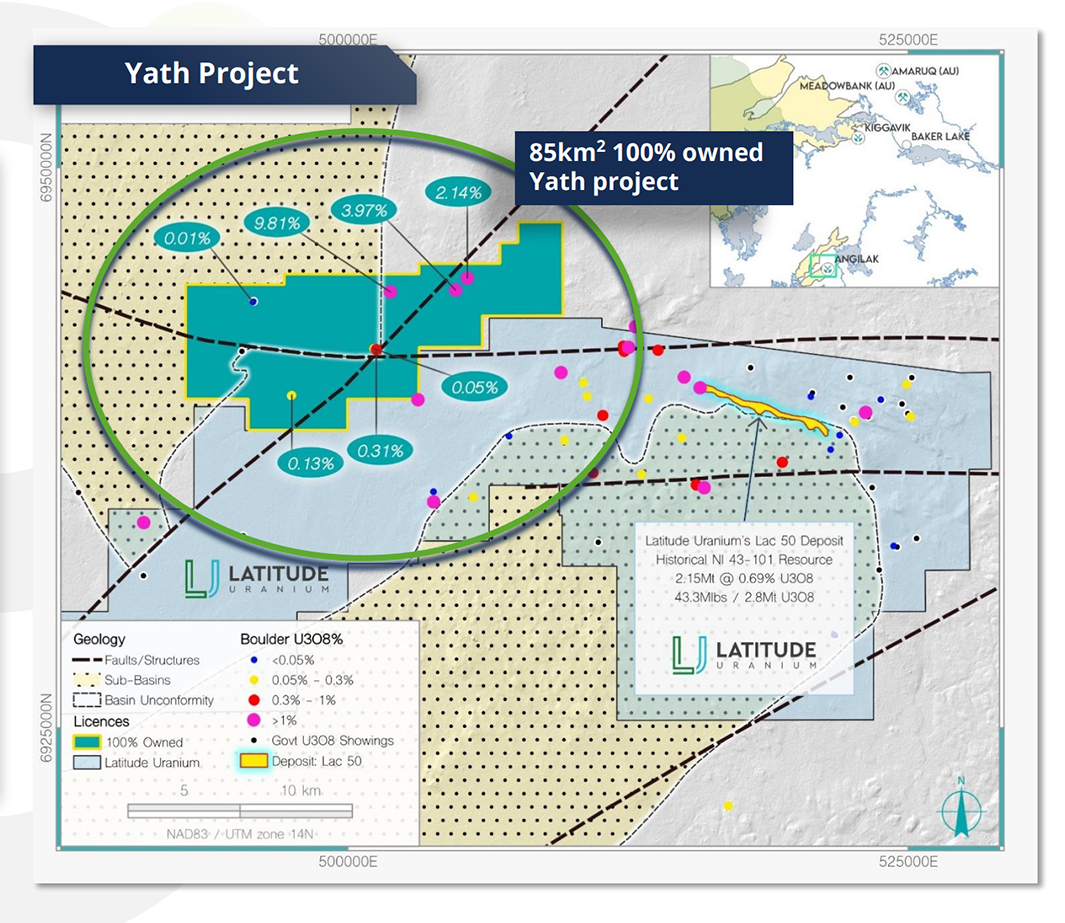
- High-Grade Discovery Potential: Historical surface sampling at the Yath Project has yielded exceptional uranium grades, including boulders testing at 9.81 percent, 3.95 percent, and 2.14 percent U3O8.
- Expert Management with Exit Experience: Led by CEO Michael Collins, the team has decades of experience in mineral exploration and a history of co-founding companies that were later acquired, such as Prime Mining and Nuclear Fuels.
- Low-Cost, Rapid Exploration Strategy: By leveraging modern geophysics and extensive historical data, the company aims for a "short road to discovery," de-risking projects quickly to maximize shareholder value.
- Bullish Market Fundamentals: Generation Uranium is well-positioned to meet the growing global demand for carbon-free nuclear power, supported by a projected supply deficit and increased interest from major tech companies seeking clean energy.
Key Project
Yath Project - Nunavut, Canada
The Yath Project is Generation Uranium’s flagship project. This 100 percent owned property covers about 120 square kilometers within the underexplored Thelon Basin in Nunavut, Canada. The project is located where the Yathkyed and Angikuni sub-basins meet, which is a region known globally for high-grade uranium potential. It sits directly along the same trend as the Angilak Project owned by ATHA Energy (TSXV:SASK, OTCQB:SASFK, FWB:XSU.F), which contains the Lac 50 deposit, one of the highest-grade uranium resources found outside of the Athabasca Basin with a historical mineral resource estimate of 43.3M lbs at an average grade of 0.69 percent U3O8.
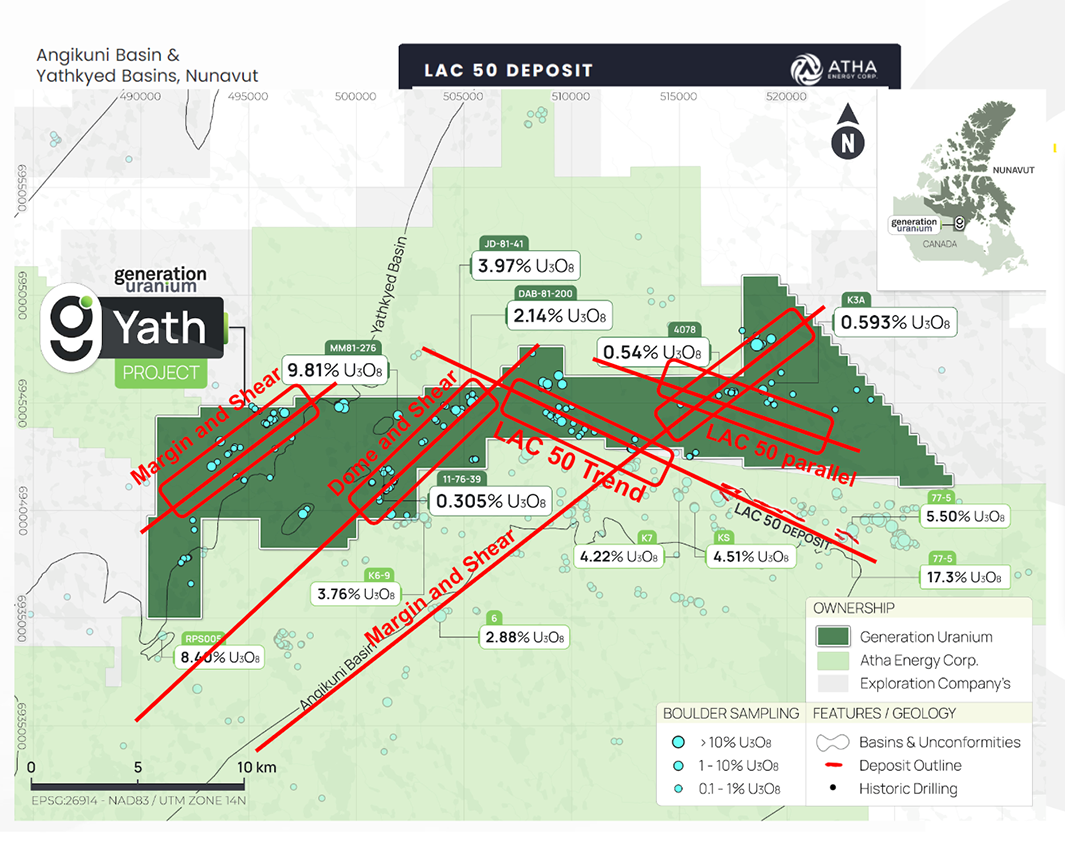
The Yath Project is contiguous to the Lac 50 trend and is crossed by several regional faults and basin boundaries. Past exploration work has already identified high priority targets, while surface sampling in the area has produced uranium grades from boulders, with some testing at 9.81 percent, 3.95 percent, and 2.14 percent U3O8.
The company has commenced its initial field program at the site, set to define and rank drill targets. Historic showings will be combined with new anomalies from the MMT geophysics survey, preparing the project for an anticipated drill permit.
Management Team
Michael Collins - CEO & Director
Michael Collins is a professional geoscientist with nearly 30 years of experience in mineral exploration. He has co-founded several public companies, including Exploits Discovery, Prime Mining (acquired in 2025), and Nuclear Fuels (merged with Premier American Uranium in 2025). He is also currently a director of First Atlantic Nickel.
Christoph Bruening - Director
Christoph Bruening is the founder and managing partner of Value Relations GmbH, a full-service investor relations and public relations agency in Frankfurt with over 25 years of excellence, focusing on mining, exploration, biotech and health care. In addition, he has listed over 600 companies on the Frankfurt Stock Exchange and is a speaker and author of several publications, including on rare earths and uranium.
Dallas Miller - Director
Dallas Miller has been working within the international mining industry for over 15 years, working with BHP and Santos Ltd. He has experience on the ground from an operational standpoint, as well as being an integral part of raising millions of dollars in capital funding for both private and public companies in recent years.
Roger Leschuk - VP Corporate Development
Roger Leschuk has been in corporate management for over two decades, with the past 15 years dedicated to corporate development and investor relations. He has experience participating in and assisting with mergers and acquisitions, and was an investment advisor for various services such as stocks, mutual funds and tax-sheltered investments. He is a Chartered Investment Manager and a Fellow of the Canadian Securities Institute.
Monty Sutton - CFO
Monty Sutton brings over 35 years of experience in public markets and corporate governance. He previously served as CFO for Nuclear Fuels from its IPO through its acquisition.
Browse Companies
MARKETS
COMMODITIES
CURRENCIES
Originally from Calgary, Georgia has been right at home in Toronto for more than two decades. Graduating from the University of Toronto with an honors BA in journalism, she is passionate about writing on diverse topics, including resources, arts, politics and social issues.
At INN Georgia covers a wide range of topics, including energy, battery and critical metals and diamonds. In her spare time, Georgia enjoys watching documentaries and experiencing Toronto's vibrant food, arts and cultural scene.
Learn about our editorial policies.