Kazatomprom plans to cut its 2026 uranium production by 10 percent compared to previous targets due to weak H1 profits and market conditions.

LuckyStep / Shutterstock
Kazatomprom, Kazakhstan’s state-owned uranium giant, said it will scale back production in 2026, noting that current supply and demand dynamics do not justify a return to full capacity even as long-term prices hold firm.
The company, which accounts for more than one-fifth of the world’s primary uranium output, said in an August 22 release that it expects to lower production by roughly 10 percent next year compared to earlier targets.
It will reduce its nominal output level from 32,777 metric tons of U3O8 to 29,697 metric tons.
That equates to a drop of around 8 million pounds of uranium, or about 5 percent of global supply. Most of the reduction will come from adjustments at Kazatomprom's Budenovskoye joint venture.
“As the world’s largest producer and seller of natural uranium, Kazatomprom fully recognises the critical role the Company has in supporting the global energy transition,” Chief Executive Meirzhan Yussupov commented.
Kazatomprom said the present environment does not warrant lifting production to the 100 percent level. The long-term uranium price is currently stable at around US$80 per pound, despite volatility in the spot market.
Instead, the company said it plans to “exercise its downflex opportunity within the acceptable 20 percent deviation under the updated 2026 Subsoil Use production levels.” Actual guidance for the 2026 output will be released later.
The company further added that supplies of sulfuric acid, a critical reagent for the in-situ recovery mining method used across its operations, are expected to be stable in 2026.
Kazatomprom also pointed to Kazakhstan’s own nuclear energy ambitions. The government has floated plans for three nuclear power plants, each of which would require about 400 metric tons (1.04 million pounds) of uranium annually.
The company's updates came as part of its half-year results. Kazatomprom reported a 54 percent fall in net profit to 263.2 billion Kazakhstani tenge (around US$489.5 million) in the first six months of 2025, compared with the same period a year earlier. Revenue slipped 6 percent to 660.2 billion tenge due to lower sales volumes.
In August 2024, the company cut its 2025 uranium output forecast by 12 to 17 percent amid a sulfuric acid shortage.
Its new acid plant won’t be ready until at least 2026, while higher mineral extraction taxes, which commenced earlier this year, are set to raise costs and erode its traditional competitive edge. But even as it trims output targets, Kazatomprom stressed that it is pushing ahead with large-scale exploration programs across Kazakhstan. The initiatives are aimed at replenishing reserves and safeguarding the company’s status as the leading global supplier of nuclear fuel.
“Kazatomprom is currently undertaking a large-scale exploration in Kazakhstan, which is a top priority for replenishing its resource base and maintaining its leading position as a global nuclear fuel supplier,” Yussupov said.
Potential uranium market deficit ahead
Although Kazatomprom has seen a decline in profits, uranium sector major Cameco (TSX:CCO,NYSE:CCJ) registered growth in Q2 of this year, and is anticipating a broad uptick in global demand.
“We believe that supportive government policies, the tangible actions of energy-intensive industries, and positive public conversations are all pointing to a global convergence: nuclear energy is a critical solution for providing clean, constant, secure and reliable power to electrify global economies," wrote President and CEO Tim Gitzel in July.
Given uranium's key role in clean energy, FocusEconomics analysts are forecasting that prices will stay well above 2010 levels through the decade, with price sprojected in the US$65 to US$80 range.
The World Nuclear Association (WNA) projects that uranium demand will rise 28 percent by 2030, outpacing an 18 percent supply increase, driven by emerging market growth, artificial intelligence-related power needs, modular reactor adoption and energy security concerns. Primary uranium production from mines, conversion plants and enrichment plants meets most global reactor demand, with secondary supply helping bridge short-term gaps.
"However, secondary supply is projected to have a gradually diminishing role in the world market, decreasing from the current level in supplying 11-14 percent of reactor uranium requirements to 4-11 percent in 2050," the WNA states.
Despite the looming shortfall in the uranium sector, FocusEconomics analysts don’t anticipate a return to 2024’s highs, when prices overshot fundamentals amid investor exuberance.
“Supply/demand dynamics are supportive of higher uranium prices: We forecast a structural supply deficit of ~20 million pounds in 2025 to grow to ~130 million pounds by 2040, or representing 40 percent-45 percent undersupply," the firm states. "This view is supported by increasing demand for uranium as the global nuclear fleet expands to support growing power needs amid a lack of meaningful potential supply to come online.”
Don’t forget to follow us @INN_Resource for real-time updates!
Securities Disclosure: I, Giann Liguid, hold no direct investment interest in any company mentioned in this article.
Securities Disclosure: I, Georgia Williams, hold no direct investment interest in any company mentioned in this article.
https://x.com/giannliguid
https://www.linkedin.com/in/giannliguid/
The Conversation (0)

Giann Liguid is a graduate of Ateneo De Manila University with an AB in Interdisciplinary Studies. With a diverse writing background, Giann has written content for the security, food and business industries. He also has expertise in both the public and private sectors, having worked in the government specializing in local government units and administrative dynamics.
When he is not chasing the next market headline, Giann can most likely be found thrift shopping for his dogs.
Originally from Calgary, Georgia has been right at home in Toronto for more than two decades. Graduating from the University of Toronto with an honors BA in journalism, she is passionate about writing on diverse topics, including resources, arts, politics and social issues.
At INN Georgia covers a wide range of topics, including energy, battery and critical metals and diamonds. In her spare time, Georgia enjoys watching documentaries and experiencing Toronto's vibrant food, arts and cultural scene.
INN Article Notification
Latest News
Outlook Reports world
Featured Uranium Investing Stocks

Investor Insight
Generation Uranium offers investors high-leverage exposure to a potential major discovery in Canada’s underexplored and resource-rich Thelon Basin, led by a management team with a proven track record of securing high-value exits.
Overview
Generation Uranium (CSE:GEN, OTCQB:GENR, FRA:W85) is a Canadian exploration company focused on wealth creation through discovery within the uranium sector. The company’s primary strategy is to build a high-caliber exploration team that can rapidly test and drill high-potential targets, de-risking projects for potential takeover by larger producers. Currently centered in the prolific Thelon and Angikuni Basins of Nunavut, the company is also actively evaluating additional project acquisitions in the Athabasca Basin to expand its portfolio.
The company is led by a veteran management team with nearly 30 years of experience in mineral development. CEO Michael Collins has a significant track record of building and exiting public companies, including the co-founding of Bluerock Resources, a conventional uranium producer during the 2000-2008 cycle. This expertise is paired with a focused business model that leverages modern geophysical targeting to accelerate exploration timelines and reduce costs, ensuring the company can deliver results quickly in a bullish uranium market.
Company Highlights
- Strategic Location in a Premier Uranium District: The flagship Yath Project is located in Nunavut’s Thelon Basin, contiguous to ATHA Energy’s Angilak Project, which hosts the high-grade Lac 50 deposit.
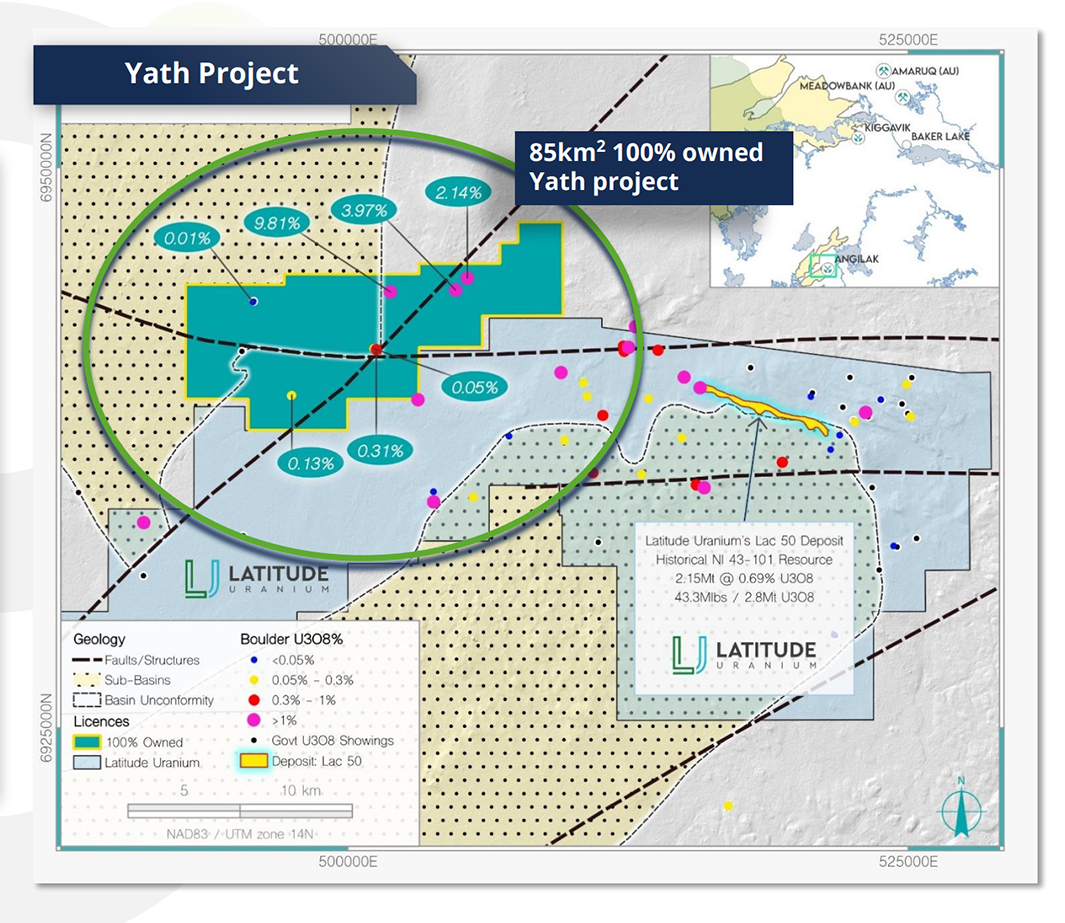
- High-Grade Discovery Potential: Historical surface sampling at the Yath Project has yielded exceptional uranium grades, including boulders testing at 9.81 percent, 3.95 percent, and 2.14 percent U3O8.
- Expert Management with Exit Experience: Led by CEO Michael Collins, the team has decades of experience in mineral exploration and a history of co-founding companies that were later acquired, such as Prime Mining and Nuclear Fuels.
- Low-Cost, Rapid Exploration Strategy: By leveraging modern geophysics and extensive historical data, the company aims for a "short road to discovery," de-risking projects quickly to maximize shareholder value.
- Bullish Market Fundamentals: Generation Uranium is well-positioned to meet the growing global demand for carbon-free nuclear power, supported by a projected supply deficit and increased interest from major tech companies seeking clean energy.
Key Project
Yath Project - Nunavut, Canada
The Yath Project is Generation Uranium’s flagship project. This 100 percent owned property covers about 120 square kilometers within the underexplored Thelon Basin in Nunavut, Canada. The project is located where the Yathkyed and Angikuni sub-basins meet, which is a region known globally for high-grade uranium potential. It sits directly along the same trend as the Angilak Project owned by ATHA Energy (TSXV:SASK, OTCQB:SASFK, FWB:XSU.F), which contains the Lac 50 deposit, one of the highest-grade uranium resources found outside of the Athabasca Basin with a historical mineral resource estimate of 43.3M lbs at an average grade of 0.69 percent U3O8.
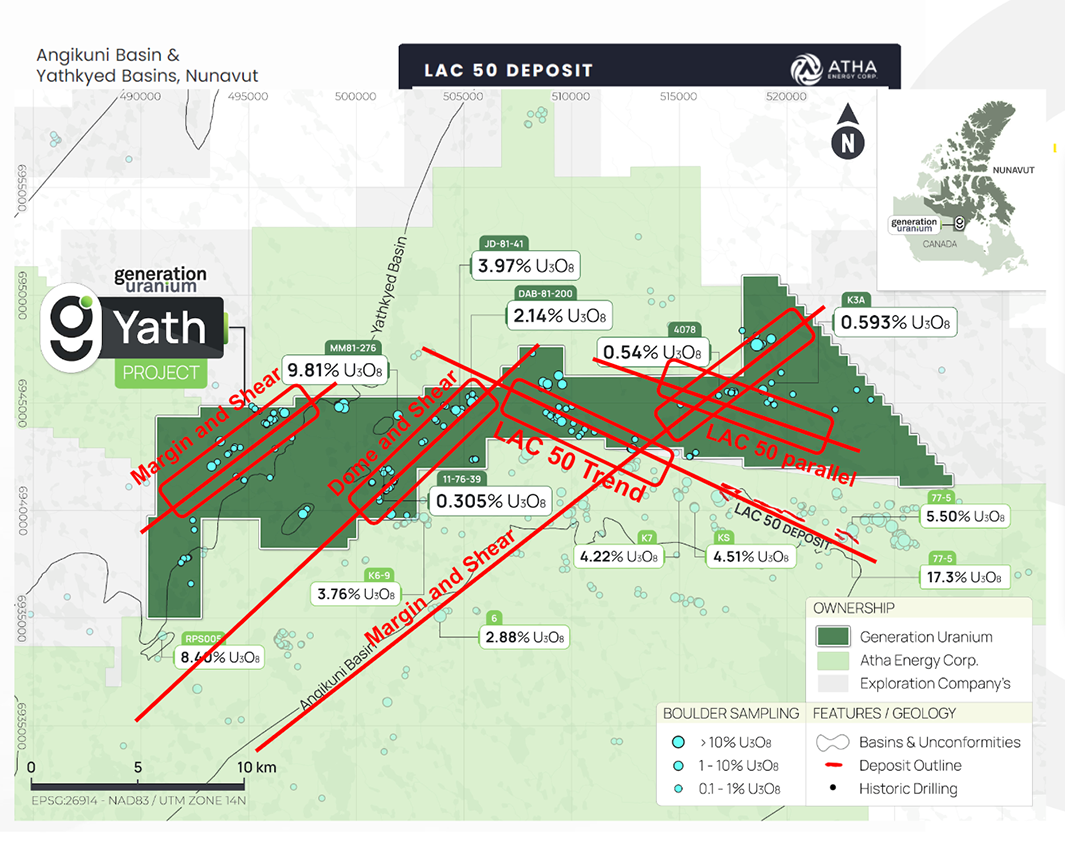
The Yath Project is contiguous to the Lac 50 trend and is crossed by several regional faults and basin boundaries. Past exploration work has already identified high priority targets, while surface sampling in the area has produced uranium grades from boulders, with some testing at 9.81 percent, 3.95 percent, and 2.14 percent U3O8.
The company has commenced its initial field program at the site, set to define and rank drill targets. Historic showings will be combined with new anomalies from the MMT geophysics survey, preparing the project for an anticipated drill permit.
Management Team
Michael Collins - CEO & Director
Michael Collins is a professional geoscientist with nearly 30 years of experience in mineral exploration. He has co-founded several public companies, including Exploits Discovery, Prime Mining (acquired in 2025), and Nuclear Fuels (merged with Premier American Uranium in 2025). He is also currently a director of First Atlantic Nickel.
Christoph Bruening - Director
Christoph Bruening is the founder and managing partner of Value Relations GmbH, a full-service investor relations and public relations agency in Frankfurt with over 25 years of excellence, focusing on mining, exploration, biotech and health care. In addition, he has listed over 600 companies on the Frankfurt Stock Exchange and is a speaker and author of several publications, including on rare earths and uranium.
Dallas Miller - Director
Dallas Miller has been working within the international mining industry for over 15 years, working with BHP and Santos Ltd. He has experience on the ground from an operational standpoint, as well as being an integral part of raising millions of dollars in capital funding for both private and public companies in recent years.
Roger Leschuk - VP Corporate Development
Roger Leschuk has been in corporate management for over two decades, with the past 15 years dedicated to corporate development and investor relations. He has experience participating in and assisting with mergers and acquisitions, and was an investment advisor for various services such as stocks, mutual funds and tax-sheltered investments. He is a Chartered Investment Manager and a Fellow of the Canadian Securities Institute.
Monty Sutton - CFO
Monty Sutton brings over 35 years of experience in public markets and corporate governance. He previously served as CFO for Nuclear Fuels from its IPO through its acquisition.
Browse Companies
MARKETS
COMMODITIES
CURRENCIES
Giann Liguid is a graduate of Ateneo De Manila University with an AB in Interdisciplinary Studies. With a diverse writing background, Giann has written content for the security, food and business industries. He also has expertise in both the public and private sectors, having worked in the government specializing in local government units and administrative dynamics.
When he is not chasing the next market headline, Giann can most likely be found thrift shopping for his dogs.
Learn about our editorial policies.
Originally from Calgary, Georgia has been right at home in Toronto for more than two decades. Graduating from the University of Toronto with an honors BA in journalism, she is passionate about writing on diverse topics, including resources, arts, politics and social issues.
At INN Georgia covers a wide range of topics, including energy, battery and critical metals and diamonds. In her spare time, Georgia enjoys watching documentaries and experiencing Toronto's vibrant food, arts and cultural scene.
Learn about our editorial policies.