The Conversation (1)
Itan1409 / Shutterstock
With gold prices surging to new all-time highs at the start of 2026, the top gold-producing countries are set to benefit significantly from a runaway bull market.
After surging more than 80 percent since January 2025, the market's momentum peaked on January 28, when gold reached an all-time high of US$5,589.38.
The underlying trends driving gold in 2025 remain in 2026, including significant interest from central banks, falling interest rates and geopolitical uncertainty driven by the ongoing war between Russia and Ukraine and fresh hostilities in the Middle East between the United States and Iran.
Additionally, since US President Donald Trump took office, his aggressive trade tactics have sent ripples through the global economy, prompting investors to seek safe-haven assets such as gold.
As uncertainty grips the markets, rising gold prices will benefit gold producers and the countries they operate in. So, which countries produce the most gold?
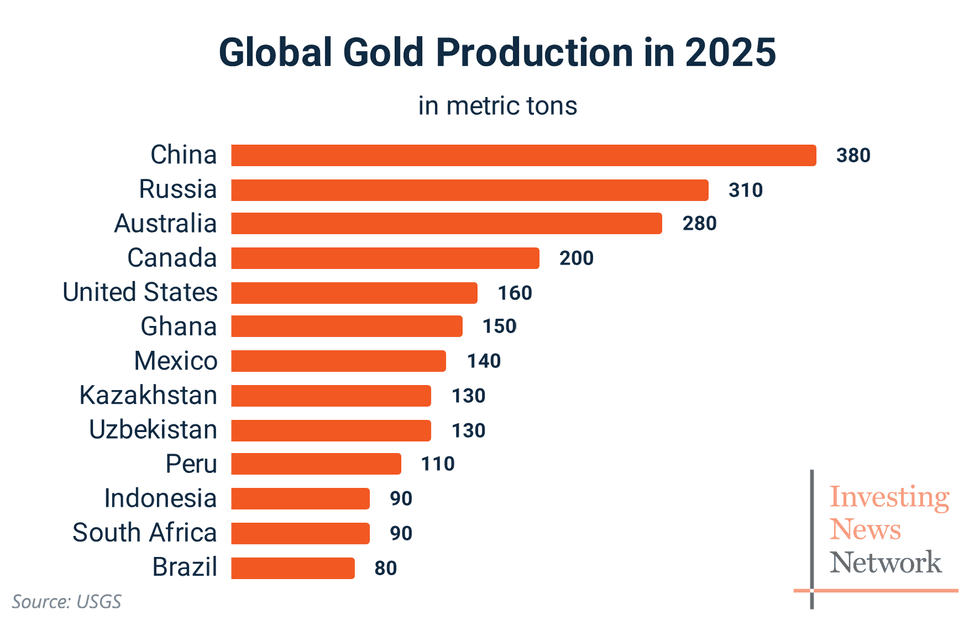
Here, the Investing News Network outlines the top gold producers by country in 2025 using the latest production numbers from the US Geological Survey's 2026 Mineral Commodity Summary.
Global gold production totaled 3,300 metric tons in 2025, up 20 metric tons from 2024, according to the USGS.
While gold is often measured and discussed in troy ounces, the USGS uses metric tons for its gold data, so this article will contain a mix of the two measurements. For perspective, 1 metric ton of gold is equal to 32,151 troy ounces and worth US$145 million at a price of US$4,500 per gold ounce.
1. China
Gold production: 380 metric tons
China was the world's top gold-mining country in 2025 with output of 380 metric tons.
While China's gold output peaked at 455 metric tons in 2016, it hasn’t dipped below 300 metric tons in more than a decade. This consistent production continues to ensure China's status as the world's top gold producer, a title it first claimed in 2007.
China's gold-mining industry is dominated by state-owned operators, although several are partially publicly traded. One of the country's largest mining companies is Zijin Mining Group (HKEX:2899,SHA:601899,OTCPL:ZIJMF), whose portfolio includes an 84.2 percent stake in the Longnan mine in the Gansu Province. According to its 2025 results, the mine produced 238,170 ounces of gold, with 200,590 attributable to Zijin.
Another significant mining company is China Gold International Resources (TSX:CGG,OTCPL:JINFF), which owns a 96.5 percent stake in the Chang Shan Hao gold mine located in Inner Mongolia. One of China’s largest gold mines, it produced 96,816 ounces of gold in 2025.
China also hosts major gold-smelting operations. Its Belt and Road Initiative has resulted in Chinese companies exploring and developing sites elsewhere in Asia and Africa, subsequently sending raw resources back to China for refinement.
The country is one of the largest consumers of gold in the world, although its gold consumption pulled back slightly to 950.1 metric tons last year on decreasing jewelry demand, according to a report from Reuters.
Meanwhile, China’s central bank was among the largest buyers of the precious metal in 2025, adding 27 metric tons of gold to its coffers during the year to bring its official gold holdings to 2,306 metric tons.
2. Russia
Gold production: 310 metric tons
Gold production from Russia came in at 310 metric tons in 2025, the same as the prior year. The country's output has risen fairly significantly since 2017, when it produced only 255 metric tons of gold.
The US Geological Survey states that Russian gold reserves stand at 12,000 metric tons, making it the second-largest country for reserves after Australia.
Russia has several large gold mines, but none are more prolific than Polyus' (MCX:PLZL) Olimpiada mine in the Ksasnoyarsk Krai region of Siberia. According to the company's most recent data, the mine produced 926,000 ounces of gold in 2025.
Despite high production and reserves, Russian's invasion of Ukraine in 2022 led the London Bullion Market Association to halt trading and remove Russian refiners from its accredited list world markets since the country invaded Ukraine in February 2022. In response, Russian operators have sought out alternative markets, particularly the BRICS nations and other Asian countries like Kazakhstan.
While Russian gold has faced challenges reaching western markets, reports indicate that in Q1 2026 the country sold 21.8 metric tons of gold to its partners to help combat a widening deficit as the war with Ukraine entered its fifth year. At the same time, the government also banned individuals and private entities from exporting over 100 grams in gold bullion in an attempt to prevent capital flight from the country.
3. Australia
Gold production: 280 metric tons
Australian gold production slightly decreased in 2025 to 280 metric tons, down from 284 metric tons the previous year.
In terms of economic impact, gold is one of Australia's most important resources. In December 2025, the country predicted that gold would overtake natural gas to become its second most valuable commodity in the 2025/2026 financial year, forecasting AU$69 billion in gold exports, due to rising prices and higher volumes.
According to government data, Western Australia accounts for the majority of all gold mined in the country and is home to several large gold mines, including Newmont’s (ASX:NEM,NYSE:NEM) Boddington operation, which produced 565,000 ounces of gold in 2025. It also hosts the Tropicana mine, a joint venture between AngloGold Ashanti (NYSE:AU) and Regis Resources (ASX:RRL,OTCPL:RGRNF) that produced 436,000 ounces of gold last year.
The second largest gold-producing state in Australia is New South Wales. It's home to several significant operations, including Newmont's Cadia Valley mine, which produced 385,000 ounces in 2025, and Evolution Mining's (ASX:EVN,OTCPL:CAHPF) Cowal mine, which produced 330,008 ounces in the company's 2025 fiscal year.
Not only is Australia one of the top gold producers, it also holds the world's largest gold reserves, with an estimated 13,000 metric tons. These reserves will ensure the country remains in the top 10 for years to come.
4. Canada
Gold production: 200 metric tons
In 2025, gold production in Canada totaled 200 metric tons, the same output it recorded in 2024.
Ontario and Québec are the largest gold-producing provinces in the country; together, they represent nearly 70 percent of Canada’s gold output, followed by British Columbia and the Yukon.
The Canadian government states that gold is the nation’s most valuable mined commodity, with domestic gold exports surging 33 percent in 2024 to reach a record of C$40.2 billion thanks to high gold prices and central bank demand.
Canada has a number of very large gold mines, the largest of which is Detour Lake in Ontario, followed closely by the Canadian Malartic Complex in Québec. The mines, both owned by Agnico Eagle Mines (TSX:AEM,NYSE:AEM), produced 692,675 and 642,612 ounces of gold in 2025 respectively.
British Columbia's north is home to the Golden Triangle, a resource-rich area that hosts several significant operations, such as the Newmont-owned Brucejack mine, which produced 231,000 ounces in 2025. Outside of the Golden Triangle is the newly opened Blackwater mine owned by Artemis Gold (TSXV:ARTG,OTCQX:ARGTF). Currently in the ramp-up stage, Blackwater produced 192,808 ounces of gold last year and is expected to deliver 265,000 to 290,000 ounces in 2026.
5. United States
Gold production: 160 metric tons
The US produced 160 metric tons of gold in 2025, a drop from 163 metric tons produced in 2024. This continues a trend of production declines that started in 2017, when the US produced 237 metric tons of gold.
According to the US Geological Survey, the top state for production of the yellow metal was Nevada, which accounted for 64 percent of total domestic production, followed by Alaska with 22 percent. The top 25 operations in the country were responsible for 94 percent of American gold output in 2025.
Gold reserves in the US are estimated at 3,000 metric tons.
The largest gold-mining assets in the US are all owned by Nevada Gold Mines, a joint venture between Barrick Gold (TSX:ABX,NYSE:GOLD) and Newmont, and consist of Turquoise Ridge, the Cortez Complex and the Carlin Complex. Between them, the mines produced 2.59 million ounces of gold in 2025.
6. Ghana
Gold production: 150 metric tons
West Africa has a rich history of gold production dating back hundreds of years. Ghana's gold production totaled 150 metric tons in 2025, continuing an upward trend over the last few years. The most substantial gains in its gold output during that time came between 2022 and 2023, when it leaped from 88 to 126 metric tons.
Gold has become an important economic driver for the country, and its most valuable export. In 2025, Ghana's gold exports reached a record US$20 billion compared to US$10.1 billion the prior year. Its export value far exceeded that of cocoa and oil, which totaled US$3.8 billion and US$2.6 billion in 2025 respectively.
The country is home to several highly productive gold mines, including the Ahafo South mine, which produced 734,000 ounces of gold in 2025 under Newmont, and the Tarkwa mine, split 90/10 between Gold Fields (NYSE:GFI)
and the Ghanaian government, with 427,000 ounces.
7. Mexico
Gold Production: 140 metric tons
Mexico’s gold production in 2025 came in at 140 metric tons, matching output from the previous year.
Mexico has a long history of gold mining; in fact, the Spanish colonization of Central America in the early and mid-1500s was largely targeting gold and silver. Today, Mexico is among the global leaders in gold production. Precious metals account for nearly 50 percent of the country’s total metal output.
While much of Mexico's gold mining is controlled by foreign entities, one of the largest operations, the Herradura mine, is owned by Mexico City based Fresnillo (LSE:FRES,OTCPK:FNLPF). Herradura produced 356,097 ounces of gold in 2025, more than half of Fresnillo’s total gold production.
8. Kazakhstan
Gold production: 130 metric tons
Kazakhstan's gold output was 130 metric tons in 2025, remaining stable over the last few years following a period of growth in the country's gold production from just 69 metric tons in 2016.
Kazakhstan’s largest gold-mining operation is the Altyntau Kokshetau mine. While the mine is owned by Kazakhstan-based Kazzinc, mining giant Glencore (LSE:GLEN,OTC Pink:GLCNF) holds a 69.7 percent ownership stake in the company.
In its 2025 production report, Glencore stated that it produced 543,000 ounces of gold across all its Kazakhstan assets, the majority of which came from the Altyntau Kokshetau mine.
SolidCore Resources (AIX:CORE) is one of Kazakhstan's largest producers, with several mines in the country. Its largest asset is the Kyzyl mine, which hosts reserves 2.4 million ounces. In its fiscal year 2025 financial results, the company reported gold equivalent production of 395,000 ounces from its assets, shy of the 420,000 ounces it anticipated at the start of the year.
SolidCore previously operated in Russia as well, but the company was delisted from the LSE and its assets, sanctioned, due to Russia's invasion of Ukraine. It has since divested its Russian operations and focused solely on Kazakhstan, redomiciling in the country in 2023.
9. Uzbekistan
Gold Production: 129 metric tons
Uzbekistan produced 130 metric tons of gold in 2025, nearly on par with the 129 metric tons it produced in 2024.
Operated by Navoi Mining and Metallurgical Company, Uzbekistan's Muruntau gold mine is one of the largest gold operations in the world. Massive deposits of gold were first discovered at the site in the 1950s, and it still holds some of the largest reserves in the world at 4,500 metric tons. The discovery marked the beginning of gold mining in Uzbekistan. The mine produces more than 2.5 million ounces of gold per year and is expected to continue operating into the 2030s.
Following the fall of the Soviet Union in 1991, gold mining in Uzbekistan fell to all-time lows in the mid-1990s. In 2019, the country’s government announced renewed investment into development and exploration. While that hasn't yet been reflected in its annual production, upgrades at Muruntau scheduled to be completed in 2026 are expected to increase its output from 38.5 million to 50 million metric tons of ore per year.
10. Peru
Gold production: 110 metric tons
Peru is a mineral-rich country, known for deposits of copper, silver and gold. In 2025, Peru’s gold production was flat with the prior year’s, with 110 metric tons being extracted.
While Peru’s gold mines may not produce as much gold as some others on this list, some are still significant producers, including Newmont’s Yanacocha mine, which produced 515,000 ounces in 2025, and Pan American Silver’s (TSX:PAAS,NYSE:PAAS) Shahuindo mine, which produced 132,000 ounces.
Peru has spent years working to crack down on illegal mining. While it has had some success, illegal gold operations account for roughly half of all gold produced in Peru. These operations have also wreaked havoc on vast swaths of the Amazon, as mercury used in the production of gold leaches into groundwater and soil.
There are also legal artisanal miners who oppose recent government action to regulate illegal operations. Currently, illegal miners are granted temporary legal status, giving them time to formalize their licenses. These licenses have been disputed by legal artisanal miners and mining companies who say it encourages illegal activities. In November 2025, Peru extended the temporary licenses until the end of 2027.
FAQs for gold investing
How is gold mined?
Gold is mined by several different methods, including: placer mining, hard-rock mining, by-product mining and by processing gold ore. The method a gold-mining company chooses depends upon the size, location, geological model and metallurgy of the deposit in question.
What is the production cost of gold?
The cost of producing gold varies from one miner to the next, and is reported as the all-in sustaining cost (AISC). AISC was first introduced in 2013 by the World Gold Council. Deposit type, energy costs and inflation are the factors that have the largest impact on AISC. The average AISC for the entire gold industry is calculated by averaging the production costs of the largest gold producers. The average AISC fluctuates with changes in energy costs and inflation.
Which nation is the largest owner of gold?
The country with the largest central bank gold reserves is the US, which had 8,133.5 metric tons as of March 2026. Most US central bank gold is held in deep storage in Denver, Fort Knox and West Point.
Don’t forget to follow us @INN_Resource for real-time news updates!
Securities Disclosure: I, Dean Belder, currently hold no direct investment interest in any company mentioned in this article.
From Your Site Articles
- 10 Largest Gold Mines in the World by Production ›
- Top 10 Gold Reserves by Country ›
- Top 10 Gold-mining Companies ›
- Why Do Central Banks Buy Gold? ›
- Top 10 Central Bank Gold Holdings ›
Related Articles Around the Web
https://twitter.com/INN_Resource
https://www.linkedin.com/in/deanbelder
dbelder@investingnews.com

Featured Gold Investing Stocks





Learn about our editorial policies.