

The Conversation (1)
- NORTH AMERICA EDITIONAustraliaNorth AmericaWorld
Oct. 14, 2026 01:55PM PST
|Fact CheckedThis article has been reviewed and updated according to INN's rigorous fact-checking process. Our staff editors verify all articles against information and data from primary sources, reputable publishers and experts.
What are the top Canadian uranium stocks? Learn about the best-performing Canadian uranium companies and what's moving their share prices.
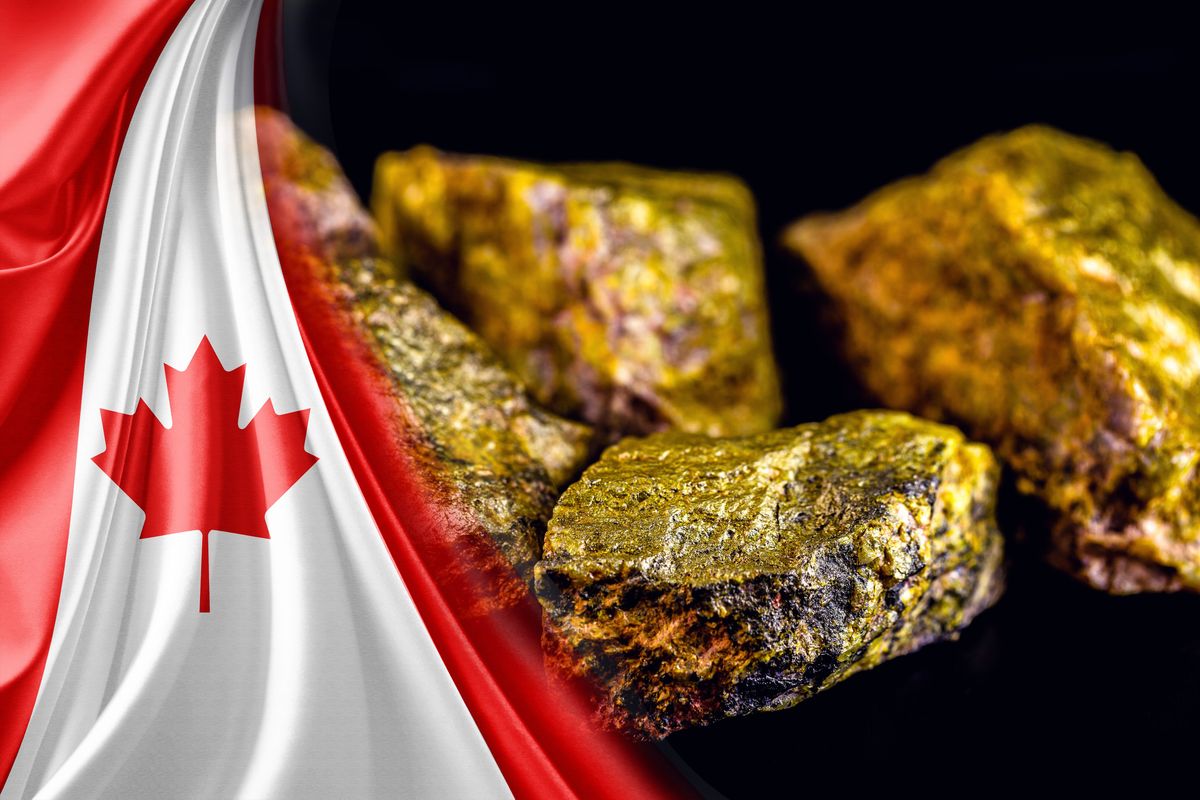
RHJPhtotos, patrice6000 / Shutterstock
Uranium prices regained momentum in the third quarter as the long-term contract price reached a record high and uranium equities posted strong gains, even as the spot market remained rangebound.
The U3O8 spot price started Q3 at US$85.92 per pound, climbed to a third quarter high of US$90.49 on August 27 and ended September at US$85.92, up 4.17 percent for the three month session.
Since briefly rallying to US$101 in late January, spot uranium has largely traded between US$83 and US$90, despite a backdrop of growing nuclear demand and constrained future supply.
Uranium equities delivered a much stronger performance.
Sprott Asset Management data shows that the VettaFi Global Uranium Mining Index (INDEXNYSEGIS:URNMX) gained 17.29 percent in August, while the Sprott Junior Uranium Miners ETF (NASDAQ:URNJ) rose 19.2 percent.
“Overall, we’re seeing the shift from the buyer having the power to the seller having the power. It’s just slowly happening, but it’s happening,” Global X analyst Brooke Thackray told the Investing News Network in an interview.
The longer-term outlook is also supporting the uranium investment case.
According to the 2026 Red Book, a joint report by the OECD Nuclear Energy Agency and the International Atomic Energy Agency, global uranium resources are sufficient to meet even their highest projected demand through 2050, but turning those resources into supply will require sustained investment, higher prices and long-term contracts.
Additionally, the report notes that uranium exploration and mine development spending reached US$1.8 billion in the 2023/2024 period, up an impressive 46 percent from 2021/2022.
Against that backdrop, investors are watching producers, developers and junior miners positioned to benefit from a strengthening uranium market and the next phase of nuclear growth.
Read on to learn about the top Canadian uranium stocks in 2026, including what factors have been moving their share prices. All data was obtained on October 6, 2026, using TradingView’s stock screener. Uranium companies on the TSX, TSXV and CSE with market caps above C$10 million at that time were considered.
1. ATHA Energy (TSXV:SASK)
Year-to-date gain: 64.06 percent
Market cap: C$371.16 million
Share price: C$1.05
ATHA Energy is a uranium explorer focused on its flagship Angilak project in Southern Nunavut, where it controls 100 percent of the Angikuni Basin. It also holds land in Saskatchewan's Athabasca Basin and Labrador's Central Mineral Belt. It has a 10 percent carried interest in Athabasca Basin exploration projects operated by NexGen Energy (TSX:NXE,NYSE:NXE) and IsoEnergy (TSX:ISO,NYSEAMERICAN:ISOU).
ATHA opened the third quarter with two drill updates from Angilak.
On July 8, it reported a new discovery about 4 kilometers along strike from the Lac 50 deposit. Hole L50W-DD-002 intersected 11.5 meters of composite uranium mineralization across five zones.
The next day, the company reported its widest intersection to date at the RIB North discovery. Hole RIBN-DD-003 returned 37 meters of composite mineralization across 15 zones, and six of the first eight holes hit uranium.
On July 16, ATHA amended its royalty agreement with the New Saskatchewan Syndicate. The amendment allows it to drop properties covered by the agreement in exchange for 1 million shares and 1 million warrants.
Later in the month, on July 31, the company elected to pay part of the interest on its US$25 million convertible debenture in shares, saying it would issue 340,136 shares to Queen's Road Capital.
ATHA released no news in August until a board update on August 31. Even so, its shares climbed to a year-to-date high of C$1.40 on August 27 during a broad rally in uranium stocks.
On September 8, the company extended RIB North's strike length from 300 meters to 1.45 kilometers. Hole RIBN-DD-011 intersected 20 meters of composite mineralization, including 1.5 meters averaging 8,453 counts per second (cps).
Shares touched an intraday high of C$1.30 that day.
ATHA closed out the RIB North program on October 7. It said seven more holes had expanded the strike length to 3.4 kilometers and announced the identification of a higher-grade subzone, with 21 of 23 holes in the campaign hitting mineralization. All of ATHA's reported results are radiometric readings, not assays.
2. Myriad Uranium (CSE:M)
Year-to-date gain: 34.29 percent
Market cap: C$66.3 million
Share price: C$0.47
Myriad Uranium holds a 100 percent interest in the Copper Mountain uranium project in Wyoming, which hosts several historic uranium deposits and past-producing mines. The company also owns the Arizona breccia pipe project, with at least 24 breccia pipes prospective for uranium and rare earths. It holds a 10 percent free-carried interest in the Red Basin project in New Mexico, an asset it sold to Subatomic Industries in May.
Myriad's biggest third quarter milestone was consolidating Copper Mountain by acquiring Rush Rare Metals. On July 13, Rush set an August 17 shareholder vote on Myriad's acquisition offer. After Rush shareholders and the Supreme Court of BC approved the deal, Myriad closed the acquisition on August 21. It issued 24,983,671 shares to Rush shareholders and took its Copper Mountain ownership from 75 percent to 100 percent.
Myriad began Phase 2 drilling at Copper Mountain on July 2. On August 20, it released preliminary radiometric results from four holes at Lucky Cliff. Hole LUC0004DD returned 19.96 meters grading 269 parts per million (ppm) eU3O8 from 18 meters. Myriad issued a correction on August 24 to the Lucky Cliff historical estimate cited in that release.
The completed acquisition and drill results came as uranium stocks rallied in late August. Myriad's share price reached a third quarter high of C$0.55 on August 25; however, its year-to-date high remains C$0.63, a level set on February 26, shortly after the firm signed a definitive agreement to acquire Rush.
On September 10, Myriad reported results from the Gem deposit, where hole GEM0001DD returned 29.41 meters at 295 ppm eU3O8 from 43.17 meters. On September 22, it reported slurry ablation test results from DISA Uranium on Copper Mountain material. The test concentrated 83.9 percent of the uranium into 29.3 percent of the original mass.
In early October, Myriad ended an option agreement with Wedgemount Resources (CSE:WDGY,OTCPL:WDGRF) on its Arizona breccia pipe project, taking back 100 percent control of the project.
3. IsoEnergy (TSX:ISO)
Year-to-date gain: 19.18 percent
Market cap: C$965.14 million
Share price: C$14.79
IsoEnergy is a uranium explorer and developer with assets in Canada, the US and Australia. Its flagship Larocque East project in Saskatchewan's Athabasca Basin hosts the Hurricane deposit, with indicated resources of 48.6 million pounds of U3O8 at 34.5 percent U3O8. It added Western Australian assets, including the Wiluna project, through its June acquisition of Toro Energy. It also holds about 33 percent of DISA Uranium, which now owns its former Utah mines.
The DISA deal was IsoEnergy's main corporate move of the quarter. On August 4, IsoEnergy and DISA Technologies agreed to form DISA Uranium. IsoEnergy contributed its Utah portfolio, including the Tony M, Daneros and Rim mines, and committed US$33 million to a US$105 million private placement. The transaction closed on August 19, leaving IsoEnergy as DISA Uranium's largest shareholder. The new company named Tony M a near-term priority.
At Larocque East, IsoEnergy resumed summer drilling on the Hurricane South Trend on July 8 after a wildfire suspension. Hole LE26-250 returned 11,075 cps over 3.5 meters, including 43,160 cps over 0.5 meters.
IsoEnergy shares rose sharply on August 21, closing at C$16.31, up from C$14.11 the previous day. The company released no news that day. However, Cameco (TSX:CCO,NYSE:CCJ) and other uranium stocks also rallied amid a positive trend in the uranium market. The stock reached a third quarter high of C$17.16 on August 27.
On September 8, IsoEnergy completed summer drilling at Larocque East, reporting its strongest radioactivity to date on the Hurricane South trend. The summer program covered 10,159 meters in 26 holes. Hole LE26-273 returned 14,135 cps over 3 meters, including 36,292 cps over 1 meter. Assays are pending.
4. Mega Uranium (TSX:MGA)
Year-to-date gain: 14.58 percent
Market cap: C$212.44 million
Share price: C$0.55
Mega Uranium holds a portfolio of uranium equities, as well as the Georgetown property in Northern Queensland, Australia, which includes the Maureen uranium-molybdenum project.
Its portfolio was valued at C$291.8 million as of June 20. Mega Uranium’s largest holding by far is 19,476,265 shares of NexGen Energy, valued at C$259 million, or 89 percent of its portfolio.
The company also holds 1,581,880 IsoEnergy shares, as well as positions in ATHA Energy, Premier American Uranium (TSXV:PUR) and Borealis Mining (TSXV:BOGO,OTCQB:BORMF).
Mega released no news of its own during the third quarter.
On August 7, it filed results for its third fiscal quarter, the three months ended on June 30. It reported net income of C$3.53 million for the quarter. Results include a C$7.98 million gain on the disposal of its Toro Energy shares, which it exchanged for 548,144 IsoEnergy shares when IsoEnergy acquired Toro in June.
Because NexGen makes up most of Mega's portfolio, news from NexGen bears directly on its value. On August 25, NexGen reported drill results from its Rook I project and said it was adding a fifth drill rig. Mega shares hit a third quarter high of C$0.70 on August 27 during the broader uranium rally.
5. Western Uranium and Vanadium (CSE:WUC)
Year-to-date gain: 7.22 percent
Market cap: C$37.36 million
Share price: C$0.52
Western Uranium & Vanadium is a uranium and vanadium company focused on the Western US. Its Sunday mine complex in Colorado's Uravan Mineral Belt is fully permitted.
The company is also permitting the San Rafael project in Emery County, Utah, and plans to build the Mustang mineral processing plant at the former Pinon Ridge mill site in Montrose County, Colorado. It is developing a proprietary kinetic separation technology that it says reduces milling costs.
On July 7, Western reported final assays from ore it delivered from the Sunday mine complex to Energy Fuels' (TSX:EFR,NYSEAMERICAN:UUUU) White Mesa mill in Utah. Final uranium grades came in more than 40 percent higher than the probe estimates made at delivery, which the company said means a larger final payment. Its Q2 10-Q later put the added revenue at US$167,111. The 10-Q also shows no uranium ore deliveries in the first half of 2026.
On July 14, Western provided a mill license update. It plans to file the Mustang plant's radioactive materials license application with Colorado's Department of Public Health and Environment by the end of 2026, aiming for review in 2027. The plant is designed to process 1,000 metric tons per day.
Western released no news in August or September. Its shares reached a third quarter high of C$0.72 on August 27 during the sector-wide uranium rally.
FAQs for investing in uranium
What is uranium used for?
Uranium is primarily used for the production of nuclear energy, a form of clean energy created in nuclear power plants. In fact, 99 percent of uranium is used for this purpose. As of 2022, there were 439 active nuclear reactors, as per the International Atomic Energy Agency. In 2023, 9 percent of US power came from nuclear energy.
The commodity is also used in the defense industry as a component of nuclear weaponry, among other uses. However, there are safeguards in effect to keep this to a minimum. To create weapons-grade uranium, the material has to be enriched significantly — above 90 percent — to the point that to achieve just 5.6 kilograms of weapons-grade uranium, it would require 1 metric ton of uranium pre-enrichment.
Because of this necessity, uranium enrichment facilities are closely monitored under international agreements. Uranium used for nuclear power production only needs to be enriched to 5 percent; nuclear enrichment facilities need special licenses to enrich above that point for uses such as research at 20 percent enrichment.
The metal is also used in the medical field for applications such as transmission electron microscopy. Before uranium was discovered to be radioactive, it was used to impart a yellow color to ceramic glazes and glass.
Where is uranium found?
The country with the greatest uranium reserves by far is Australia — the island nation holds 28 percent of the world’s uranium reserves. Rounding out the top three are Kazakhstan with 15 percent and Canada with 9 percent.
Although Australia has the highest reserves, it holds uranium as a low priority and is only fourth overall for production. All its uranium output is exported, with none used for domestic nuclear energy production.
Kazakhstan is the world’s largest producer of the metal, with production of 23,270 metric tons in 2024. The country’s national uranium company, Kazatomprom, is the world’s largest producer.
Canada’s uranium reserves are found primarily in its Athabasca Basin, and the region is a top producer as well.
Why should I buy uranium stocks?
Investors should always do their own due diligence when looking at any commodity so that they can decide whether it fits into their investment plans. With that being said, many experts are convinced that uranium has entered into a significant bull market, meaning that uranium stocks could be a good buy.
We explore options for how to invest in uranium here.
A slew of factors have led to this bull market. Discourse has been building around the metal's use as a source of clean energy, which is important for countries looking to reach climate goals, and interest in nuclear power to fuel artificial intelligence energy demand has increased significantly as well.
Nations are now prioritizing a mix of clean energies such as solar and wind energy alongside nuclear. Significantly, in August 2022, Japan began looking into restarting its idled nuclear power plants and commissioning new ones.
Uranium prices are very important to uranium miners, and levels had not been high enough for production to be economic. However, prices have climbed significantly in recent years, and spiked from US$58 per pound in August 2023 to a high of US$106 per pound in February 2024. It has since consolidated above US$80 in 2026.
Don't forget to follow us @INN_Resource for real-time updates!
Securities Disclosure: I, Georgia Williams, hold no direct investment interest in any company mentioned in this article.
Editorial Disclosure: Western Uranium and Vanadium is a client of the Investing News Network. This article is not paid-for content.
TSXV:NSU
https://x.com/INN_Resource
https://www.linkedin.com/in/georgia-williams-15845447/
gwilliams@investingnews.com
Originally from Calgary, Georgia has been right at home in Toronto for more than two decades. Graduating from the University of Toronto with an honors BA in journalism, she is passionate about writing on diverse topics, including resources, arts, politics and social issues.
At INN Georgia covers a wide range of topics, including energy, battery and critical metals and diamonds. In her spare time, Georgia enjoys watching documentaries and experiencing Toronto's vibrant food, arts and cultural scene.
At INN Georgia covers a wide range of topics, including energy, battery and critical metals and diamonds. In her spare time, Georgia enjoys watching documentaries and experiencing Toronto's vibrant food, arts and cultural scene.
INN Article Notification
Outlook Reports
Featured Uranium Investing Stocks
Browse Companies
MARKETS
COMMODITIES
CURRENCIES
Originally from Calgary, Georgia has been right at home in Toronto for more than two decades. Graduating from the University of Toronto with an honors BA in journalism, she is passionate about writing on diverse topics, including resources, arts, politics and social issues.
At INN Georgia covers a wide range of topics, including energy, battery and critical metals and diamonds. In her spare time, Georgia enjoys watching documentaries and experiencing Toronto's vibrant food, arts and cultural scene.
Learn about our editorial policies.