As nuclear energy demand for uranium takes off, here's a look at the top five uranium countries with the highest reserves in the world.

RHJPhtotos / Shutterstock
Uranium is an important commodity in the energy sector, and knowing the countries with the top uranium reserves is key.
Mined uranium resources have provided fuel for nuclear power generation for more than 60 years, and today nuclear power serves 10 percent of global energy needs. Global uranium demand is anticipated to grow in the coming years, which bodes well for future uranium prices. According to the World Nuclear Association (WNA), around 60 nuclear reactors are under construction worldwide, and significant increases to capacity at existing plants are also planned.
Global uranium production totaled 57,651 metric tons (MT) of U3O8 in 2022, the latest year for which numbers are available. The five top uranium-producing countries in the world are Kazakhstan, Canada, Namibia, Australia and Uzbekistan, and they were responsible for the vast majority of that production.
But what are the top uranium reserves by country? Here the Investing News Network provides an overview of the five countries with the largest uranium resources, with data sourced from the WNA. Reserves data for deposits owned by public companies is sourced from MiningDataOnline.
1. Australia
Uranium resources: 1,684,100 metric tons (28 percent of world uranium resources)
Which country has the most uranium? While Australia ranks fourth in global uranium production, it takes the lead for the highest uranium reserves in the world.
Australia’s crown jewel is Olympic Dam, the largest-known single deposit of uranium in the world with proven and probable reserves of 588 million MT at an average grade of 590 grams per MT (g/t) uranium in-situ. The mine is owned by BHP (ASX:BHP,NYSE:BHP,LSE:BHP) and produces uranium as a byproduct.
Other major uranium deposits in the country include Ranger, Beverley and Four Mile. While the latter two are owned by a private company, Ranger is owned by Energy Resources of Australia (ASX:ERA,OTC Pink:EGRAF), in which Rio Tinto (ASX:RIO,NYSE:RIO,LSE:RIO) has a majority interest. However, production at Ranger was brought to a halt in early 2021 and the site is now being rehabilitated.
Australia is key to the global uranium industry, but mining the material is politically contentious in the country. For example, the Western Australian government has put the brakes on any new domestic uranium-mining project approvals, although it is allowing existing projects to go ahead. In addition, the federal government is opposed to nuclear energy.
In July, the Australian Government put the kibosh on Energy Resources of Australia's attempt to renew its licence permit for the Jabiluka uranium project in the Northern Territory in response to community backlash.
2. Kazakhstan
Uranium resources: 815,200 metric tons (13 percent of world uranium resources)
Kazakhstan comes in second in terms of uranium resources, but ranks first in uranium production. The country's national uranium-mining company, Kazatomprom (LSE:KAP,OTC Pink:NATKY), is the world’s largest uranium producer. Kazatomprom's Inkai uranium mine, a 60/40 joint venture with Canada's Cameco (TSX:CCO,NYSE:CCJ), hosts proven and probable reserves of 261.7 million pounds of uranium contained in 305.6 million MT of ore grading 0.04 percent.
At least 67 percent of Kazakhstan's electricity production comes from coal, with the remainder supplied by natural gas (22 percent), hydro (9 percent) and solar and wind (1.5 percent). However, the country's energy development plan details changes to the mix that would include 5 percent of electricity generation from nuclear power and 10 percent from renewable energy by 2030. Kazakhstan has two proposed and planned nuclear power plants.
Russia's war in Ukraine has created a significant roadblock for Kazakhstan's uranium exports to western markets. Sanctions imposed on Russia have made the cost-effective route via St Petersburg no longer a viable option for transport.
Another issues facing Kazakhstan's uranium mining sector is supply shortages of sulphuric acid, which is used during in-situ leaching to dissolve uranium from host rock. This challenge, coupled with construction delays at new projects, led Kazatomprom to cut its production targets for 2025 by 17 percent.
3. Canada
Uranium resources: 588,500 metric tons (10 percent of world uranium resources)
The second largest uranium producer, Canada is third largest in terms of top uranium countries by reserves. Saskatchewan’s Athabasca Basin is a hotbed for uranium exploration and is known the world over for having the highest-grade uranium deposits on the planet.
The North American nation is home to the world’s top uranium mines: Cameco’s Cigar Lake and McArthur River. Together, they make the province of Saskatchewan an international leader in the uranium sector, although in recent years these operations have spent time offline.
The mines host high-grade deposits, with Cigar Lake's proven and probable reserves totaling 208.6 million pounds of uranium from 600,000 MT grading 17.03 percent, and McArthur River's coming in at 380.5 million pounds of uranium from 2.6 million MT grading 6.72 percent.
Nuclear energy accounts for about 15 percent of Canada’s electricity demand, and its nuclear power infrastructure includes 19 nuclear reactors. As the second largest country by landmass, providing reliable energy to Canada’s many remote regions poses a significant challenge. However, novel reactor technologies, such as small modular reactors, have the potential to supply power to smaller electrical grids or to remote, off-grid areas.
4. Russia
Uranium resources: 480,900 metric tons (8 percent of world uranium resources)
As the largest country by landmass, Russia has a wealth of resources, including 8 percent of the world’s uranium. The majority of Russia’s domestic uranium output comes via Rosatom, a subsidiary of ARMZ Uranium Holding, which owns the Priargunsky underground mine and is developing the Vershinnoye deposit in Southern Siberia.
To meet the nation’s growing energy needs, Russia’s government is keen on increasing its uranium output. According to the WNA, nuclear energy accounted for 19 percent of Russia’s energy mix as of December 2021, the most up-to-date data available. The country has 36 nuclear reactors generating 26,802 megawatts of electricity, with an additional four units under construction.
Russia is among the world's top 10 uranium producers in addition to holding significant reserves, and the country's war with Ukraine has raised questions about the extent to which Russia will be able to continue exports. However, European countries such as France are still importing Russian uranium. In 2023, Russia reportedly accounted for 27 percent of all enriched uranium supplied to US nuclear plants. However, in May 2024, US President Joe Biden signed into law a ban on enriched uranium imports from Russia.
In mid-September 2024, Russian President Vladimir Putin said his government is considering limiting uranium exports in response to ongoing sanctions.
5. Namibia
Uranium resources: 470,100 metric tons (8 percent of world uranium resources)
The world’s third largest uranium-producing country, Namibia, comes in fifth for reserves.
The African nation’s Langer Heinrich mine, owned by Paladin Energy (ASX:PDN,OTC Pink:PALAF), and Rössing mine, majority owned by China National Uranium, are capable of producing 10 percent of the world’s uranium output. Langer Heinrich hosts total proven and probable reserves of 83.8 million pounds uranium from 84.8 million MT at a grade of 448 parts per million.
Significant Namibian deposits also include Trekkopje, which is near Rössing and owned by Orano, and the world-class Husab uranium mine, which is also majority owned by China National Uranium. Husab hosts 224.8 million pounds of probable uranium reserves.
The Namibian government is in favor of expanding the country’s uranium-mining industry. While there are no nuclear power plants in Namibia, there is some support for a national nuclear power industry.
Don’t forget to follow us @INN_Resource for real-time news updates!
Securities Disclosure: I, Melissa Pistilli, hold no direct investment interest in any company mentioned in this article.
NYSE:BHP
https://x.com/INN_Resource
https://www.linkedin.com/in/melissa-pistilli-865271a9/
mpistilli@investingnews.com
The Conversation (0)
Melissa Pistilli has been reporting on the markets and educating investors since 2006. She has covered a wide variety of industries in the investment space including mining, cannabis, tech and pharmaceuticals. She helps to educate investors about opportunities in a variety of growth markets. Melissa holds a bachelor's degree in English education as well as a master's degree in the teaching of writing, both from Humboldt State University, California.
INN Article Notification
Latest News
Outlook Reports world
Featured Uranium Investing Stocks

Investor Insight
Generation Uranium offers investors high-leverage exposure to a potential major discovery in Canada’s underexplored and resource-rich Thelon Basin, led by a management team with a proven track record of securing high-value exits.
Overview
Generation Uranium (CSE:GEN, OTCQB:GENR, FRA:W85) is a Canadian exploration company focused on wealth creation through discovery within the uranium sector. The company’s primary strategy is to build a high-caliber exploration team that can rapidly test and drill high-potential targets, de-risking projects for potential takeover by larger producers. Currently centered in the prolific Thelon and Angikuni Basins of Nunavut, the company is also actively evaluating additional project acquisitions in the Athabasca Basin to expand its portfolio.
The company is led by a veteran management team with nearly 30 years of experience in mineral development. CEO Michael Collins has a significant track record of building and exiting public companies, including the co-founding of Bluerock Resources, a conventional uranium producer during the 2000-2008 cycle. This expertise is paired with a focused business model that leverages modern geophysical targeting to accelerate exploration timelines and reduce costs, ensuring the company can deliver results quickly in a bullish uranium market.
Company Highlights
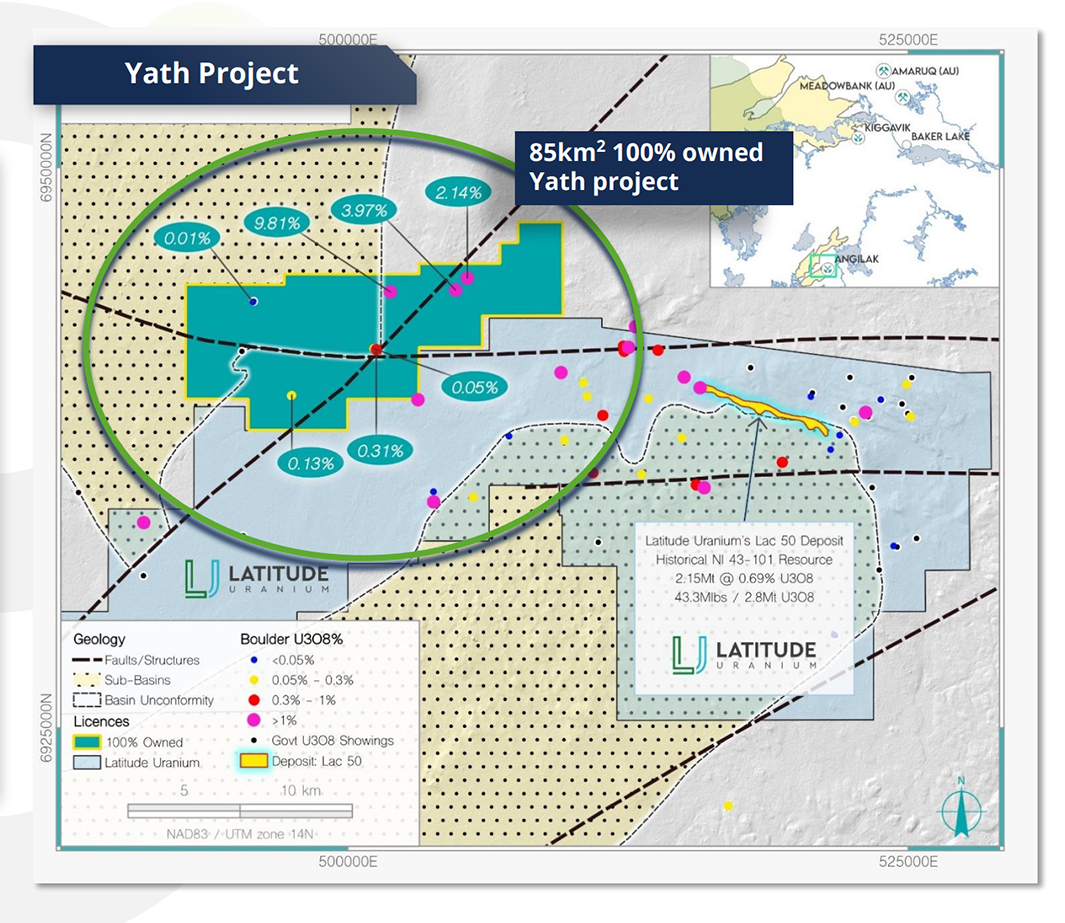
- Strategic Location in a Premier Uranium District: The flagship Yath Project is located in Nunavut’s Thelon Basin, contiguous to ATHA Energy’s Angilak Project, which hosts the high-grade Lac 50 deposit.
- High-Grade Discovery Potential: Historical surface sampling at the Yath Project has yielded exceptional uranium grades, including boulders testing at 9.81 percent, 3.95 percent, and 2.14 percent U3O8.
- Expert Management with Exit Experience: Led by CEO Michael Collins, the team has decades of experience in mineral exploration and a history of co-founding companies that were later acquired, such as Prime Mining and Nuclear Fuels.
- Low-Cost, Rapid Exploration Strategy: By leveraging modern geophysics and extensive historical data, the company aims for a "short road to discovery," de-risking projects quickly to maximize shareholder value.
- Bullish Market Fundamentals: Generation Uranium is well-positioned to meet the growing global demand for carbon-free nuclear power, supported by a projected supply deficit and increased interest from major tech companies seeking clean energy.
Key Project
Yath Project - Nunavut, Canada
The Yath Project is Generation Uranium’s flagship project. This 100 percent owned property covers about 120 square kilometers within the underexplored Thelon Basin in Nunavut, Canada. The project is located where the Yathkyed and Angikuni sub-basins meet, which is a region known globally for high-grade uranium potential. It sits directly along the same trend as the Angilak Project owned by ATHA Energy (TSXV:SASK, OTCQB:SASFK, FWB:XSU.F), which contains the Lac 50 deposit, one of the highest-grade uranium resources found outside of the Athabasca Basin with a historical mineral resource estimate of 43.3M lbs at an average grade of 0.69 percent U3O8.
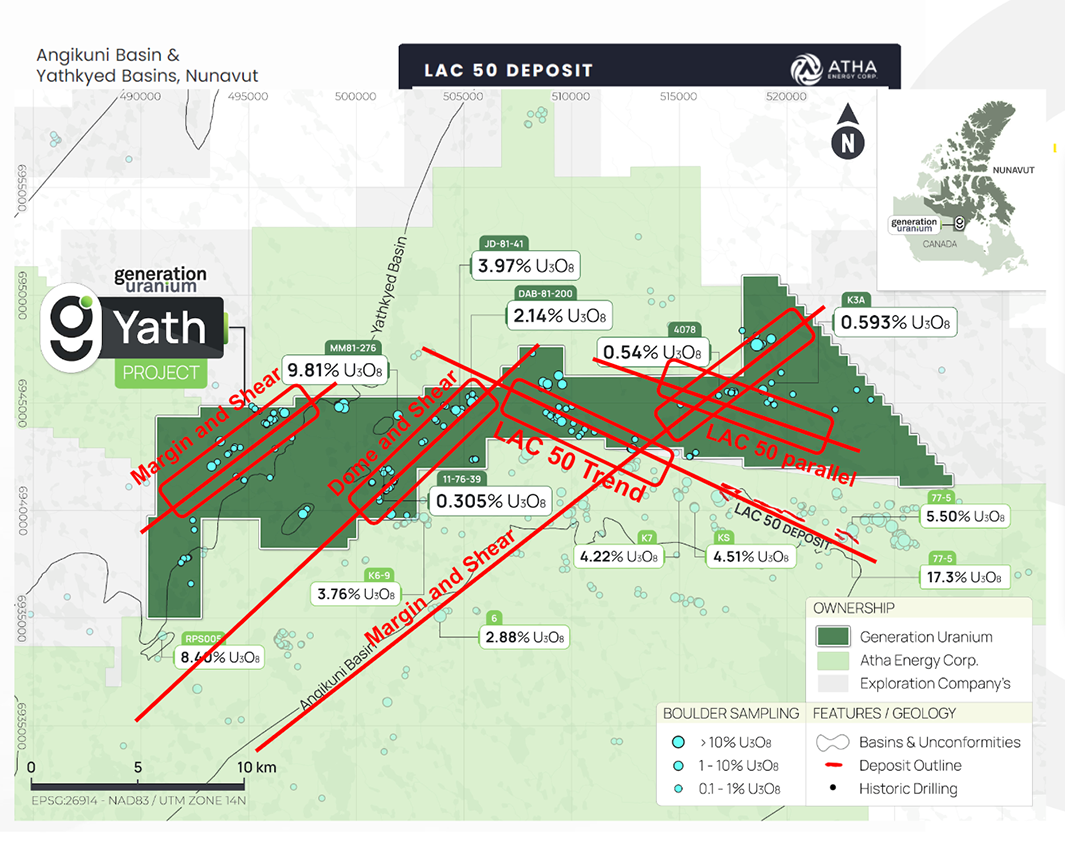
The Yath Project is contiguous to the Lac 50 trend and is crossed by several regional faults and basin boundaries. Past exploration work has already identified high priority targets, while surface sampling in the area has produced uranium grades from boulders, with some testing at 9.81 percent, 3.95 percent, and 2.14 percent U3O8.
The company has commenced its initial field program at the site, set to define and rank drill targets. Historic showings will be combined with new anomalies from the MMT geophysics survey, preparing the project for an anticipated drill permit.
Management Team
Michael Collins - CEO & Director
Michael Collins is a professional geoscientist with nearly 30 years of experience in mineral exploration. He has co-founded several public companies, including Exploits Discovery, Prime Mining (acquired in 2025), and Nuclear Fuels (merged with Premier American Uranium in 2025). He is also currently a director of First Atlantic Nickel.
Christoph Bruening - Director
Christoph Bruening is the founder and managing partner of Value Relations GmbH, a full-service investor relations and public relations agency in Frankfurt with over 25 years of excellence, focusing on mining, exploration, biotech and health care. In addition, he has listed over 600 companies on the Frankfurt Stock Exchange and is a speaker and author of several publications, including on rare earths and uranium.
Dallas Miller - Director
Dallas Miller has been working within the international mining industry for over 15 years, working with BHP and Santos Ltd. He has experience on the ground from an operational standpoint, as well as being an integral part of raising millions of dollars in capital funding for both private and public companies in recent years.
Roger Leschuk - VP Corporate Development
Roger Leschuk has been in corporate management for over two decades, with the past 15 years dedicated to corporate development and investor relations. He has experience participating in and assisting with mergers and acquisitions, and was an investment advisor for various services such as stocks, mutual funds and tax-sheltered investments. He is a Chartered Investment Manager and a Fellow of the Canadian Securities Institute.
Monty Sutton - CFO
Monty Sutton brings over 35 years of experience in public markets and corporate governance. He previously served as CFO for Nuclear Fuels from its IPO through its acquisition.
Browse Companies
MARKETS
COMMODITIES
CURRENCIES
Melissa Pistilli has been reporting on the markets and educating investors since 2006. She has covered a wide variety of industries in the investment space including mining, cannabis, tech and pharmaceuticals. She helps to educate investors about opportunities in a variety of growth markets. Melissa holds a bachelor's degree in English education as well as a master's degree in the teaching of writing, both from Humboldt State University, California.
Learn about our editorial policies.