The Conversation (0)

Jul. 31, 2026 01:30PM PST
Fact CheckedThis article has been reviewed and updated according to INN's rigorous fact-checking process. Our staff editors verify all articles against information and data from primary sources, reputable publishers and experts.

Westlight / Adobe Stock
Welcome to the Investing News Network's weekly brief on tech news and tech stocks driving the market.
We also break down next week's catalysts to help you prepare for the week ahead.
In this article:
This week's tech sector performance
The week started slowly as the market took a breath in anticipation of earnings reports and the US Federal Reserve's interest rate decision. Tech shares led the S&P/TSX Composite Index (INDEXTSI:OSPTX) higher on Monday (July 27), driven by a surge in the IT sector. In the US, the Nasdaq Composite (INDEXNASDAQ:.IXIC) declined after reports that NVIDIA (NASDAQ:NVDA) is in talks to provide roughly US$250 billion in financing guarantees to back OpenAI’s data center project, alongside separate discussions to finance up to US$350 billion in chip purchases.
As concerns over CAPEX spending lingered following Google's (NASDAQ:GOOGL) earnings last week, NVIDIA's news reignited concerns about circular financing in the artificial intelligence (AI) ecosystem.
Meanwhile, Chinese DRAM maker CXMT (SHA:688825) made its Shanghai STAR Market debut, surging around 470 percent to become China’s most valuable onshore-listed company. The initial public offering (IPO) was Asia’s largest so far this year, contributing to broader concerns about intensifying competition.
The rotation out of chip stocks accelerated on Tuesday (July 28), with the PHLX Semiconductor Sector (INDEXNASDAQ:SOX) dropping 4.5 percent at the closing bell. Major chipmakers like Marvell Technology (NASDAQ:MRVL), Micron Technologies (CSE:MWM), Intel (NASDAQ:INTC) and Advanced Micro Devices (NASDAQ:AMD) were under pressure. The Nasdaq Composite briefly dipped into correction territory before closing down 0.2 percent.
In Canada, the TSX climbed to another record high, again led by strength in technology and financials.
On Wednesday (July 29), as major airstrikes resumed in the Middle East, the Fed opted to leave rates unchanged, as was widely expected. However, three dissenting votes favoring a hike — the most dissents since 2016 — resulted in a sharp market reaction. The Dow Jones Industrial Average (INDEXDJX:.DJI) saw its worst day in 15 months, while the Nasdaq Composite dropped 1.7 percent as AI chip stocks extended losses to close just shy of correction territory. The Nasdaq-100 (INDEXNASDAQ:NDX) officially entered a correction.
Fed Chair Kevin Warsh's lack of clear guidance was another major contributor to Wednesday's selloff. While reconfirming his position against enduringly high inflation, he did not clarify the specific indicators that would prompt a response, nor did he confirm whether increasing rates is still being considered as an option.
Post-market trading revealed a mixed reaction to earnings from Meta Platforms (NASDAQ:META) and Microsoft (NASDAQ:MSFT). Meta's share price plunged even though the company beat revenue expectations due to missed earnings per share and weak Q3 revenue guidance. Free cashflow also collapsed to just US$784 million compared to US$31.08 billion in CAPEX, and the company raised its full-year CAPEX guidance.
Concurrently, Microsoft reported a solid beat, with revenue and earnings per share both beating market expectations. Cloud revenue also hit a new record high of US$50 billion.
Solid US economic data on Thursday (July 30) helped markets rebound. Analysts attributed some of the GDP resilience to AI-driven business investment, which helped offset rate concerns.
Chipmakers led the Nasdaq’s recovery, while the PHLX Semiconductor Sector rebounded as chipmakers rose after strong results from Samsung Electronics (KRX:005930). All three major indexes closed sharply higher.
Futures ticked higher overnight after Amazon (NASDAQ:AMZN) and Apple's (NASDAQ:AAPL) earnings, and markets opened higher on Friday (July 31). In Canada, Telus (TSX:T,NYSE:TU) dropped after it cut its full-year service revenue outlook and reset its quarterly dividend, cutting the annualized payout by 55 percent to focus on debt reduction.
US tech stocks started the day higher, but intraday selling pressure erased early gains as July closed. By midday, major indexes were flat to lower, with technology once again leading the fade. The Nasdaq-100 closed at 28,274.2, a 0.6 percent gain for the day, but 0.49 percent lower for the week.
3 tech stocks moving markets this week
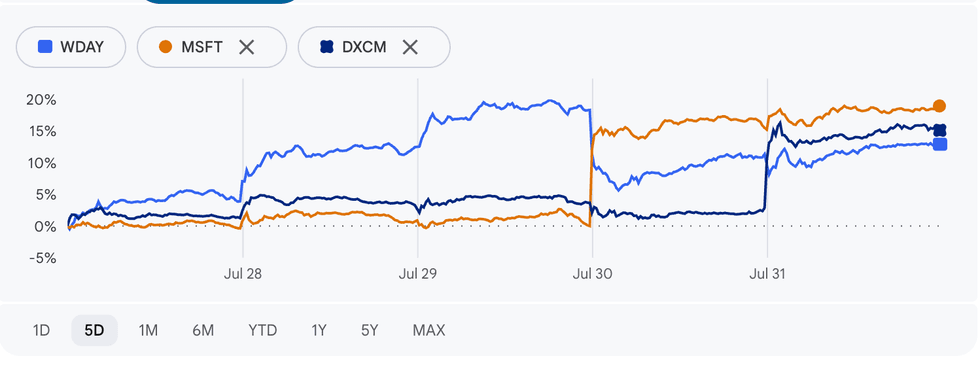
This week's top tech stock movers, according to TradingView data, were:
1. Workday (NASDAQ:WDAY)
Canada's Workday led gains with a 22.88 percent improvement.
2. Microsoft (NASDAQ:MSFT)
Microsoft's earnings report led to a boost of 20.07 percent for the week.
3. Dexcom (NASDAQ:DXCM)
DexCom saw a gain of 17.45 percent
Top tech news of the week
- A coalition of major tech companies backing the open‑weight AI ecosystem grew over the weekend, and on Monday, NVIDIA launched the Open Secure AI Alliance with over 25 other companies, calling for open research and regulatory support for open models as defensive assets, not liabilities. “The world needs both closed and open models,” NVIDIA wrote in a blog post, arguing that guardrails on closed frontier models are counterproductive because they can prevent security teams from analyzing cyber threats. This week, NVIDIA also announced a partnership with Ilya Sutskever’s AI startup, Safe Superintelligence.
- Shanghai Aishengna Electronic Technology Group, a state-backed company in China, has reportedly begun manufacturing the immersion deep ultraviolet lithography machines, or DUVs, used to make chips. Nine months ago, the editor of an American international relations magazine wrote on social media about a Chinese firm reverse-engineering an ASML Holding (NASDAQ:ASML) chipmaking machine to learn how they worked and evade US sanctions. Dutch chipmaking firm ASML saw its shares drop.
- Amazon has applied to the Federal Communications Commission to launch 5,105 satellites for a direct-to-device mobile service, intended to “complement existing mobile networks” by filling coverage gaps.
- Microsoft introduced Project Perception, a new AI security product for finding software vulnerabilities.
- PJM Interconnection warned data centers on Monday that they may face temporary involuntary disconnections during peak demand starting in mid-2027. The move comes after a failed capacity auction left PJM nearly 7 gigawatts short of needed power for 2028, and a 3 gigawatt sudden data center disconnection on July 21 highlighted grid instability risks. PJM said it will hold an emergency power auction in September to secure backup generation, with costs allocated to data centers, not residential customers. The grid operator is also creating a registry to track data center power needs and a matchmaking system for direct contracts with power producers.
- Apple launched Apple Upgrade in the US, a device leasing program backed by Klarna Group (NYSE:KLAR) that replaces the company's existing iPhone Upgrade Program. The new program offers 12 to 36 month lease terms for iPhones, iPads, Macs and Apple Watches, with prices starting at US$17.99 per month for iPhones and US$11.99 per month for iPads and Apple Watches. Customers can upgrade, purchase outright or return devices at lease end.
- Meta has entered a joint venture with BlackRock (NYSE:BLK) for a new data center in El Paso, Texas. Meta will retain 20 percent ownership, while BlackRock will take 80 percent.
- Supply chain AI startup Freehand announced a US$75 million seed funding round led by Battery Ventures and NewRoad Capital Partners, with participation from PSP Growth, Nexus Venture Partners and others. The company builds autonomous AI agents to manage supply chain spend by replacing legacy software and outsourced labor. Freehand claims its agents can recover between 5 and 10 percent of spending, complete workflows up to seven times faster and reduce procure-to-pay cycles for deployed enterprises including Meta, Unilever (LSE:ULVR,NYSE:UL), Johnson & Johnson (NYSE:JNJ), Pfizer (NYSE:PFE) and Cardinal Health (NYSE:CAH).
- The Information reported that Taiwan Semiconductor Manufacturing Company (TSMC) (NYSE:TSM) is developing advanced chip-packaging technology, similar to Intel’s Embedded Multi-die Interconnect Bridge, citing two people familiar with the matter. The technology embeds tiny silicon bridges directly into the organic package substrate, unlike TSMC’s Chip-on-Wafer-on-Substrate (CoWoS), which uses a continuous silicon interposer to stack logic chips and high-bandwidth memory. The move is meant to reduce cost and improve area utilization. TSMC’s CoWoS is capital-intensive and capacity-constrained.
- NextEra Energy (NYSE:NEE) and Brookfield (NYSE:BAM), in partnership with the DOE, announced a US$100 billion planto redevelop a former Cold War-era uranium enrichment site in Paducah, Kentucky, into a massive power and data center campus. The project aims to support AI infrastructure without increasing costs for existing electric customers and is slated for completion in 2032.
- Claude maker Anthropic said three outside companies were hacked during cybersecurity "capture-the-flag" tests on Thursday. The incident was discovered during a review of 141,006 test sessions after OpenAI reported that ChatGPT had hacked into Hugging Face last week. The earliest Anthropic cases date back to April 2026, and the models involved included Claude Opus 4.7, Claude Mythos 5 and an internal research model. A misconfiguration by the cybersecurity lab and Anthropic’s partner, Irregular, left the environment connected to the public internet despite prompts stating otherwise. Claude exploited weak passwords, unauthenticated endpoints and software vulnerabilities. Anthropic suspended cyber evaluations on July 23 and notified the affected organizations on Monday; two were previously unaware. Anthropic termed it an "operational failure" rather than a safety breach, saying there was no evidence of intentional escape or autonomous goal seeking.
- Cloud provider Nscale has agreed to acquire software company Anyscale for US$1.65 billion. “The acquisition brings together two highly complementary companies. Nscale supplies the infrastructure — GPUs, data centers, power — and the software that AI runs on. Anyscale brings the software layer that machine learning engineers and AI platform teams use to run their workloads,” the company said.
- CyrusOne, a data center operator owned by KKR & Co. (NYSE:KKR) and BlackRock’s Global Infrastructure Partners, is reportedly preparing to hire investment banks for a potential IPO next year, which could rank among the largest IPOs.
Major tech stocks report earnings
1. Meta Platforms (NASDAQ:META)
Meta Platforms said its capital expenditures nearly doubled to US$30 billion, causing free cashflow to shrink by 91 percent. On the company's earnings call, CEO Mark Zuckerberg noted that the firm has received offers for excess compute at a meaningful premium, but also sees valuable internal uses.
Full-year 2026 CAPEX guidance was adjusted to between US$130 billion and US$145 billion, raised from the prior range of US$125 billion to US$145 billion.
2. Microsoft (NASDAQ:MSFT)
Microsoft reported that its operating expenses rose only 10 percent, leading to an 18 percent increase in operating income. AI-related CAPEX was US$35.8 billion, roughly 40 percent of revenue.
The company reported 30 million paid subscriptions for its Microsoft 365 Copilot AI assistant, and Azure cloud revenue growth accelerated by 3 percent. 2026 capital spending is guided at about US$190 billion after accounting changes in Q4, but management said underlying investment plans are unchanged. Around US$25 billion of the US$190 billion reflects higher component prices rather than additional capacity.
3. Amazon (NASDAQ:AMZN)
Amazon reported 37 percent growth in its cloud unit and achieved an operating profit margin of 39.4 percent. The company reported in its results that Amazon Web Services (AWS) customers are already reserving capacity through 2028, with most AI capacity contracted for five years.
CAPEX in Q2 was US$53.1 billion, primarily for AWS and generative AI.
The company raised 2026 fiscal year CAPEX guidance to about US$220 billion, up from around US$200 billion, due to higher memory costs and continued AI/cloud infrastructure investments.
4. Apple (NASDAQ:AAPL)
Apple beat analysts' estimates, reporting revenue of US$109.4 billion and a net profit of US$29.8 billion. Services revenue came in strong, helped by strong iPhone demand. CAPEX for the 2026 fiscal year is expected to be only about US$13 billion to 14 billion, with management leaning on on-device Apple Intelligence and rented cloud capacity rather than building massive data centers. The company did not give explicit full-year revenue targets.
5. Qualcomm (NASDAQ:QCOM)
Qualcomm delivered revenue of US$9.95 billion, roughly in line with estimates, driven by strength in automotive and IoT, but the company flagged ongoing memory supply constraints weighing on handset volumes. Automotive revenue hit record levels, contributing to a more diversified revenue mix.
Qualcomm said it expects revenue for its fourth fiscal quarter to range from US$9.7 billion to US$10.5 billion, below some analysts' estimates, reflecting continued memory-driven weakness. Longer term, management is targeting US$5 billion in data center revenue by 2027 and US$15 billion by 2029, as part of a broader goal of over US$40 billion in non-handset revenue by the end of the decade.
Tech ETF performance
Tech exchange-traded funds (ETFs) track baskets of major tech stocks, meaning their performance helps investors gauge the overall performance of the niches they cover.
This week, the iShares Semiconductor ETF (NASDAQ:SOXX) closed down 5.02 percent, while the Invesco PHLX Semiconductor ETF (NASDAQ:SOXQ) lost 5.17 percent.
The VanEck Semiconductor ETF (NASDAQ:SMH) declined by 4.4 percent.
Tech news to watch next week
Next week, market watchers will focus on US nonfarm payrolls, unemployment and wages for clues on the Fed’s path, alongside ISM manufacturing and services data to gauge growth and inflation.
In tech, key upcoming quarterly reports will include Palantir Technologies (NASDAQ:PLTR) on August 3; Advanced Micro Devices, Sandisk (NASDAQ:SNDK) and Western Digital (NASDAQ:WDC) on August 4; and SoftBank Group (TSE:9984,OTCPL:SFBQF) on August 5.
Don't forget to follow us @INN_Technology for real-time news updates!
Securities Disclosure: I, Meagen Seatter, hold no direct investment interest in any company mentioned in this article.
https://x.com/INN_Technology
https://www.linkedin.com/in/meagen-seatter-23675b193/
mseatter@investingnews.com

Learn about our editorial policies.