

The Conversation (3)
Oct. 16, 2026 02:00PM PST
|Fact CheckedThis article has been reviewed and updated according to INN's rigorous fact-checking process. Our staff editors verify all articles against information and data from primary sources, reputable publishers and experts.
Explore the week's best-performing Canadian mining stocks on the TSX, TSXV and CSE, and dive into the Canadian news affecting commodities prices and stock markets.
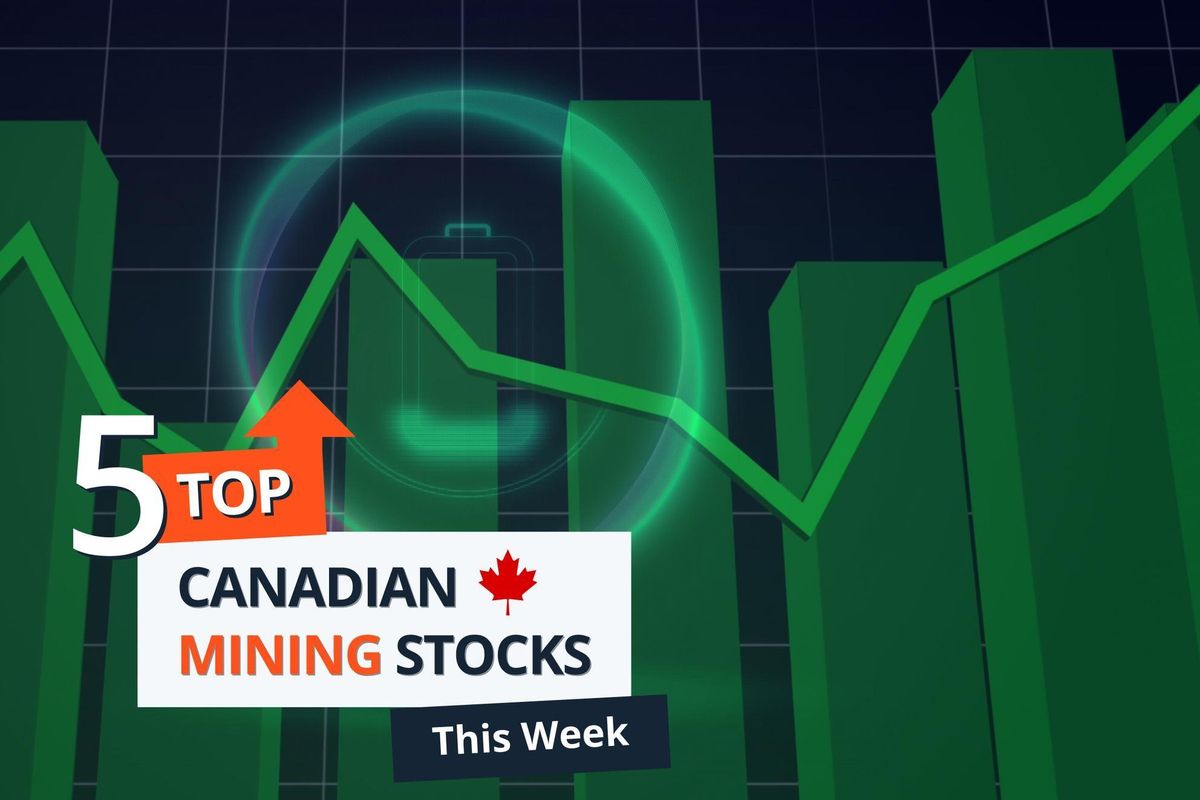
Welcome to the Investing News Network's weekly look at the best-performing Canadian mining stocks on the TSX, TSXV and CSE, starting with a round-up of Canadian news impacting the resource sector.
On Friday (October 16), Cabin Radio reported that the Northwest Territories is pushing for a North of 60 Mineral Exploration Tax Credit to attract investment and increase mineral production in Canada’s north. Alberta is backing the proposal, saying the province could become a processing hub for mining operations in the territories.
The federal government has been noncommittal, reportedly pointing to existing Canada-wide programs and to the 12 commodities added to Canada’s critical minerals list in the fall 2025 budget.
Still, the federal government and Prime Minister Mark Carney have said they want to expand investment in the north. Some supporters are hopeful that a new credit could come as early as this fall’s budget, or otherwise in the spring.
On the global stage, Reuters reported that World Bank President Ajay Banga said on Friday (October 16) that the lender plans to quintuple its critical minerals business over five years.
The bank is targeting US$19 billion in critical minerals financing for fiscal 2026 to 2030, up from US$3.6 billion in the previous five year period, and has identified 20 countries it could partner with.
The plan follows pressure from the US, the bank’s largest shareholder.
Earlier this week, US Secretary of the Treasury Scott Bessent called on the bank to help build mining and processing capacity by de-risking projects and financing supporting infrastructure.
In labor news, Reuters reported on Wednesday (October 14) that BHP (ASX:BHP,NYSE:BHP,LSE:BHP) has reached a preliminary agreement with the union representing supervisors at its Escondida copper mine in Chile.
The workers had voted to strike if government-led mediation did not produce a deal with better pay and benefits. In the vote on the agreement, 64 percent of members accepted it and 35 percent voted against.
In Canada, about 1,200 union members at Teck Resources' (TSX:TECK.A,TECK.B,NYSE:TECK) Highland Valley copper mine, the country’s largest copper mine, will vote on a strike mandate. Voting takes place on Friday and Saturday (October 17) in Logan Lake and Kamloops, BC. The union and the company began talks in early October, but those talks broke off after about a week. The previous five year contract expired on September 30.
For more on what’s moving markets this week, check out our top market news round-up.
Markets and commodities react
Canadian equity markets were mixed this week.
The S&P/TSX Composite Index (INDEXTSI:OSPTX) gained 2.19 percent over the week to close Friday at 36,176.55, while the S&P/TSX Venture Composite Index (INDEXTSI:JX) lost 3.87 percent to 845.30.
The CSE Composite Index (CSE:CSECOMP) slid 7.2 percent to 139.77.
The gold price gained 0.81 percent to close at US$4,168.21 per ounce on Friday at 4:00 p.m. EDT. The silver price fared worse, closing the week down 3.65 percent at US$56.98.
In base metals, the Comex copper price recorded a 0.35 percent increase this week to US$6.57.
The S&P Goldman Sachs Commodities Index (INDEXSP:SPGSCI) was up 1.85 percent to end Friday at 752.04.
Top Canadian mining stocks this week
How did mining stocks perform against this backdrop?
Take a look at this week’s five best-performing Canadian mining stocks below.
Stocks data for this article was retrieved at 4:00 p.m. EDT on Friday using TradingView's stock screener. Only companies trading on the TSX, TSXV and CSE with market caps greater than C$10 million are included. Mineral companies within the non-energy minerals, energy minerals, process industry and producer manufacturing sectors were considered.
1. Lithium Africa (TSXV:LAF)
Year-to-date gain: 51.9 percent
Market cap: C$18.74 million
Share price: C$1.20
Lithium Africa is an explorer and developer building a portfolio of hard-rock lithium projects in South Africa and Côte d’Ivoire. Its current focus is its Springbok project in South Africa's Northern Cape province. The asset covers a 1,675 square kilometer area that includes a 5 hectare mining permit over the past-producing Norrabees I lithium mine. The company filed a technical report for the project in July, but has not yet defined a resource.
On Thursday (October 15), Lithium Africa reported complete assays from a hole at Norrabees I that returned 8 meters grading 1.7 percent lithium oxide (Li2O) from 21 meters depth, including 4 meters at 2.59 percent Li2O.
Spodumene has now been intersected in all four holes reported so far at Norrabees I, with three returning high-grade intervals within about 21 meters of surface. CEO Thomas Benson commented, “Both drilling campaigns at Norrabees I have intersected high-grade mineralization at shallow depths, and that consistency underpins our objective of evaluating a potential small-scale operation to help fund exploration at Springbok."
The results follow the company’s October 7 decision to advance Springbok toward spodumene concentrate production, targeting first output in the second half of 2027. Mining at Norrabees I is already permitted, although the processing plant it plans to build will need further approvals. Three rigs remain active at Springbok, and the company expects more drill and channel sampling results through early 2027.
2. Lion Copper (TSXV:LCU)
Year-to-date gain: 45.3 percent
Market cap: C$148.57 million
Share price: C$8.50
Developer Lion Copper is moving forward at its Yerington copper project in Nevada, US.
The brownfield project is located in Lyon County, in the historic Yerington copper district, and is being advanced under an earn-in agreement with Nuton, a Rio Tinto (ASX:RIO,NYSE:RIO,LSE:RIO) venture that is funding the work and supplying its heap-leach technology to process sulfide material at the site.
An August 2025 prefeasibility study outlines a 12 year open-pit, heap-leach operation that would produce 120 million pounds of copper cathode annually; it also shows a post-tax net present value of US$694 million and an internal rate of return of 14.6 percent and a payback period of 6.7 years. The company has now shifted its focus to a definitive feasibility study, which it says will be completed in the first quarter of 2027.
On Wednesday, Lion Copper received approval to list its shares on the Nasdaq Capital Market, with trading expected to begin on October 19. It expects the listing to increase its exposure to US retail and institutional investors.
On Monday (October 12), the company also agreed to extend the maturity of US$2.7 million in convertible debentures from November 2026 to May 2027, providing near term payment relief.
3. Pacific Booker (TSXV:BKM)
Year-to-date gain: 31.67 percent
Market cap: C$72.99 million
Share price: C$3.70
Pacific Booker Minerals is an exploration and development company focused on its Morrison property, located in Central BC, Canada. The site is in the advanced stages of development and hosts copper, gold and molybdenum mineralization. The company has been working on development plans since 2004, and completed a feasibility study in 2009. However, work hasn’t been able to proceed as it needs approval from the nearby Lake Babine Nation.
In May 2024, Pacific Booker announced it would be seeking legal recourse after communications between itself and Lake Babine Nation broke down. The company indicated it had received a memorandum of understanding from Lake Babine Nation in 2012, but legal counsel for the nation has refuted that the understanding was in existence.
On August 21, it announced it was working complete a prefeasibility study for the project, including an updated mineral resource estimate, with the study expected in the first quarter of 2027.
“The PFS is expected to incorporate current engineering practices, cost estimates and economic assumptions and will assist the Company in evaluating the potential future development of the Project,” said CEO John Plourde.
The most recent news came on October 7, when the company upsized a private placement for gross proceeds of up to C$12 million, which it plans to use to advance Morrison. Pacific Booker has not released any news since then.
4. Roxmore Resources (TSX:RM)
Year-to-date gain: 29.89 percent
Market cap: C$499.46 million
Share price: C$6.91
Roxmore Resources is a gold development company advancing its Converse gold project in Nevada, US.
The project is located on the Battle Mountain-Eureka trend in North-Central Nevada. On April 20, Roxmore released a preliminary economic assessment for Converse that outlines an economic case with a post-tax net present value of US$2.7 billion and an internal rate of return of 43 percent from a base-case gold price of US$3,600.
The company is currently working toward the completion of a prefeasibility study for Q4 2027.
The most recent news came on Tuesday (October 13), when Roxmore agreed to be acquired by SSR Mining (TSX:SSRM,NASDAQ:SSRM) in a deal valued at about C$712 million. The company will spin out its exploration assets into a new company, with shareholders receiving 0.33 shares for each Roxmore share they hold.
Roxmore CEO John Dorward will lead the spinout company, which will hold its remaining exploration assets, including the Rattlesnake Hills gold project in Wyoming and the Newton gold project in BC, along with US$10 million in cash. SSR will take a minority stake in that firm.
5. Aurania Resources (TSXV:ARU)
Year-to-date gain: 31.67 percent
Market cap: C$72.99 million
Share price: C$3.70
Aurania Resources is an exploration company focused on precious metals and critical energy projects in Europe and abroad. Its recent focus has been on its Thormódsdalur gold-silver project, located about 20 kilometers east of Reykjavík, Iceland. It covers approximately 51,300 hectares under a single national exploration permit.
Aurania is exploring it as part of an earn-in agreement with St-Georges Eco-Mining. Under the terms of the agreement, Aurania can earn up to a 70 percent interest in the project by incurring phased exploration expenditures of US$5 million over four years. For an additional US$2 million in expenses plus a royalty, Aurania can earn up to 100 percent. The project hosts a historically known epithermal gold system and has no current resource.
On Tuesday, Aurania completed its 2026 drill program at Thormódsdalur, totaling eight holes and 780.7 meters. The program was designed to test historical holes which had achieved only 50 percent core recovery.
Core recovery from the new holes was closer to 100 percent, with every hole demonstrating vein and breccia textures consistent with an epithermal gold-silver system.
“Previous drilling programs reported core recoveries of approximately 50% or less, with fine material lost during drilling, particularly in the mineralized zones,” said President and CEO Keith Barron.
Samples have been sent to the lab, and Aurania expects assay results in November.
FAQs for Canadian mining stocks
What is the difference between the TSX and TSXV?
The TSX, or Toronto Stock Exchange, is used by senior companies with larger market caps, and the TSXV, or TSX Venture Exchange, is used by smaller-cap companies. Companies listed on the TSXV can graduate to the senior exchange.
How many mining companies are listed on the TSX and TSXV?
As of July 2026, 892 mining companies and 68 oil and gas companies are listed on the TSXV, combining for 64 percent of the 1,501 total companies listed on the exchange.
The TSX is home to 182 mining companies and 51 oil and gas companies. The exchange has 2,264 companies listed on it in total.
Together, the TSX and TSXV host around 40 percent of the world’s public mining companies.
How much does it cost to list on the TSXV?
There are a variety of different fees that companies must pay to list on the TSXV, and according to the exchange, they can vary based on the transaction’s nature and complexity.
As of April 2026, the listing fee alone will most likely cost between C$10,000 to C$70,000, and accounting and auditing fees could rack up between C$25,000 and C$100,000. Legal fees are expected to be over C$75,000 and an underwriters’ commission may hit up to 12 percent.
The exchange lists a handful of other fees and expenses companies can expect, including but not limited to security commission and transfer agency fees, investor relations costs and director and officer liability insurance.
These are all just for the initial listing, of course. There are ongoing expenses once companies are trading, such as sustaining fees and additional listing fees, plus the costs associated with filing regular reports.
How do you trade on the TSXV?
Investors can trade on the TSXV the way they would trade stocks on any exchange. This means they can use a stock broker or an individual investment account to buy and sell shares of TSXV-listed companies during the exchange's trading hours.
Don't forget to follow us @INN_Resource for real-time updates!
Securities Disclosure: I, Dean Belder, hold no direct investment interest in any company mentioned in this article.
From Your Site Articles
- Top 3 Canadian Lithium Stocks in 2026 ›
- 5 Best-performing Gold Stocks on the TSX ›
- 5 Best-performing Canadian Uranium Stocks ›
- Top 5 Junior Gold Mining Stocks on the TSXV ›
- 5 Best-performing Copper Stocks on the TSX ›
Related Articles Around the Web
LAF:CC
https://x.com/INN_Resource
https://www.linkedin.com/in/deanbelder
dbelder@investingnews.com
Dean has been writing in one form or another since penning stage plays in his youth. He is a graduate of both Emily Carr University and Simon Fraser University, with a BFA in photography and a BA in communications.
As a writer, Dean has traveled throughout BC and the Pacific Northwest covering cultural events, interviewing small business owners and working alongside fellow writers and photographers from publications like Rolling Stone Magazine, Spin and the Georgia Straight.
Dean has a keen interest in investing, and enjoys learning about the mining industry and better understanding the technical aspects of trading. In his spare time, Dean is an avid home chef, ponders the space-time continuum and makes his own cider. On weekends he can be found cycling the Seawall, exploring farmers markets or sampling the city’s local craft breweries.
INN Article Notification
Latest News
Outlook Reports world
Featured Lithium Investing Stocks


Browse Companies
MARKETS
COMMODITIES
CURRENCIES
Dean has been writing in one form or another since penning stage plays in his youth. He is a graduate of both Emily Carr University and Simon Fraser University, with a BFA in photography and a BA in communications.
As a writer, Dean has traveled throughout BC and the Pacific Northwest covering cultural events, interviewing small business owners and working alongside fellow writers and photographers from publications like Rolling Stone Magazine, Spin and the Georgia Straight.
Dean has a keen interest in investing, and enjoys learning about the mining industry and better understanding the technical aspects of trading. In his spare time, Dean is an avid home chef, ponders the space-time continuum and makes his own cider. On weekends he can be found cycling the Seawall, exploring farmers markets or sampling the city’s local craft breweries.
Learn about our editorial policies.