The Conversation (0)

Nov. 20, 2026 12:30PM PST
Fact CheckedThis article has been reviewed and updated according to INN's rigorous fact-checking process. Our staff editors verify all articles against information and data from primary sources, reputable publishers and experts.

pharoah / Adobe Stock
Welcome to the Investing News Network's weekly brief on tech news and tech stocks driving the market.
We also break down next week's catalysts to help you prepare for the week ahead.
In this article:
This week's tech sector performance
Artificial intelligence (AI)-related stocks trended down early in the week as several key events weighed on investors.
NVIDIA (NASDAQ:NVDA) was still reeling from Jensen Huang’s sudden resignation as CEO just ahead of the firm's Q3 results, along with an equally swift push to bring him back.
At the same time, the Trump administration moved to close a loophole that allows Chinese companies to reach sensitive US technology through data centers outside Mainland China.
The leadership upheaval raised questions about who will steer NVIDIA and keep its customers loyal, while analysts at UBS Group (NYSE:UBS) warned that the new rule could cut into sales to data centers in Southeast Asia.
Monday (November 16) saw all three major indexes fall in a steep selloff led by chipmakers and data center stocks after a source told CNBC that NVIDIA's board was not discussing bringing Huang back.
Micron Technology (NASDAQ:MU), Intel (NASDAQ:INTC), Sandisk (NASDAQ:SNDK), Lumentum (NASDAQ:LITE) and Advanced Micro Devices (AMD) (NASDAQ:AMD) were among the biggest losers, falling between 5.6 and 8.6 percent.
On Tuesday (November 17), selling spread to software stocks ahead of Anthropic's (NASDAQ:ANT) debut. The losses were smaller than Monday’s, but much broader, with all 11 sectors on the S&P 500 (INDEXSP:.INX) finishing lower. The index recorded its lowest close since July, while the Nasdaq Composite (INDEXNASDAQ:.IXIC) hit its lowest level since April. Chip stocks partially recovered following NVIDIA's earnings, which beat analysts' expectations.
Shares of NVIDIA and companies tied to it, including suppliers and smaller AI cloud firms, stayed elevated in pre-market trading on Wednesday (November 18), but slipped after the open. Summit Insights downgraded NVIDIA from "buy" to "hold" that morning, while most firms kept their "buy" or "overweight" ratings intact while lowering their 12 month price targets. AMD and Broadcom (NASDAQ:AVGO) gained, ending the Nasdaq Composite’s four day losing streak.
After the close, Anthropic's debut price was set at US$83 per share and the number of shares was raised from 825 million to 980 million. The sale raised US$81.3 billion, topping SpaceX (NASDAQ:SPCX) for the largest IPO on record and valuing the company at about US$1.5 trillion on a fully diluted basis.
The strong demand carried into Thursday (November 19). Anthropic opened at US$150 just before 12:00 p.m. EST, well above its IPO price. Chipmakers had led a broad rally at the open, but gains faded by late morning.
Stocks pulled back sharply in afternoon trading, with the Nasdaq Composite, Nasdaq-100 (INDEXNASDAQ:NDX) and the PHLX Semiconductor Sector (INDEXNASDAQ:SOX) all falling more than 2 percent. The pullback left market watchers weighing what Anthropic’s debut could mean for the rest of the AI trade.
Alex Tsepaev, chief strategy officer at B2PRIME Group, told the Investing News Network that the IPO shows investor interest in AI “is still going strong,” but that it doesn’t mean the industry will keep growing the way it has:
“The doubts about high valuations have become very widespread among investors now, so we can expect that the market will only grow stricter about scrutinizing AI companies and deciding which are truly worth the heavy investment."
Tsepaev added that the IPO gives the market a new benchmark for valuing AI businesses, which could make it harder for companies whose valuations rest mainly on future promise to raise money.
Outside the AI trade, a wave of technology failures kept security in the headlines this week.
Outages hitting Microsoft's (NASDAQ:MSFT) office apps, the Federal Aviation Administration's (FAA) flight network, United Airlines (NASDAQ:UAL), several big bank apps, Apple (NASDAQ:AAPL) and the National Security Agency's internal network piled up, raising alarms about the state of the country’s computer systems.
Officials said there are no signs of a coordinated attack, blaming aging computer systems, software updates that overwhelmed them and, in some cases, hurried fixes for security holes found by AI.
The market reaction to the outages was limited: FAA contractor L3Harris (NYSE:LHX) and Hewlett Packard Enterprise (HP) (NYSE:HPE), which owns the maker of the routers tied to the FAA ground stop, both fell briefly.
Real hacking, however, had a notable effect on market sentiment. In light of widespread reporting of hackers using AI tools that can break into systems largely on their own, cybersecurity stocks moved higher midweek.
Separately, minutes from the US Federal Reserve's October meeting, released on Wednesday, showed officials are worried that the AI building boom is helping keep prices high. Officials held interest rates steady in October, but agreed a faster pace of hikes may be needed to bring inflation down, and traders are betting on a hike in December. Nearly every Fed official also flagged the risk that AI spending won't pay off as hoped.
On Friday (November 20), big tech led a weak open for US indexes after Korean markets fell overnight, with Nasdaq futures slipping below their 200 day average. Anthropic was down more than 7 percent in pre-market trading, and slipped as much as 10.27 percent before closing at US$88.30, 23.28 percent below its opening price on Thursday.
By midday, the Nasdaq Composite was firmly in correction territory, down over 3.5 percent from its opening price and roughly 16.3 percent below its October 6 record close of 27,599.89.
It closed at 22,617.73, 5.28 lower on the day and 9 percent lower for the week.
Top tech news of the week
- In a deal valued at about US$5 billion, Blackstone's (NYSE:BX) newly listed data center fund, Blackstone Digital Infrastructure Trust (NYSE:BXDC), is buying a majority stake in two joint ventures with Amazon Web Services (AWS). The fund will own 13 newly built data center buildings on AWS campuses located in Northern Indiana and Mississippi.
- Alibaba (NYSE:BABA) launched Qwen4-Max, a new flagship AI model. Alibaba claims it rivals models created by competitors Anthropic and OpenAI.
- At COP31 climate talks in Turkey, organizers launched a voluntary pledge for more climate-friendly AI, pushing for cleaner power and openness about data centers’ environmental impact. A draft deal would raise electricity’s share of global energy use “from roughly 23 percent to 35 percent by 2035.”
- Microsoft introduced new AI models at Ignite, its flagship annual conference, and said it will license the models’ weights so customers can build custom versions.
- Google (NASDAQ:GOOGL) announced free Gemini updates called Tasks that let it carry out more jobs on its own, similar to Meta Platforms' (NASDAQ:META) Muse and OpenAI’s Dots.
- SpaceX sold US$32 billion in AI chip-backed debt on Thursday, mostly at yields above 8 percent, as the centerpiece of an over US$40 billion financing package to lease roughly US$47.3 billion worth of NVIDIA's new Rubin GPUs. Lenders reportedly pushed for covenants barring Elon Musk from launching the financed chips into orbit, where they would be impossible to repossess in a default.
- The US Senate passed its bipartisan permitting reform bill by 62 to 33 late on Thursday, sending the measure onward to the House. The legislation accelerates federal reviews for power plants, pipelines and transmission lines, while directing federal regulators to ensure data centers pay for both their dedicated grid upgrades and existing grid usage.
- NVIDIA is reportedly in advanced talks to buy Inception, a private startup that builds a faster type of AI model called a diffusion language model, for at least US$500 million plus awards for staff tied to goals, according to insiders. The technology would help NVIDIA's open-source Nemotron models.
- AMD shares fell on Thursday after short-selling research firm Hunterbrook reported on AMD’s exposure to possible US chip export limits and its business ties in China.
- Google will work with Jeff Bezos’ Blue Origin on Project Suncatcher, Google's experiment to test solar-powered data centers in space.
Major tech stocks report earnings
NVIDIA (NASDAQ:NVDA)
NVIDIA beat expectations in its first quarterly report since Huang’s resignation.
Q3 revenue more than doubled from a year earlier to US$115.8 billion, ahead of the roughly US$109.1 billion analysts expected, while net income also more than doubled to US$65.3 billion. Data center revenue, which makes up most of the company’s sales, rose 110 percent to US$107.6 billion, topping estimates of about US$101.87 billion.
NVIDIA expects fourth quarter revenue of about US$130 billion, above the roughly US$125 billion analysts had forecast. The quarter includes an extra week, and the outlook assumes no data center chip sales to China. CFO and Interim CEO Colette Kress said the company’s new Vera Rubin platform is “off to an explosive start.”
On the earnings call, newly appointed board chair Harvey Jones said the board “does not intend to reinstate” Huang as CEO. He said NVIDIA has hired executive search firm Heidrick & Struggles to find a permanent CEO, and declined to take questions about Huang’s resignation or the ongoing investigation. Huang has agreed to a transcribed interview with the House Foreign Affairs and Intelligence committees and the Select Committee on the Chinese Communist Party on December 1, while general counsel Tim Teter is scheduled to appear on December 2.
Palo Alto Networks (NASDAQ:PANW)
Palo Alto Networks beat expectations in results for its first fiscal quarter of 2027, which ended on October 31. Revenue rose 39 percent from a year earlier to US$3.44 billion, ahead of the roughly US$3.31 billion analysts expected, and adjusted earnings came in at US$1.05 per share against estimates of US$0.97.
Yearly recurring sales from newer security platforms grew 66 percent to US$9.73 billion. The company raised its full-year revenue forecast to between US$14.52 billion and US$14.57 billion, up from its earlier range of US$14.1 billion to US$14.2 billion. It expects revenue of US$3.53 billion to US$3.55 billion in the current quarter.
Alongside the results, Palo Alto agreed to buy AI startup Applied Compute US$4.5 billion in stock. The company said Applied Compute reached more than US$100 million in yearly revenue within 18 months of its founding.
3 tech stocks moving markets this week
This week's top tech stock movers, according to TradingView data, were:
1. PDD Holdings (NASDAQ:PDD)
PDD Holdings led with a gain of 8.62 percent.
2. Palo Alto Networks (NASDAQ:PANW)
Palo Alto Networks followed with a weekly gain of 4 percent.
3. Walmart (NYSE:WMT)
Walmart saw a gain of 1.11 percent.
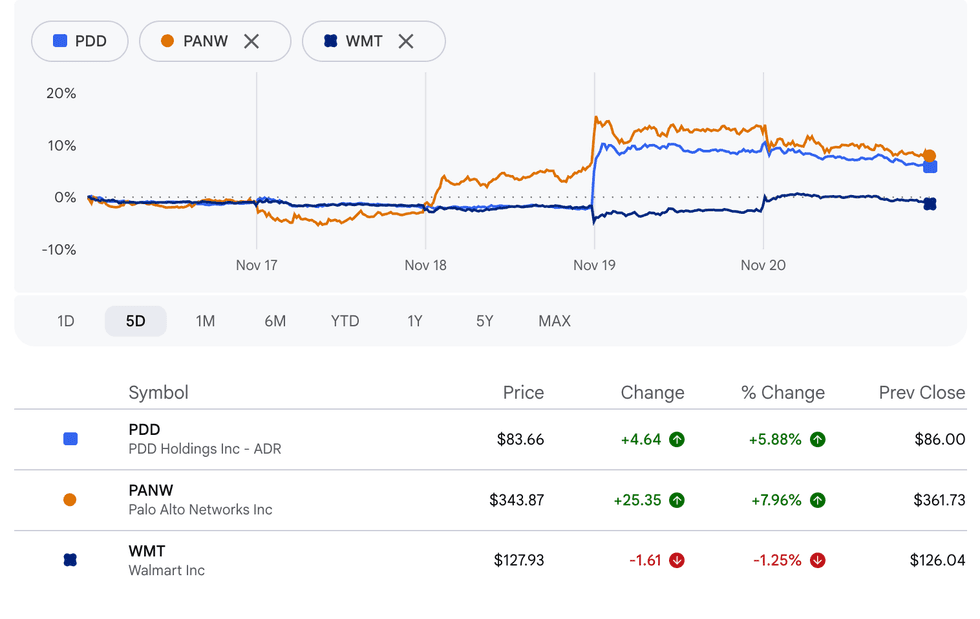
PDD Holdings, Palo Alto Networks and Walmart performance, November 16 to 20, 2026.
Chart via Google Finance.
Tech ETF performance
Tech exchange-traded funds (ETFs) track baskets of major tech stocks, meaning their performance helps investors gauge the overall performance of the niches they cover.
This week, the iShares Semiconductor ETF (NASDAQ:SOXX) finished the week 19.52 percent lower, according to TradingView data, while the Invesco PHLX Semiconductor ETF (NASDAQ:SOXQ) gave back 19.35 percent.
The VanEck Semiconductor ETF (NASDAQ:SMH) gave back 20.01 percent.
For software funds, the State Street SPDR S&P Software & Services ETF (ARCA:XSW) lost 8.28 percent, the First Trust Cloud Computing ETF (NASDAQ:SKYY) declined by 7.3 percent and the iShares AI Innovation and Tech Active ETF (ARCA:BAI) gave back 18.43 percent.
Tech news to watch next week
In a Thanksgiving-shortened trading week, tech investors will be zeroing in on enterprise AI hardware and software earnings alongside a pivotal inflation print. November 24 will bring a heavy post-market slate led by Dell Technologies (NYSE:DELL), HP and Workday (NASDAQ:WDAY). Market watchers will be looking for AI server shipment momentum and margin durability at Dell and HP, and enterprise software spending at Workday.
October personal consumption expenditures (PCE) price index data for the US will come out on November 25, alongside the second estimate for Q3 GDP. With core PCE forecast at around 3.2 to 3.3 percent year-on-year, the reading will heavily influence rate expectations heading into the Fed’s December 9 policy decision.
Don't forget to follow us @INN_Technology for real-time news updates!
Securities Disclosure: I, Meagen Seatter, own shares of Archer Aviation.
Editorial Disclosure: The Investing News Network does not guarantee the accuracy or thoroughness of the information reported in the interviews it conducts. The opinions expressed in these interviews do not reflect the opinions of the Investing News Network and do not constitute investment advice. All readers are encouraged to perform their own due diligence.
https://x.com/INN_Technology
https://www.linkedin.com/in/meagen-seatter-23675b193/
mseatter@investingnews.com

Learn about our editorial policies.