The Conversation (0)
Apr. 22, 2026 01:10PM PST
Love You Stock / Adobe Stock
Precious metals prices are trading sideways as the US and Iran find themselves in a high-stakes stalemate and the US Federal Reserve chair confirmation hearings strike a hawkish tone.
The price action for the precious metals complex just can’t seem to shake out of the grip of Middle East conflict and the unclear direction on interest rates from the Fed.
However, investor sentiment is clearly on the side of the bulls as prices for gold, silver, platinum and palladium remain resilient in the face of such global-wide market uncertainty.
Let’s take a look at how precious metals prices have performed over the past week.
Gold price news
Gold has experienced significant volatility between April 16 and Tuesday (April 21), primarily reacting to high-stakes negotiations over the Middle East war and shifting US monetary policy expectations.
After testing multi-week highs near US$4,850, the gold price has recently pulled back toward the US$4,720 to US$4,760 per ounce range. Compared to the same time last week, the yellow metal lost more than 1.15 percent, and remained down about 15 percent from the US$5,589.38 reached on January 28.
On April 16, gold was trading at an intraday high of US$4,823.65 in the morning trade, before a lower close at US$4,790.84. While resilient US jobs and manufacturing data helped strengthen the US dollar and pressured gold, the price of the yellow metal held steady above the key US$4,800 threshold as mediators facilitated US-Iran peace talks.
Gold made gains in the morning trade on April 17, tracking closer to the US$4,900 level to an intraday high of US$4,883.30 in the morning. However, by the afternoon it had slipped to close at US$4,831.91.
On Monday (April 20), the gold price had pulled back slightly and were range bound in the low US$4,800 level with a close of US$4,820.58. Reports that the US Navy had seized an Iranian cargo ship in the Strait of Hormuz followed by retaliatory threats out of Iran caused a surge in oil prices. Subsequently, rising US treasury yields and a strengthening US dollar increased the opportunity cost of holding non-yielding gold.
The following day, gold’s earlier gains were eroded as the deadline for peace negotiations approached without a commitment from Iran to come to the table. US President Donald Trump signaled potential military escalation if a "great deal" was not reached in Pakistan. At the same, the confirmation hearing for Fed Chair nominee Kevin Warsh signaled a hawkish shift toward fighting persistent inflation with interest rates staying higher for longer.
Gold slid below the US$4,700 level in the midday trade before closing at US$4,720.56.
For Wednesday (April 22), gold remained well above the US$4,700 mark after US President Donald Trump announced an indefinite extension of the US-Iran ceasefire. Despite the seeming easing of tensions, any potential gains were tempered when Iran reaffirmed it has no intention of reopening the Strait of Hormuz.
By 11:00 a.m. PDT on Wednesday, gold was holding up at US$4,737.26.
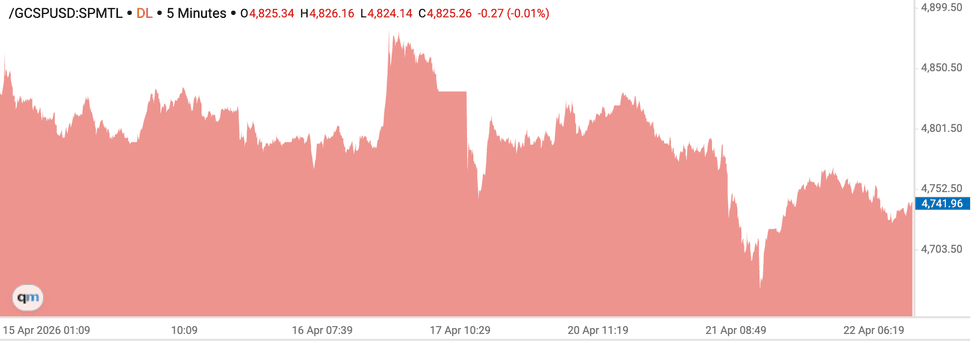
Gold price chart, April 15 to April 22 2026.
Chart via the Investing News Network.
Here are the primary drivers for gold this past week:
- The Middle East conflict pitting US and Israel against Iran and its proxies in Lebanon continues to block the flow of global oil through the Strait of Hormuz. The up-and-down volatility of the ongoing peace negotiations is reflected in the see-saw of the gold price.
- Investors are closely monitoring the Senate confirmation hearing for Warsh. His dedication to battling persistent inflation has bolstered US treasury yields, which typically pressure gold.
- Strong US economic data, including a drop in jobless claims for the second week of April, rising retail sales for March and a bigger than expected surge in the Philadelphia Fed Manufacturing Index all helped to reduce safe-haven demand for gold.
These drivers are causing gold to plateau after a 40 percent surge experienced between October 2025 and March 2026. However, this impact is only a temporary pause in an otherwise bullish market for the yellow metal, according to Eugenia Mykuliak, founder and executive director of B2PRIME Group.
“By the end of the day, gold is being traded between two forces. On the one hand are real rates and the dollar which are limiting an increase at present. On the other is relentless official-sector demand and a fragile geopolitical environment, which restrains downside. The outcome is a plateau and not a collapse,” Mykuliak stated in a market commentary shared with the Investing News Network (INN).
“Over the next few months, a broad and bouncing range seems more realistic than an unambiguously oriented direction, and a new advancement will probably require a distinct change in the rates cycle or a more severe macro shock,” she said.
For more insight into what’s moving the gold market, check out INN's recent interview with Don Durrett.
In other gold market news, data from the World Gold Council shows gold mine supply growth is lagging demand. Read INN’s article Has Gold Production Peaked? to find out what it means for the market’s fundamentals.
In gold-mining news, Agnico Eagle Mines (TSX:AEM,NYSE:AEM) plans to acquire Rupert Resources (TSXV:RUP,OTCQX:RUPRF), Aurion Resources (TSXV:AU,OTCQX:AIRRF) and a B2Gold (TSX:BTO,NYSEAMERICAN:BTG) joint venture stake as it looks to develop a massive gold hub in Northern Finland’s gold belt.
Silver price news
The silver price is down 1.5 percent over the last week, and has declined nearly 36 percent from its all-time high of US$121.62 per ounce, which it reached on January 29, 2026.
The precious metal has a strong floor of support from a persistent supply deficit and robust industrial demand, especially out of the solar sector. The price of the white metal managed to once again break above the psychological important US$80 level.
However, a strengthening US dollar and shifting geopolitical headlines in the Middle East have sparked another noisy week of volatility for silver. After hitting an intraday high of US$79.72 in the morning on April 16, the price of silver slid to a low of US$78.20 later in the session before a close of US$78.43.
On April 17, silver soared to its highest point over the seven day period to US$83 in the morning trade. The metal hit the five-week high on the temporary easing of Middle East tensions and boosted confidence on eventual interest rate cuts if oil prices come down. The white metal later retreated to close at US$80.82.
Monday’s trading session brought further declines. After a high of US$80.45 in the morning, silver slipped to close out the trading day at US$79.72. The US Navy's seizure of an Iranian vessel in the Strait of Hormuz sent silver seesawing once again as investors sought liquidity over hedges.
By the late morning on Tuesday, silver had dipped down to an intraday low of US$76.17 before a close of US$76.69. The metal hit its lowest point in several weeks as hawkish sentiment out of Warsh’s confirmation hearing strengthened the greenback.
On Wednesday, silver reached an intraday high of US$78.40 in the morning session, but by 11:00 a.m. PDT had pulled back slightly to US$77.88.
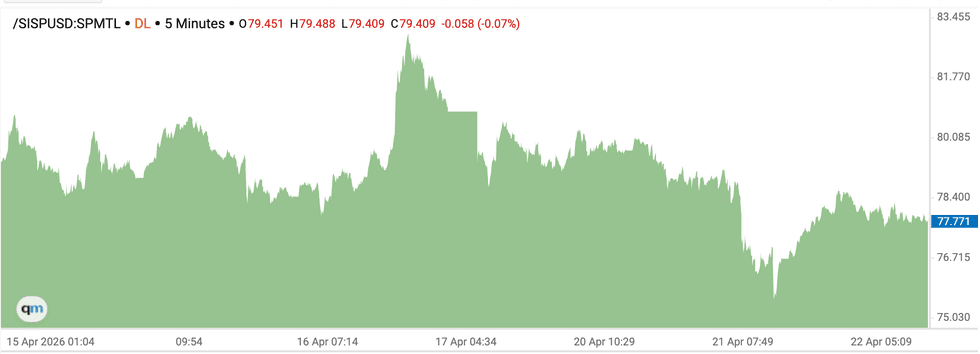
Silver price chart, April 15 to April 22 2026.
Chart via the Investing News Network.
Silver is in its sixth consecutive year of structural supply deficits.
Despite high prices for the metal, industrial demand from sectors such as solar, electric vehicles, and artificial intelligence infrastructure remains robust, providing a strong floor during geopolitical swings.
“From a fundamental standpoint, it is important to recognize that silver continues to be supported by strong industrial demand, particularly amid the ongoing global transition toward clean energy and related technologies,” Simon-Peter Massabni, head of business development at XS.com, said in a market commentary shared with INN.
“In my opinion, this factor provides a solid foundation for prices over the medium term and limits the likelihood of a sharp decline, even amid short-term volatility,” Massabni added. “Therefore, any pullback toward $75 or even $72.50, if it occurs, could be viewed as a repositioning opportunity rather than the beginning of a long-term bearish trend. This outlook reinforces my conviction that the market still holds an underlying bullish bias.”
Want more information about the impact of the supply deficit on the silver market, check out INN’s article Silver Institute: Sustained Supply Deficit Exposes Market to Squeezes.
In silver-mining news, Kuya Silver (CSE:KUYA,OTCQB:KUYAF) reported record quarterly silver production at the Bethania project in Peru, and said it's on track to achieve a 350 metric ton per day production rate by the end of the year.
Platinum price news
Platinum was only down by nearly 1.3 percent during the period. The metal has battled through a tug-of-war between structural supply deficits and immediate geopolitical volatility this past week.
The platinum price was trading at an intraday high of US$2,167.40 in the early morning trade on April 16, but had slipped by US$60 by the afternoon to US$2,097.40 per ounce by closing.
On the morning of April 17, the price of the precious metal reached a four-week high of US$2,170 before closing at US$2,114.40. Strong industrial demand and a positive manufacturing outlook supported the metal. Investors also eyed accelerated Eurozone inflation and hopes for a diplomatic resolution in the Middle East.
The price of platinum slipped in the morning trade on Monday to an intraday low of US$2,064.30, but later managed to close up at US$2,096.90. The following day, platinum picked up in the morning to a high of US$2,104. However, later in the afternoon trade the metal lost ground falling to a low of US$2,019.80 before a close of US$2,045.50.
Platinum seemingly lost its hold on the US$2,100 level on hostilities in the Strait of Hormuz once again flaring up and the hawkish sentiment out of the Fed chair nominee hearing which impacted the broader precious metals complex.
On Wednesday, platinum once again tested the US$2,100 level in the morning with an intraday high of US$2,106.70 before falling back to US$2,093.60 by 11:00 a.m. PDT.
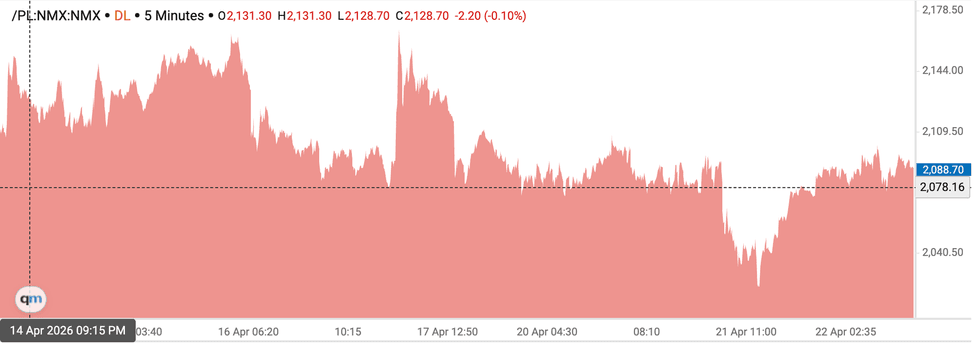
Platinum price chart, April 14 to April 22 2026.
Chart via the Investing News Network.
Platinum continues to benefit from a floor of support given the structural tightness in South African and Russian mines, which together account for more than 80 to 85 percent of global supply. The World Platinum Investment Council (WPIC) is forecasting a fourth consecutive annual deficit for 2026 at a projected 240,000 ounces.
The trend toward electrification in the auto industry may have slowed, but it's still expected to erode platinum demand, especially as catalytic converter manufacturers shift back to more cost-effective palladium.
Palladium price news
Palladium prices lost 0.55 percent over the weekly period, performing almost as well as silver as both the metals are experiencing a floor of support from healthy industrial demand. On April 16, the palladium price was trading at US$1,604.50 per ounce in the early morning before sliding to close the day at US$1,562.
While the price of palladium had slid even lower in early morning trading on April 17 to an intraday low of US$1,548.50, the metal’s value quickly shot up to US$1,615. However, it later closed out the day at US$1,576. Palladium's losses were tempered by its industrial role in a steady manufacturing sector.
The palladium price remained rangebound on Monday as traders adopted a "wait-and-see" stance ahead of Warsh's testimony and hopes of a firmer peace deal in the Middle East.
The metal started as low as US$1,541 in the early morning session and closed the day at US$1,573.50.
Tuesday was a choppy trading day for palladium, which began the session up as high as US$1,585.50 before dipping to their lowest point this week at US$1,527 in the afternoon before ending the day at US$1,550.50.
The price of palladium hit a high of US$1,580 in the morning of Wednesday and was trading slightly lower at US$1,564 as of 11:00 a.m. PDT.
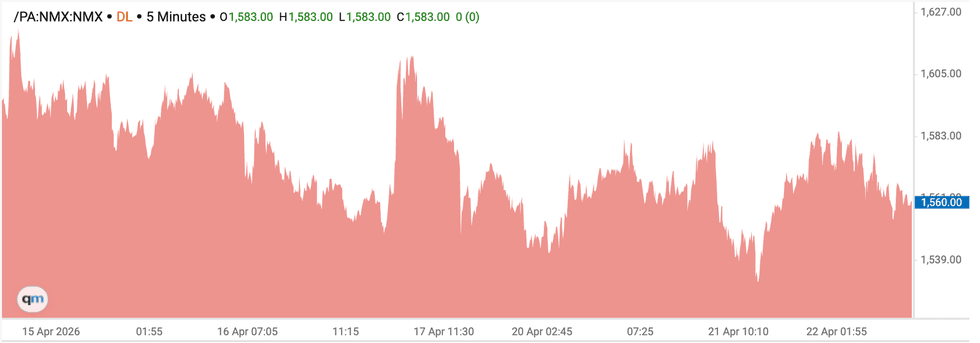
Palladium price chart, April 15 to April 22 2026.
Chart via the Investing News Network.
Palladium has experienced heightened volatility for the past few months, driven primarily by evolving geopolitical conflict in the Middle East and a shifting outlook on US monetary policy. However, palladium has managed to show some resiliency due to its distinct industrial demand and supply-side challenges.
The automotive sector accounts for a near majority of palladium demand as it is used in catalytic converters to reduce emissions from internal combustion engine vehicles.
Although the transition to battery electric vehicles (BEVs) has weighed on palladium demand, the slowdown in consumer demand for BEVs in lieu of hybrid vehicles has helped buoy the palladium price. Additionally, demand from the hydrogen technology sector represents a new avenue of growth for the market.
On the supply side, the market remains highly vulnerable to output disruption in South Africa and export constraints out of Russia. The World Platinum Investment Council is forecasting that palladium mine supply to fall by 3 percent in 2026. However, secondary supply is projected to increase by 10 percent as recycling activity recovers.
Don't forget to follow us @INN_Resource for real-time updates!
Securities Disclosure: I, Melissa Pistilli, hold no direct investment interest in any company mentioned in this article.
Editorial Disclosure: The Investing News Network does not guarantee the accuracy or thoroughness of the information reported in the interviews it conducts. The opinions expressed in these interviews do not reflect the opinions of the Investing News Network and do not constitute investment advice. All readers are encouraged to perform their own due diligence.
From Your Site Articles
- Gold Price Update: Q1 2026 in Review ›
- Silver Price Update: Q1 2026 in Review ›
- Platinum Price Forecast: Top Trends for Platinum in 2026 ›
- Palladium Price Forecast: Top Trends for Palladium in 2026 ›
- Gold’s Next Test: WGC Lists 3 Potential Price Scenarios in 2026 Outlook ›
Related Articles Around the Web
https://x.com/INN_Resource
https://www.linkedin.com/in/melissa-pistilli-865271a9/
mpistilli@investingnews.com

Featured Precious Metals Investing Stocks





Learn about our editorial policies.