
The Conversation (0)
Gold mine production is growing more slowly than demand, requiring greater emphasis on recycling. How sustainable is this situation?
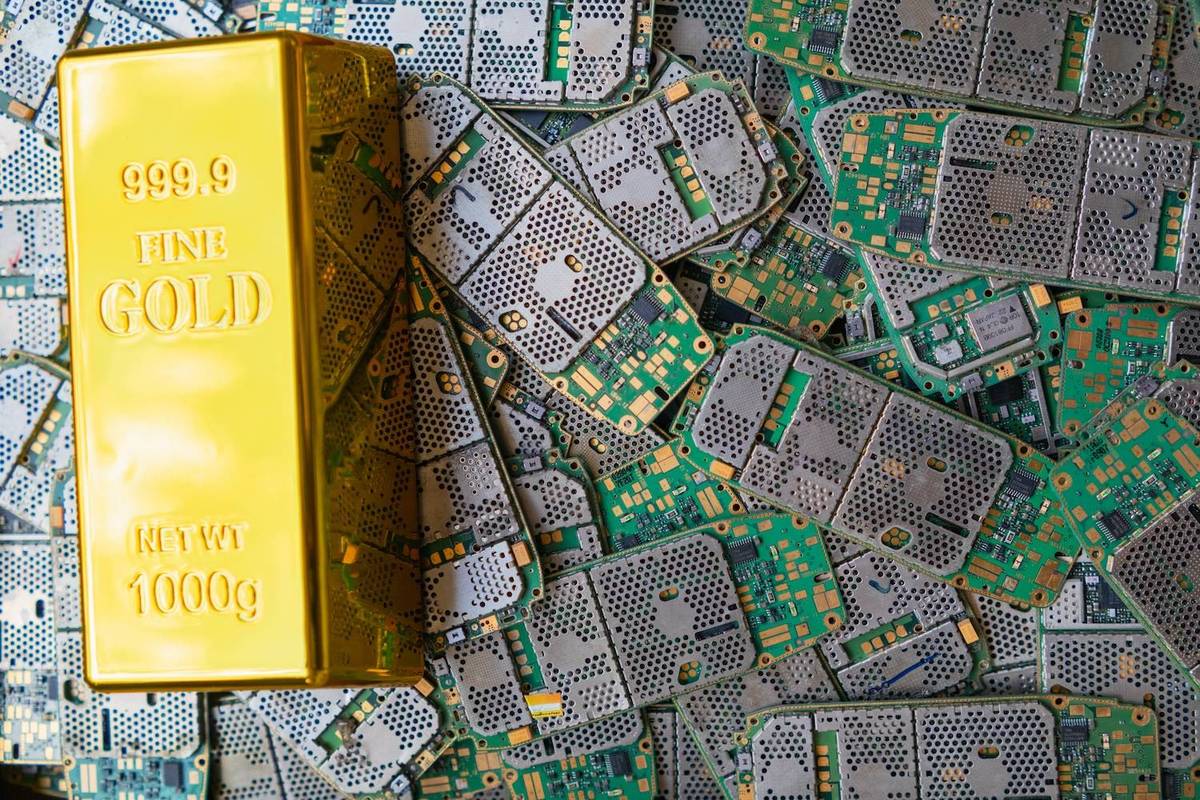
thatinchan / Adobe Stock
Gold has soared in recent years, climbing from around US$1,300 per ounce in 2016 to over US$5,500 in 2026.
Its impressive price rise is due to a wide variety factors, including central banks adding to their reserves because of gold's appeal as a monetary asset, and retail investors seeking its safe-haven status.
As an investment, gold is inflation-proof. It’s been a monetary instrument and a store of value for thousands of years. Now a new cycle of geopolitical and economic instability is bringing fresh attention to the metal, along with a generation of investors that has been chasing the peaks and valleys of meme stocks and Bitcoin.
With these demand drivers colliding, what is the impact for gold’s supply chain?
Gold mine output lags demand
According to data from the World Gold Council, mining supply over the last 10 years has been relatively steady.
In 2016, gold mine output was 3,516.2 metric tons (MT); after hedging, total mine supply came in at 3,553.8 MT. By 2025, gold production had risen to 3,671.6 MT, but after de-hedging, total mine supply fell to 3,598 MT.
Demand has increased more substantially, rising from 4,786 MT in 2016 to 5,002.3 MT in 2025. The market balance was largely maintained through recycled gold, which increased from 1,232.1 MT in 2016 to 1,404.3 MT in 2025.
During that 10 year period, few events carried the same impact on supply as the COVID-19 pandemic.
It had wide-reaching effects on global supply chains for many goods, including gold, and its inflationary fallout raised producers' costs due to rising wages, higher prices and temporary mine shutdowns.
Although COVID-19 was an important contributing factor to costs, it was far from the only one.
Many older mines are becoming more expensive because of the need to process lower-grade ore or mine deposits at greater depth, while development projects are taking longer due to increasingly complex permitting.
During the 2016 to 2020 period, World Gold Council data shows that average all-in sustaining costs for gold-mining companies were relatively stable at just under US$1,000 per ounce.
In early 2021, as the effects of the pandemic rippled through the market, those costs crept over the US$1,000 threshold and have steadily risen ever since, reaching over US$1,500 in 2025.
While the price of gold rose to around US$2,000 in late 2020, it failed to sustain the momentum producers would need to increase capital expenditures on mergers and acquisitions, exploration or development activity.
In an email to the Investing News Network, Joe Cavatoni, senior market strategist, Americas, at the World Gold Council, said this isn’t unexpected: “Mining supply is structurally slower to respond to price movements. New projects can take a decade or more to come online, so they aren’t necessarily gold price sensitive."
Has gold mine output plateaued?
Not necessarily.
Since the gold price began rising in 2025, margins have improved and money spent in the sector has increased.
According to S&P Global, the number of deals decreased in 2024, while deal value reached a record high.
Transactions included Coeur Mining's (TSX:CDE,NYSE:CDE) US$6.88 billion merger with New Gold, and Gold Fields' (NYSE:GFI) US$3.69 billion takeover of Gold Road Resources.
Overall, more than 162.1 million ounces of reserves and resources changed hands in 2025.
Likewise, financing within the sector experienced a significant resurgence in 2025.
According to a report by Keystone Financial, intermediate and junior companies had raised US12.8 billion by the end of October 2025, outpacing the 2024 full-year total of US$10.3 billion. Even though this doesn’t indicate an immediate increase in annual gold production, it can signal an improvement in the industry's overall health.
As money flows into the sector, it’s going into the ground.
S&P states that this past January was the strongest for drilling metrics since 2023. The number of gold projects reporting results rose to 179, a 15 percent increase over the same period in 2025.
“Mine supply has grown only modestly and hasn’t been a meaningful driver of recent price increases. Gold’s price strength over the past year has been driven far more by demand factors than by constraints or expansions in mining output,” Cavatoni noted.
The role of recycling in gold supply
The biggest challenge facing the gold sector is declining grades and a lack of new projects entering the development pipeline — the widespread belief is that the easy deposits have already been found.
Citing the US Geological Survey, the Oregon Group notes that there are roughly 54,000 MT of identified gold reserves. Its expectation is that no new significant reserves will be found, and that Earth’s gold could be depleted by 2050.
However, the gold is still out there. In 2024, geologists discovered a massive new deposit in China. It's estimated to contain upward of 1,100 MT of gold, which at US$4,500 would be worth over US$150 billion.
The caveat is that it's located at a depth of 9,800 feet below the surface, or about 3 kilometers.
For context, the deepest mine in operation is Harmony Gold's (NYSE:HMY,JSE:HAR) Mponeng gold mine in South Africa, which operates at a depth of about 4 kilometers. Underground operations at those depths face more significant challenges than open-pit or shallower mines. Workers need to deal with high temperatures and safety concerns. As a result, the mine's all-in sustaining costs are around US$1,800 per ounce, higher than the global average.
With high costs, it could take time before deep mines become financially viable to develop. On top of that, in general it can take the better part of a decade or more before a mine can begin production.
So with few new mines coming online, the sector needs to rely on recycled gold to maintain market balance.
“Recycling is the most price-responsive part of gold supply, so it naturally increases when prices rise, helping the market stay balanced,” Cavatoni said. However, he also noted that the situation far from perfect, pointing out that the majority of recycled material comes from jewelry or investors cashing out physical gold holdings, and that it doesn’t necessarily translate into unlimited or permanent increases in gold reaching the market.
“If demand remains structurally strong, recycling can help smooth short-term pressures, but it can’t fully replace the need for long-term investment in mine supply,” Cavatoni added.
Investor takeaway
As Cavatoni noted, gold's high price isn't due to a low supply environment.
Recycling has helped close the gap between mine supply and demand. However, it may not be a sustainable solution as more investors seek to shield themselves from uncertainty in global financial markets.
While equities have been slow to react, major miners have posted considerable gains over the past year. Barrick Mining (TSX:ABX,NYSE:B) and Newmont (NYSE:NEM,ASX:NEM) have seen their share prices double over the past year, while Agnico Eagle Mines (TSX:AEM,NYSE:AEM) has gained nearly 70 percent.
Money flowing into the sector should also trickle down to juniors as majors look to fill their development pipelines with new projects, which, in turn, should spur new exploration activity. This could present new opportunities for gold investors looking to capitalize on the high gold price without investing in physical gold.
Don't forget to follow us @INN_Resource for real-time updates!
Securities Disclosure: I, Dean Belder, hold no direct investment interest in any company mentioned in this article.
Editorial Disclosure: The Investing News Network does not guarantee the accuracy or thoroughness of the information reported in the interviews it conducts. The opinions expressed in these interviews do not reflect the opinions of the Investing News Network and do not constitute investment advice. All readers are encouraged to perform their own due diligence.
https://x.com/INN_Resource
https://www.linkedin.com/in/deanbelder
dbelder@investingnews.com
Dean has been writing in one form or another since penning stage plays in his youth. He is a graduate of both Emily Carr University and Simon Fraser University, with a BFA in photography and a BA in communications.
As a writer, Dean has traveled throughout BC and the Pacific Northwest covering cultural events, interviewing small business owners and working alongside fellow writers and photographers from publications like Rolling Stone Magazine, Spin and the Georgia Straight.
Dean has a keen interest in investing, and enjoys learning about the mining industry and better understanding the technical aspects of trading. In his spare time, Dean is an avid home chef, ponders the space-time continuum and makes his own cider. On weekends he can be found cycling the Seawall, exploring farmers markets or sampling the city’s local craft breweries.
As a writer, Dean has traveled throughout BC and the Pacific Northwest covering cultural events, interviewing small business owners and working alongside fellow writers and photographers from publications like Rolling Stone Magazine, Spin and the Georgia Straight.
Dean has a keen interest in investing, and enjoys learning about the mining industry and better understanding the technical aspects of trading. In his spare time, Dean is an avid home chef, ponders the space-time continuum and makes his own cider. On weekends he can be found cycling the Seawall, exploring farmers markets or sampling the city’s local craft breweries.
INN Article Notification
Latest News
Outlook Reports world
Featured Gold Investing Stocks



Browse Companies
MARKETS
COMMODITIES
CURRENCIES
Dean has been writing in one form or another since penning stage plays in his youth. He is a graduate of both Emily Carr University and Simon Fraser University, with a BFA in photography and a BA in communications.
As a writer, Dean has traveled throughout BC and the Pacific Northwest covering cultural events, interviewing small business owners and working alongside fellow writers and photographers from publications like Rolling Stone Magazine, Spin and the Georgia Straight.
Dean has a keen interest in investing, and enjoys learning about the mining industry and better understanding the technical aspects of trading. In his spare time, Dean is an avid home chef, ponders the space-time continuum and makes his own cider. On weekends he can be found cycling the Seawall, exploring farmers markets or sampling the city’s local craft breweries.
Learn about our editorial policies.