The Conversation (0)
May. 19, 2026 01:50PM PST
SimoneN / Shutterstock
Copper miners with productive assets have much to gain as supply and demand tighten and prices soar.
The price of copper reached new all-time highs in 2026 on both the COMEX in the United States and the London Metals Exchange (LME) in the United Kingdom, maintaining copper's momentum in 2025.
They first set record highs on January 29 of US$6.61 per pound on the COMEX and US$14,527.50 per metric ton on the LME. On May 13, the COMEX price surpassed its January peak, hitting a new all-time high of US$6.71.
Copper is one of the most important resources for the energy transition, but demand for the red metal is outpacing mining supply. While construction and electrical grids have long been major markets for copper, today the rise in demand for electric vehicles, EV charging infrastructure and energy storage applications are emerging drivers of copper consumption.
Another trend driving future copper demand is the rapid urbanization in the Global South, as rural populations migrate to cities, putting pressure on electricity grids.
Due to the challenges associated with finding, developing, permitting and mining copper deposits, the higher demand is being met by slow growth of new supply. Mines that are in operation tend to be quite large and operate for decades as copper producers concentrate on mine expansions and brownfield projects aimed at extending mine lifetimes.
Given those factors, investors interested in copper should keep an eye on the world’s top copper miners and their operations.
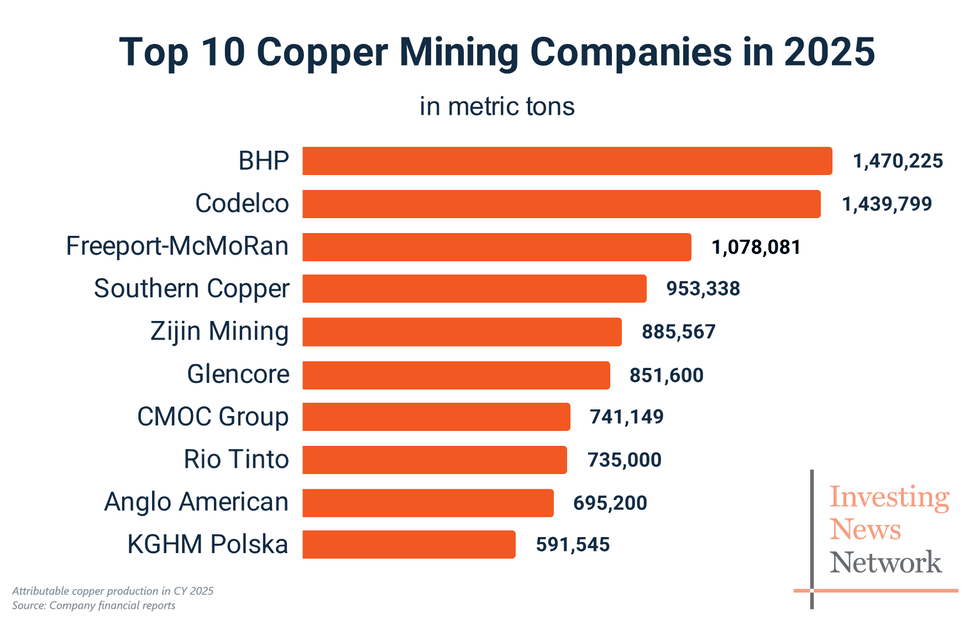
This list of the 10 largest copper-mining companies in the world is ranked by attributable copper production for 2025.
As companies' reporting methods for copper production differ, the Investing News Network has calculated attributable copper production for the companies below using figures from company reports in order to provide investors with the most accurate ranking of global copper production by company.
1. BHP (ASX:BHP,NYSE:BHP,LSE:BHP)
Copper production: 1.47 million metric tons
BHP is one of the world’s largest mining companies, and its global portfolio of assets includes significant copper mining operations in Chile, Australia and Peru.
According to the company’s quarterly operational review data, the mining giant’s attributable copper production totaled 1.47 million metric tons across the calendar year 2025.
Its most significant copper asset is Escondida, the world’s largest copper mine. BHP holds a 57.5 percent stake in the Chilean operation, which produced 1.31 million metric tons of copper in 2025, of which 751,525 was attributable to BHP. Its other Chilean copper operation is its wholly owned Pampa Norte mine, which produced 254,800 metric tons of copper in 2025.
BHP also owns the Olympic Dam polymetallic mine in South Australia, from which it produced 222,600 metric tons of copper last year. Not only is it the largest mine in Australia, Olympic Dam hosts one of the world’s largest copper deposits as well as the largest uranium deposit. In 2023, BHP expanded its portfolio in the state with its acquisition of OZ Minerals and its Prominent Hill and Carrapateena copper operations.
In January 2025, BHP formed a 50/50 joint venture company with Lundin Mining (TSX:LUN,OTCPL:LUNMF) to acquire Filo Mining and its Filo del Sol project in Argentina. The arrangement combines Filo del Sol with Lundin’s Josemaria project in the Vicuña mining district.
2. Codelco
Copper production: 1.44 million metric tons
The Chilean state-owned Codelco is the world’s second-largest copper mining company with copper production of 1.44 million metric tons in 2025, according to its 2025 annual report.
The company's highest copper-producing asset in 2025 was the El Teniente mine in Chile, producing 310,100 metric tons of copper last year. It is the world’s largest underground copper mine. Codelco also owns the Radomiro Tomic open-pit mine in Chile’s Antofagasta region, which produced 295,300 metric tons of copper.
Its Chuquicamata mine, which produced 265,800 metric tons, began transitioning from an open pit to an underground mine beginning in 2019. In its annual report, Codelco stated that Phase 1 had reached 90 percent completion. It added that feasibility studies were underway for expanding the current mine level, as were prefeasibility studies evaluating developing a potential deeper mine level.
The company’s other significant Chilean mines include Gabriela Mistral, Ministro Hales and Andina.
3. Freeport-McMoRan (NYSE:FCX)
Copper production: 1.08 million metric tons
Freeport-McMoRan is consistently ranked among the world’s top copper producers, and its share of copper production from its wide array of wholly owned and joint venture mines totaled 1.08 million metric tons of copper in 2025.
The largest contributor to its output is the Grasberg copper-gold mine in Indonesia. The mine itself is a joint venture between Freeport and state-owned Indonesia Asahan Aluminum, with the entities holding interests of 48.76 percent and 51.24 percent respectively. According to the company’s 2025 annual report, the mine produced 1.02 billion pounds, or 460,395 metric tons, with 224,489 metric tons attributable to Freeport-McMoRan.
Grasberg has transitioned from open pit to underground operations, and expansion work continues at the site. Output from the mine was significantly impacted due to an incident in September 2025, when the main Grasberg Block Cave suffered an ingress of wet material that killed seven workers and forced the closure of the operation. Unaffected portions of Grasberg opened by the end of 2025, and the Grasberg Block Cave is expected to see a phased restart beginning in the second quarter of 2026, according to the annual report.
Additionally, Freeport holds a 55 percent stake in the Cerro Verde copper-molybdenum complex in Peru, which produced 3191,450 metric tons of copper last year, with 215,610 attributable to the company. The mine is expected to be in operation until 2052.
Its largest US based operation is its 72 percent owned Morenci mine in Arizona, which contributed 225,435 metric tons to Freeport in 2025. It also owns the Safford and Sierrita mines in the same state.
4. Southern Copper (NYSE:SCCO)
Copper production: 953,337 metric tons
Southern Copper recorded 953,337 metric tons of total copper production for 2025. The company operates major copper mines in Peru and Mexico and has exploration projects in Argentina, Chile, Ecuador, Mexico and Peru.
Southern Copper is a majority-owned, indirect subsidiary of Grupo Mexico (OTCPK:GMBXF), and holds a 99.29 and 99.998 percent interest in its Peruvian and Mexican assets, respectively.
Its largest copper-producing asset is the Buenavista mine in Northern Mexico, which sits atop one of the world’s largest porphyry copper deposits. According to Southern Copper’s 2025 report, the mine produced 322,706 metric tons with an additional 91,800 metric tons of mined production attributed to its solvent extraction and electrowinning (SX-EW) plant.
Its other copper operations include the Toquepala and Cuajone mines in Peru and the La Caridad mine in Mexico. Toquepala produced 223,272 metric tons of attributable copper last year.
5. Zijin Mining Group (HKEX:2899,SHA:601899,OTCPL:ZIJMF)
Copper production: 885,567 metric tons
Zijin Mining is one of the world’s largest mining companies, with a large global portfolio of operations. In 2025, its copper mining division produced 885,567 metric tons attributable to the company from mines in countries such as the Democratic Republic of Congo (DRC), China, Serbia and Eritrea.
Zijin’s largest asset is its Kamoa-Kakula joint venture in the DRC. Zijin and Ivanhoe Mines (TSX:IVN,OTCQX:IVPAF) each own a 39.6 percent stake in the operation with the DRC owning 20 percent and Crystal River owning 0.8 percent. Kamoa-Kakula is one of the largest copper operations in the world, producing 435,815 metric tons in 2025, with Zijin's share accounting for 172,583 metric tons of Zijin’s copper production.
This was nearly matched by Zijin's production from the mines in its wholly owned, vertically integrated Serbian Zijin Copper business, which combined for 172,307 metric tons last year.
The company also owns a 58 percent stake in the Julong copper mine in Tibet. It’s one of the biggest copper mines in China, and hosts reserves of more than 25 million metric tons of copper. In 2025, Zijin’s share of production was 107,801 metric tons.
6. Glencore (LSE:GLEN,OTCPL:GLCNF)
Copper production: 851,600 metric tons
Mining major Glencore's copper production totaled 851,600 metric tons in 2025 from its operations in countries such as Peru, Chile and Australia.
According to the company’s 2025 production report, its copper production dipped from 951,600 million metric tons in 2024 due to mine sequencing affecting feedstock at its Antapaccay, Collahuasi and Antamina mines and the mid-year closure of the MICO mine at Mount Isa.
Located along Chile’s coast, Collahuasi is the company’s largest operation, a 44/44/12 joint operation between Glencore, Anglo American (LSE:AAL,OTCQX:NGLOY) and Japan’s Mitsui & Co. (TSE:8031,OTCPL:MITSF). The mine produced 403,863 metric tons of copper in 2025 with 177,700 metric tons attributed to Glencore.
The partners are working to build a large-scale desalination plant designed to help overcome water shortage issues. In Glencore’s annual report, it indicated that water restrictions that impacted production at Collahuasi have eased since the staged commissioning started, with H2 production increasing by 11,000 metric tons over H1.
Other significant copper-producing assets in the company’s portfolio include the 34 percent owned Antamina and wholly owned Antapaccay operations in Peru and its wholly owned Katanga Complex in the DRC.
7. CMOC Group (OTCPL:CMCLF,HKEX:3993)
Copper production: 741,149 metric tons
CMOC Group produced approximately 741,149 metric tons of attributable copper in 2025 from its joint venture copper-cobalt mines in the Democratic Republic of the Congo.
CMOC is a relatively recent addition to the top 10 copper companies after its copper production jumped significantly in 2024. Its 2025 production marks a 14 percent increase over 650,161 metric tons produced in 2024 and an 88 percent increase from 394,000 metric tons in 2023.
The majority of CMOC’s copper production comes from its Tenke Fungurume copper-cobalt mine, an 80/20 joint venture with the state-owned mining firm Gecamines. While it didn't provide mine-specific production data, according to CMOC's 2025 annual report, Tenke Fungurume is one of the world's top five copper mines.
Its other DRC mine is Kisanfu, a 71/24/5 joint venture with Chinese battery manufacturer Contemporary Amperex Technology (SZSE:300750) and the DRC government. A Phase 2 expansion project for Kisanfu is expected to begin production in 2027 and add about 100,000 metric tons of copper per year once it reaches full production.
For 2026, CMOC is forecasting another increase in copper production, setting guidance between 760,000 and 820,000 metric tons.
8. Rio Tinto (ASX:RIO,NYSE:RIO,LSE:RIO)
Copper production: 735,000 metric tons
In 2025, Rio Tinto reported attributable copper production of 735,000 metric tons from three mines, a substantial increase from the 624,000 metric tons it produced in 2024.
Much of the increase came from the Oyu Tolgoi mine in Mongolia as it began to ramp up the underground expansion of the mine. Rio Tinto owns a 66 percent stake in the Oyu Tolgoi operation, which produced 335,000 metric tons in 2025, with 228,000 metric tons attributable to Rio Tinto.
The company’s largest copper asset is its 30 percent stake in Escondida, which it owns alongside a consortium of international companies including majority owner BHP. The mine, one of the largest in the world, produced 1.27 million metric tons of copper in 2025, with Rio Tinto’s share coming in at 382,000 metric tons.
Its other operation is its wholly owned Bingham Canyon mine in Utah, United States. The mine has been in operation since 1906 and is one of the deepest open pit mines in the world at 1,210 meters. Over its lifetime, Bingham Canyon has produced 17 million metric tons of copper. In 2025, Bingham Canyon contributed 125,000 metric tons to Rio Tinto’s copper production.
9. Anglo American (LSE:AAL,OTCQX:NGLOY)
Copper production: 695,200 metric tons
In 2025, British miner Anglo American reported total copper production of 695,200 metric tons, a decrease from 772,700 metric tons in 2024. Its copper operations, located in Chile and Peru.
The company attributed the year-on-year decline to lower recovery and grades at its 44 percent owned Collahuasi operation in Chile, which produced 177,800 of attributable copper for Anglo American last year.
Anglo American also noted an impact from the planned closure of the smaller processing plant at Los Bronces in Chile in mid-2024, which was partially offset by higher ore grades and recoveries. The company's 50.1 percent share of production from the mine totaled 164,600 metric tons in 2025. It signed an agreement with Codelco in September 2025 to establish a joint mine plan for their neighboring Los Bronces and Andina assets.
Anglo also owns a 60 percent stake in the Quellaveco mine in Peru, with Mitsubishi (TSE:8058,OTCPL:MSBHF) owning the remaining 40 percent. The open pit mine started operating in 2022 and produced 310,200 metric tons of copper for Anglo American in 2025.
On September 9, Anglo American announced plans to combine with Canadian mining giant Teck Resources (TSX:TECK.A,TECK.B,NYSE:TECK) in a merger of equals to form Anglo Teck. The merged company would focus on critical minerals and be headquartered in Canada. Teck produced 395,772 metric tons of attributable copper last year, meaning Anglo Teck's combined production would make it a top five global copper producer.
10. KGHM Polska Miedz (FWB:KGHA.F)
Copper production: 591,545 metric tons
Poland’s KGHM Polska Miedz has operations in Europe, North America and South America, and says that it controls over 40 million metric tons of copper ore resources worldwide. In 2025, KGHM produced 591,545 metric tons of attributable copper.
KGHM’s largest operation is the Polkowice-Sieroszowice mine in Western Poland. The mine has been in operation since 1968 and in 2025 produced 202,100 metric tons of copper in ore.
Additionally, KGHM’s other Polish operations include the Rudna mine, which produced 177,900 metric tons of copper in ore last year, and the Lubin mine, which produced 72,400 metric tons.
Its largest operation outside of Poland is its 55 percent owned Sierra Gorda mine in Chile, a joint venture with South32 (ASX:S32,OTCPL:SOUHY). Sierra Gorda produced 157,900 metric tons copper in concentrate last year, with 86,845 metric tons attributable to KGHM. Its wholly owned Robinson mine in Nevada, US, added 49,300 metric tons to its annual production.
This is an updated version of an article originally published by the Investing News Network in 2016.
Don’t forget to follow us @INN_Resource for real-time news updates!
Securities Disclosure: I, Dean Belder, hold no direct investment interest in any company mentioned in this article.
https://x.com/INN_Resource
https://www.linkedin.com/in/deanbelder
dbelder@investingnews.com

Featured Copper Investing Stocks



Learn about our editorial policies.