The Conversation (3)
Jun. 26, 2026 02:00PM PST
|Fact CheckedThis article has been reviewed and updated according to INN's rigorous fact-checking process. Our staff editors verify all articles against information and data from primary sources, reputable publishers and experts.
Explore the week's best-performing Canadian mining stocks on the TSX, TSXV and CSE, and dive into the Canadian and US news affecting commodities prices and stock markets.
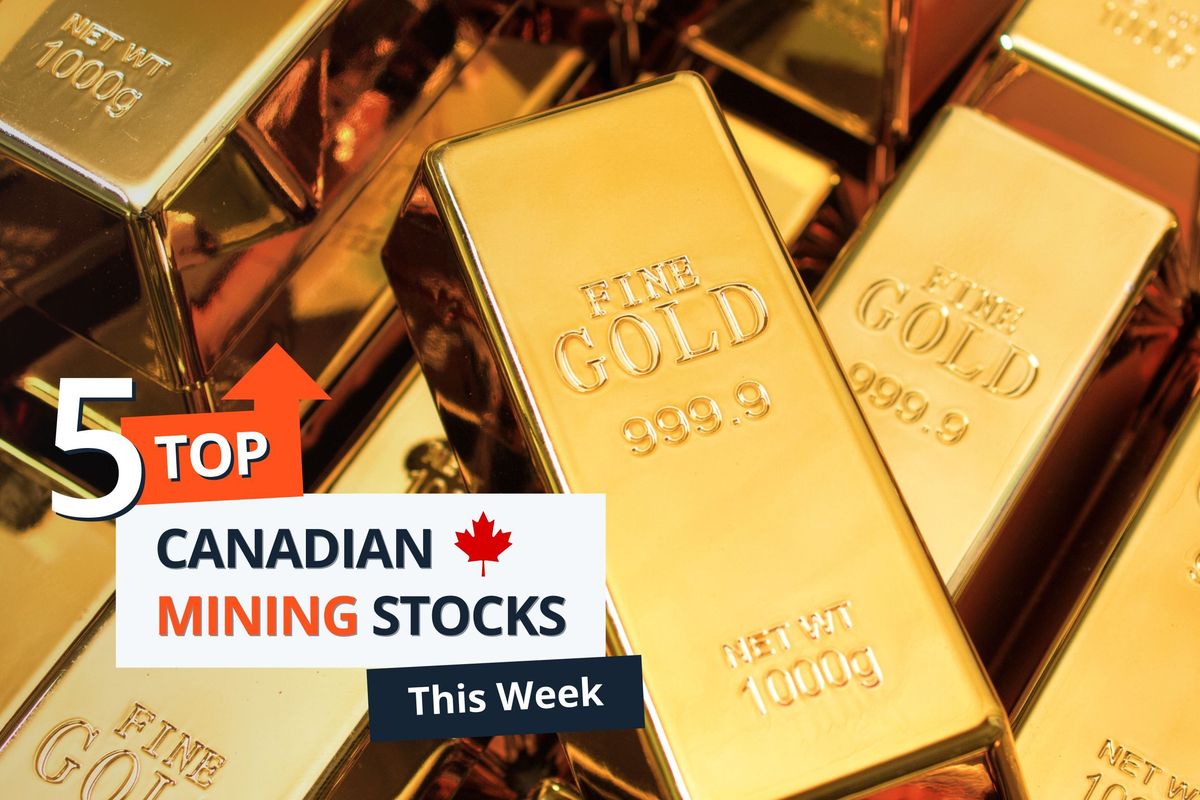
Welcome to the Investing News Network's weekly look at the best-performing Canadian mining stocks on the TSX, TSXV and CSE, starting with a round-up of Canadian news impacting the resource sector.
Statistics Canada released May’s consumer price index data on Monday (June 22). The data shows that inflation increased to 3.2 percent on an annualized basis, up from the 2.8 percent gain posted in April.
The agency attributes the surge to higher gasoline prices, which were up 33.2 percent compared to the same time last year, and 28.6 percent from April. The increased prices are a result of the US-led war against Iran, which has caused Iranian forces to close the Strait of Hormuz, a key shipping lane that accounts for 20 percent of global oil supply.
At the end of last week, the BC government approved the expansion of the Red Chris mine, a joint venture between Newmont (NYSE:NEM,ASX:NEM) and Imperial Metals (TSX:III,OTCPL:IPMLF). The upgraded operation is expected to increase ore processing by up to 15 million metric tons annually. The mine is currently operating as an open pit, but once the expansion is complete, it will transition to an underground block cave, extending the mine's life into the 2040s.
In its release, the government states that the project will create 1,800 construction jobs and 1,500 permanent jobs, and that it has received support from the local Tahltan Nation.
Canada Nickel Company (TSXV:CNC,OTCQX:CNIKF) announced on Wednesday (June 24) that it has appointed SB1 Markets as an advisor as it works to arrange a US$600 million debt facility. The company said it will apply investment tax credits generated from the construction of the Crawford nickel project toward raising the facility.
Canada Nickel is working to secure funding by the end of 2026, ahead of a final investment decision for Crawford.
For more on what’s moving markets this week, check out our top market news round-up.
Markets and commodities react
Canadian equity markets were mixed this week.
While the S&P/TSX Composite Index (INDEXTSI:OSPTX) gained a slight 0.24 percent over the week to close Friday (June 26) at 34,980, the S&P/TSX Venture Composite Index (INDEXTSI:JX) fell 6.84 percent to 895.84.
The CSE Composite Index (CSE:CSECOMP) slid 7.63 percent to 160.57.
In precious metals, the gold price lost 1.86 percent to close at US$4,067.51 per ounce on Friday at 4:00 p.m. EDT. The silver price fared worse, closing the week down 9.65 percent at US$58.59 per ounce on Friday.
In base metals, the Comex copper price recorded a 3.25 percent decrease this week to US$6.12 per pound.
The S&P Goldman Sachs Commodities Index (INDEXSP:SPGSCI) shed 4.77 percent to end Friday at 616.28.
Top Canadian mining stocks this week
How did mining stocks perform against this backdrop?
Take a look at this week’s five best-performing Canadian mining stocks below.
Stocks data for this article was retrieved at 3:00 p.m. EDT on Friday using TradingView's stock screener. Only companies trading on the TSX, TSXV and CSE with market caps greater than C$10 million are included. Mineral companies within the non-energy minerals, energy minerals, process industry and producer manufacturing sectors were considered.
1. Grande Portage Resources (TSXV:GPG)
Weekly gain: 32.08 percent
Market cap: C$64.58 million
Share price: C$0.35
Grande Portage Resources is a gold explorer advancing its New Amalga gold project in Alaska, US.
The property consists of 91 unpatented load claims in the Juneau gold belt and hosts six main composite vein-fault mineralized structures. A June 2024 resource for New Amalga reports an indicated resource of 1.44 million ounces of gold and 891,000 ounces of silver from 4.73 million metric tons grading 9.47 grams per metric ton (g/t) gold and 5.86 g/t silver. The site also contains an inferred resource of 515,700 ounces of gold and 390,600 ounces of silver within 1.81 million metric tons grading 8.85 g/t gold and 6.7 g/t silver.
On June 17, Grande Portage announced it launched its summer 2026 drill program at the property, including up to 4,300 meters of diamond drilling across up to 14 holes and the installation of downhole instrumentation.
Then, on Thursday (June 25), the company entered into a binding commercial offtake agreement with Ocean Partners UK, a metals trading company, for up to 100 percent of production for the first seven years in exchange for equity investment of C$6 million and a construction loan and overrun facility of US$25 million.
The company is developing New Amalga as an underground gold mine, and hopes to begin initial production in 2031.
2. New Break Resources (CSE:NBRK)
Weekly gain: 31.58 percent
Market cap: C$12.1 million
Share price: C$0.25
New Break Resources is a gold exploration company working to advance its Moray gold project within the Abitibi greenstone belt in Northeastern Ontario, Canada. Moray now spans a contiguous land package of 28,286 hectares following the May acquisition of five mineral claims covering 108 hectares, which attached two previously non-contiguous land packages, and the staking of an additional 36 covering 774 hectares.
The site is situated 32 kilometers northwest of Alamos Gold's (TSX:AGI,NYSE:AGI) Young-Davidson gold mine, which produced 153,000 ounces of gold in 2025. New Break has extensively explored the property in recent years and is planning to complete a total of 10,000 meters of drilling in 2026.
The most recent update from Moray drill program came on May 13, when New Break announced assay results from the first 22 holes, totaling 3,376 meters. One highlighted hole returned a grade of 3.46 g/t gold over 38.6 meters, which includes an intersection of 7.16 g/t over 12.1 meters.
The company has not released news in the last week.
3. Benz Mining (TSXV:BZ)
Weekly gain: 31.32 percent
Market cap: C$784.04 million
Share price: C$2.39
Benz Mining is a gold exploration company is focused on advancing projects in Western Australia.
In 2025, Benz acquired the Glenburgh and Mount Egerton gold projects in Western Australia from Spartan Resources (ASX:SPR). Since then the company has largely focused on exploring Glenburgh, which covers an area of 786 square kilometers and features 50 kilometers of strike. The site hosts six priority extension targets and 5 kilometers of exploration trend with over 100 parts per billion gold.
While Benz has not yet released an updated mineral resource estimate, Spartan’s November 2024 resource estimate for the property showed an indicated and inferred resource of 510,000 ounces of gold from 16.3 million metric tons of ore with an average grade of 1 gram per metric ton (g/t) gold. The property is also prospective for tungsten, with the company reporting on May 19 that it had encountered widespread mineralization across the property. Re-analysis of previous drill holes returned grades up to 0.24 percent tungsten oxide over 26 meters.
On June 17, Benz confirmed 95.5 percent gold extraction within 24 hours from samples collected from the core of the Icon deposit at Glenburgh, along with high extraction from the broader mineralized area.
According to the company, the results represent operational upside for future open-pit studies and show that the surrounding area could become mill feed rather than mining waste.
Then, on Wednesday, Benz released a maiden exploration target at Glenburgh, which it said defined the potential for a major gold system, with scale and geological architecture. Based on its exploration at the site, including drilling, Benz believes the exploration target could contain up to 12 million ounces of gold, with 6.1 million to 7.3 million ounces in the higher-grade core and the remainder in a lower-grade mineralized halo.
However, it was also careful to state that future studies would help determine how much of the lower-grade outer halo to include, given the cutoff grade and pit geometry. The company plans to advance definition drilling and testwork aimed at “converting a substantial portion of the target into a Mineral Resource in CY27.”
“Importantly, this is not a loose conceptual target — approximately 80% of the Exploration Target is drill-defined, assay-supported and wireframed, providing a strong technical foundation for resource conversion,” Benz CEO Mark Lynch-Staunton said in the company's press release.
4. Mackay Gold & Silver (TSXV:MACK)
Weekly gain: 29.53 percent
Market cap: C$238.29 million
Share price: C$3.18
Mackay Gold & Silver is focused on its flagship Comstock gold-silver project in Nevada, US. The property is situated within the historic Comstock mining district, an area that has hosted mining operations dating back more than 100 years. The Comstock lode itself produced over 8.3 million ounces of gold and 192 million ounces of silver.
On Monday, the company entered an agreement to acquire Comstock's (NYSEAMERICAN:LODE) Nevada mining assets in the Silver City lode. The transaction, if approved, will consolidate the Silver City lode with Mackay's Occidental-Brunswick and Comstock lodes, and increase Mackay’s holdings in the area by 70 percent to 4,343 hectares.
Under the terms of the deal, Comstock will receive cash consideration of US$20 million and 2 million shares of Mackay when it closes. Within 18 months the company will receive another US$7 million in a combination of cash and shares, along with other future considerations.
5. Monumental Energy (TSXV:MNRG)
Weekly gain: 28.57 percent
Market cap: C$10.04 million
Share price: C$0.09
Monumental Energy is an energy-focused exploration and development company partnered with New Zealand Energy (TSX:NZ,OTCPL:NZERF) to advance projects in New Zealand’s Taranaki Basin.
According to New Zealand’s most recent oil and gas reserves summary, it holds proven and probable reserves of 1.15 million barrels of oil equivalent across a range of producing, non-producing and undeveloped projects. The main producing projects are the Tariki 5 and Tariki 5A wells, which themselves are 50 percent joint ventures with L&M Energy.
It also owns the Waihapa production station, which hosts a 45 million cubic foot per day gas processing facility and capacity to produce 25,000 barrels of oil per day.
On Thursday, Monumental announced that a new chemical formula has been developed, increasing oil production and improving flow rates at operations in the Taranaki Basin. The expectation from the new chemical blend is that, in the short term, treatment costs will be optimized and performance will become more predictable.
FAQs for Canadian mining stocks
What is the difference between the TSX and TSXV?
The TSX, or Toronto Stock Exchange, is used by senior companies with larger market caps, and the TSXV, or TSX Venture Exchange, is used by smaller-cap companies. Companies listed on the TSXV can graduate to the senior exchange.
How many mining companies are listed on the TSX and TSXV?
As of March 2026, 906 mining companies and 71 oil and gas companies are listed on the TSXV, combining for 64 percent of the 1,524 total companies listed on the exchange.
The TSX is home to 176 mining companies and 50 oil and gas companies. The exchange has 2,149 companies listed on it in total.
Together, the TSX and TSXV host around 40 percent of the world’s public mining companies.
How much does it cost to list on the TSXV?
There are a variety of different fees that companies must pay to list on the TSXV, and according to the exchange, they can vary based on the transaction’s nature and complexity.
As of April 2026, the listing fee alone will most likely cost between C$10,000 to C$70,000, and accounting and auditing fees could rack up between C$25,000 and C$100,000. Legal fees are expected to be over C$75,000 and an underwriters’ commission may hit up to 12 percent.
The exchange lists a handful of other fees and expenses companies can expect, including but not limited to security commission and transfer agency fees, investor relations costs and director and officer liability insurance.
These are all just for the initial listing, of course. There are ongoing expenses once companies are trading, such as sustaining fees and additional listing fees, plus the costs associated with filing regular reports.
How do you trade on the TSXV?
Investors can trade on the TSXV the way they would trade stocks on any exchange. This means they can use a stock broker or an individual investment account to buy and sell shares of TSXV-listed companies during the exchange's trading hours.
Don't forget to follow us @INN_Resource for real-time updates!
Securities Disclosure: I, Dean Belder, hold no direct investment interest in any company mentioned in this article.
Editorial Disclosure: Copper Quest Exploration is a client of the Investing News Network. This article is not paid-for content.
https://x.com/INN_Resource
https://www.linkedin.com/in/deanbelder
dbelder@investingnews.com

Dean has been writing in one form or another since penning stage plays in his youth. He is a graduate of both Emily Carr University and Simon Fraser University, with a BFA in photography and a BA in communications.
As a writer, Dean has traveled throughout BC and the Pacific Northwest covering cultural events, interviewing small business owners and working alongside fellow writers and photographers from publications like Rolling Stone Magazine, Spin and the Georgia Straight.
Dean has a keen interest in investing, and enjoys learning about the mining industry and better understanding the technical aspects of trading. In his spare time, Dean is an avid home chef, ponders the space-time continuum and makes his own cider. On weekends he can be found cycling the Seawall, exploring farmers markets or sampling the city’s local craft breweries.
As a writer, Dean has traveled throughout BC and the Pacific Northwest covering cultural events, interviewing small business owners and working alongside fellow writers and photographers from publications like Rolling Stone Magazine, Spin and the Georgia Straight.
Dean has a keen interest in investing, and enjoys learning about the mining industry and better understanding the technical aspects of trading. In his spare time, Dean is an avid home chef, ponders the space-time continuum and makes his own cider. On weekends he can be found cycling the Seawall, exploring farmers markets or sampling the city’s local craft breweries.
INN Article Notification
Latest News
Outlook Reports world
Featured Gold Investing Stocks



Browse Companies
MARKETS
COMMODITIES
CURRENCIES
Dean has been writing in one form or another since penning stage plays in his youth. He is a graduate of both Emily Carr University and Simon Fraser University, with a BFA in photography and a BA in communications.
As a writer, Dean has traveled throughout BC and the Pacific Northwest covering cultural events, interviewing small business owners and working alongside fellow writers and photographers from publications like Rolling Stone Magazine, Spin and the Georgia Straight.
Dean has a keen interest in investing, and enjoys learning about the mining industry and better understanding the technical aspects of trading. In his spare time, Dean is an avid home chef, ponders the space-time continuum and makes his own cider. On weekends he can be found cycling the Seawall, exploring farmers markets or sampling the city’s local craft breweries.
Learn about our editorial policies.