The Conversation (0)

HIGHLIGHTS:
Maiden Glenburgh Exploration Target indicates Glenburgh has the potential to be an emerging major gold system, with the scale, geological architecture and growth potential to support a world-class gold project.
The Exploration Target is informed and supported by substantial drilling, with approximately 80% of the Exploration Target being drill-defined, assay-supported and wireframed. The balance reflects a more conceptual geological projection of the system beyond the current drill footprint.
Aggressive infill, extensional and down-plunge drilling, metallurgical testwork and updated geological modelling are planned over the next 12 months, with the objective of converting a substantial portion of the Exploration Target into a Mineral Resource in CY27.
Ongoing tungsten assaying is expected to support the incorporation of tungsten into potential future Exploration Targets and Mineral Resource models.
The entire Exploration Target sits within Benz's wholly owned, granted and fully permitted Mining Lease, providing a clear and rapid pathway to development following pending definition of a maiden Mineral Resource.
Vancouver, British Columbia--(Newsfile Corp. - June 23, 2026) - Benz Mining Corp (ASX: BNZ) (TSXV: BZ,OTC:BENZF) ("Benz" or the "Company") is pleased to report a maiden Exploration Target, as defined under the JORC Code (2012) and contemplated in Section 2.3(2) of National Instrument 43-101 Standards of Disclosure for Mineral Projects ("NI 43-101"), for its 100%-owned Glenburgh Gold Project in the Gascoyne region of Western Australia ("Exploration Target").
Table 1: Glenburgh Exploration Target (see "Cautionary Statement" below).
| Component | Tonnage Range | Grade Range | Contained Gold Range |
| Higher-grade core | 110 - 125 Mt | 1.7 - 1.8 g/t Au | 6.1 - 7.3 Moz Au |
| Mineralised halo | 375 - 415 Mt | 0.33 - 0.35 g/t Au | 4.0 - 4.6 Moz Au |
| Glenburgh Exploration Target Total | 485 - 540 Mt | 0.6 - 0.7 g/t Au | 10.1 - 12.0 Moz Au |
| Cautionary Statement: The potential quantity and grade of the Exploration Target, and of each of its components, is conceptual in nature and uncertain. There has been insufficient exploration to define a Mineral Resource and it is uncertain if further exploration will result in the Exploration Target being delineated as a Mineral Resource. The Exploration Target is not, and does not carry the classification of, a Mineral Resource or Ore (Mineral) Reserve. It has been determined from exploration results already obtained and not from any proposed exploration programme. Investors are cautioned not to rely on the Exploration Target as an indication of a Mineral Resource or Ore (Mineral) Reserve. |
The combined Exploration Target grade reflects the inclusion of the broader lower-grade mineralised halo in full and does not represent an optimised mining inventory. Future studies would assess which portions of the halo may be selectively included based on pit geometry, cut-off grade, mining selectivity, metallurgical performance and economics. Previously announced initial metallurgical testwork at Icon returned gold recoveries of up to 93.3% (see announcement dated 17 June 2026) from tested lower-grade halo material, supporting its potential to provide significant incremental feed where captured within future mining shapes.
Benz CEO, Mark Lynch-Staunton, commented:
"This initial Exploration Target frames the conceptual scale and quality of Glenburgh on a project-wide basis for the first time.
"Importantly, this is not a loose conceptual target - approximately 80% of the Exploration Target is drill-defined, assay-supported and wireframed, providing a strong technical foundation for resource conversion.
"Our objective is clear: keep drilling aggressively, convert a substantial portion of this Exploration Target into a Mineral Resource in CY27, and test the projected extensions open at depth that have the potential to grow the system further.
"Glenburgh has the conceptual scale and geological architecture to become a major Australian gold project, with the potential to evolve into a world-class gold system.
"Following the $75 million raise completed earlier this year, Benz is well funded to execute this program at pace."
Structure of the Exploration Target
The Glenburgh Exploration Target is reported as a single Exploration Target. To assist interpretation, it has been separated in two complementary ways:
By grade domain: a higher-grade core and a mineralised halo, reflecting the known grade distribution of the mineralised system; and
By basis of estimation (within each grade domain): a drill-defined component, derived from existing drillhole data and interpreted mineralised wireframes; and a conceptual geological projection component, derived by extrapolation of those wireframes down-plunge and/or down-dip beyond the current limit of drilling.
This structure allows readers to see both the grade distribution of the target and the level and type of information supporting each part of it. All components form part of the one Glenburgh Exploration Target and are subject to the Cautionary Statement above. Figures are stated as ranges and are approximations. Full breakdown by deposit can be viewed in Appendix 1.
Exploration Target Summary
Table 2: Exploration target split by mineralisation domain
| High Grade Core | |||
| Basis | Tonnes (Mt) | Grade (g/t Au) | Contained Gold (Moz) |
| Drill-defined higher-grade core | 82 - 92 | 1.7 - 1.9 | 4.6 - 5.5 |
| Conceptual projection | 29 - 33 | 1.6 - 1.8 | 1.5 - 1.9 |
| Subtotal – higher-grade domains | 110 - 125 | 1.7 - 1.8 | 6.1 - 7.3 |
| Mineralised Halo | |||
| Basis | Tonnes (Mt) | Grade (g/t Au) | Contained Gold (Moz) |
| Drill-defined mineralised halo | 295 - 328 | 0.33 -0.35 | 3.1 - 3.7 |
| Conceptual projection | 79 - 88 | 0.33- 0.35 | 0.8 - 1.0 |
| Subtotal – mineralised halo | 375 - 415 | 0.33-0.35 | 4.0 - 4.6 |
| Glenburgh Exploration Target | |||
| Basis | Tonnes (Mt) | Grade (g/t Au) | Contained Gold (Moz) |
| Higher-grade core | 110 - 125 | 1.7 - 1.8 | 6.1 - 7.3 |
| Mineralised halo | 375 - 415 | 0.33 - 0.35 | 4.0 - 4.6 |
| GLENBURGH EXPLORATION TARGET | 485 - 540 | 0.6 - 0.7 | 10.1 - 12.0 |
Notes: Tonnes are rounded to the nearest 1 Mt for components and 5 Mt for subtotals and the total; grade to 0.1 g/t Au; contained gold to 0.1 Moz. A range that rounds to a single value is shown as one figure. Rows may not sum exactly due to rounding. The "Glenburgh Exploration Target" line is the arithmetic total of the higher-grade domain and the lower-grade mineralised halo; it is conceptual, uncertain, and is not a Mineral Resource.
| Cautionary Statement: The potential quantity and grade of the Exploration Target, and of each of its components, is conceptual in nature and uncertain. There has been insufficient exploration to define a Mineral Resource and it is uncertain if further exploration will result in the Exploration Target being delineated as a Mineral Resource. The Exploration Target is not, and does not carry the classification of, a Mineral Resource or Ore (Mineral) Reserve. It has been determined from exploration results already obtained and not from any proposed exploration programme. Investors are cautioned not to rely on the Exploration Target as an indication of a Mineral Resource or Ore (Mineral) Reserve. |
The combined Exploration Target grade reflects the inclusion of the broader lower-grade mineralised halo in full and does not represent an optimised mining inventory. Future studies will assess which portions of the halo may be selectively included based on pit geometry, cut-off grade, mining selectivity, metallurgical performance and economics.
A conservative approach has been applied to the conceptual geological projection component. At Icon and Hurricane, only 20% of the interpreted search-space beyond existing drill control has been included in the Exploration Target. At Thunderbolt, where mineralisation is shallow, open and materially under-tested, 80% of the interpreted search-space has been included, reflecting the Company's current geological interpretation and the significant untested potential of the camp. Overall, approximately 80% of the Glenburgh Exploration Target is drill-constrained and supported by existing drilling and interpreted mineralised wireframes, with the conceptual geological projection component representing approximately 20% of the total target.
The exploration target does not currently account for exploration upside outside of the current granted 12km mining lease.

Thunderbolt, Icon and Hurricane Exploration Targets
To view an enhanced version of this graphic, please visit:
https://images.newsfilecorp.com/files/1818/302650_e7073a1ad46298c0_002full.jpg
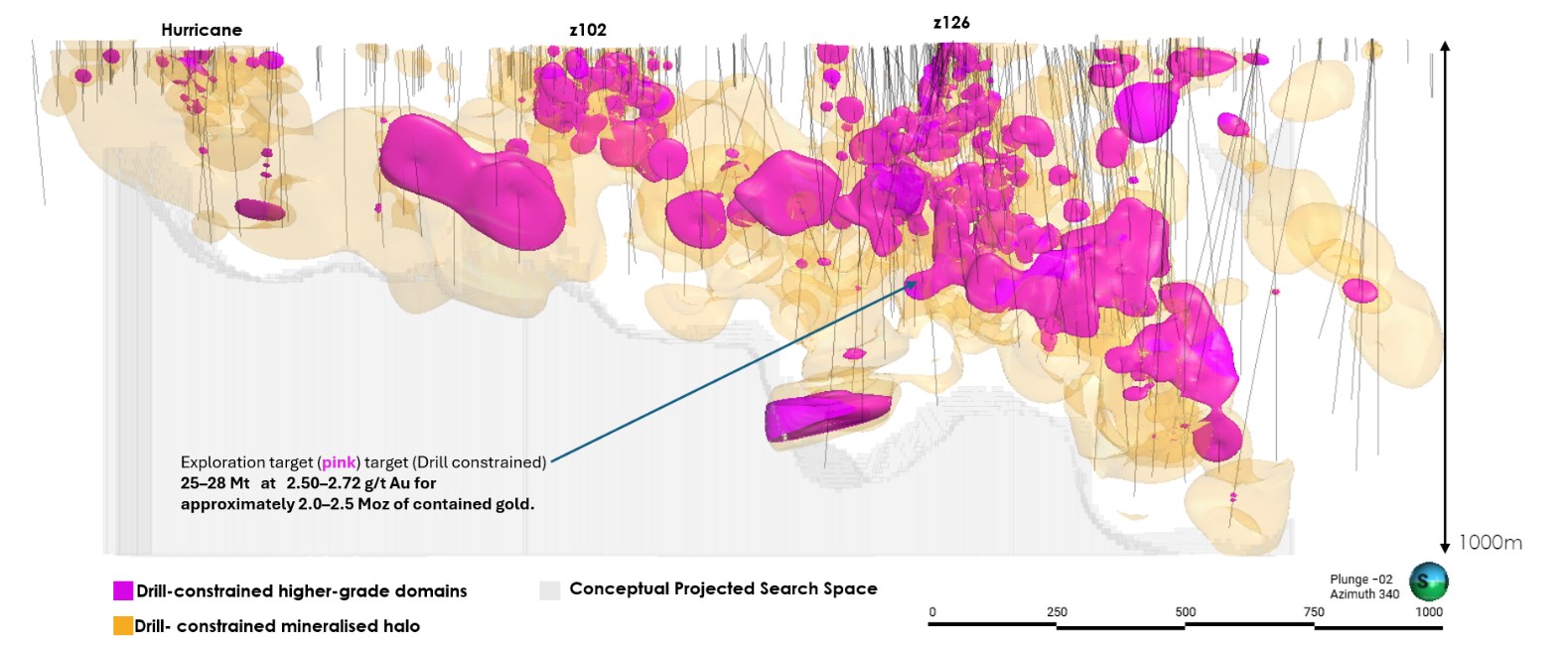
Hurricane Camp Exploration Target
To view an enhanced version of this graphic, please visit:
https://images.newsfilecorp.com/files/1818/302650_e7073a1ad46298c0_003full.jpg
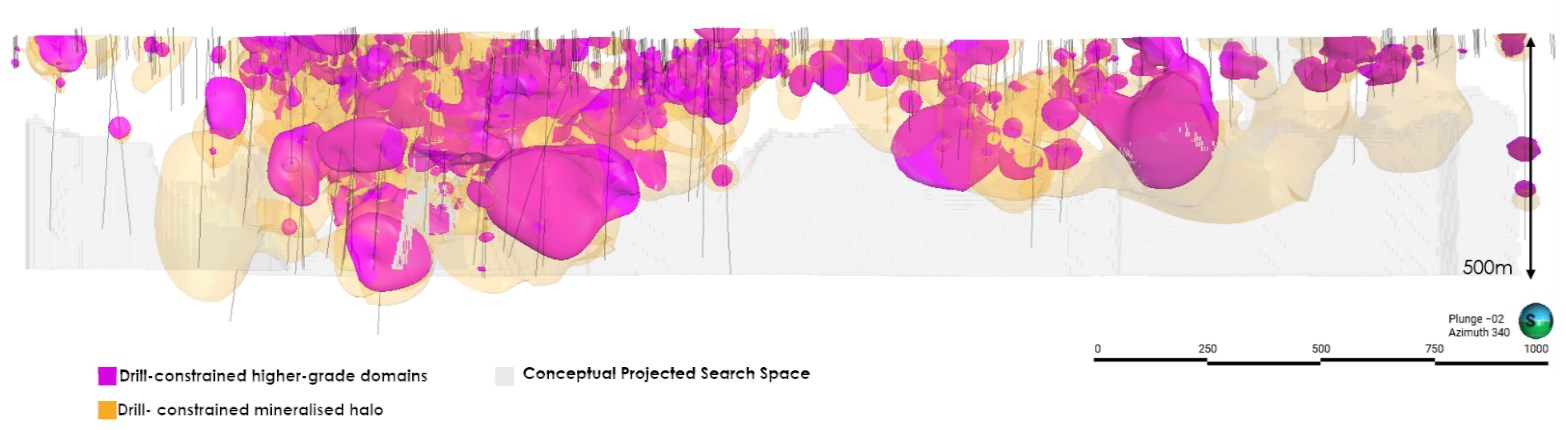
Icon Camp Exploration Target
To view an enhanced version of this graphic, please visit:
https://images.newsfilecorp.com/files/1818/302650_e7073a1ad46298c0_004full.jpg
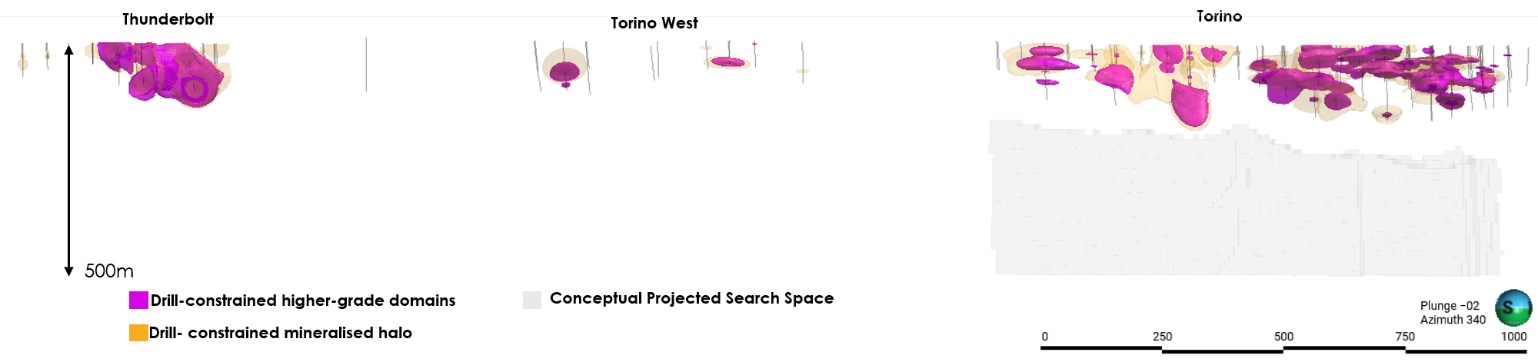
Thunderbolt Camp Exploration Target
To view an enhanced version of this graphic, please visit:
https://images.newsfilecorp.com/files/1818/302650_e7073a1ad46298c0_005full.jpg
Figures 1-4: Long sections looking north of Glenburgh exploration target areas.
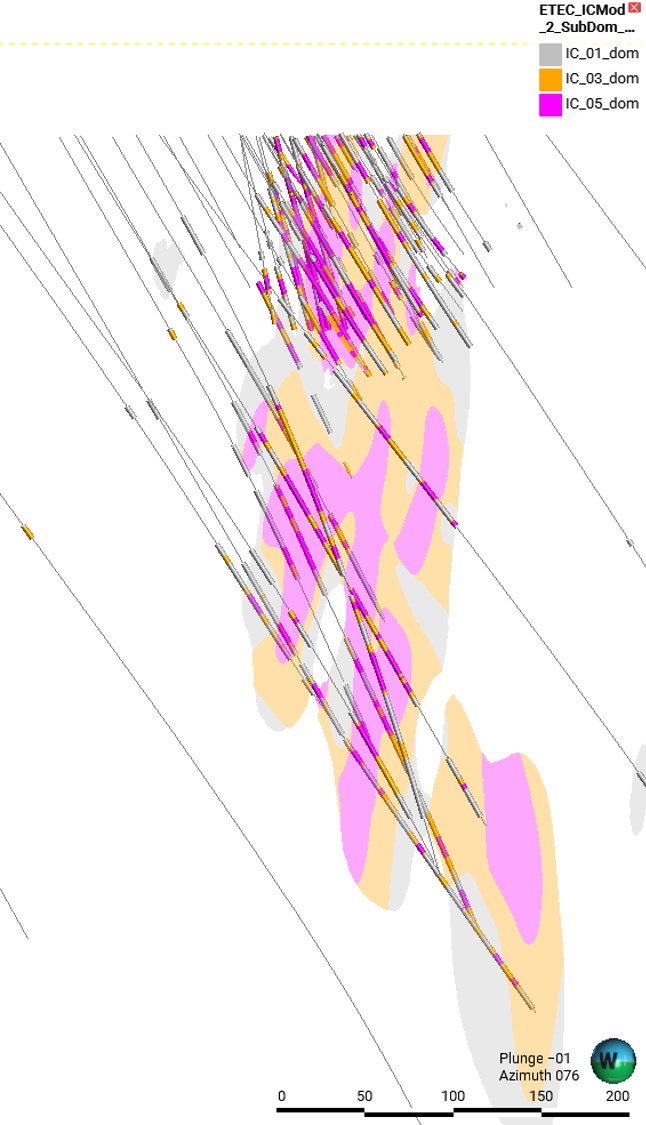
Figure 5: Section view of Icon deposit (Icon camp). Viewing window +/-50m. Modelled grade shell wireframes guided by grade composites in leapfrog software. Higher-grade (pink) and lower-grade(orange) domains were separated using nominal thresholds of approximately 0.5 g/t Au and 0.3 g/t Au respectively. 0.1g/t Au cut off (grey)modelled but not used in exploration target.
To view an enhanced version of this graphic, please visit:
https://images.newsfilecorp.com/files/1818/302650_e7073a1ad46298c0_006full.jpg
Basis of the Exploration Target
The Exploration Target is majority based on exploration results already received by Benz and prior explorers.
The Exploration Target is based on exploration results from 1,100 drillholes (diamond and reverse-circulation), totalling approximately 200,022 metres completed by Benz and prior explorers, together with the associated logging, sampling and assay data as previously reported to the ASX. The methods used for sampling, sub-sampling, assaying and quality control are summarised in JORC Table 1 (Sections 1 and 2), appended to this announcement.
Three-dimensional wireframe interpretations of the mineralised domains were constructed in Leapfrog Geo from logged lithology and downhole gold assay composites and structural measurements.
Grade estimation
The lower bound of each grade range was derived from top-cut and spatially declustered assay composites, while the upper bound was derived from the equivalent raw, uncut and undeclustered composites. The use of top-cut and declustered grades for the lower bound provides a conservative basis for the reported grade ranges. Higher-grade and lower-grade domains were separated using nominal camp-specific grade thresholds, reflecting differences in grade distribution and mineralisation style across the Glenburgh system. At Icon and Thunderbolt, higher-grade and lower-grade domains were separated using nominal thresholds of approximately 0.5 g/t Au and 0.3 g/t Au respectively. At Hurricane, higher-grade and lower-grade domains were separated using nominal thresholds of approximately 0.7 g/t Au and 0.3 g/t Au respectively.
Tonnage estimation
Tonnage ranges were derived by applying an approximate ±10% range to the modelled mineralised wireframe volumes to reflect the conceptual nature of the Exploration Target. Bulk densities of 2.75 t/m³ for Hurricane and 2.68 t/m³ for Icon and Thunderbolt were applied, based on available density measurements collected from drill core and/or representative geological domains within the Glenburgh drilling database.
Drill-constrained and conceptual projection components
The drill-constrained components comprise modelled volumes constrained by existing drillhole intersections, at a current drill spacing of approximately 40m × 40m. The conceptual geological projection components were derived by projecting the modelled wireframes down-plunge and/or down-dip beyond the limit of current drilling, applying conversion factors of approximately 20% (Hurricane and Icon) and 80% (Torino) to the respective projection volumes. The projection components are extrapolations of results already obtained and are not based on any proposed exploration programme.
In accordance with the JORC Code (2012) and NI 43-101, the Company confirms that the Exploration Target, including all components, has been determined from exploration results already obtained, and not from any proposed exploration programme. Infill and extensional drilling will be required to establish whether any part of the Exploration Target can be reported as a Mineral Resource.
Proposed Exploration to Test the Exploration Target
The Company intends to undertake the following activities to test the Exploration Target:
Infill drilling of the drill-constrained domains to a nominal spacing of approximately 25m × 25m to test grade and tonnage continuity and to support conversion to a Mineral Resource estimate;
Extensional, step-out and down-plunge drilling to test the conceptual projection components;
Further metallurgical testwork building on the Icon results reported on 17 June 2026; and
Updated geological modelling, density determination and Mineral Resource estimation.
These activities are expected to be undertaken over the next 12 months.
Glenburgh Deposit Geology
The Glenburgh deposit geology is interpreted to comprise muddy pelitic sediments and mafic volcanic rocks metamorphosed to migmatites and amphibolites during the ca. 1990Ma Glenburgh Orogeny. Within this package of rocks, an extensive sea floor or sub-sea floor alteration system is associated with gold mineralisation.
The core of the mineralised envelope at Glenburgh is defined by a folded sequence of metapelitic rocks interlayered with silica-rich grey chert bands, sulphide and oxide sedimentary iron formations, iron-rich grunerite bearing layers, and tungsten-rich and phosphate bands.
Recrystallisation of gold and other silicate minerals during granulite facies metamorphism is considered responsible for the exceptional metallurgical recoveries reported on 17 June 2026.
Glenburgh – A New Frontier Gold District
The 100%-owned Glenburgh Gold Project is rapidly emerging as a new frontier gold district with multi-million-ounce potential. Located in Western Australia's Gascoyne region, Glenburgh hosts an 18-20 kilometre mineralised corridor anchored by the large-scale Icon-Apollo trend and the high-grade Zone 126 system.
Glenburgh's unique combination of thick, bulk-style gold mineralisation (Icon-Apollo) and multiple high-grade underground lenses (Zone 126) positions it as a rare opportunity in the Australian gold sector. With gold prices at record levels, the ability to develop both large-scale open pit and underground operations offers exceptional leverage and growth potential.
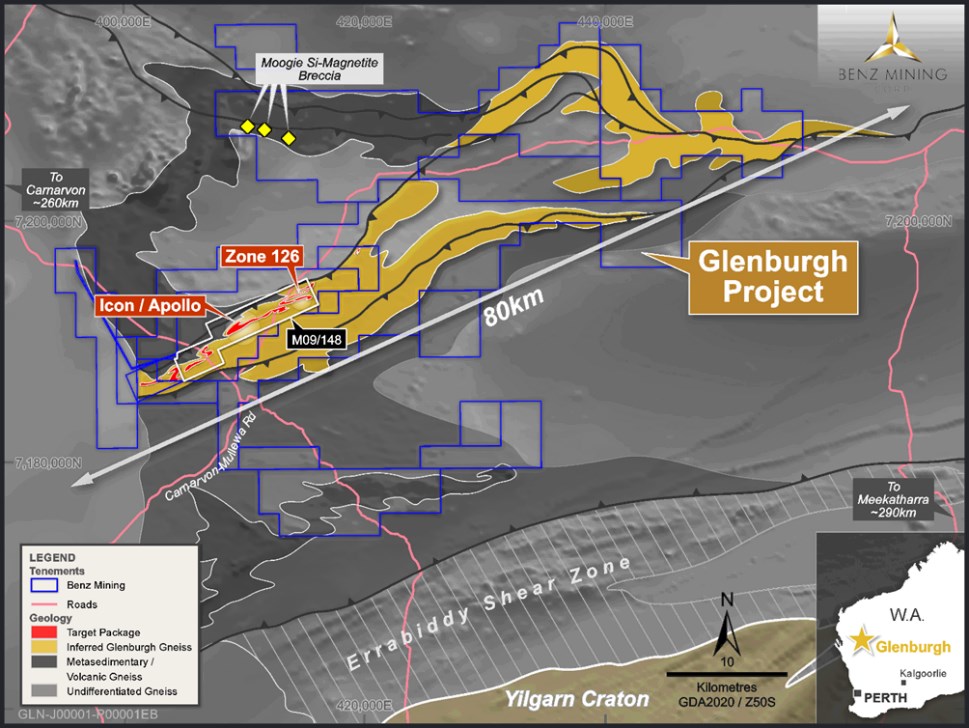
Figure 6: Geological overview of the Glenburgh Gold Project.
To view an enhanced version of this graphic, please visit:
https://images.newsfilecorp.com/files/1818/302650_e7073a1ad46298c0_007full.jpg
- END -
This announcement has been approved for release by the Board of Benz Mining Corp.
For more information, please contact:
Mark Lynch-Staunton
Chief Executive Officer Benz Mining Corp.
E: mstaunton@benzmining.com
T: +61 8 6143 6702
About Benz Mining Corp.
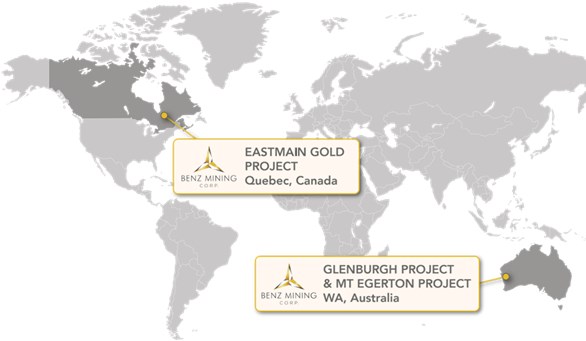
Benz Mining Corp. (TSXV: BZ,OTC:BENZF) (ASX: BNZ) is a pure-play gold exploration company dual-listed on the TSX Venture Exchange and Australian Securities Exchange. The Company owns the Eastmain Gold Project in Quebec, and the recently acquired Glenburgh and Mt Egerton Gold Projects in Western Australia.
Benz's key point of difference lies in its team's deep geological expertise and the use of advanced geological techniques, particularly in high-metamorphic terrane exploration. The Company aims to rapidly grow its global resource base and solidify its position as a leading gold explorer across two of the world's most prolific gold regions.
To view an enhanced version of this graphic, please visit:
https://images.newsfilecorp.com/files/1818/302650_e7073a1ad46298c0_008full.jpg
For more information, please visit: https://benzmining.com/.
Qualified Person's Statement (NI 43-101)
The scientific and technical information in this announcement is based on, and fairly represents, information and supporting documentation compiled by Mr Mark Lynch-Staunton, a Member of the Australian Institute of Geoscientists (AIG) (Membership ID: 6918), and a Qualified Person as defined in NI 43-101. Mr Lynch-Staunton is the Chief Executive Officer Benz Mining Corp.and has sufficient experience that is relevant to the style of mineralisation and type of deposit under consideration, and to the activity being undertaken, to qualify as a Competent Person as defined in the 2012 Edition of the Australasian Code for Reporting of Exploration Results, Mineral Resources and Ore Reserves (the JORC Code). Mr Lynch-Staunton consents to the inclusion in this news release of the matters based on this information in the form and context in which it appears. Mr Lynch-Staunton owns securities in Benz Mining Corp.
Forward-Looking Statements
This news release contains "forward-looking information" or "forward-looking statements" within the meaning of applicable securities legislation (collectively, "forward-looking statements"). Forward-looking statements are based on the beliefs, expectations and opinions of management as at the date of this news release, are made as of the date of this news release, and involve known and unknown risks, uncertainties and other factors. Forward-looking statements in this news release include, but are not limited to, statements with respect to: (i) the nature, scope and results of the Company's exploration programs; (ii) the potential quantity and grade of the Company's exploration targets; (iii) the potential for delineation of a Mineral Resource from the Exploration Target; the timing and results of future drilling, metallurgical testwork and geological modelling; the Company's plans, objectives and expectations with respect to advancing its mineral properties; and the potential for future development of its mineral properties. In certain cases, forward-looking statements can be identified by the use of words such as "plans", "expects", "is expected", "budget", "scheduled", "estimates", "forecasts", "intends", "anticipates", "believes", "potential" or variations of such words and phrases, or statements that certain actions, events or results "may", "could", "would", "might" or "will" occur or be achieved. Forward-looking statements relating to exploration targets are inherently speculative in nature.
Forward-looking statements are subject to a number of risks, uncertainties and assumptions, including, but not limited to: (i) risks relating to the inherently uncertain nature of mineral exploration and development; (ii) uncertainty in the estimation of Mineral Resources and exploration targets; (iii) the possibility that future exploration results will not be consistent with expectations; (iv) commodity price fluctuations; (v) changes in general economic and market conditions; (vi) the Company's ability to obtain financing on acceptable terms; (vii) risks related to permitting, environmental regulation and community relations; (viii) operational risks in conducting exploration activities, including weather, equipment failure and access issues; and other risks disclosed in the Company's continuous disclosure filings available on SEDAR+.
Although the Company believes that the assumptions and expectations reflected in such forward-looking statements are reasonable, no assurance can be given that these assumptions will prove to be correct, and actual results may differ materially from those anticipated. Readers are cautioned not to place undue reliance on forward-looking statements.
The Exploration Target is conceptual in nature; there has been insufficient exploration to estimate a Mineral Resource and it is uncertain whether further exploration will result in the estimation of a Mineral Resource. Accordingly, there can be no assurance that the Exploration Target will be realized or that future exploration will result in any Mineral Resources being identified. The Company does not undertake to update any forward-looking statement except as required by law.
NEITHER THE TSX VENTURE EXCHANGE NOR ITS REGULATION SERVICES PROVIDER (AS THAT TERM IS DEFINED IN THE POLICIES OF THE TSX VENTURE EXCHANGE) ACCEPTS RESPONSIBILITY FOR THE ACCURACY OR ADEQUACY OF THIS RELEASE.
Appendix 1: Detailed Breakdown of Exploration Target
| GLENBURGH EXPLORATION TARGET – by deposit and grade domain | |||
| Hurricane Camp | |||
| Basis | Tonnes (Mt) | Grade (g/t Au) | Contained Gold (Moz) |
| High grade | |||
| Drill-constrained (data-driven) | 25 - 28 | 2.50 - 2.72 | 2.0 - 2.5 |
| Conceptual projection | 6 - 7 | 2.50 - 2.72 | 0.5 - 0.6 |
| Subtotal – high grade | 31 - 35 | 2.50 - 2.72 | 2.5 - 3.0 |
| Mineralised halo | |||
| Drill-constrained (data-driven) | 166 - 184 | 0.37 - 0.39 | 2.0 - 2.3 |
| Conceptual projection | 40 - 44 | 0.37 - 0.39 | 0.5 - 0.6 |
| Subtotal – mineralised halo | 206 - 229 | 0.37 - 0.39 | 2.4 - 2.9 |
| TOTAL – Hurricane | 235 - 265 | 0.65 - 0.70 | 5.0 - 5.9 |
| Icon | |||
| Basis | Tonnes (Mt) | Grade (g/t Au) | Contained Gold (Moz) |
| High grade | |||
| Drill-constrained (data-driven) | 54 - 60 | 1.40 - 1.47 | 2.4 - 2.8 |
| Conceptual projection | 8 - 9 | 1.40 - 1.47 | 0.35 - 0.41 |
| Subtotal - high grade | 62 - 69 | 1.40 - 1.47 | 2.8 - 3.3 |
| Mineralised halo | |||
| Drill-constrained (data-driven) | 125 - 139 | 0.28 - 0.29 | 1.1 - 1.3 |
| Conceptual projection | 18 - 20 | 0.28 - 0.29 | 0.16 - 0.19 |
| Subtotal – mineralised halo | 143 - 159 | 0.28 - 0.29 | 1.3 - 1.5 |
| TOTAL – Icon | 205 - 230 | 0.62 - 0.65 | 4.1 - 4.7 |
| Thunderbolt | |||
| Basis | Tonnes (Mt) | Grade (g/t Au) | Contained Gold (Moz) |
| High grade | |||
| Drill-constrained (data-driven) | 3.07 - 3.41 | 1.40 - 1.55 | 0.1 - 0.2 |
| Conceptual projection | 16 - 17 | 1.40 - 1.55 | 0.7 - 0.9 |
| Subtotal – high grade | 19 - 21 | 1.40 - 1.55 | 0.8 - 1.0 |
| Mineralised halo | |||
| Drill-constrained (data-driven) | 4 - 5 | 0.28 - 0.31 | 0.04 - 0.05 |
| Conceptual projection | 21 - 24 | 0.28 - 0.31 | 0.19 - 0.24 |
| Subtotal – mineralised halo | 26 - 29 | 0.28 - 0.31 | 0.2 - 0.3 |
| TOTAL – Thunderbolt | 45 - 50 | 0.75 - 0.83 | 1.1 - 1.3 |
| Glenburgh Exploration Target – reconciliation by camp | |||
| Basis | Tonnes (Mt) | Grade (g/t Au) | Contained Gold (Moz) |
| Hurricane | 235 - 265 | 0.65 - 0.70 | 5.0 - 5.9 |
| Icon | 205 - 230 | 0.62 - 0.65 | 4.1 - 4.7 |
| Thunderbolt | 45 - 50 | 0.75 - 0.83 | 1.1 - 1.3 |
| GLENBURGH EXPLORATION TARGET | 485 - 540 | 0.65 - 0.69 | 10.1 - 12.0 |
Appendix 2: JORC Tables
JORC Code, 2012 Edition – Table 1 report template
Section 1 Sampling Techniques and Data
(Criteria in this section apply to all succeeding sections.)
| Criteria | Commentary |
| Sampling techniques |
|
| Drilling techniques |
|
| Drill sample recovery |
|
| Logging |
|
| Sub-sampling techniques and sample preparation |
|
| Quality of assay data and laboratory test |
|
| Verification of sampling and assaying |
|
| Location of data points |
|
| Data spacing and distribution |
|
| Orientation of data in relation to geological structure |
|
| Sample security |
|
| Audits or reviews |
|
Section 2 Reporting of Exploration Results
(Criteria listed in the preceding section also apply to this section.)
| Criteria | Commentary |
| Mineral tenement and land tenure status |
|
| Exploration done by other parties |
|
| Geology |
|
| Drill hole Information |
|
| Data aggregation methods |
|
| Relationship between mineralisation widths and intercept lengths |
|
| Diagrams |
|
| Balanced reporting |
|
| Other substantive exploration data |
|
| Further work |
|

To view the source version of this press release, please visit https://www.newsfilecorp.com/release/302650
News Provided by TMX Newsfile via QuoteMedia