China’s dual-track progress on low-cost electrochemical extraction and high-efficiency separation technologies could turn what was once a scientific aspiration into a viable industrial reality.

Picstings / Adobe Stock
Chinese researchers have unveiled a method of extracting uranium from seawater at a fraction of the previous cost and energy use, positioning the country to potentially secure long-term domestic supply.
Scientists from Hunan University have developed an advanced electrochemical system that can extract uranium from seawater more efficiently and economically than any method currently in use.
The innovation, led by Professor Shuangyin Wang and his team, features a novel dual-electrode design using copper at both the positive and negative terminals, allowing uranium ions to be collected simultaneously at both ends.
The system achieved a 100 percent extraction rate from a synthetic seawater solution within 40 minutes — a remarkable leap from earlier physical adsorption methods, which typically extract less than 10 percent.
When tested with natural seawater, the device extracted all uranium from East China Sea samples and up to 85 percent from South China Sea water, reaching 100 percent in the latter case with larger electrodes.
It accomplished these results while consuming over 1,000 times less energy than existing electrochemical systems. The total cost was estimated at US$83 per kilogram of uranium — half the cost of physical adsorption (US$205 per kilogram) and nearly one-fourth that of previous electrochemical approaches (US$360 per kilogram).
The implications for China’s energy security could be substantial.
According to the International Energy Agency, China is building more nuclear power plants than any other country, and is expected to surpass the US and EU in installed nuclear capacity by 2030.
However, much of the uranium needed to fuel this growth is imported. In 2024, China imported 13,000 metric tons of uranium, compared to just 1,700 tonnes mined domestically.
Given the estimated 4.5 billion metric tons of uranium dissolved in the world’s oceans — over 1,000 times the amount in terrestrial reserves — seawater extraction has long been seen as a tantalizing, but technologically elusive solution.
Japan led early efforts in the 1980s and 1990s, extracting 1 kilogram of uranium using large-scale marine trials, a milestone that China is now poised to eclipse. The new electrochemical technique builds on recent momentum in China’s marine uranium research. In March of this year, scientists from Lanzhou University’s Frontiers Science Center for Rare Isotopes published a separate study detailing a breakthrough in uranium-vanadium separation, a major technical challenge due to the similar chemical properties of the two elements in seawater.
The Lanzhou team engineered a metal-organic framework (MOF) material embedded with diphenylethylene molecules that can change pore sizes under ultraviolet light.
This enabled the MOF to selectively attract uranium ions over vanadium, increasing uranium adsorption capacity to 588 milligrams per gram, and improving uranium-vanadium separation efficiency by 40-fold.
Their uranium selectivity factor reached 215 — the highest ever reported in natural seawater.
Both research efforts support China’s national nuclear strategy. In 2019, China National Nuclear partnered with 14 domestic research institutions to establish the Seawater Uranium Extraction Technology Innovation Alliance.
This government-backed initiative set ambitious milestones: match Japan’s kilogram-level extraction record by 2025, build a metric ton-scale demonstration plant by 2035 and reach continuous industrial production by 2050.
The alliance's work is driven by projections from the International Atomic Energy Agency, which forecasts that China’s uranium demand will exceed 40,000 metric tons annually by 2040. Marine extraction, if scaled successfully, could ease long-term supply pressures and reduce geopolitical risk tied to uranium imports.
Of course, despite promising lab results, transitioning to industrial-scale extraction poses engineering and economic hurdles. For example, scaling up the Hunan system would involve increasing the number and size of electrochemical cells and managing flow rates across larger volumes of seawater.
If successful, the innovation could revolutionize the global uranium market. By tapping into the ocean’s near-limitless uranium reserves, China could not only meet its own needs, but also shift the geopolitical dynamics of nuclear energy.
Don’t forget to follow us @INN_Resource for real-time updates!
Securities Disclosure: I, Giann Liguid, hold no direct investment interest in any company mentioned in this article.
https://x.com/giannliguid
https://www.linkedin.com/in/giannliguid/
The Conversation (0)

Giann Liguid is a graduate of Ateneo De Manila University with an AB in Interdisciplinary Studies. With a diverse writing background, Giann has written content for the security, food and business industries. He also has expertise in both the public and private sectors, having worked in the government specializing in local government units and administrative dynamics.
When he is not chasing the next market headline, Giann can most likely be found thrift shopping for his dogs.
INN Article Notification
Latest News
Outlook Reports world
Featured Uranium Investing Stocks

Investor Insight
Generation Uranium offers investors high-leverage exposure to a potential major discovery in Canada’s underexplored and resource-rich Thelon Basin, led by a management team with a proven track record of securing high-value exits.
Overview
Generation Uranium (CSE:GEN, OTCQB:GENR, FRA:W85) is a Canadian exploration company focused on wealth creation through discovery within the uranium sector. The company’s primary strategy is to build a high-caliber exploration team that can rapidly test and drill high-potential targets, de-risking projects for potential takeover by larger producers. Currently centered in the prolific Thelon and Angikuni Basins of Nunavut, the company is also actively evaluating additional project acquisitions in the Athabasca Basin to expand its portfolio.
The company is led by a veteran management team with nearly 30 years of experience in mineral development. CEO Michael Collins has a significant track record of building and exiting public companies, including the co-founding of Bluerock Resources, a conventional uranium producer during the 2000-2008 cycle. This expertise is paired with a focused business model that leverages modern geophysical targeting to accelerate exploration timelines and reduce costs, ensuring the company can deliver results quickly in a bullish uranium market.
Company Highlights
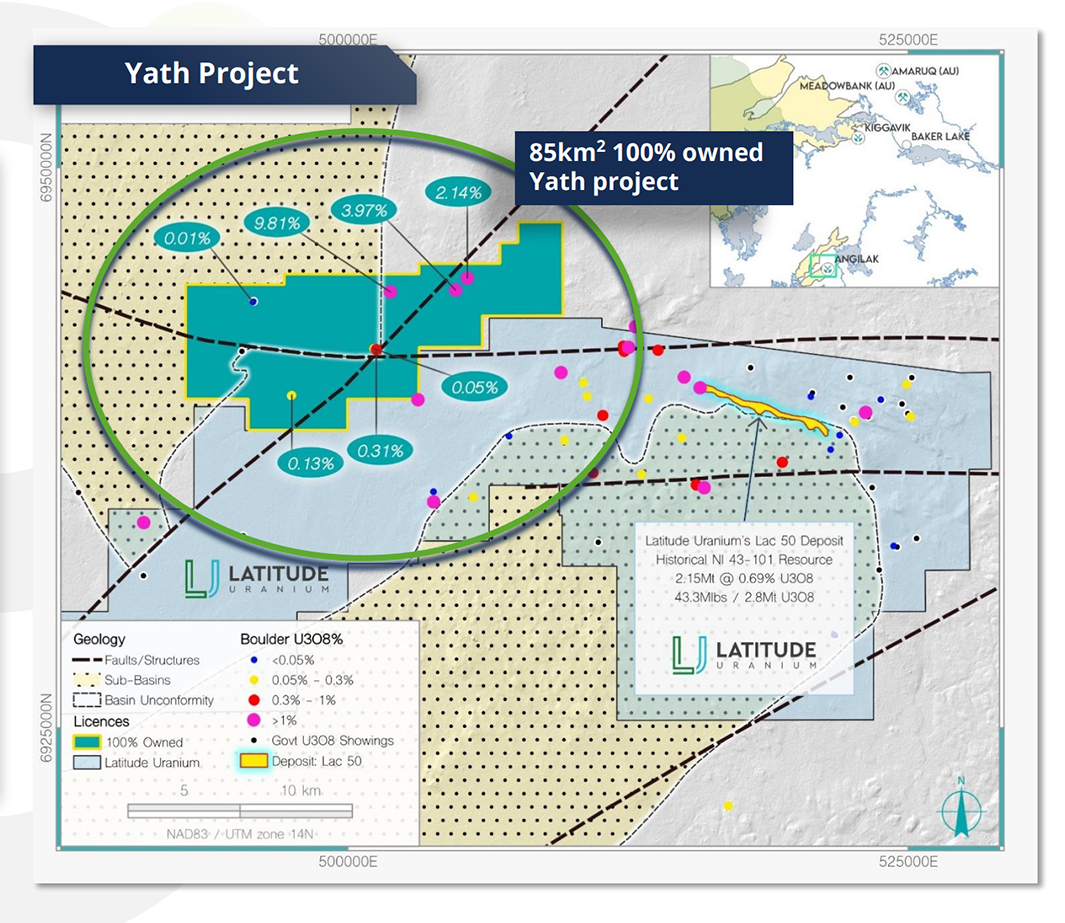
- Strategic Location in a Premier Uranium District: The flagship Yath Project is located in Nunavut’s Thelon Basin, contiguous to ATHA Energy’s Angilak Project, which hosts the high-grade Lac 50 deposit.
- High-Grade Discovery Potential: Historical surface sampling at the Yath Project has yielded exceptional uranium grades, including boulders testing at 9.81 percent, 3.95 percent, and 2.14 percent U3O8.
- Expert Management with Exit Experience: Led by CEO Michael Collins, the team has decades of experience in mineral exploration and a history of co-founding companies that were later acquired, such as Prime Mining and Nuclear Fuels.
- Low-Cost, Rapid Exploration Strategy: By leveraging modern geophysics and extensive historical data, the company aims for a "short road to discovery," de-risking projects quickly to maximize shareholder value.
- Bullish Market Fundamentals: Generation Uranium is well-positioned to meet the growing global demand for carbon-free nuclear power, supported by a projected supply deficit and increased interest from major tech companies seeking clean energy.
Key Project
Yath Project - Nunavut, Canada
The Yath Project is Generation Uranium’s flagship project. This 100 percent owned property covers about 120 square kilometers within the underexplored Thelon Basin in Nunavut, Canada. The project is located where the Yathkyed and Angikuni sub-basins meet, which is a region known globally for high-grade uranium potential. It sits directly along the same trend as the Angilak Project owned by ATHA Energy (TSXV:SASK, OTCQB:SASFK, FWB:XSU.F), which contains the Lac 50 deposit, one of the highest-grade uranium resources found outside of the Athabasca Basin with a historical mineral resource estimate of 43.3M lbs at an average grade of 0.69 percent U3O8.
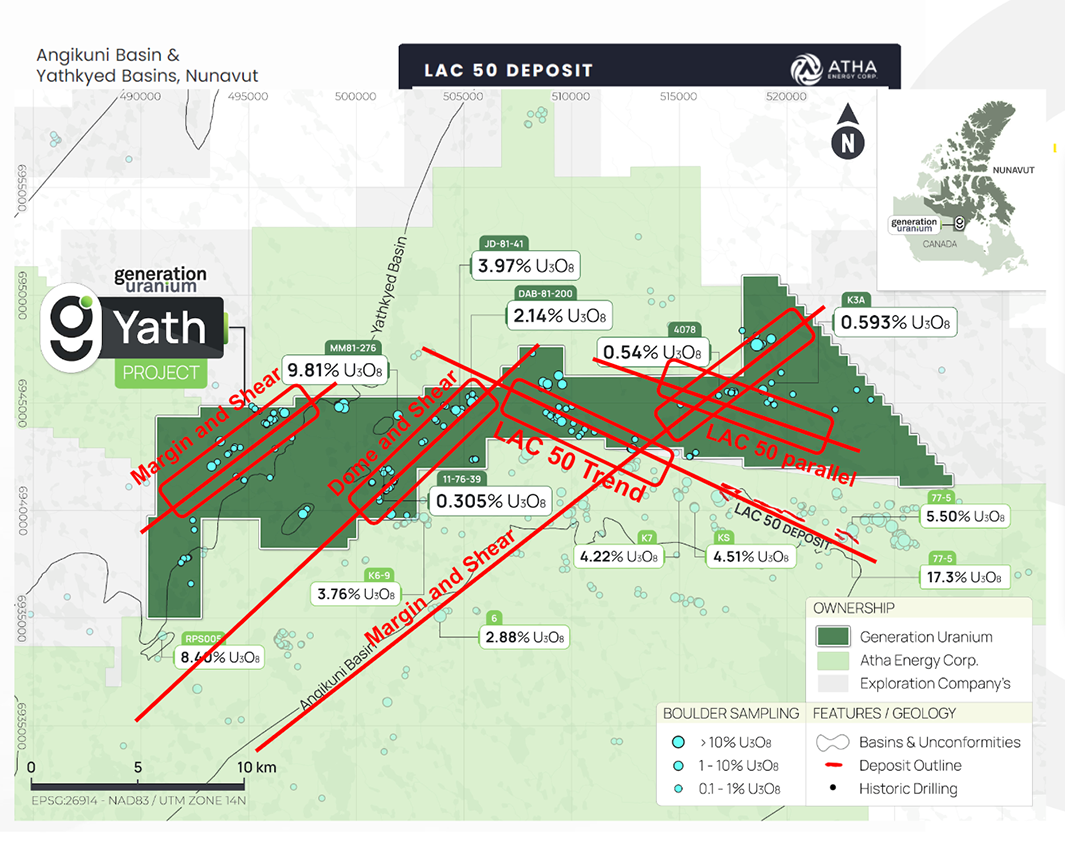
The Yath Project is contiguous to the Lac 50 trend and is crossed by several regional faults and basin boundaries. Past exploration work has already identified high priority targets, while surface sampling in the area has produced uranium grades from boulders, with some testing at 9.81 percent, 3.95 percent, and 2.14 percent U3O8.
The company has commenced its initial field program at the site, set to define and rank drill targets. Historic showings will be combined with new anomalies from the MMT geophysics survey, preparing the project for an anticipated drill permit.
Management Team
Michael Collins - CEO & Director
Michael Collins is a professional geoscientist with nearly 30 years of experience in mineral exploration. He has co-founded several public companies, including Exploits Discovery, Prime Mining (acquired in 2025), and Nuclear Fuels (merged with Premier American Uranium in 2025). He is also currently a director of First Atlantic Nickel.
Christoph Bruening - Director
Christoph Bruening is the founder and managing partner of Value Relations GmbH, a full-service investor relations and public relations agency in Frankfurt with over 25 years of excellence, focusing on mining, exploration, biotech and health care. In addition, he has listed over 600 companies on the Frankfurt Stock Exchange and is a speaker and author of several publications, including on rare earths and uranium.
Dallas Miller - Director
Dallas Miller has been working within the international mining industry for over 15 years, working with BHP and Santos Ltd. He has experience on the ground from an operational standpoint, as well as being an integral part of raising millions of dollars in capital funding for both private and public companies in recent years.
Roger Leschuk - VP Corporate Development
Roger Leschuk has been in corporate management for over two decades, with the past 15 years dedicated to corporate development and investor relations. He has experience participating in and assisting with mergers and acquisitions, and was an investment advisor for various services such as stocks, mutual funds and tax-sheltered investments. He is a Chartered Investment Manager and a Fellow of the Canadian Securities Institute.
Monty Sutton - CFO
Monty Sutton brings over 35 years of experience in public markets and corporate governance. He previously served as CFO for Nuclear Fuels from its IPO through its acquisition.
Browse Companies
MARKETS
COMMODITIES
CURRENCIES
Giann Liguid is a graduate of Ateneo De Manila University with an AB in Interdisciplinary Studies. With a diverse writing background, Giann has written content for the security, food and business industries. He also has expertise in both the public and private sectors, having worked in the government specializing in local government units and administrative dynamics.
When he is not chasing the next market headline, Giann can most likely be found thrift shopping for his dogs.
Learn about our editorial policies.