The Conversation (0)
Apr. 08, 2026 01:10PM PST
Stockfotos-MG / Adobe Stock
Precious metals prices are still riding a wave of uncertainty as the ground continues to shift under the Iran war.
As is the case for many commodities, the price action for the precious metals complex remains at the whim of global leaders set to come to the negotiating table later this week. Investors are reacting swiftly to any new statements out of the White House, and to further escalations on the battlefront in the Middle East.
Let’s take a look at what’s got the precious metals moving over the past week.
Gold price
The gold price has gained a mere 0.6 percent over the last week of trading, and remains down nearly 16 percent from the record high of US$5,589.38 per ounce that it reached on January 28.
The metal surged midweek on the potential for a more lasting de-escalation in the Iran war. Last week, during a televised address, US President Donald Trump threatened to strike Iran "extremely hard" over the coming weeks. However, on Tuesday (April 7), the Trump administration announced that a two week ceasefire arrangement had been reached — it involves Iran agreeing to allow safe passage for ships through the Strait of Hormuz.
However, Iran’s leaders changed course on that decision as Israel continued to launch attacks in Lebanon on Iran-backed Hezbollah. Iran still seems keen to flex its only bargaining chip — one extremely critical to global trade.
Official peace negotiations are slated for Thursday (April 10) in Pakistan.
On April 2, gold was trading at an intraday high of US$4,697.31 in morning trade before closing at US$4,676.40 as a stronger US dollar added downward pressure. US markets were closed the following day on Good Friday.
Gold picked up some steam in early morning trading on Monday (April 6) as the price flirted with the US$4,700 level. However, by the afternoon the price had slipped to an intraday low of US$4,645.83; it later finished at US$4,650.90.
On Tuesday, the gold price slipped in the morning to a low of US$4,607.06. However, by midday, reports that a potential ceasefire deal was in the works sent the yellow metal's price climbing above the US$4,700 level.
Gold rose as high as US$4,715.08 before achieving a close of US$4,706.01.
Following the ceasefire agreement, the momentum in gold’s gains carried forward the next day, with the price breaching the US$4,800 level in early morning trade. By 12:00 p.m. PST on Wednesday, gold had eased back to US$4,705.33 soon after Iran once again threatened access to the Strait of Hormuz.
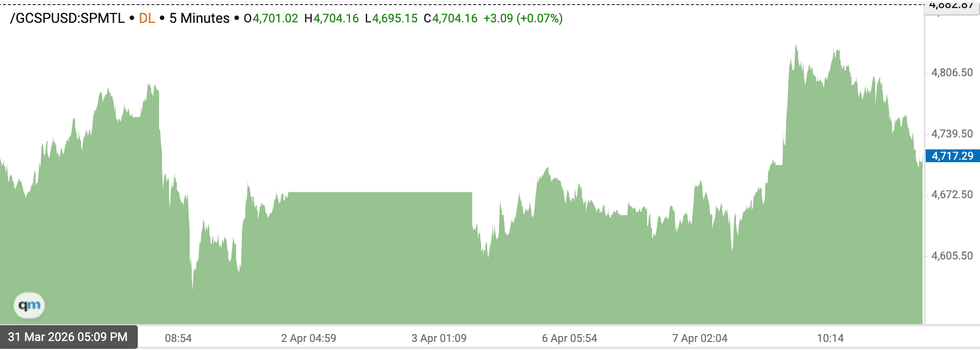
Gold price chart, March 31 to April 8, 2026.
Chart via the Investing News Network.
Here are the primary drivers for gold this past week:
- For weeks, the Iran war has effectively blocked transport through the Strait of Hormuz, an important route for global oil markets and a key component of the conflict. Any potential end to the conflict would be price positive for gold, which moves inversely with oil prices.
- Gold also has an inverse relationship with the dollar, which has struggled to sustain gains during the last week, providing a tailwind for the dollar-denominated gold price.
- If oil prices stabilize, the threat of higher-for-longer inflation will abate — that's another positive signal for the price of gold. If the war comes to a conclusion sooner than later, investors see renewed potential for the US Federal Reserve to cut interest rates in the second half of this year. Lower rates make non-yielding assets such as gold more attractive.
For more insight into what’s moving gold, check out the Investing News Network's (INN) recent interviews:
- Dr. Mark Thornton: Has Gold Bottomed? Why it Fell, Key Price Drivers Now
- Carley Garner: Gold, Silver, Oil — My Price Calls and Strategies
In other gold market news, the World Gold Council (WGC) released its March report on gold exchange-traded fund (ETF) flows. The WGC highlights that although global gold ETFs were set to mark their strongest quarter on record during Q1, March brought a reversal with the largest monthly outflow on record.
In gold-mining news, shareholders voted to approve Eldorado Gold's (TSX:ELD,NYSE:EGO) deal to acquire Foran Mining (TSX:FOM,OTCQX:FMCXF), valued at C$3.8 billion.
Silver price
The silver price gained 0.8 percent over the last week, but is down nearly 40 percent from its all-time high of US$121.62 per ounce, which it set on January 29. Although the precious metal is known for its volatility, it has a strong floor of support from an entrenched supply deficit and robust industrial demand.
After sliding to a low of US$69.58 in early in the morning on April 2, the price of silver rebounded to US$72.38 before a close of US$73.05. On Monday, the metal posted modest gains to hit an intraday high of US$73.56 before pulling back slightly to a low of US$72.04. The white metal managed to close at US$72.84.
The following day’s trading session was a choppy one as the market awaited news of a pending ceasefire deal. After reaching a high of US$73.08 in the early morning, silver fell to a low of US$69.83 later on.
The precious metal closed out the trading day on Tuesday at US$72.95.
On Wednesday, following the ceasefire deal, silver surged to an intraday high of US$77.53 in early morning trade. Silver had slid back to US$73.64 by 12:00 p.m. PST that day.
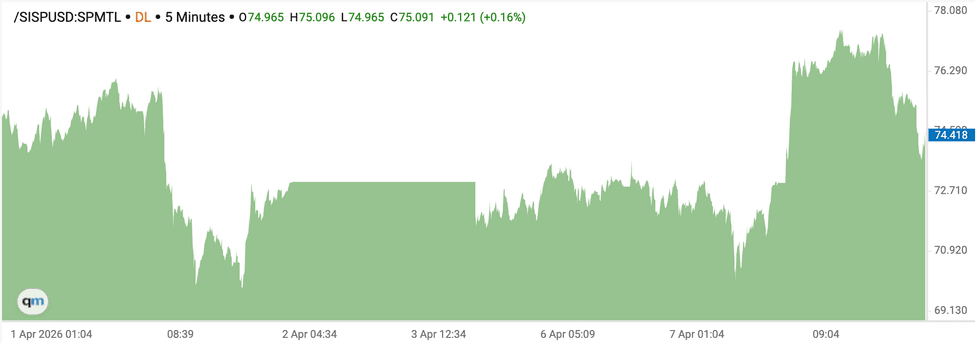
Silver price chart, April 1 to April 8, 2026.
Chart via the Investing News Network.
Silver is currently entering its sixth consecutive year of structural supply deficits.
Despite high prices for the metal, industrial demand from sectors such as solar, electric vehicles, and artificial intelligence infrastructure remains robust, providing a strong floor during geopolitical swings.
For more information on silver's performance, check out INN’s Silver Price Update: Q1 2026 in Review.
In silver-mining news, Endeavour Silver (TSX:EDR,NYSE:EXK) reported its first quarter production, including 1,875,375 ounces of silver and 11,740 ounces of gold. Although realized production came in slightly lower than projected, it was 56 percent higher than production in the first quarter of 2025.
Platinum price
Platinum continues to outperform gold and silver, with the price up nearly 2.24 percent this past week.
The platinum price was trading at a low of US$1,903.90 per ounce in morning trade on April 2, but had gained more than US$100 by the afternoon to reach a high of US$2,008.20; it then slipped slightly to US$1,999 by closing.
On Monday, the precious metal's price was at a high of US$2,017 in early morning trade, but fell to a low of US$1956.80 before closing at US$1,985.60. Platinum rose early on Tuesday to a high of US$2,000, but then retreated quickly to a low of US$1,910.70. Platinum later managed to close the day up at US$1,966.70.
The following day, platinum rallied to a high of US$2,105 in the morning trade.
The metal lost some of that ground, falling to US$2,043.80 by 12:00 p.m. PST on Wednesday.
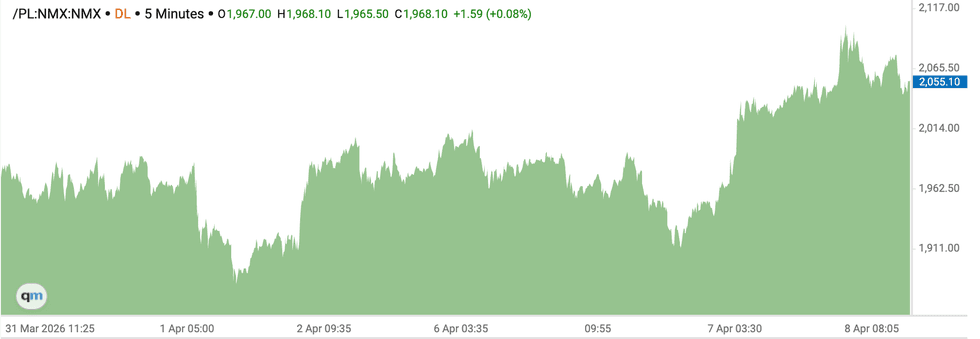
Platinum price chart, March 31 to April 8, 2026.
Chart via the Investing News Network.
Platinum has struggled to overtake the US$2,000 level since mid-March, weighed down by the Iran war and the disruptions to trade via the Strait of Hormuz. The sharp rally on Wednesday following Trump's announcement of a two week ceasefire and a deal to reopen the Strait lifted platinum's price alongside the entire metals complex.
Platinum is also benefiting from persistently tight mine supply out of South Africa, which accounts for more than 70 percent of global supply. The World Platinum Investment Council is forecasting a fourth consecutive annual deficit for platinum in 2026 at a projected 240,000 ounces.
Palladium price
Palladium put up the best price performance of the precious metals again this week, gaining 3.9 percent.
On April 2, palladium was trading as low as US$1,446 per ounce in the early morning before rising to US$1,517 in the afternoon session and closing the day at US$1,515.
While the price of palladium had risen to US$1,528 in early morning trading on Monday, the metal’s value quickly pulled back to US$1,477, and later closed out the day at US$1,490.
Palladium had another day of volatility on Tuesday, rising to a high of US$1,507 in the early morning session, but soon after lost ground to a low of US$1,403. It closed the day at US$1,478.
The following day, palladium soared to an intraday high of US$1,634.50 in morning trade before dipping back below the US$1,600 level a few hours later. The price of palladium was trading US$1,575 as of 12:00 p.m. PST.
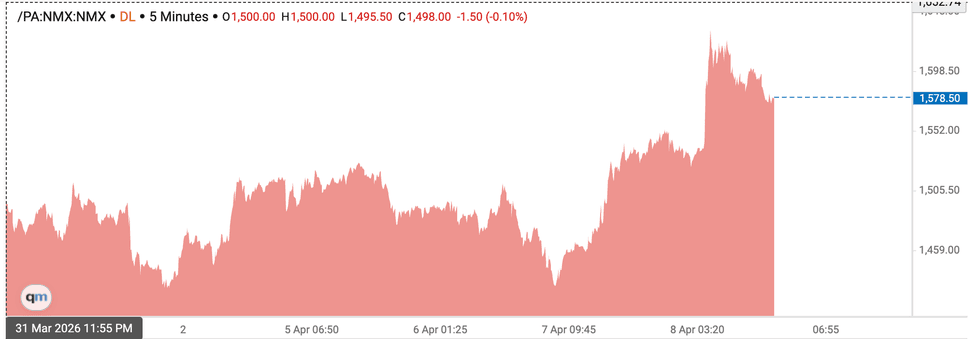
Palladium price chart, March 31 to April 8, 2026.
Chart via the Investing News Network.
On top of the factors driving the precious metals, palladium is finding further support from tight supply.
Output disruptions are an ongoing concern in South Africa as are the reliability of Russian exports, which together account for roughly 75 to 80 percent of global supply. Such regional concentration in the supply network makes palladium highly sensitive to instability in these nations.
Don't forget to follow us @INN_Resource for real-time updates!
Securities Disclosure: I, Melissa Pistilli, hold no direct investment interest in any company mentioned in this article.
From Your Site Articles
- Gold’s Next Test: WGC Lists 3 Potential Price Scenarios in 2026 Outlook ›
- Gold Price Forecast: Top Trends for Gold in 2026 ›
- Gold Price 2025 Year-End Review ›
- Silver Price Forecast: Top Trends for Silver in 2026 ›
- Silver Price 2025 Year-End Review ›
Related Articles Around the Web
- 2026 Gold Outlook: Analysing the Macro Forces Driving the Path to $6,000 ›
- Gold Outlook 2026: Push ahead or pull back | World Gold Council ›
- Every major analyst's gold price forecast for 2026 - Yahoo Finance ›
- Gold price predictions from J.P. Morgan Global Research ›
- Why Gold's Rally Is Likely to Go On - Morgan Stanley ›
https://x.com/INN_Resource
https://www.linkedin.com/in/melissa-pistilli-865271a9/
mpistilli@investingnews.com

Featured Precious Metals Investing Stocks





Learn about our editorial policies.