Oct. 26, 2026 02:00PM PST
|Fact CheckedThis article has been reviewed and updated according to INN's rigorous fact-checking process. Our staff editors verify all articles against information and data from primary sources, reputable publishers and experts.
The ongoing Middle East conflict continued to push oil benchmarks higher in Q3, with both Brent and WTI rising more than 35 percent over the three month session.

Alleachday / Adobe Stock
Oil prices climbed back above US$100 per barrel in Q3 as fighting resumed in the Middle East and the Strait of Hormuz stayed largely shut. Natural gas traded in a narrow range, shielded by North America's locked-in market.
The oil market spent the third quarter of 2026 caught between hopes for a deal in the Middle East and a physical supply chain that has yet to recover.
Brent crude opened the period at its Q3 low of US$71.50 per barrel on July 1, and finished September at US$97.91, a gain of nearly 37 percent. West Texas Intermediate (WTI) followed a similar path.
The International Energy Agency (IEA) has described the conflict that began on February 28 as causing "the largest supply disruption in the history of the global oil market and significant disruptions to natural gas flows."
Read on for a look at the key trends that moved oil and gas prices in Q3, and what experts expect as the year draws to a close.
Oil prices swing as Middle East conflict keeps markets on edge
Oil started the quarter close to pre-war levels.
According to the US Energy Information Administration (EIA), the July 1 low reflected improved tanker traffic through the Strait of Hormuz in June, following a June 17 memorandum of understanding.
That calm was short-lived. Military strikes resumed on July 7, and Brent climbed to US$100.69 by July 23. WTI rose from its Q3 low of US$69.6 (July 6) to US$93.08 on July 23.
Prices then slid as optimism over diplomacy built. By August 4, Brent was down to US$79.36 and WT to US$77.33.
During an August 5 interview with the Investing News Network (INN) Kojo Orgle of ICIS said sentiment, not supply, was behind the sell-off.
"Supplies are still extremely tight, but the cautious optimism of a deal coming soon is causing the market to, in our opinion, oversell," he said. He noted that only five vessels had transited the strait the previous day, compared with about 130 per day before the war.
Listen to the full interview to hear more from Orgle on the supply risks facing the market.
The market began to rebound in September when Brent broke above US$100 (September 9) again, following escalating attacks on energy infrastructure in the Middle East and Russia, according to the EIA.
Both benchmarks reached Q3 highs on September 15, with Brent 108.61 and WTI at US$107.02. The EIA notes that spot prices for Brent reached as high as US$132 around that time.
Brent ended the quarter at US$97.91 and WTI at US$97.18. A United Nations policy brief released in September said Brent averaged US$101 for the month, up 22 percent since the cease fire broke down in July.
Josef Schachter of the Schachter Energy Report told INN in mid-September that the war accounts for a large share of the current price. "If we didn't have the war, no, it'd probably be in the 70s," he said, putting the war premium at as much as US$30. He does not expect that premium to disappear this year.
Watch the full interview to hear Schacter's stock strategy amid market volatility.
Brent crude has held above the US$99 per barrel threshold since October 1.
Key oil and gas news from Q3
The fragile calm that followed the June memorandum of understanding between the US and Iran ended on July 7, when military strikes resumed. Neither an end to the conflict nor a full reopening of the Strait of Hormuz has been achieved since, according to the UN.
The Red Sea quickly became a second flashpoint. Brent broke above US$100 on July 23 after a reported strike on two Saudi oil tankers, which Yemen's Houthi rebels claimed as part of a declared naval blockade against Saudi Arabia. Schachter later warned that if the group controls access to the Bab el-Mandeb strait, Iran and its proxies would effectively hold "the two most important straits for oil tanker traffic coming out of the Middle East."
Tensions in the Gulf flared again at the end of August. US forces struck Iran's Islamic Revolutionary Guard Corps on Larak Island in the Strait of Hormuz on August 30, and Iran responded with ballistic missiles and drones aimed at US installations in Jordan. Visible commodity traffic through the strait fell to five ships a day that weekend.
In mid-September, the bypass routes that had cushioned the market came under fire. Strikes damaged Saudi Arabia's East-West pipeline, the kingdom's main route around Hormuz, and satellite imagery confirmed heavy damage to at least two pumping stations, according to Reuters. Only four commodity vessels moved through the strait on September 17, compared with a 10-day average of 16.
A McKinsey report published on September 24 warned that those buffers are wearing thin. It found that the Hormuz closure disrupted 14 percent of combined global oil and gas supply at its peak. Bypass pipelines filled 35 percent of the gap, inventory draws 20 percent and demand destruction and flexibility 45 percent.
Emergency stockpiles are shrinking as well. The US Strategic Petroleum Reserve fell to 285.4 million barrels in mid-September, down 119.9 million barrels year-on-year and its lowest level since 1982, Schachter said in a September interview with INN.
In Canada, the period also brought consolidation, as Tamarack Valley Energy (TSX:TVE,OTCPL:TNEYF) and Headwater Exploration (TSX:HWX,OTCPL:CDDRF) agreed to merge to form a Clearwater-focused producer of about 80,000 barrels of oil equivalent per day.
Refiners feel the squeeze
The quarter's biggest pressure point was not crude itself, but the products made from it.
US refineries ran at an average 95 percent utilization in Q3, the most crude processed in a third quarter since 2019, the EIA notes. Distillate and jet fuel crack spreads nearly tripled from a year earlier, and US distillate inventories were 13 percent below their five-year average as of September 25.
Adam Rozencwajg of Goehring & Rozencwajg told INN in early September that consensus forecasts are misreading demand. Global refining throughput has fallen by about 6 million barrels per day as Middle Eastern refineries sit idle, China halts product exports and Russian plants recover from war damage. Because demand models track refinery runs, he said, that drop is being booked as lost demand.
"That to me is not the sign of a very weak demand market. That's the sign of a refining problem, and that I think is exactly what we have," Rozencwajg said.
Watch the full interview above to hear Rozencwajg explain why refineries could be a critical pinch point in the market.
He believes non-OECD refined product inventories may have fallen by as much as 500 million barrels, roughly ten times the IEA's estimate. "It's not nearly as calm as the price would suggest," he said.
The disruption has also spilled into mining.
According to the IEA's Global Critical Minerals Outlook 2026, the Middle East supplies about a quarter of global sulphur, and half of seaborne sulphur trade moves through Hormuz. Tighter supply pushed up sulphuric acid prices, raising costs for copper, lithium, cobalt and nickel producers. In some cases, acid overtook energy as the largest cost component.
US gas prices remain muted as global LNG demand creates export opportunities
US natural gas largely sat out the volatility. Henry Hub prices began the quarter at US$3.22 per million British thermal units (MMBtu),fell to a Q3 low of US$2.64 on August 6 and peaked at US$3.36 on September 24 .Prices closed September at US$3.02 and stood at US$3.27 on October 13.
Orgle explained that most US LNG export capacity is locked into long-term contracts, which limits how much global tightness reaches domestic prices. "Global dynamics do not trickle back into Henry Hub prices right now," he said, during the August interview.
He added that new pipeline takeaway capacity out of the Permian Basin, including the Blackcomb and Hugh Brinson pipelines, is sending more supply toward Henry Hub and putting pressure on prices. Seasonal heating demand should still lift prices over the winter.
The gap with international markets is wide. Schachter pointed to Asian LNG prices of about US$23 per MMBtu,with Bangladesh paying US$28.50 for a spot cargo. He expects US LNG export capacity to grow from about 19 billion cubic feet per day to 30 Bcf/d by the end of the decade.
That gap is drawing attention to North American supply.
Orgle expects Asian buyers that relied on Qatari LNG to diversify, and said the current environment could accelerate investment in US export infrastructure.
Schachter sees the same opportunity for Canada, which exports about 2 Bcf/d through LNG Canada today and could reach 6 to 7 Bcf/d by 2031 or 2032 if projects in the queue go ahead.
Oil and gas outlook for Q4 and beyond
Most experts INN spoke with believe the market is underpricing the risk ahead.
Orgle expects physical tightness to take about nine months to unwind once the conflict ends, lasting into mid-2027, with refinery repairs taking longer. Strategic restocking should also support prices. "I think prices right now are undervalued," he said.
Rozencwajg sees two possible paths: a shortage of refined products in the developing world before the strait reopens, or a surge in demand from refiners and governments rushing to rebuild inventories once it does. "Where do prices go from here? I mean, I suspect higher," he said.
Schachter said his firm's US$80 WTI forecast for 2026 now looks too low,and it is using US$90 for 2027. Longer term, he expects oil to break its 2008 record of US$147 before the end of the decade.
Security of supply is also likely to favour producers outside the Middle East. Schachter noted that the US produced 13.95 million barrels per day of crude in the week before his interview, up 452,000 barrels from a year earlier. Orgle said the US imports about 70 percent of its heavy crude from Canada, and expects those flows to rise while refining margins stay high.
Not every forecast is as bullish. A July outlook from JPMorgan Chase (NYSE:JPM) calls for Brent to average US$80 in Q4 and end 2026 at US$78, though that was issued before September's rally.
Technical analyst Steve Barton told INN on October 5 that WTI appears to be forming a bear flag and could fall toward its 200 day moving average, around US$82 to US$83.
He is bullish on Brent, however.
Watch the full interview with Barton to hear his thoughts on the broader energy sector and where else he sees opportunity.
"WTI looks like it's going down, and Brent looks like it's going up," he said. Barton has been playing the sector through large producers and oilfield service companies rather than the commodity itself.
Over the longer term, McKinsey expects demand to keep growing, with oil consumption potentially reaching nearly 130 million barrels per day by 2035. "The defining question is shifting from 'How quickly will fossil fuels decline?' to 'What will supply the world's growing energy needs?'" the firm said.
Don’t forget to follow us @INN_Resource for real-time updates!
Securities Disclosure: I, Georgia Williams, hold no direct investment interest in any company mentioned in this article.
Editorial Disclosure: The Investing News Network does not guarantee the accuracy or thoroughness of the information reported in the interviews it conducts. The opinions expressed in these interviews do not reflect the opinions of the Investing News Network and do not constitute investment advice. All readers are encouraged to perform their own due diligence.
From Your Site Articles
- Have We Reached Peak Oil? ›
- How to Invest in Oil and Gas ›
- Top 10 Oil-producing Countries ›
- Oil Price and Inflation: What’s the Correlation? ›
Related Articles Around the Web
https://x.com/INN_Resource
https://www.linkedin.com/in/georgia-williams-15845447/
gwilliams@investingnews.com
The Conversation (0)

Originally from Calgary, Georgia has been right at home in Toronto for more than two decades. Graduating from the University of Toronto with an honors BA in journalism, she is passionate about writing on diverse topics, including resources, arts, politics and social issues.
At INN Georgia covers a wide range of topics, including energy, battery and critical metals and diamonds. In her spare time, Georgia enjoys watching documentaries and experiencing Toronto's vibrant food, arts and cultural scene.
INN Article Notification
Latest News
Outlook Reports world
Featured Oil and Gas Investing Stocks

Investor Insight
Coelacanth Energy is a pure-play Montney oil and natural gas company advancing one of the largest contiguous land positions in the Montney light oil window of northeastern British Columbia. Supported by a substantial discovered and undiscovered hydrocarbon resource base, growing production, established infrastructure and a management team that has built and sold six successful energy companies, Coelacanth is executing a strategy focused on increasing both near-term cash flow and long-term resource value.
Overview
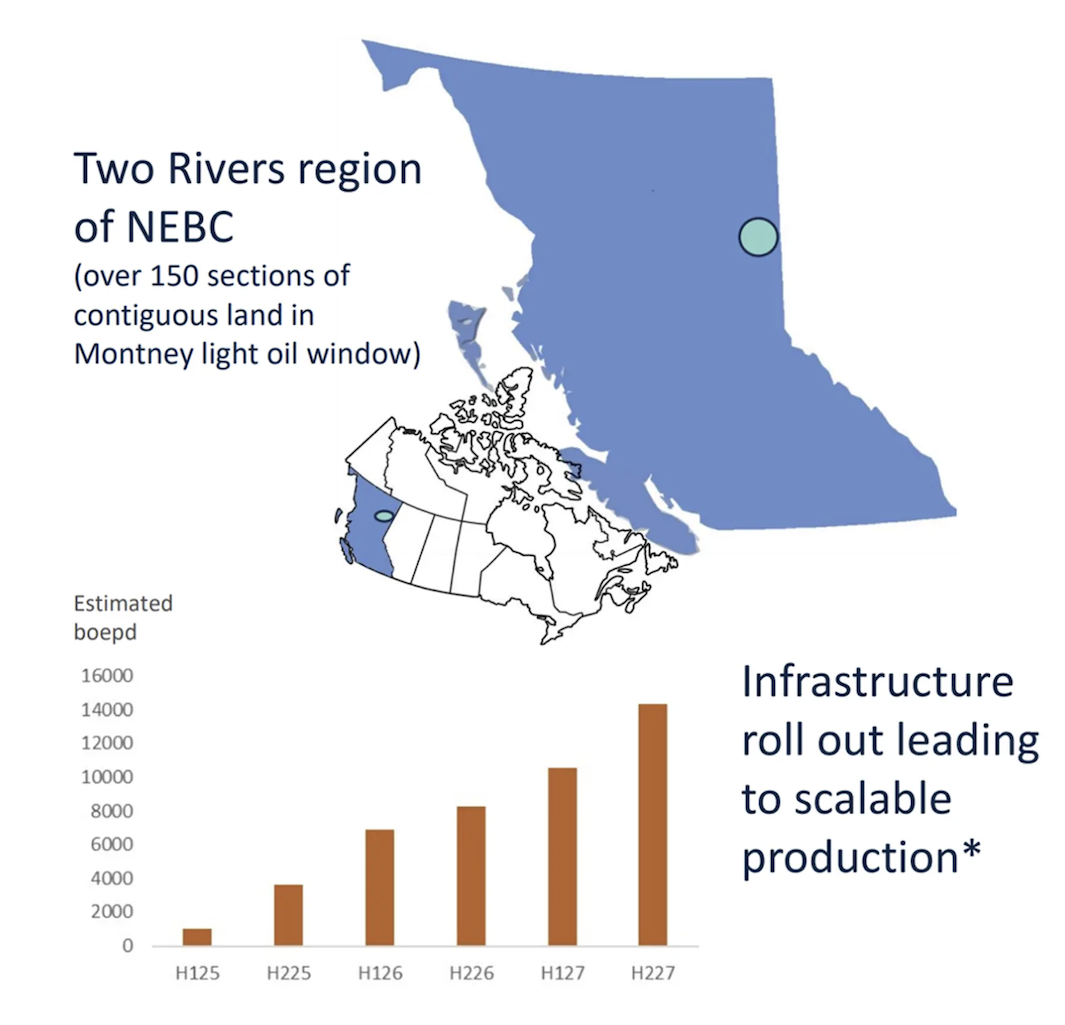
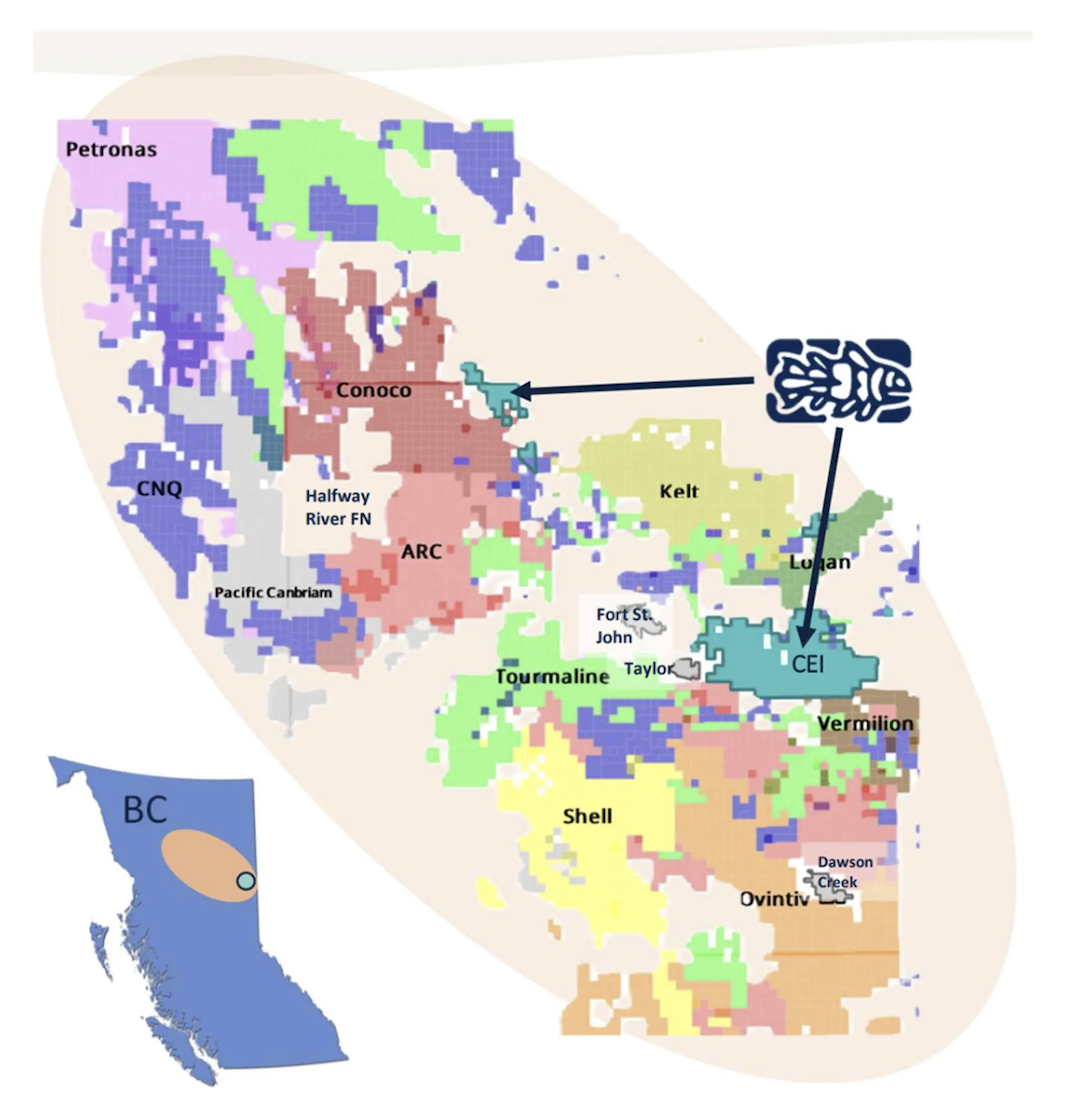
Coelacanth Energy (TSXV:CEI) is a Canadian oil and natural gas exploration and development company focused on the Montney Formation in northeastern British Columbia. The company controls over 150 contiguous sections in the Two Rivers region, a strategically positioned acreage block within the Montney light oil window. As one of the largest landholders in this highly prospective area, Coelacanth has assembled a large-scale resource platform with significant development potential.
The company’s asset base is supported by substantial petroleum initially-in-place estimates prepared by GLJ. These include 6.9 billion barrels of discovered oil PIIP and 8.3 billion barrels of undiscovered oil PIIP, alongside 5.9 Tcf of discovered gas PIIP and 7.1 Tcf of undiscovered gas PIIP. The resource spans multiple Montney intervals, including the Upper, Lower, Basal and Middle Montney, providing extensive opportunities for future development and delineation.
Coelacanth’s strategy combines near-term production growth with long-term resource value creation. The company has secured critical infrastructure, contracted gas takeaway and processing capacity, and advanced development activities across its Two Rivers assets. Average production reached 7,632 boe/d in Q2 2026, reflecting continued progress in transitioning from delineation and infrastructure buildout toward scalable production growth.
A key differentiator for Coelacanth is its leadership team. Management has successfully built and sold six previous public energy companies and has demonstrated an ability to create value through multiple commodity cycles. Supported by deep operational, geological and financial expertise, the team is focused on disciplined execution of the company’s Montney growth strategy.
Company Highlights
- Premier Montney land position: Controls over 150 contiguous sections in the Two Rivers region of northeastern British Columbia, making Coelacanth the largest landholder in the Montney light oil window.
- Substantial hydrocarbons in place: GLJ estimates 6.9 billion barrels of discovered oil PIIP, 8.3 billion barrels of undiscovered oil PIIP, 5.9 Tcf of discovered gas PIIP, and 7.1 Tcf of undiscovered gas PIIP across the company’s Montney acreage.
- Infrastructure-led growth strategy: Key infrastructure, including facilities, pipelines, processing agreements and gas takeaway capacity, has been secured to support scalable production growth.
- Growing production base: Average production reached 7,632 boe/d in Q2 2026, supported by ongoing development at the Two Rivers project.
- Multiple productive Montney horizons: The asset base includes the Upper, Lower, Basal and Middle Montney intervals, providing extensive development opportunities across multiple zones.
- Strong market access: Secured 100 mmcf/d of gas takeaway capacity and up to 60 mmcf/d of processing capacity, with access to major pipeline networks and potential LNG Canada connectivity through Coastal GasLink.
- Proven value-creation team: Management has built and sold six successful energy companies and brings extensive operational, technical and financial expertise to Coelacanth’s development strategy.
Key Project
Two Rivers Montney Development
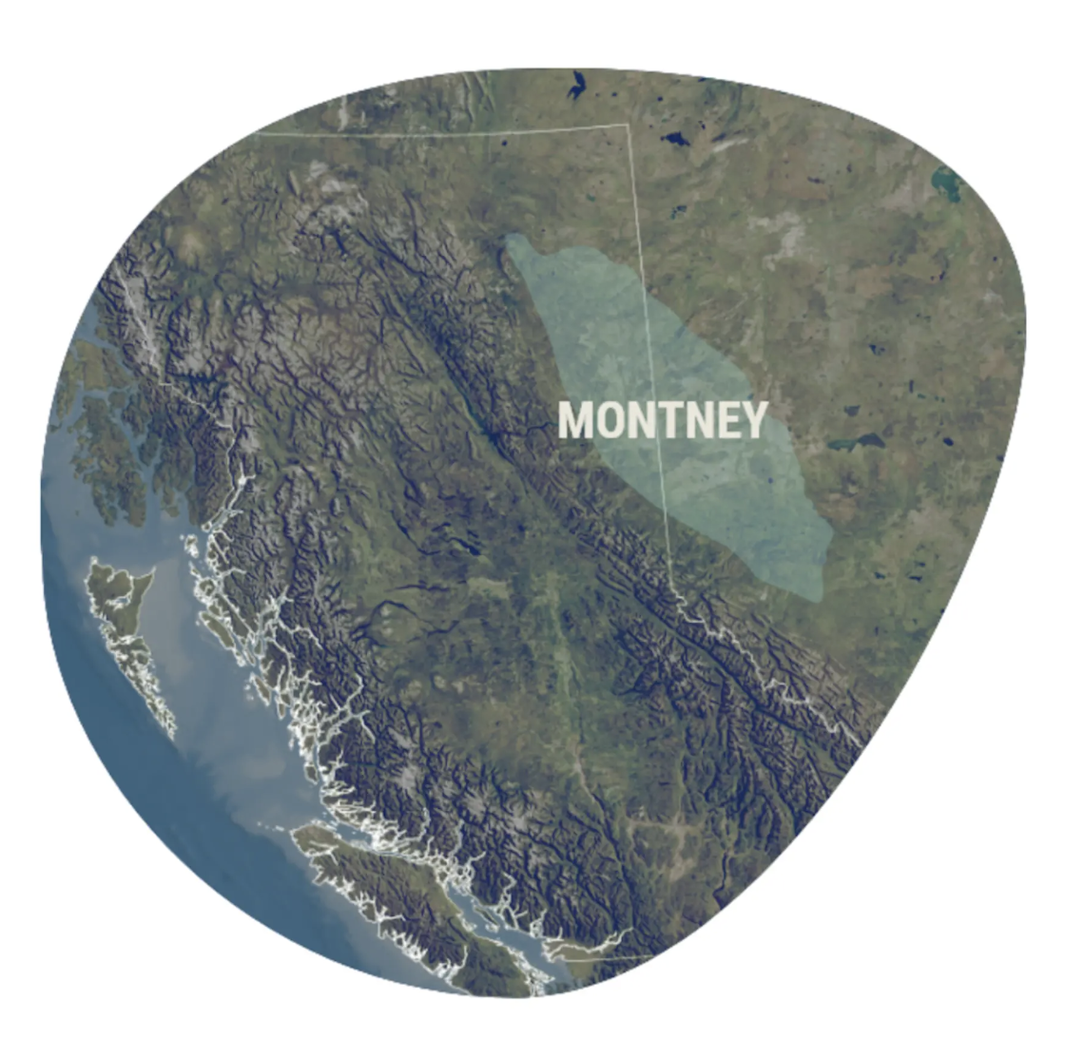
The Two Rivers project forms the cornerstone of Coelacanth’s growth strategy and encompasses the company’s extensive Montney land position in northeastern British Columbia. The project hosts multiple productive horizons, including the Upper, Lower, Basal and Middle Montney intervals, supporting a multi-zone development approach across the acreage. Geological delineation has been completed, providing a strong technical foundation for future drilling and development.
The project has demonstrated commercial productivity through successful drilling and testing programs. Coelacanth established proof of commerciality at both Two Rivers East and Two Rivers West, while development at the 5-19 and 10-08 pads confirmed productivity across multiple Montney benches. All 12 wells on the 5-19 pad were onstream by April 1, 2026, marking a significant milestone in the project’s progression.
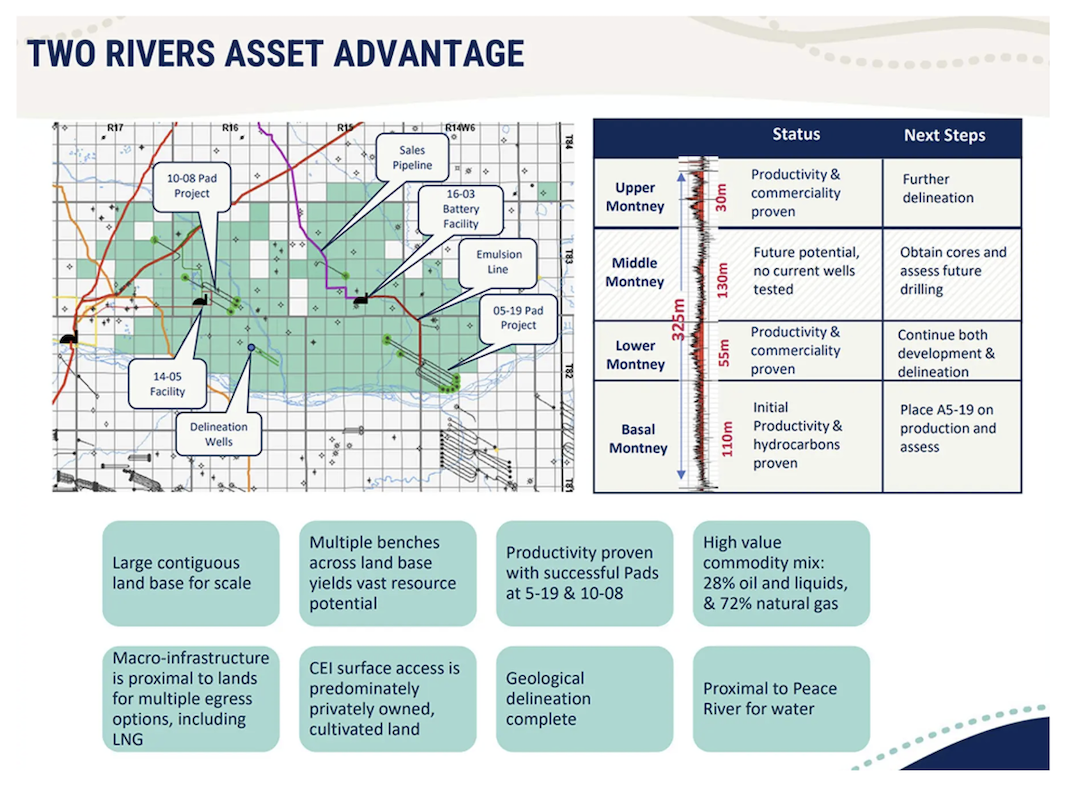
Infrastructure development has been a major focus of the company’s execution strategy. Coelacanth has secured infrastructure financing, completed key facility and pipeline construction, contracted up to 100 mmcf/d of gas takeaway capacity and secured processing capacity of up to 60 mmcf/d. These initiatives establish the infrastructure foundation required to support future production growth.
The Two Rivers asset also benefits from strong market access. The company’s production can access major regional pipeline systems, including NGTL, Westcoast and Alliance, while its acreage is directly connected to LNG Canada through the Coastal GasLink system for potential future delivery. Coelacanth Energy said the long-term view for LNG expansion in British Columbia is very positive for its land, believing that lands with scale and direct access as such will trade at a premium once they are delineated and the resource is proven for development.
Combined with a commodity mix of approximately 31 percent oil and liquids and 72 percent natural gas, the project offers exposure to multiple energy markets.
Management Team
Rob Zakresky – President, CEO and Director
Rob Zakresky is a veteran energy executive who previously served as president and CEO of Leucrotta Exploration, Crocotta Energy, Chamaelo Exploration, Chamaelo Energy, Viracocha Energy and Bellator Exploration. He has a proven track record of building and monetizing public energy companies and leads Coelacanth’s strategic growth and value creation initiatives.
Nolan Chicoine – Vice President of Finance and CFO
Nolan Chicoine previously served as CFO and vice-president finance at Leucrotta Exploration, Crocotta Energy and Chamaelo Exploration, and was controller at Chamaelo Energy and Viracocha Energy. He is responsible for financial strategy, reporting and capital management.
Jody Denis – Vice President of Operations
Jody Denis is a former drilling, engineering and operations engineer at Leucrotta Exploration. His previous experience also includes senior operational and drilling leadership roles with Black Swan Energy, ARC Resources and Birchcliff Energy. He formerly led Coelacanth Energy’s drilling and completions activities.
John Fur – Vice President of Geosciences
John Fur previously served as manager of exploration at Leucrotta Exploration and held senior geophysical positions with Crocotta Energy, Chamaelo Energy, Viracocha Energy, Canadian Natural Resources, Post Energy, Amber Energy and Husky Oil. He oversees geological evaluation and resource delineation across the company’s Montney assets.
Jonathon Hanson — Vice President of Engineering
Jonathon Hanson has 20 years of industry experience. He previously served as manager for exploitation at Spartan Dela Corp, and was a senior exploitation engineer for companies Vermilion Energy, Lynx Energy and Saguaro Resources. He will focus on exploitation and reservoir management for Coelacanth Energy.
Browse Companies
MARKETS
COMMODITIES
CURRENCIES
Originally from Calgary, Georgia has been right at home in Toronto for more than two decades. Graduating from the University of Toronto with an honors BA in journalism, she is passionate about writing on diverse topics, including resources, arts, politics and social issues.
At INN Georgia covers a wide range of topics, including energy, battery and critical metals and diamonds. In her spare time, Georgia enjoys watching documentaries and experiencing Toronto's vibrant food, arts and cultural scene.
Learn about our editorial policies.