The Conversation (0)
Apr. 06, 2026 02:00PM PST
PUKPIK / Adobe Stock
Propelled by surging nuclear demand projections, the spot U3O8 price started 2026 at just over US$80 per pound. Positive fundamentals pushed the energy fuel to US$101.41 on January 29, marking a year-to-date high.
Geopolitical instability in February and March weighed on the spot price as investor sentiment turned to safe-haven assets, and U3O8 tumbled to US$85.50 on February 5, a 15.91 percent decline over seven days.
The pressure continued through March as the war in Iran prevented shipments through the Strait of Hormuz, creating a global energy crisis. By the end of the quarter, the spot price was sitting at US$83.90, representing a 2.52 percent increase from its January start position.
Market challenges were underscored during a Bloor Street Capital virtual uranium conference on March 28.
“We've definitely had a cooling off as people have kind of stepped away and de-risked and taken money off the table in terms of not really knowing how this is all going to play out,” said John Ciampaglia, CEO of Sprott Asset Management.
“But I think the longer-term fundamentals, the story, remain very intact. And we would argue that this recent energy crisis, no matter how long it lasts, is another positive development, longer term, for uranium and nuclear energy.”
SPUT returns to market
A key feature of the quarter was the re-emergence of the Sprott Physical Uranium Trust (TSX:U.U,OTCQX:SRUUF) as an active buyer. After a six month lull tied to capital-raising constraints and macroeconomic uncertainty, the trust moved aggressively in early 2026, purchasing more than 5 million pounds year-to-date.
"When it is on, it really can go,” Ciampaglia noted.
He highlighted a rapid return of investor demand following a January prospectus renewal. Large back-to-back institutional inflows helped drive a surge in buying activity, and briefly pushed U3O8 back to US$100.
While the trust operates under a 9 million pound annual spot purchase cap, Ciampaglia underscored flexibility within its mandate, suggesting additional off-market procurement could extend its buying capacity if needed.
Long-term price sees steady growth
Although the first quarter saw volatility in the spot market, the uranium term market is sending a strong bullish signal, with the long-term contract price climbing to US$90, its highest level since 2008.
According to Ciampaglia, this benchmark, which serves as a reference for future delivery, “has been going up for the last six months,” reinforcing the upward trajectory for uranium pricing.
He noted that the increasing importance of the term price is helping to anchor the spot market. When the spot price drifts too far below long-term levels, market participants step in to arbitrage the gap.
“You’ll have participants come in, buy uranium and basically sell that uranium forward ... and keep that relationship quite tightly tethered,” he explained. This dynamic — commonly referred to as a carry trade — allows traders to capitalize on short-term weakness by locking in spreads between spot and future prices.
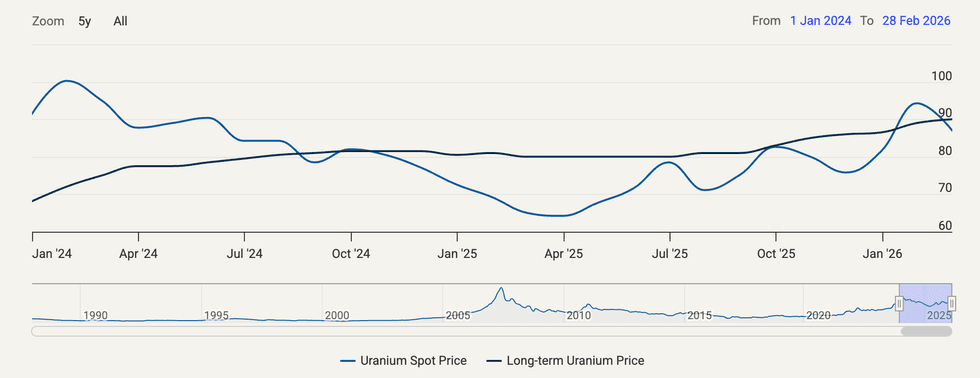
Uranium spot and long-term prices, January 2024 to February 2026.
Chart via Cameco.
As a result, the mechanism has acted as a stabilizing force during recent volatility, cushioning downside moves and preventing a sharper disconnect between spot and term markets.
Long-term uranium demand growing rapidly
According to industry experts who spoke at this year's Prospectors & Developers Association of Canada (PDAC) convention, held in Toronto in early March, the most telling indicator of uranium demand is not the spot market, but the amount of fuel utilities still need to contract for future years.
Grant Isaac, Cameco's (TSX:CCO,NYSE:CCJ) president and chief operating officer, noted that the volume of “uncovered requirements” — future uranium demand not yet secured by utilities — has reached record levels.
“The forward demand that has yet to come to the market has never been bigger,” he said. “Between now and 2045, that is a wall of demand that ultimately cannot be avoided.”
At the same time, utilities have not been contracting uranium at replacement rates since 2012. That means the industry has been consuming fuel faster than it has been replenishing long-term contracts.
The result is a steadily widening supply gap.
Q1 developments in the uranium market underscore a structural shift in demand that remains underappreciated, particularly as sovereign-driven agreements quietly reshape long-term supply dynamics.
According to Isaac, recent contracting activity, including major deals with India and the US, highlights “one of the most unrecognized pieces of uranium demand,” namely the strategic, off-market procurement of fuel tied to national energy security. These bilateral agreements are already translating into substantial, and often overlooked, demand.
Isaac pointed to the US government’s plan to support 10 new reactors, noting that “10 reactors with 10 years' worth of fuel is 65 million pounds of uranium ... (that) nobody had in their mind ahead of time.”
Similarly, Cameco’s agreement with India, announced in March, adds another 20 million pounds, reinforcing the scale of demand emerging outside traditional market channels.
Crucially, uranium demand is not confined to new builds. Reactor life extensions, capacity upgrades and restarts are collectively driving a “more durable demand profile ... than we have ever seen.”
At the same time, the industry faces a growing backlog of uncovered requirements, with utilities yet to secure future supply. Isaac emphasized that this forward demand “has never been bigger in the history of the uranium fuel cycle,” a trend compounded by the fact that utilities have not been contracting at replacement rates since 2012.
Q1's top uranium news stories
Q1 saw a wave of significant uranium deals and corporate developments that reinforced a shift toward long-term, strategic contracting, particularly among sovereign buyers seeking to secure future fuel supply.
The standout transaction came from Cameco, which signed a landmark agreement with India valued at approximately C$2.6 billion. The deal will see the company supply nearly 22 million pounds of uranium over a nine year period beginning in 2027, marking one of the largest bilateral supply agreements in recent years.
Beyond Cameco, the quarter also pointed to intensifying competition among global suppliers.
Kazakhstan’s state producer Kazatomprom signaled it is pursuing its own long-term supply arrangements with India, further illustrating how key buyers are diversifying supply sources through parallel negotiations.
In Canada, Denison Mines' (TSX:DML,NYSEAMERICAN:DNN) Phoenix mine in Saskatchewan’s Athabasca Basin became the first fully permitted uranium mine to enter construction in over a decade.
“We are truly ready to start construction,” Denison CEO David Cates told the Investing News Network at PDAC.
“Because our mine is an in-situ recovery mine, we have a much shorter construction timeline. We're not sinking a shaft or opening a pit. We're not building a big mill,” he said. “We're drilling a series of vertical, or near vertical, wells that are like a water well that'll go from surface into the orebody, and we're building a process plant.”
Cates went on to explain that the style of project also avoids the need for a tailings facility or a large workforce camp, which shortens the construction timeline to about two years, two to three years less than a typical underground mine.
The company is aiming for first production in 2028.
Demand dynamics and tightening supply outlook
Beyond the price volatility seen in Q1, a deeper examination of the uranium market reveals a demand landscape poised for significant expansion, shadowed by a supply side fraught with structural challenges.
Industry analysts project a substantial increase in global nuclear capacity that will inevitably strain available resources.
Speaking at PDAC, Nick Carter, executive vice president at UxC, outlined a trajectory of robust growth.
“In today's market, we have about 441 units producing about 400 gigawatts of electricity,” he noted. “By 2040 we expect that to increase by about 47 percent.” This growth, he explained, is largely concentrated in Asia, with China alone operating 60 reactors and a staggering 38 more under construction.
While Asian markets dominate the expansion, established nuclear powers are also contributing to demand.
Carter noted that Japan is seeing a steady return to service with 14 restarts, and operational improvements in France could add further pressure on fuel supplies. This rising demand is set to collide with a supply landscape that is struggling to keep pace. While 2025 saw world production reach approximately 173 million pounds, primary demand stood at roughly 204 million pounds, creating a deficit that is projected to widen significantly.
Carter’s analysis points to a looming supply gap beginning around 2030 and extending to the end of the next decade.
“Obviously, it's probably going to be a little higher, assuming some of the US reactor demand ... but overall, there's a pretty big supply gap out in the mid-2030s,” the expert stated.
The challenge, according to industry analysts, will be closing this gap.
Carter highlighted a litany of risks that plague new project development and production restarts, from underestimated capital costs and geopolitical instability to supply chain bottlenecks and regulatory delays. He gave specific examples, such as the sulfuric acid shortages that hampered production in Kazakhstan, and the political uncertainties surrounding projects in Mongolia and New Mexico, to underscore the difficulty of bringing new supply online.
“Filling that supply gap will be, in my opinion, quite challenging going forward,” Carter remarked.
Further complicating the supply picture for western markets is a fundamental shift in global trade flows.
Carter noted that a combination of Russian import bans in the US and Europe, coupled with Chinese strategic buying, has redirected vast quantities of uranium.
“China imported a massive amount of uranium, nearly 70 million pounds … that’s literally about 40 percent of the world's primary production that China has a share of in this market,” he explained.
This aggressive purchasing by Beijing and New Delhi is effectively shrinking the pool of material available to western utilities, adding a new geopolitical imperative to secure non-Russian, western-aligned supply chains.
Looking ahead to the remainder of 2026, the market is expected to remain influenced by financial players rather than utilities demand. While funds like the Sprott trust have been active buyers, their purchasing capacity is finite.
However, the UxC analyst pointed to potential new sources of demand, including small-scale producers that may be forced to buy on the spot market to meet commitments, and the continued emergence of new investment vehicles drawn by the artificial intelligence narrative around nuclear power.
The outlook suggests a market defined by competing forces: bullish long-term demand underpinned by structural supply constraints, set against a near-term environment of financial speculation and shifting geopolitical realities.
Don’t forget to follow us @INN_Resource for real-time updates!
Securities Disclosure: I, Georgia Williams, hold no direct investment interest in any company mentioned in this article.
Editorial Disclosure: The Investing News Network does not guarantee the accuracy or thoroughness of the information reported in the interviews it conducts. The opinions expressed in these interviews do not reflect the opinions of the Investing News Network and do not constitute investment advice. All readers are encouraged to perform their own due diligence.
From Your Site Articles
- Uranium Stocks: 5 Biggest Companies ›
- Top 10 Uranium-producing Countries ›
- Uranium Reserves: Top 5 Countries ›
- When Will Uranium Prices Go Up? ›
Related Articles Around the Web
TSXV:AEC
https://x.com/INN_Resource
https://www.linkedin.com/in/georgia-williams-15845447/
gwilliams@investingnews.com

Featured Uranium Investing Stocks
Investor Insight
Generation Uranium offers investors high-leverage exposure to a potential major discovery in Canada’s underexplored and resource-rich Thelon Basin, led by a management team with a proven track record of securing high-value exits.
Overview
Generation Uranium (CSE:GEN, OTCQB:GENR, FRA:W85) is a Canadian exploration company focused on wealth creation through discovery within the uranium sector. The company’s primary strategy is to build a high-caliber exploration team that can rapidly test and drill high-potential targets, de-risking projects for potential takeover by larger producers. Currently centered in the prolific Thelon and Angikuni Basins of Nunavut, the company is also actively evaluating additional project acquisitions in the Athabasca Basin to expand its portfolio.
The company is led by a veteran management team with nearly 30 years of experience in mineral development. CEO Michael Collins has a significant track record of building and exiting public companies, including the co-founding of Bluerock Resources, a conventional uranium producer during the 2000-2008 cycle. This expertise is paired with a focused business model that leverages modern geophysical targeting to accelerate exploration timelines and reduce costs, ensuring the company can deliver results quickly in a bullish uranium market.
Company Highlights
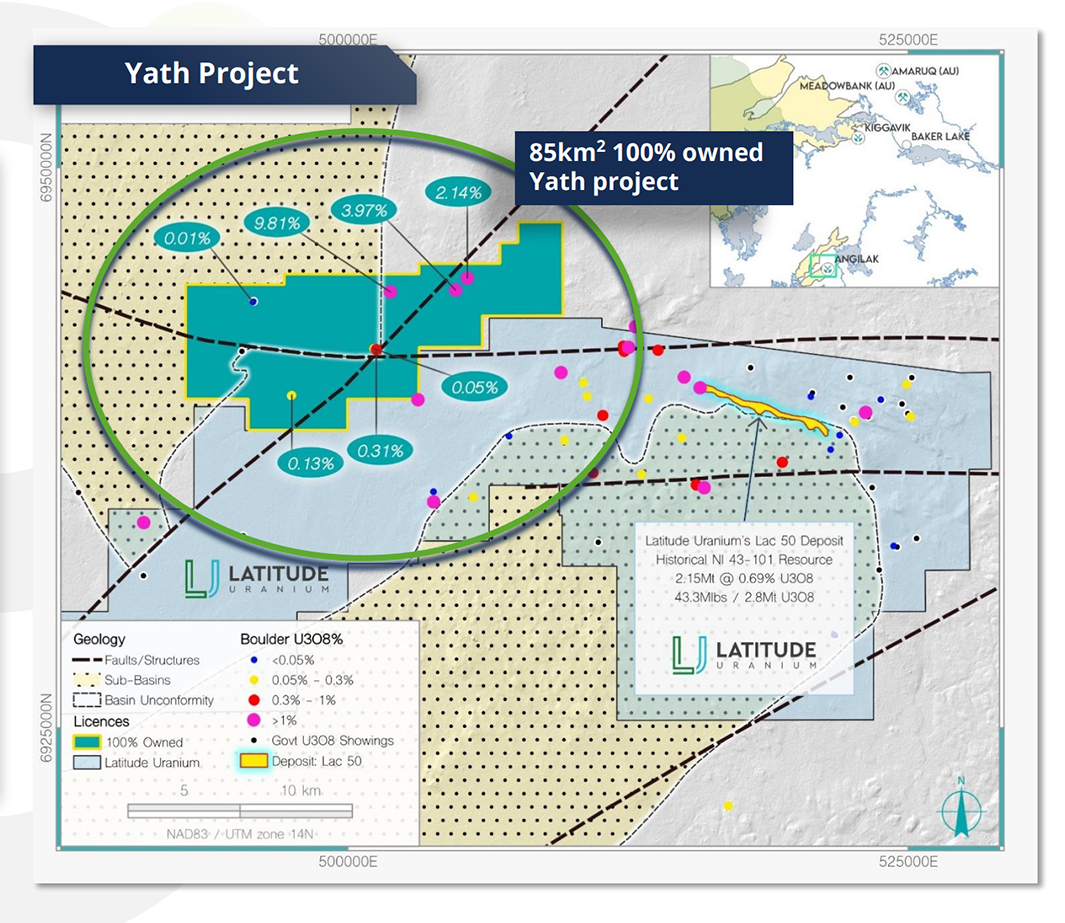
- Strategic Location in a Premier Uranium District: The flagship Yath Project is located in Nunavut’s Thelon Basin, contiguous to ATHA Energy’s Angilak Project, which hosts the high-grade Lac 50 deposit.
- High-Grade Discovery Potential: Historical surface sampling at the Yath Project has yielded exceptional uranium grades, including boulders testing at 9.81 percent, 3.95 percent, and 2.14 percent U3O8.
- Expert Management with Exit Experience: Led by CEO Michael Collins, the team has decades of experience in mineral exploration and a history of co-founding companies that were later acquired, such as Prime Mining and Nuclear Fuels.
- Low-Cost, Rapid Exploration Strategy: By leveraging modern geophysics and extensive historical data, the company aims for a "short road to discovery," de-risking projects quickly to maximize shareholder value.
- Bullish Market Fundamentals: Generation Uranium is well-positioned to meet the growing global demand for carbon-free nuclear power, supported by a projected supply deficit and increased interest from major tech companies seeking clean energy.
Key Project
Yath Project - Nunavut, Canada
The Yath Project is Generation Uranium’s flagship project. This 100 percent owned property covers about 120 square kilometers within the underexplored Thelon Basin in Nunavut, Canada. The project is located where the Yathkyed and Angikuni sub-basins meet, which is a region known globally for high-grade uranium potential. It sits directly along the same trend as the Angilak Project owned by ATHA Energy (TSXV:SASK, OTCQB:SASFK, FWB:XSU.F), which contains the Lac 50 deposit, one of the highest-grade uranium resources found outside of the Athabasca Basin with a historical mineral resource estimate of 43.3M lbs at an average grade of 0.69 percent U3O8.
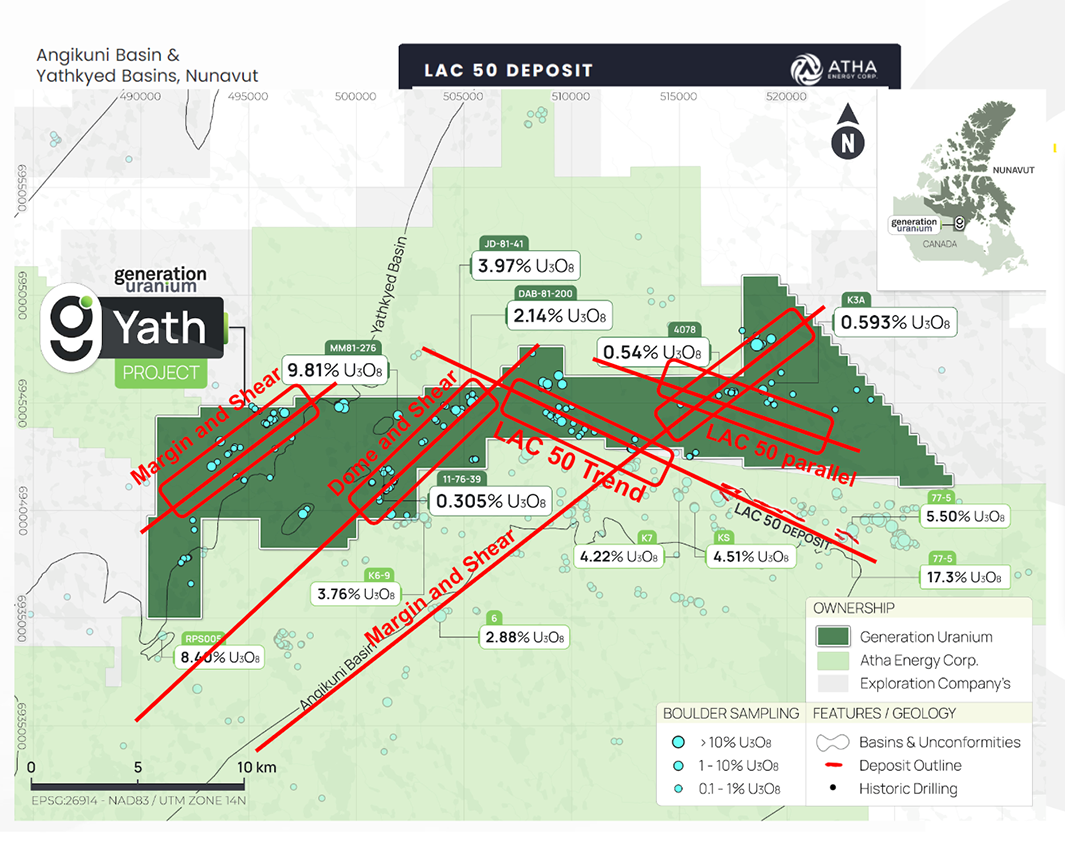
The Yath Project is contiguous to the Lac 50 trend and is crossed by several regional faults and basin boundaries. Past exploration work has already identified high priority targets, while surface sampling in the area has produced uranium grades from boulders, with some testing at 9.81 percent, 3.95 percent, and 2.14 percent U3O8.
The company has commenced its initial field program at the site, set to define and rank drill targets. Historic showings will be combined with new anomalies from the MMT geophysics survey, preparing the project for an anticipated drill permit.
Management Team
Michael Collins - CEO & Director
Michael Collins is a professional geoscientist with nearly 30 years of experience in mineral exploration. He has co-founded several public companies, including Exploits Discovery, Prime Mining (acquired in 2025), and Nuclear Fuels (merged with Premier American Uranium in 2025). He is also currently a director of First Atlantic Nickel.
Christoph Bruening - Director
Christoph Bruening is the founder and managing partner of Value Relations GmbH, a full-service investor relations and public relations agency in Frankfurt with over 25 years of excellence, focusing on mining, exploration, biotech and health care. In addition, he has listed over 600 companies on the Frankfurt Stock Exchange and is a speaker and author of several publications, including on rare earths and uranium.
Dallas Miller - Director
Dallas Miller has been working within the international mining industry for over 15 years, working with BHP and Santos Ltd. He has experience on the ground from an operational standpoint, as well as being an integral part of raising millions of dollars in capital funding for both private and public companies in recent years.
Roger Leschuk - VP Corporate Development
Roger Leschuk has been in corporate management for over two decades, with the past 15 years dedicated to corporate development and investor relations. He has experience participating in and assisting with mergers and acquisitions, and was an investment advisor for various services such as stocks, mutual funds and tax-sheltered investments. He is a Chartered Investment Manager and a Fellow of the Canadian Securities Institute.
Monty Sutton - CFO
Monty Sutton brings over 35 years of experience in public markets and corporate governance. He previously served as CFO for Nuclear Fuels from its IPO through its acquisition.
Investor Insight
Metals.io is a real-world asset platform built within the Tezos ecosystem, enabling direct investment exposure across uranium, gold, cobalt, nickel, and a diversified basket of strategic metals via tokenization. It reflects the ecosystem’s expansion into precious metals, rare earth elements, and critical minerals that underpin energy systems, industrial supply chains, and advanced technologies.
Overview
Metals.io is a unified real-world asset platform built on Tezos infrastructure, designed to simplify access to physically backed commodities through blockchain tokenization. It enables investors to gain exposure to uranium, gold, and strategic metals through a single digital interface, reducing fragmentation, limited accessibility, and opacity traditionally associated with commodity markets.

The platform builds on the foundation of tokenized uranium and expands into a broader multi-asset framework aligned with growing global demand for critical resources. Uranium remains central due to its role in nuclear energy and long-term decarbonization efforts, while gold continues to function as a global store of value in periods of macroeconomic uncertainty.
Alongside these core assets, Metals.io incorporates exposure to strategic and rare earth metals that are increasingly vital to modern industrial systems. These materials underpin semiconductors, electrification, defense technologies, and AI-driven infrastructure, reflecting their growing importance in global supply chains.
By integrating blockchain infrastructure with real-world commodity markets, Metals.io enables fractional ownership, real-time settlement, 24/7 global trading access, and programmable financial utility. The platform represents a streamlined gateway to tokenized commodities that are central to both energy transition and technological advancement.
As of June 2026, the company has also purchased and tokenized cobalt and nickel, allowing investors to own the metals through xCo and xNi tokens. This allows for easier access, ownership and trading of both metals, which are utilized in high-demand sectors such as electric vehicles, battery storage systems and clean energy technologies.
Company Highlights
- Multi-Asset Commodity Platform: Provides access to tokenized uranium (xU3O8), cobalt (xCo), nickel (xNi), gold (VNXAU), a diversified strategic metals basket (RARE) through a single interface, with more coming soon
- Built on Tezos: Utilizes Tezos smart-rollup technology to enable scalable, low-latency and energy-efficient real-world asset tokenization.
- Physically Backed Assets: Tokens represent ownership of underlying physical commodities or allocated reserves, ensuring a direct link between digital assets and real-world commodity.
- Institutional-Grade Custody: Archax, an FCA-regulated digital asset custodian, provides secure and compliant custody, with uranium stored in regulated facilities operated by Cameco, and physical nickel and cobalt stored at industry-certified bonded warehouses in the Netherlands
- Established Supply Chain: Curzon Uranium supports sourcing and logistics for uranium; Steinweg / C. Steinweg are physical custodian of the underlying cobalt and nickel; while VNX and Noemon Tech contribute gold and strategic metals exposure.
- Global Market Access: Enables 24/7 access to tokenized commodities through digital asset infrastructure, supporting broader investor participation.
- Enhanced Market Transparency: Integrates pricing and data systems aimed at improving visibility in traditionally opaque commodity markets.
- On-Chain Financial Utility: Tokenized commodities can be used within decentralized finance applications, enabling liquidity access without selling underlying assets.
- Aligned with Global Demand Trends: Provides exposure to commodities central to nuclear energy, monetary hedging, industrial production, and advanced technologies, including AI and electrification.
Key Assets
xU3O8 – Tokenized Uranium

xU3O8 provides direct exposure to physically backed uranium ore concentrate, a core input in nuclear energy generation. Each token represents ownership of uranium stored in regulated facilities, enabling fractional access to a historically institutional market.
Uranium plays a critical role in the global energy transition as nuclear power expands to meet rising electricity demand and decarbonization targets. xU3O8 enables investors to participate in this sector through a transparent, digitally accessible structure linked to physical supply.
On July 2026, Metals.io announced that xU3O8 is now available for trading on global crypto platforms Kraken and Kraken Pro. Aside from the Metals.io website, xU3O8 is also accessible via Gate, KuCoin, MEXC, Bitrue, LBank, BingX, the decentralized exchange Hanji and uranium.io.
The company highlighted the value of access to uranium with fractional ownership, no minimums, 24/7 global availability and near-instant settlement, providing individual investors with ownership options amidst the growing global electricity demand.
VNXAU – Tokenized Gold

VNXAU represents allocated physical gold stored in secure, regulated vaults. Each token reflects direct ownership of gold reserves, combining the stability of gold as a traditional store of value with the efficiency and divisibility of blockchain infrastructure.
Gold continues to serve as a hedge against inflation, currency volatility, and macroeconomic uncertainty. Tokenization enhances accessibility and transferability while preserving full physical backing.
RARE – Strategic Metals Basket

RARE provides diversified exposure to strategic and rare earth metals essential to modern industrial and technological systems. The basket includes metals used in semiconductors, renewable energy infrastructure, defense technologies, and advanced manufacturing.
As global supply chains tighten and demand accelerates for critical inputs, strategic metals have become increasingly important to economic and technological resilience. RARE enables diversified exposure through a single tokenized instrument.
xCo - Tokenized Cobalt
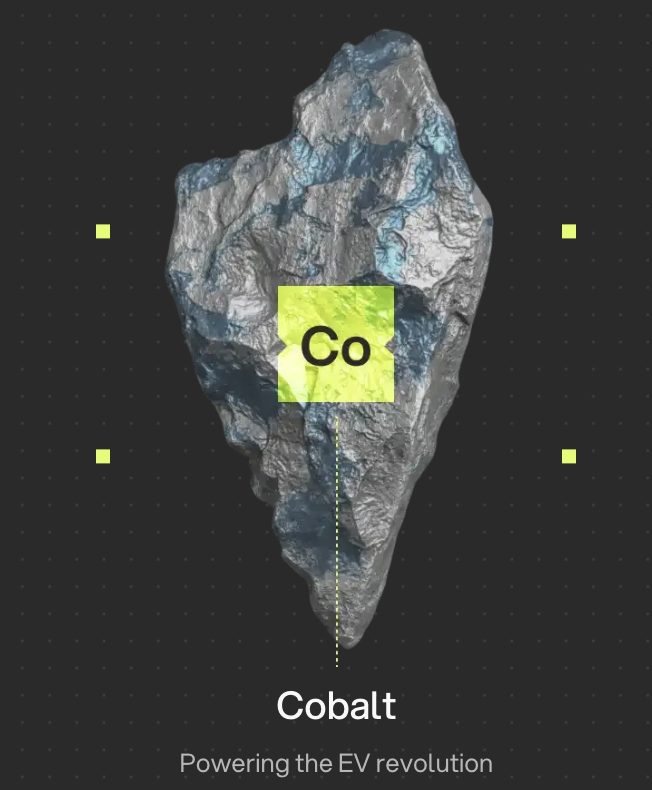
xCo enables investors to own and trade physical cobalt in an investment-friendly and transparent manner by administering fractional ownership of physical cobalt in the form of a smart contract ledger. Each xCo represents a right of ownership of cobalt held by Archax as a trustee for investors.
Over 70% of cobalt comes from one country. Supply is tightening as the DRC (Democratic Republic of Congo) caps exports at 96,600 metric tons per year. Global EV (Electric Vehicle) battery demand is projected to increase cobalt consumption.
xNi - Tokenized Nickel
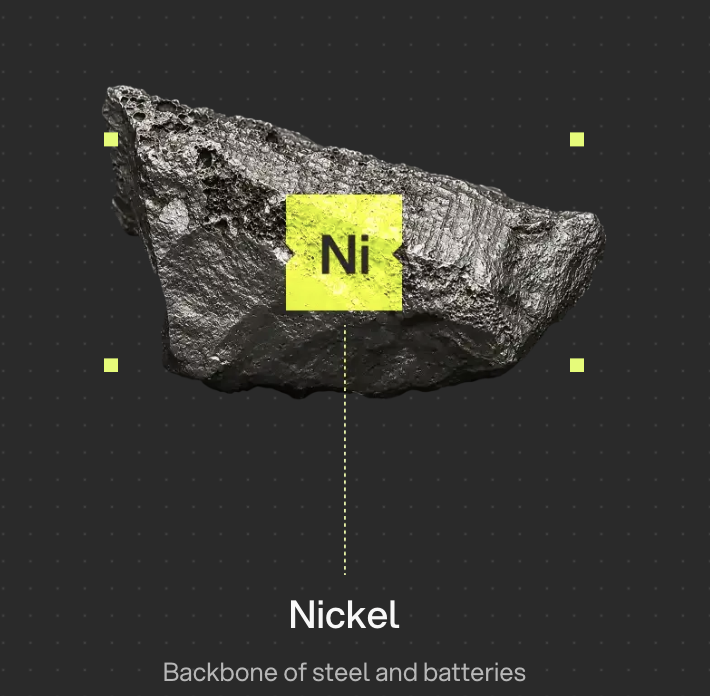
xNi enables investors to own and trade physical nickel in an investment-friendly and transparent manner by administering fractional ownership of physical nickel in the form of a smart contract ledger. Each xNi represents a right of ownership of nickel held by Archax as a custodian for investors.
Nickel powers the modern industry, essential for stainless steel and increasingly critical for EV (Electric Vehicle) batteries. Indonesia controls over 60% of supply and is tightening quotas. Trade restrictions, export bans, and policy shifts influence price movements, making real-time investment access vital.Key Technology Platform

Tezos Infrastructure
Metals.io is built on Tezos smart-rollup architecture, enabling high-speed execution, low latency, and scalable tokenization of real-world assets.
Physically Backed Asset Framework
Each token is backed by physical commodities or allocated reserves, ensuring verifiable linkage between digital assets and underlying real-world holdings across uranium, gold, cobalt, nickel, and strategic metals.

Institutional Custody & Supply Chain
- Archax provides FCA-regulated custody
- Cameco-operated facilities store uranium reserves
- Curzon Uranium manages sourcing and logistics for Uranium
- VNX supports allocated gold issuance structures
- Steinweg / C. Steinweg are physical custodian of the underlying nickel and cobalt, with material held in LME (London Metals Exchange)-approved or equivalent warehouse facilities
Market Infrastructure
Metals.io incorporates pricing and transparency systems designed to improve visibility in historically opaque commodity markets, particularly uranium and strategic metals.
On-Chain Utility
Tokenized commodities can be used as collateral in decentralized finance applications, enabling access to liquidity without requiring asset liquidation; currently available for Uranium and being expanded to other metals.
Learn about our editorial policies.