The Conversation (0)
Dec. 13, 2012 04:30AM PST
Although volatility still hangs over the market, bullish sentiment from most industry analysts dominates any discussion of uranium’s long-term outlook.

Uranium industry consultancy firm TradeTech is reporting a U3O8 spot price of $43.50 per pound, up a dollar from the previous week on “increased buying interest,” although volatility still hangs over the market.
Bullish sentiment from most industry analysts still dominates any discussion of uranium’s long-term outlook. News that BHP Billiton (NYSE:BHP,ASX:BHP,LSE:BLT) is shutting down its uranium division after shelving expansion plans at Olympic Dam earlier this year — on top of production cutbacks from big names such as Cameco (TSX:CCO,NYSE:CCJ), Uranium One (TSX:UUU) and Paladin Energy (TSX:PDN,ASX:PDN) — has only encouraged analysts’ strong belief in a positive long-term outlook for uranium prices.
“Low prices are pushing expansions off or canceling them altogether, which is negative from a company standpoint but is actually positive from a long-term supply-demand perspective,” David Talbot, a senior mining analyst at Dundee Securities, told The Energy Report in a recent interview.
Both Talbot and Rob Chang, metals and mining equity research analyst at Cantor Fitzgerald, spoke to Uranium Investing News (UIN) last month about the looming supply deficit. In the coming years, there won’t be enough new production coming online to meet rising uranium demand from burgeoning nuclear programs in nations including China, India and Russia. “Mines aren’t coming online as quickly as reactors are and that is increasing the likelihood of a nuclear fuel shortage in the coming years,” Talbot told UIN.
This week, Russian enrichment plant Siberian Chemical Combine — part of state-controlled nuclear company Rosatom — received its first shipment of uranium from Energy Resources of Australia (ASX:ERA). In 2007, Australia and Russia signed a nuclear cooperation agreement that allows for the sale of Australia-mined uranium to fuel Russia’s nuclear power plants. India is also turning to Australia and Canada to meet its rising demand for nuclear fuel, securing nuclear cooperation agreements that include uranium exports with both countries. By 2050, the Southeast Asian nation hopes to generate 25 percent of its electricity from nuclear power.
Company news
Last week, Alpha Minerals (TSXV:AMW) and its joint venture partner (50 percent), Fission Energy (TSXV:FIS), reported assay results from the recently completed drill program at their Patterson Lake South uranium property in Saskatchewan. The nine-hole, 1,631.86-meter core drilling program focused on the partially tested PL-3B EM Conductor. Highlights from the results include hole PLS12-024, which returned assays of 18 meters at 1.78 percent U3O8 from 65 to 83 meters; 12.5 meters at 2.49 percent U3O8 from 65.5 to 78 meters; 3.5 meters at 4.33 percent U3O8 from 66.5 to 70 meters; and 0.5 meters at 11.1 percent U3O8 from 69.5 to 70 meters.
A 2013 winter drill program is planned and will include additional core drilling to both define the mineralized area established by these latest results and test a number of similar targets.
On Monday, Uranium Energy (AMEX:UEC) announced its fiscal 2013 first-quarter financial and production results, noting that 29,000 pounds of U3O8 were produced by production areas one and two at the Palangana mine, while 31,000 pounds of U3O8 were processed at the Hobson facility. Uranium Energy’s financial review for the three months ended October 31, 2012 shows recorded revenue of $2.2 million resulting from the sale of 50,000 pounds of U3O8 at an average sales price of $43 per pound. Minus the cost of sales including royalties ($1.9 million), the company’s gross profit was $0.3 million.
Uranium Energy also reported that its Goliad ISR project has received all the required permits from the Texas Commission on Environmental Quality. The company is now advancing construction at the project in preparation for production.
Also on Monday, Macusani Yellowcake (TSXV:YEL) reported further high-grade intersections from the drill program at its Kihitian property in Southeastern Peru. The ongoing drill work has targeted the Quebrada Blanca anomaly and 4,511 meters of drilling have been completed to date. Results from the initial 10 holes were reported in a news release dated October 17, 2012.
“Drill holes PT-QB44-TV and PT-QB36-TV appear to have discovered a new mineralized horizon occurring at depths between 80 to 100 metres below manto ‘B,’” states Monday’s news release. “This new mineralized sequence, also intercepted in hole 42V, has a thickness of 7-8 m and grades ranging from 0.25 to 0.65 lbs/ton.”
On Tuesday, Peninsula Energy (ASX:PEN) announced that it has entered into an agreement with ARSA to pay $50 million for its South African uranium and molybdenum assets, including the largest single body of known uranium-molybdenum mineralization in the Karoo Basin.
“The Company has acquired a significant uranium and molybdenum portfolio which adds substantially to our existing asset base in the Karoo and our plans to develop a second mining operation in South Africa following the successful ramp up of Lance,” stated Gus Simpson, Peninsula’s executive chairman.
Also on Tuesday, Khan Resources (CNSX:KRI) provided shareholders with an update concerning its international arbitration action against the government of Mongolia. The company has submitted a claim for damages totaling US$326 million, including interest from the July 2009 date of the expropriation of the Dornod deposit by the Mongolian government.
The case is being heard by the United Nations (UN) Commission on International Trade Law. The Mongolian government has until April 5, 2013 to respond and then Khan will have until June 28, 2013 to respond to its defence. The UN Tribunal will meet in November 2013 to hear the claim and a ruling is expected in the first half of 2014.
Khan is also pursuing litigation in Ontario’s Superior Court against Russian uranium producer ARMZ over the allegedly illegal expropriation of the Dornod deposit. Khan has filed a $300-million claim against ARMZ for “an alleged breach of fiduciary duties and damage to its rights, reputation, and property,” reported the Russian Legal Information Agency (RAPSI). Russia’s Justice Ministry refused to serve ARMZ with process, so Khan filed a motion with the Canadian court to validate the service of process, according to RAPSI. The court initially held for Khan, but ARMZ successfully appealed, saying that Khan had not exhausted all process service options. Khan is now appealing that decision.
Securities Disclosure: I, Melissa Pistilli, hold no direct investment interest in any company mentioned in this article.
Featured Energy Investing Stocks
Investor Insight
Generation Uranium offers investors high-leverage exposure to a potential major discovery in Canada’s underexplored and resource-rich Thelon Basin, led by a management team with a proven track record of securing high-value exits.
Overview
Generation Uranium (CSE:GEN, OTCQB:GENR, FRA:W85) is a Canadian exploration company focused on wealth creation through discovery within the uranium sector. The company’s primary strategy is to build a high-caliber exploration team that can rapidly test and drill high-potential targets, de-risking projects for potential takeover by larger producers. Currently centered in the prolific Thelon and Angikuni Basins of Nunavut, the company is also actively evaluating additional project acquisitions in the Athabasca Basin to expand its portfolio.
The company is led by a veteran management team with nearly 30 years of experience in mineral development. CEO Michael Collins has a significant track record of building and exiting public companies, including the co-founding of Bluerock Resources, a conventional uranium producer during the 2000-2008 cycle. This expertise is paired with a focused business model that leverages modern geophysical targeting to accelerate exploration timelines and reduce costs, ensuring the company can deliver results quickly in a bullish uranium market.
Company Highlights
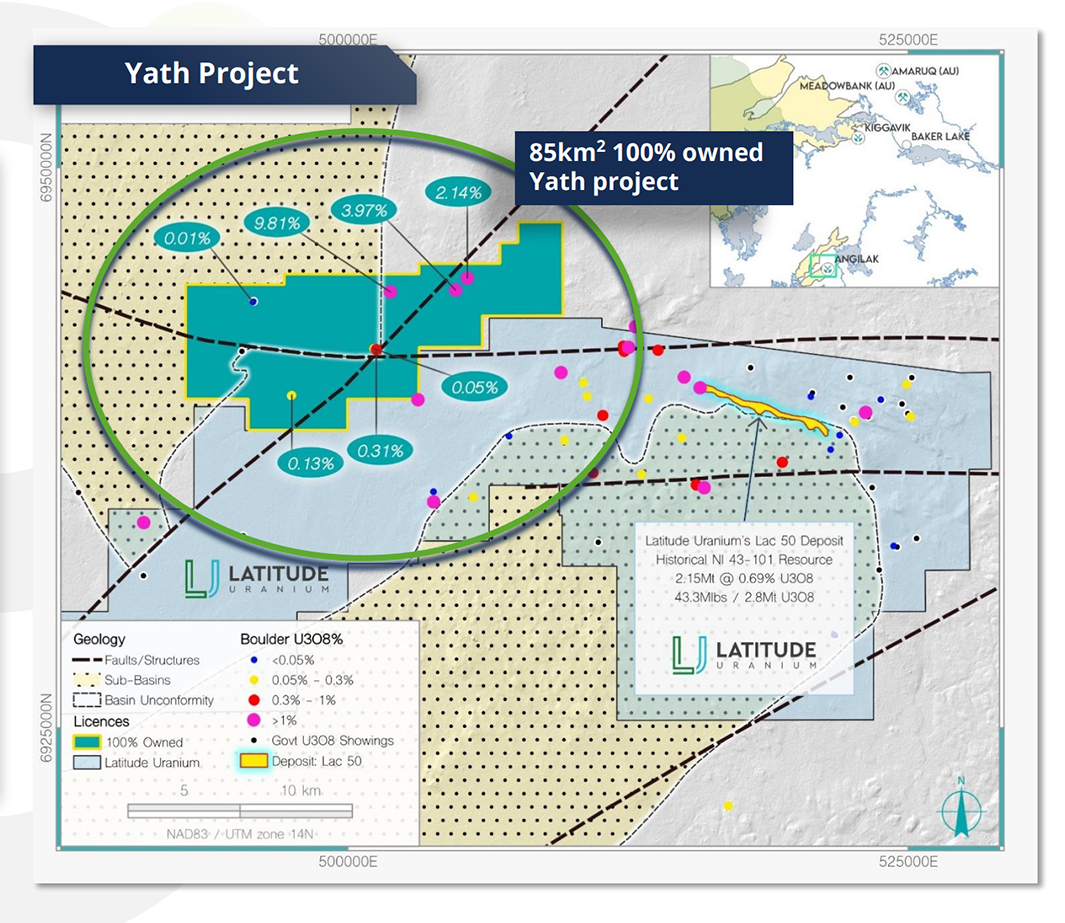
- Strategic Location in a Premier Uranium District: The flagship Yath Project is located in Nunavut’s Thelon Basin, contiguous to ATHA Energy’s Angilak Project, which hosts the high-grade Lac 50 deposit.
- High-Grade Discovery Potential: Historical surface sampling at the Yath Project has yielded exceptional uranium grades, including boulders testing at 9.81 percent, 3.95 percent, and 2.14 percent U3O8.
- Expert Management with Exit Experience: Led by CEO Michael Collins, the team has decades of experience in mineral exploration and a history of co-founding companies that were later acquired, such as Prime Mining and Nuclear Fuels.
- Low-Cost, Rapid Exploration Strategy: By leveraging modern geophysics and extensive historical data, the company aims for a "short road to discovery," de-risking projects quickly to maximize shareholder value.
- Bullish Market Fundamentals: Generation Uranium is well-positioned to meet the growing global demand for carbon-free nuclear power, supported by a projected supply deficit and increased interest from major tech companies seeking clean energy.
Key Project
Yath Project - Nunavut, Canada
The Yath Project is Generation Uranium’s flagship project. This 100 percent owned property covers about 120 square kilometers within the underexplored Thelon Basin in Nunavut, Canada. The project is located where the Yathkyed and Angikuni sub-basins meet, which is a region known globally for high-grade uranium potential. It sits directly along the same trend as the Angilak Project owned by ATHA Energy (TSXV:SASK, OTCQB:SASFK, FWB:XSU.F), which contains the Lac 50 deposit, one of the highest-grade uranium resources found outside of the Athabasca Basin with a historical mineral resource estimate of 43.3M lbs at an average grade of 0.69 percent U3O8.
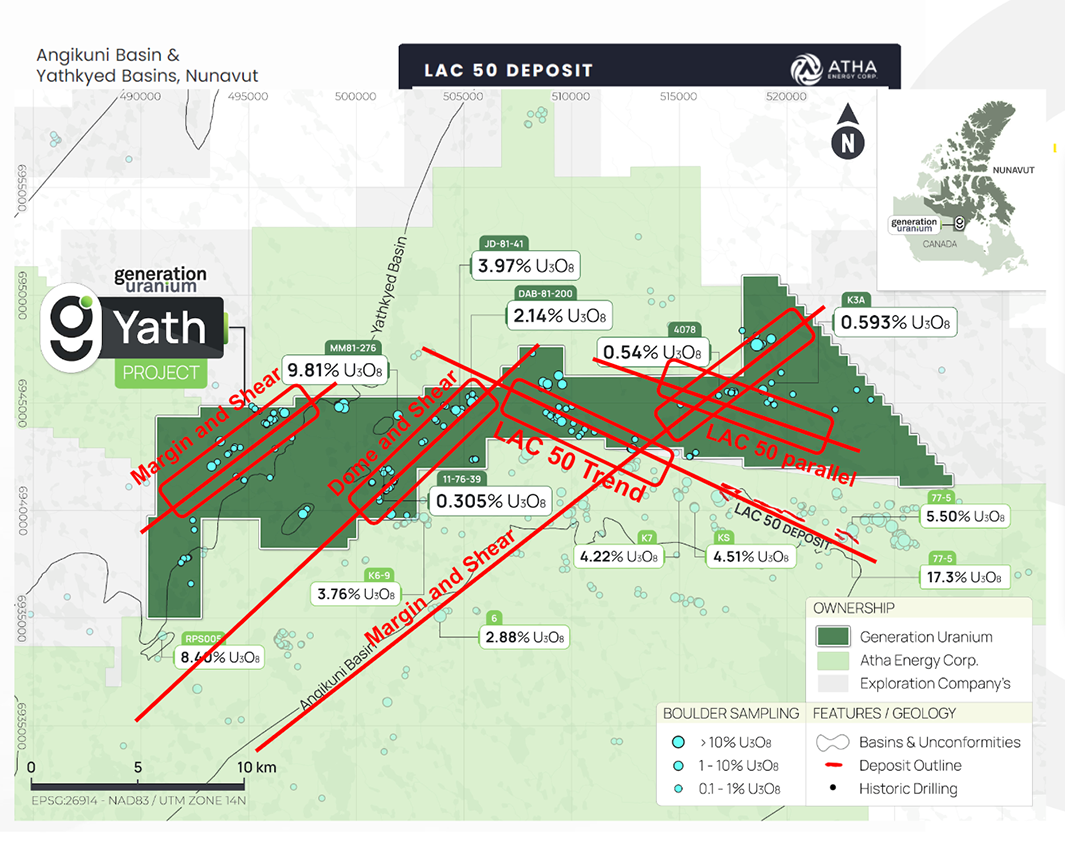
The Yath Project is contiguous to the Lac 50 trend and is crossed by several regional faults and basin boundaries. Past exploration work has already identified high priority targets, while surface sampling in the area has produced uranium grades from boulders, with some testing at 9.81 percent, 3.95 percent, and 2.14 percent U3O8.
The company has commenced its initial field program at the site, set to define and rank drill targets. Historic showings will be combined with new anomalies from the MMT geophysics survey, preparing the project for an anticipated drill permit.
Management Team
Michael Collins - CEO & Director
Michael Collins is a professional geoscientist with nearly 30 years of experience in mineral exploration. He has co-founded several public companies, including Exploits Discovery, Prime Mining (acquired in 2025), and Nuclear Fuels (merged with Premier American Uranium in 2025). He is also currently a director of First Atlantic Nickel.
Christoph Bruening - Director
Christoph Bruening is the founder and managing partner of Value Relations GmbH, a full-service investor relations and public relations agency in Frankfurt with over 25 years of excellence, focusing on mining, exploration, biotech and health care. In addition, he has listed over 600 companies on the Frankfurt Stock Exchange and is a speaker and author of several publications, including on rare earths and uranium.
Dallas Miller - Director
Dallas Miller has been working within the international mining industry for over 15 years, working with BHP and Santos Ltd. He has experience on the ground from an operational standpoint, as well as being an integral part of raising millions of dollars in capital funding for both private and public companies in recent years.
Roger Leschuk - VP Corporate Development
Roger Leschuk has been in corporate management for over two decades, with the past 15 years dedicated to corporate development and investor relations. He has experience participating in and assisting with mergers and acquisitions, and was an investment advisor for various services such as stocks, mutual funds and tax-sheltered investments. He is a Chartered Investment Manager and a Fellow of the Canadian Securities Institute.
Monty Sutton - CFO
Monty Sutton brings over 35 years of experience in public markets and corporate governance. He previously served as CFO for Nuclear Fuels from its IPO through its acquisition.