The Conversation (3)
Jun. 05, 2026 02:00PM PST
|Fact CheckedThis article has been reviewed and updated according to INN's rigorous fact-checking process. Our staff editors verify all articles against information and data from primary sources, reputable publishers and experts.
Explore the week's best-performing Canadian mining stocks on the TSX, TSXV and CSE, and dive into the Canadian and US news affecting commodities prices and stock markets.
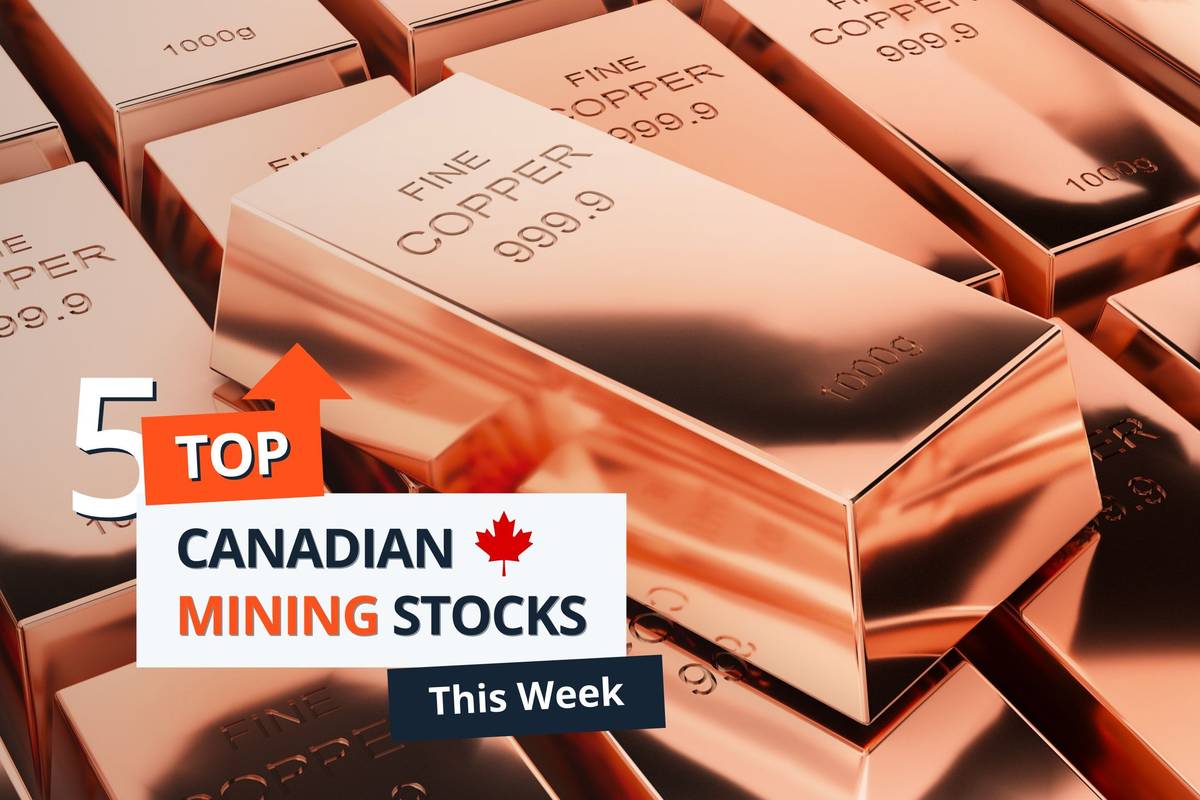
Welcome to the Investing News Network's weekly look at the best-performing Canadian mining stocks on the TSX, TSXV and CSE, starting with a round-up of Canadian news impacting the resource sector.
Statistics Canada released May’s Labor Force Survey on Friday (June 5).
The data shows that the Canadian economy added 88,000 jobs over the month, significantly higher than the 10,000 analysts had expected. On a year-on-year basis, the country added 147,000 new jobs.
May’s numbers offset a significant portion of the 112,000 net job loss seen in the first four months of 2026.
The biggest increase was from the construction industry, which added 27,000 new workers, followed by the information, culture and recreation sector, and the transportation and warehousing sector; both categories added 19,000 jobs.
The resource sector, which includes mining, quarrying and oil and gas, experienced a 0.5 percent decline, shedding 1,800 workers; however, the sector still showed positive growth from May 2025, adding 5,700 roles year-on-year.
Last week, Statistics Canada reported that the Canadian economy had entered a technical recession after posting negative annualized gross domestic product growth in Q4 2025 and Q1 2026. However, it also indicated that the economy experienced a rebound in April with its advanced estimates pointing to a gain of 0.4 percent.
With that data and a stronger-than-expected jobs report, analysts aren’t expecting the Bank of Canada to change its interest rate plans anytime soon. Instead, they are encouraging investors not to read too much into volatile data.
For more on what’s moving markets this week, check out our top market news round-up.
Markets and commodities react
Canadian equity markets were down this week.
The S&P/TSX Composite Index (INDEXTSI:OSPTX) lost 0.38 percent over the week to close Friday at 34,413.45, while the S&P/TSX Venture Composite Index (INDEXTSI:JX) sank 5.31 percent to 956.61.
The CSE Composite Index (CSE:CSECOMP) fell 0.52 percent to 179.52.
The gold price lost 4.05 percent to close at US$4,312.60 per ounce on Friday at 4:00 p.m. EDT. The silver price fared worse, closing the week down 10.36 percent at US$67.77 per ounce on Friday.
In base metals, the Comex copper price shed 2.44 percent this week to hit US$6.27 per pound.
The S&P Goldman Sachs Commodities Index (INDEXSP:SPGSCI) was down 1.29 percent to end Friday at 693.83.
Top Canadian mining stocks this week
How did mining stocks perform against this backdrop?
Take a look at this week’s five best-performing Canadian mining stocks below.
Stocks data for this article was retrieved at 4:00 p.m. EDT on Friday using TradingView's stock screener. Only companies trading on the TSX, TSXV and CSE with market caps greater than C$10 million are included. Mineral companies within the non-energy minerals, energy minerals, process industry and producer manufacturing sectors were considered.
1. Tintina Mines (TSXV:TTS)
Weekly gain: 204.84 percent
Market cap: C$313.20 million
Share price: C$1.89
Tintina Mines is advancing its flagship Domeyko Sulfuros copper-gold project in Chile. The site is located in the Atacama region of Northern Chile and comprises 75 mining concessions totaling 10,056 hectares.
On February 2, Tintina released a preliminary economic assessment for the property. The study outlines a pre-tax net present value of US$560 million, an internal rate of return of 15 percent and a payback period of eight years from a base-case copper price of US$4.30 and a gold price of US$2,500.
On Tuesday (June 2), the company announced it was opening a private placement to raise C$91 million in proceeds to advance work at Domeyko Sulfuros toward a final investment decision.
The offering will be anchored by an investment from a new investment vehicle, G Mining Capital, split between Sumitomo (OTCPK:SSUMF,TSE:8053) and the family that founded G Mining Services.
It will also include participation from Franco-Nevada (TSX:FNV,NYSE:FNV).
2. GoldQuest Mining (TSXV:GQC)
Weekly gain: 50 percent
Market cap: C$436.39 million
Share price: C$1.08
GoldQuest Mining is an exploration and development company focused on assets located in the San Juan province of the Dominican Republic. The firm's flagship assets are the Romero North and South deposits in the central portion of the larger Tireo project. Mineral reserve estimates from a 2016 prefeasibility study indicate mine reserves of 840,000 ounces of gold, 980,000 ounces of silver and 62,000 metric tons of copper.
In June 2025, the company received a terms of reference from the Ministry of Environment and Natural Resources, allowing it to initiate the final phase of an environmental impact assessment for the property.
On May 28, the company made a pair of announcements.
In the first, it reported high-grade mineralization at the Cachimbo target located within the broader Tiero project area. Results returned a highlighted interval of 12.15 meters grading 8.6 grams per metric ton (g/t) gold, 128.2 g/t silver, 0.77 percent copper, 11.21 percent zinc and 0.34 percent lead at a depth of 277.35 meters.
The company said the drill hole supports the potential for continued mineralization along the trend, and added that it sees an opportunity to expand the target and test for new anomalies along a 7.5 kilometer corridor.
In the second announcement, GoldQuest stated that assays from a five hole drill program at Romero also returned high-grade results with a highlight of 45.01 g/t gold, 14.31 g/t silver and 2.44 percent copper over 38.6 meters; that includes an intersection of 63.82 g/t gold, 18.93 g/t silver and 3.23 percent copper over 26.85 meters.
Shares continued to gain this week, but the company has not released any fresh project-related news.
3. Kobrea Exploration (CSE:KBX)
Weekly gain: 50 percent
Market cap: C$18.01 million
Share price: C$0.30
Kobrea Exploration is a advancing a portfolio of copper and gold projects in Argentina and Canada. In Argentina, it owns a district-scale land package of 73,334 hectares, which hosts more than a dozen porphyry copper and gold prospects. The site is located 80 kilometers south of Codelco’s El Teniente mine, one of the world's largest copper mines.
A significant amount of Kobrea's recent exploration has been at the El Perdido system. The most recent news from the project came on May 26, when it reported the completion of its six hole, 2,358 meter drill program.
The company said the program confirmed the presence of copper, gold, molybdenum and silver at the site, noting that the mineralization is consistent with the margins of a porphyry system.
“We look forward to drilling deeper into the core of this system in phase 2 as well as initial drill tests of other targets in the portfolio,” Kobrea CEO James Hedalen said.
4. Metals Creek Resources (TSXV:MEK)
Metals Creek Resources is an exploration company advancing a portfolio of projects in Canada, specifically in Ontario and Newfoundland and Labrador. The company’s primary focus is its Ogden gold project near Timmins, Ontario. The project is a 50/50 joint venture with Discovery Silver (TSX:DSV,OTCQX:DSVSF). The property hosts more than 8 kilometers of strike and sits in a region that has produced more than 22 million ounces of gold.
On Thursday (June 4), Metals Creek announced it had encountered visible gold in the first two drill holes completed as part of its current exploration program at the Thomas Ogden zone. While the company has not yet received assay results, Metals Creek President and CEO Alexander Stares said, “Intersecting visible gold in these first two holes is highly encouraging and validates the potential that we believe TOG holds.”
The company is also working with Benton Resources (TSXV:BEX,OTCPL:BNTRF) to advance a series of hydrogen projects in Newfoundland and Labrador. On March 25, Metals Creek partnered with Benton to acquire an initial 763 claims across six natural hydrogen prospects: Parson’s Pond, Cape St. Gregory, Bond Pond, Deer Lake, Bay St. George and Bay of Islands. The company noted that three of the zones had previous exploration that encountered gas.
The companies have continued to stake the areas around the prospects, acquiring additional claims.
The most recent news from the site came on Monday (June 1), when Metals Creek and Benton announced the addition of 242 claims at Deer Lake and 214 claims at Parson’s Pond.
Metals Creek said that the additional claims "cover favorable stratigraphy" for natural white hydrogen or helium.
5. Xcite Uranium (CSE:XRI)
Weekly gain: 50 percent
Market cap: C$15.1 million
Share price: C$0.21
Xcite Uranium is an explorer focused on projects in Saskatchewan's Athabasca Basin. The company has 12,310 hectares across five project areas within the Beaverlodge district, which surrounds Uranium City.
Its primary focus has been the Beaver River property, a 4,502 hectare site that hosts targets associated with uranium mineralization. On Wednesday (June 3), Xcite announced initial results from geophysical surveys carried out at Beaver River, stating that it had encountered anomalous conductivity and magnetic trends that correlate with mineralization at the known Vic and Combined zones. According to the announcement, historical assays from the property have reported trench samples of up to 29.89 percent uranium oxide.
FAQs for Canadian mining stocks
What is the difference between the TSX and TSXV?
The TSX, or Toronto Stock Exchange, is used by senior companies with larger market caps, and the TSXV, or TSX Venture Exchange, is used by smaller-cap companies. Companies listed on the TSXV can graduate to the senior exchange.
How many mining companies are listed on the TSX and TSXV?
As of March 2026, 906 mining companies and 71 oil and gas companies are listed on the TSXV, combining for 64 percent of the 1,524 total companies listed on the exchange.
The TSX is home to 176 mining companies and 50 oil and gas companies. The exchange has 2,149 companies listed on it in total.
Together, the TSX and TSXV host around 40 percent of the world’s public mining companies.
How much does it cost to list on the TSXV?
There are a variety of different fees that companies must pay to list on the TSXV, and according to the exchange, they can vary based on the transaction’s nature and complexity.
As of April 2026, the listing fee alone will most likely cost between C$10,000 to C$70,000, and accounting and auditing fees could rack up between C$25,000 and C$100,000. Legal fees are expected to be over C$75,000 and an underwriters’ commission may hit up to 12 percent.
The exchange lists a handful of other fees and expenses companies can expect, including but not limited to security commission and transfer agency fees, investor relations costs and director and officer liability insurance.
These are all just for the initial listing, of course. There are ongoing expenses once companies are trading, such as sustaining fees and additional listing fees, plus the costs associated with filing regular reports.
How do you trade on the TSXV?
Investors can trade on the TSXV the way they would trade stocks on any exchange. This means they can use a stock broker or an individual investment account to buy and sell shares of TSXV-listed companies during the exchange's trading hours.
Don't forget to follow us @INN_Resource for real-time updates!
Securities Disclosure: I, Dean Belder, hold no direct investment interest in any company mentioned in this article.
TTS:CC
https://twitter.com/INN_Resource
https://www.linkedin.com/in/deanbelder
dbelder@investingnews.com

Dean has been writing in one form or another since penning stage plays in his youth. He is a graduate of both Emily Carr University and Simon Fraser University, with a BFA in photography and a BA in communications.
As a writer, Dean has traveled throughout BC and the Pacific Northwest covering cultural events, interviewing small business owners and working alongside fellow writers and photographers from publications like Rolling Stone Magazine, Spin and the Georgia Straight.
Dean has a keen interest in investing, and enjoys learning about the mining industry and better understanding the technical aspects of trading. In his spare time, Dean is an avid home chef, ponders the space-time continuum and makes his own cider. On weekends he can be found cycling the Seawall, exploring farmers markets or sampling the city’s local craft breweries.
As a writer, Dean has traveled throughout BC and the Pacific Northwest covering cultural events, interviewing small business owners and working alongside fellow writers and photographers from publications like Rolling Stone Magazine, Spin and the Georgia Straight.
Dean has a keen interest in investing, and enjoys learning about the mining industry and better understanding the technical aspects of trading. In his spare time, Dean is an avid home chef, ponders the space-time continuum and makes his own cider. On weekends he can be found cycling the Seawall, exploring farmers markets or sampling the city’s local craft breweries.
INN Article Notification
Latest News
Outlook Reports world
Featured Copper Investing Stocks




Browse Companies
MARKETS
COMMODITIES
CURRENCIES
Dean has been writing in one form or another since penning stage plays in his youth. He is a graduate of both Emily Carr University and Simon Fraser University, with a BFA in photography and a BA in communications.
As a writer, Dean has traveled throughout BC and the Pacific Northwest covering cultural events, interviewing small business owners and working alongside fellow writers and photographers from publications like Rolling Stone Magazine, Spin and the Georgia Straight.
Dean has a keen interest in investing, and enjoys learning about the mining industry and better understanding the technical aspects of trading. In his spare time, Dean is an avid home chef, ponders the space-time continuum and makes his own cider. On weekends he can be found cycling the Seawall, exploring farmers markets or sampling the city’s local craft breweries.
Learn about our editorial policies.