The Conversation (0)

Oct. 23, 2026 01:30PM PST
Fact CheckedThis article has been reviewed and updated according to INN's rigorous fact-checking process. Our staff editors verify all articles against information and data from primary sources, reputable publishers and experts.
Vladyslav / Adobe Stock
Welcome to the Investing News Network's weekly brief on tech news and tech stocks driving the market.
We also break down next week's catalysts to help you prepare for the week ahead.
In this article:
This week's tech sector performance
This week opened on a positive note for the tech sector, with the Nasdaq Composite (INDEXNASDAQ:.IXIC) taking back nearly half of last week’s losses by Wednesday (October 21).
Artificial intelligence (AI) stocks led the way on Monday (October 19), with NVIDIA (NASDAQ:NVDA) and CoreWeave (NASDAQ:CRWV) partially recovering last week’s losses. The rest of the market rose more quietly.
CoreWeave jumped at the open after Goldman Sachs (NYSE:GS) analyst Gabriela Borges upgraded the stock from "neutral" to "buy," but dropped the price target to US$106 from US$139.
Borges wrote that investors are too focused on CoreWeave’s borrowing costs and not enough on what its contracts earn. She expects those contracts to become more profitable over the next two years because computing power is in short supply. She also expects CoreWeave’s borrowing costs to rise, but by a manageable amount.
The Nasdaq closed Monday up by about 1 percent, but the rebound faded overnight, and tech futures were down more than half a percent before the opening bell in New York on Tuesday (October 20).
AI stocks, already under pressure, traded lower early in the day. Ahead of North American markets’ open, Elice (KRX:0158S0), a South Korean company that runs AI data centers and sells access to computing power, much like CoreWeave, fell by more than 30 percent on its first day of trading in Seoul.
SK Hynix (KRX:000660,OTCPL:HXSCL) and Samsung Electronics (KRX:005930) also fell as worries about AI spending resurfaced, pulling South Korea’s KOSPI Composite Index to its lowest close since April 7.
Later, Apple (NASDAQ:AAPL) slipped after an analyst downgrade, and Meta Platforms (NASDAQ:META) fell ahead of its earnings report; both drops weighed on the Nasdaq, which closed flat.
The Nasdaq’s best day of the week was Wednesday. Space Exploration Technologies (NASDAQ:SPCX), known as SpaceX, posted strong AI revenue after Tuesday’s close, and Super Micro Computer (NASDAQ:SMCI) raised its sales forecast for the quarter ended in September, citing strong demand for AI hardware.
Tesla (NASDAQ:TSLA) rose on Elon Musk’s talk of a possible merger ahead of the firm's earnings report. NVIDIA also gained during its event in Berlin, where it announced new products and partnerships.
Chip stocks led, with the PHLX Semiconductor Sector (INDEXNASDAQ:SOX) rising nearly 2 percent by the close.
Cybersecurity stocks jumped late in the day, with Zscaler (NASDAQ:ZS), Okta (NASDAQ:OKTA), Cloudflare (NYSE:NET) and CrowdStrike (NASDAQ:CRWD) among the biggest gainers. The increase came after two serious flaws in PHP, the programming language behind many websites, came to light. According to research from OpenAI’s security team and security firms Wiz and Calif, these longstanding vulnerabilities allow attackers to gain control of a web server without logging in. Threat actors could also access data stored in server memory, including sensitive access keys and passwords.
Because these flaws stem from PHP rather than individual site code, websites remain vulnerable even with well-written code. Nearly every PHP version is affected, going back to PHP 5.4. PHP released fixes on Wednesday, and the National Security Agency advised taking systems offline if they can’t be patched.
An overnight selloff in Asia weighed on Nasdaq-100 (INDEXNASDAQ:NDX) futures on Thursday (October 22) morning. A report that the US and Israel are planning renewed strikes on Iran after US midterm elections brought a jump in oil prices, bringing them back near five month highs, adding pressure to futures before the open.
In tech, mixed results from Tesla and Meta revived doubts about AI spending, resulting in the Nasdaq’s worst day of the week: it fell more than 2 percent as AI stocks slid on worries about the debt needed to build data centers.
Views on the selloff were split. In an interview at the Future of Global Markets Conference in New York, Citadel founder Ken Griffin said investors are “almost certainly” in an AI bubble, while Scott Bessent, secretary of the US Department of the Treasury, said he doesn’t see “a systemic problem” with the AI boom.
JPMorgan (NYSE:JPM) took a more upbeat long-term view, raising its forecast for yearly returns on US large-cap stocks over the next 10 to 15 years to 7.5 percent, up from 6.7 percent, citing AI-driven productivity gains.
Before Friday’s open, stock futures were lower as investors rotated into US government bonds. The tech selloff deepened, dragging the S&P 500 (INDEXSP:.INX) and the Nasdaq to their lowest in five weeks. The indexes closed down at 7,623.62 and 25,953.69, respectively, logging weekly losses of 1.03 percent and 1.67 percent.
Top tech news of the week
AI spending and the neocloud selloff
- NVIDIA is reportedly in talks to put fresh money into Australian AI data center company Firmus after it shelved its initial public offering (IPO) earlier this month. No deal size was reported.
- Nscale, a UK company that rents out AI computing power, has filed to go public, but insiders told Bloomberg that the company is facing investor pushback on its target valuation of US$30 billion to US$35 billion, urging instead for a valuation in the range of US$16 billion to US$19 billion.
- In addition to that, on Sunday (October 18), Microsoft (NASDAQ:MSFT) reportedly pulled out of a data center build in Loughton, Essex, that had been delayed due to local power constraints. “We remain committed to both the Loughton project and the UK and we are exploring alternative power sources for the site, in addition to other expansion sites in the UK,” an Nscale spokesperson said. “Our relationship with Microsoft remains strong and long-term, and this unfortunate London-wide grid issue has no impact on our other contracts.” In a note to staff, Nscale CEO Josh Payne said that computing contracts have more than doubled in value since a March funding round.
- Blackstone (NYSE:BX), a major data center investor that has lent to CoreWeave and Firmus, said on its Q3 call that chips, power and raising money at scale are the limits on building more AI capacity, which makes its existing powered sites “more valuable today,” according to President Jon Gray. Chair Stephen Schwarzman said public attitudes toward data centers “will likely only amplify this scarcity.”
- SB Energy, a company controlled by SoftBank Group (TSE:9984,OTCPL:SFBQF) that is building an OpenAI data center in Ohio, is reportedly discussing pushing its IPO to December or next year.
NVIDIA product announcements
- At its GTC Berlin conference on Wednesday, NVIDIA introduced DSX POD, a design for complete AI data centers that partners build inside modular containers at a factory and then ship to a prepared site. Partners including Dell Technologies (NYSE:DELL), Hewlett Packard Enterprise (NYSE:HPE), Lenovo Group (HKEX:0992,OTCPL:LNVGF), Schneider Electric (EPA:SU) and Vertiv (NYSE:VRT) will build them, with deliveries worldwide expected in early 2027. NVIDIA says setup at a ready site can drop to as little as 14 days from six months. NVIDIA also showed software that shifts power around a data center to get more computing out of the same power supply. NVIDIA said that in a test at an Nscale site in Iceland, four racks of its chips handled 49 percent more AI work on the same power budget; CoreWeave, Google Cloud, IREN (NASDAQ: IREN), Nebius (NASDAQ:NBIS) and Nscale are among the companies exploring it. Volvo (STO:VOLV-A,OTCPL:VOLAF) is adopting NVIDIA's self-driving software for its future vehicles.
AI companies in the news
- Anthropic's leaked draft prospectus shows it spent nearly US$9 billion on computing in the six months to June 30 and that about a fifth of its US$16.3 billion in revenue for the period came from two customers. This week, the company said it plans to put 5 percent of its shares into a public benefit fund.
- Salesforce (NYSE:CRM) agreed to buy customer engagement software company Braze (NASDAQ:BRZE) for roughly US$5.66 billion including debt; Braze shares jumped about 52 percent.
- At GTC Berlin, Google Cloud said its A5X service will be generally available next month. A5X, unveiled in April at Google's (NASDAQ:GOOGL) Next conference, rents out dedicated servers running NVIDIA's newest Vera Rubin chips through Google Cloud’s AI Hypercomputer system. It is built for running large AI models and AI agents, including work that requires keeping track of long conversations or documents. Google is adding regions in Europe, the Middle East and Africa so customers in regulated industries can keep their data in those countries. London AI lab Ineffable Intelligence is the first customer running on it, and advertising group WPP (LSE:WPP,NYSE:WPP) has tested it for creative work. Google says its network can link up to 960,000 Rubin chips across multiple sites.
- Datadog (NASDAQ:DDOG) shares rose on Monday after Bernstein analysts reversed a downgrade, citing rising AI use, and raised their price target to US$350 from US$237.
Mobility
- General Motors (NYSE:GM) wants to cut the time it takes to develop a new vehicle roughly in half, from the usual four to five years, by using AI to test designs virtually before building physical prototypes. CEO Mary Barra laid out the goal on Wednesday at GM Forward, GM’s tech showcase in New York. GM also said an AI assistant will come to its cars through OnStar in the coming months.
- Archer Aviation (NYSE:ACHR) flew demo flights in the Bay Area to show what electric air taxi trips across San Francisco Bay could look like.
AI and energy
- Amazon (NASDAQ:AMZN), American Electric Power Company (NASDAQ:AEP) and nuclear startup X-energy will explore building 960 megawatts of small nuclear reactors at a retired coal plant in Indiana.
- Google is expanding a deal with Voltus that pays businesses to cut or shift their power use on demand, adding 1.1 gigawatts of capacity to the PJM grid, according to a Voltus press release, and is putting hundreds of millions more into power for its Arkansas data center campus with Entergy (NYSE:ETR).
- Virginia Governor Abigail Spanberger called for a six year freeze on home electricity base rates as a condition of the proposed merger between NextEra Energy (NYSE:NEE) and Dominion Energy (NYSE:D).
AI and cybersecurity
- Broadcom's (NASDAQ:AVGO) Symantec says it caught an automated hacking tool that takes over AI models left exposed online. The findings come from a decoy system, not confirmed victims.
Major tech stocks report earnings
Companies selling into the AI buildout had strong quarterly reports but mostly fell this week, while companies spending heavily on AI were sold even with solid results.
- Meta’s third quarter revenue rose 26 percent, and the company said it expects US$73 billion to US$76 billion in Q4. It also narrowed its full-year capital spending outlook to between US$135 billion and US$145 billion, raising the low end of the US$130 billion to US$145 billion range it gave in July. Meta’s quarterly filing also shows about US$825 billion in future spending commitments on leases and contracts, many tied to AI computing and data centers. Meta shares rose after hours before paring those gains, then fell before Thursday’s opening bell.
- SpaceX’s Q3 revenue rose 161 percent to US$14.6 billion, and it posted a profit of US$4.4 billion after losing about US$1.05 billion a year earlier. Its AI business, which includes renting out computing power to companies like Anthropic, brought in US$7.56 billion, about nine times more than a year earlier. Starlink revenue rose 69 percent to US$5.25 billion, while its launch business grew 6 percent.
- Tesla’s third quarter revenue was flat from a year earlier at about US$28 billion, as car sales revenue slipped 3 percent to US$20.56 billion and energy storage revenue fell about 16 percent.
- The company's operating income fell 56 percent to US$718 million, and adjusted earnings per share came in at US$0.48, down from US$0.50 a year earlier.
- Capital expenditures jumped more than 100 percent year-on-year to US$4.73 billion. The increased outlay supported AI initiatives, Cybercab robotaxis and the Optimus humanoid robot, which has entered production on high-volume assembly lines.
- Tesla shares rose alongside SpaceX on Wednesday after Musk said on SpaceX’s earnings call that the two companies have formed special committees to explore a merger. On the earnings call, Musk said SpaceX “could rent out our compute several times over” if it took every customer, and CFO Bret Johnsen said new computing deployments pay back their cost in less than a year.
- IBM's (NYSE:IBM) third quarter revenue rose 5 percent to US$17.1 billion, led by an 8 percent gain in software. The company kept its forecast for 4 to 5 percent revenue growth this year and raised its free cashflow outlook; it is now expecting an increase of more than US$1 billion. On the earnings call, CFO Jim Kavanaugh said about a quarter of the software growth came from deals that slipped from the second quarter. CEO Arvind Krishna said large companies are “getting worried if some of the AI spending (is) completely out of control with no real return,” and pitched IBM as the partner that helps them build AI into how they work and keep costs in check.
- Lam Research (NASDAQ:LRCX), which makes equipment used to manufacture chips, posted record quarterly revenue of US$8.22 billion, up 22 percent from the previous quarter, with an operating margin of 40 percent. CEO Tim Archer pointed to AI driving higher chip demand. Lam expects revenue of about US$8.6 billion in the current quarter. Despite the record results, Lam shares fell sharply before Thursday’s opening bell, pulling down other chip equipment makers such as Applied Materials (NASDAQ:AMAT) and KLA (NASDAQ:KLAC).
- Texas Instruments (NASDAQ:TXN), which makes basic chips used in products from cars to factory equipment, reported a 28 percent rise in third quarter revenue to US$6.06 billion, while operating profit rose 73 percent. It expects fourth quarter revenue of US$5.8 billion to US$6.3 billion. Texas Instruments shares rose about 2.5 percent during Wednesday’s session ahead of the report, then slipped slightly after hours despite results and an outlook that topped analysts’ expectations.
- SAP (NYSE:SAP), a German business software maker, reported that its third quarter cloud revenue was up 26 percent to 6.67 billion euros, and its current cloud backlog, a measure of contracted cloud revenue, rose 28 percent. It now expects full-year cloud revenue toward the upper end of its forecast range. SAP’s New York-listed shares rose more than 4 percent after hours on Wednesday; trading in Frankfurt was mixed on Thursday.
- Western Digital (NASDAQ:WDC), which makes hard drives used to store data, including in data centers, reported that revenue for its first fiscal quarter was up 55 percent to US$4.38 billion, and its gross margin widened to about 58 percent from about 44 percent a year earlier. The company expects revenue of about US$5.1 billion next quarter, which would be growth of 66 to 72 percent from a year earlier. Shares fell about 7 percent after hours on Thursday despite the results and outlook.
3 tech stocks moving markets this week
This week's top tech stock movers, according to TradingView data, were:
1. Roper Technologies (NASDAQ:ROP)
Roper Technologies led with a gain of 13.16 percent.
2. Thomson Reuters (NASDAQ:TRI)
Thomson Reuters followed with a weekly gain of 12.55 percent this week.
3. Workday (NASDAQ:WDAY)
Workday saw a gain of 6.68 percent.
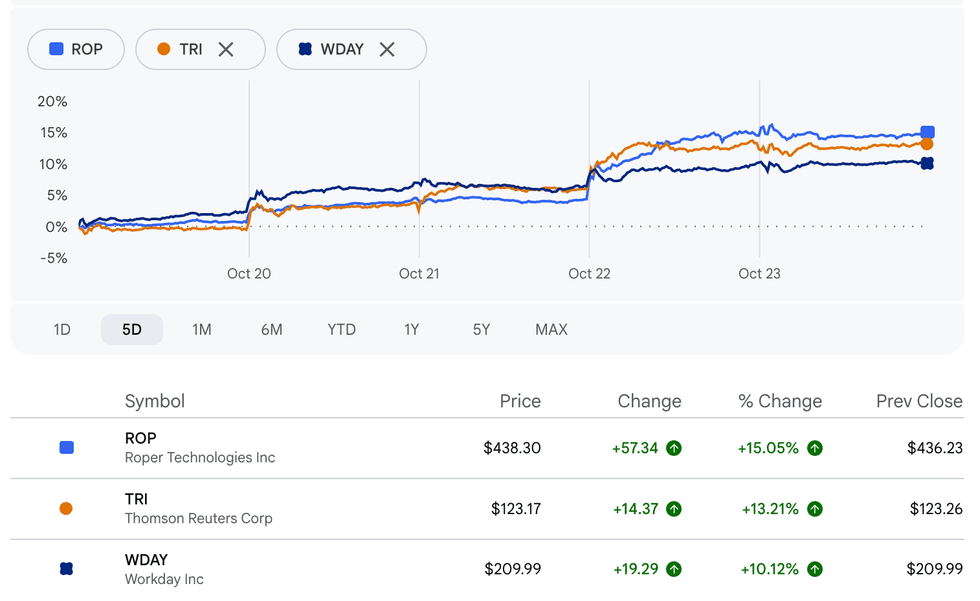
Roper Technologies, Thomson Reuters and Workday performance, October 19 to 23, 2026.
Chart via Google Finance.
Tech ETF performance
Tech exchange-traded funds (ETFs) track baskets of major tech stocks, meaning their performance helps investors gauge the overall performance of the niches they cover.
This week, the iShares Semiconductor ETF (NASDAQ:SOXX) has lost 5.31 percent over the last five days, according to TradingView data, while the Invesco PHLX Semiconductor ETF (NASDAQ:SOXQ) lost 5.45 percent.
The VanEck Semiconductor ETF (NASDAQ:SMH) lost 4.37 percent.
Tech news to watch next week
Next week, the US Federal Reserve will meet from October 27 to 28, with its interest rate decision to follow. The Bank of Canada will also announce its rate decision on October 28. The September US personal consumption expenditures price index report, the Fed’s preferred inflation measure, will come out on October 29.
October 27 will see earnings from NXP Semiconductors (NASDAQ:NXPI).
Microsoft and Alphabet (NASDAQ:GOOGL) are among the companies reporting on October 28, followed by earnings from Amazon, Intel (NASDAQ:INTC) and SanDisk (NASDAQ:SNDK) after the close on October 29.
Apple will hold an event in Los Angeles on October 28, where it's expected to show its first touchscreen MacBook Pro.
Don't forget to follow us @INN_Technology for real-time news updates!
Securities Disclosure: I, Meagen Seatter, hold a direct investment interest in Archer Aviation.
https://x.com/INN_Technology
https://www.linkedin.com/in/meagen-seatter-23675b193/
mseatter@investingnews.com

Featured Artificial Intelligence Investing Stocks
Learn about our editorial policies.