The Conversation (0)

May. 21, 2026 01:10PM PST

hallojulie / Shutterstock
Precious metals remain under pressure from the US-Iran stalemate and the resulting worsening macroeconomic outlook.
This past week, prices for gold, silver, platinum and palladium experienced a sharp mid-May sell-off brought on by sticky inflation and a stronger US dollar, followed by a late-week recovery on de-escalating tensions in the Middle East.
However, that rebound proved fleeting as the reality of a more entrenched war set in. The fear is the war may push energy prices higher for longer and lead central banks to raise rates to continue their own war on inflation.
That said, there is still plenty of bullish sentiment for the long-term outlook for the precious metals complex.
Let’s take a look at what’s got the precious metals moving over the past week.
Gold price news
Gold prices between May 14 and May 20, 2026 were squeezed by high inflation and rising bond yields before mounting a rebound on easing US-Iran tensions and falling energy prices.
The precious metal is trading in the US$4,450 to US$4,550 per ounce range.
Gold slipped below the US$4,700 per ounce on May 14 following the previous day’s release of the US Bureau of Labor’s Producer Price Index (PPI) which showed an annualized rate of wholesale inflation for April of 6 percent. The data put another nail in the coffin for any near-term Federal Reserve rate cuts. India hiked import tariffs on gold to 15 percent to defend foreign exchange reserves, placing further pressure on the yellow metal. Gold closed at US$4,652.32 per ounce.
On Friday, May 15, gold continued its slide and dropped below the US$4,600 mark in the early morning trade, sinking to an intraday low of US$4,512.11 per ounce. The metal managed to close at US$4,540.24 per ounce. The drop was a part of a broader global market sell-off as the US dollar surged, benchmark 10-year Treasury yields moved toward one-year highs, and worsening oil supply fears kept energy prices elevated.
Monday, May 18, after falling as low as US$4,512.11 mid-day, gold prices stabilized later in the session to close at US$4,566.23 per ounce. The yellow metal found support from news the US may have offered Iran a possible temporary waiver on oil sanctions in order to open the Strait of Hormuz. US President Donald Trump added to the easing of tensions with comments that he was holding off on planned military strikes as negotiations played out.
Hope for the lifting of sanctions faded the following day, sending Treasury yields higher. Gold slipped below the US$4,500 level in the morning session to an intraday low of US$4,472,21 and later closed at US$4,483.91 per ounce.
On Wednesday (May 20), the price of gold rebounded to an intraday high of US$4,550 per ounce. following comments from President Trump that the war with Iran was in its final stage. Lower oil gave some relief to future inflation fears and knocked US Treasury yields down. The metal closed out the day at US$4,543.77 per ounce.
“Beyond the Iran war, China has been reducing the risk of holding US Treasuries for years, replacing part of its UST reserves with gold. The latter – echoed by other central banks – is expected to maintain gold’s positive longer-term trend,” Ipek Ozkardeskaya, senior analyst at Swissquote stated in a market commentary shared with the Investing News Network (INN).
“In the short run, however, gold remains under pressure from rising yields – higher sovereign yields increase the opportunity cost of holding non-interest-bearing gold, making the yellow metal relatively less attractive compared to fixed-income assets. I believe every tick lower is an opportunity to strengthen a long-term bullish position,” she added.
Gold prices lost more than 3 percent compared to the previous Wednesday close (May 13), and remained down about 18 percent from the US$5,589.38 per ounce reached on January 28.
By 10:00 a.m. PDT Thursday, gold prices had retreated further to US$4,519.62 per ounce as the chances of a peace deal in the US-Iran war faded once again and the release of Fed Reserve meeting minutes showed that a rate hike this year is not off the table.

Gold price chart, May 14 to May 21, 2026.
Chart via the Investing News Network.
Despite the yellow metal currently consolidating around the US$4,500 to US$4,600 per ounce range, gold price forecasts out this month show that many of the top financial institutions remain highly bullish on gold's long-term outlook.
JP Morgan Chase & Co. (NYSE:JPM) may have lowered its 2026 average gold price forecast to US$5,243 per ounce (down from a prior estimate of US$5,708 per ounce), however the bank has maintained its base case target of around US$6,000 per ounce by the end of the year on expectations the demand will speed up in the second half.
Goldman Sachs (NYSE:GS) reaffirmed its US$5,400 per ounce gold price targets for year-end citing robust central bank demand. Meanwhile, Swiss bank Lombard Odier reiterated its 12-month price target for gold at US$5,400 per ounce as cooling short-term investor sentiment does not break the structural case for the yellow metal.
Although it sees average prices for the year at US$4,500 per ounce, Swiss precious metals bullion trader MKS PAMP is calling for a new all-time high of US$5,800 gold by the end of 2026 on structural stagflationary pressures.
In gold mining news, Equinox Gold (TSX:EQX,NYSEAMERICAN:EQX) and Orla Mining Ltd. (NYSE:ORLA) have agreed to an all-stock merger to forge a US$18.5 billion North American gold titan. The deal combines Equinox’s Greenstone and Valentine mines with Orla’s Musselwhite asset to become Canada’s second-largest gold producer, with projected domestic output of 685,000 ounces this year.
Silver price news
Silver prices experienced even more intense volatility than gold between May 14 and May 21 to trade in the US$73 to US$83 range. The white metal's dual nature as both a monetary asset and a significant industrial commodity makes it more susceptible to larger price swings in the face of higher inflation threatening global economics.
On May 14, silver had closed at US$83.51 per ounce only to collapse harder than gold, falling below the US$80 mark in the morning session the following day with a close of US$75.98 per ounce. Investors were keen on taking profits from the price rally earlier in the month.
Silver prices continued to trade in the US$76 to US$77 range on Monday, May 18 after hitting a high of US$78.16 per ounce in the early morning trade. Strong physical buying from Asian markets helped support the US$75 floor and prevented a deeper collapse.
However, that floor of support did collapse on Tuesday when silver fell below US$75 in the early morning trade before falling further to close at US$73.70 per ounce.
Wednesday’s session brought relief alongside gold’s rebound as silver reached an intraday high of US$76.63 per ounce in the morning before later closing at US$75.86 per ounce.
The silver price shaved off more than 13 percent since the previous Wednesday close (May 13), and remained down more than 37 percent from its all-time high of US$121.62 per ounce, which it set on January 29.
By 10:00 a.m. PDT Thursday, silver prices had picked up a bit of ground to US$76.02 per ounce.

Silver price chart, May 14 to May 21, 2026.
Chart via the Investing News Network.
As for silver price forecasts, some major banks may be trimming their near-term price targets, but long-term targets remain exceptionally bullish.
JP Morgan is eyeing US$90 silver in the fourth quarter of 2026 with an average price of US$81 per ounce for the full-year. The bank sees silver’s supply tightness easing but believes demand for gold will benefit the white metal’s safe-haven appeal.
UBS also expects silver’s supply deficit to narrow significantly this year, and has revised down its Q2 2026 silver price forecast from US$100 to US$85 by the end of the quarter. It also lowered its 2026 year-end target to US$80 from US$85, and its March 2027 forecast is now at US$75 from US$85.
HSBC raised its silver forecasts significantly, predicting an average price of US$75 per ounce for 2026 and $68 per ounce for 2027, up from its previous estimates of US$68.25 and US$57, respectively.
In silver mining news, Elemental Royalty (TSX:ELE,NASDAQ:ELE,OTCQX:ELEMF) acquired Vizsla Royalties in a US$239 million deal that includes exposure to the Mexico-based Panuco silver-gold project through an uncapped 2 to 3.5 percent net smelter return royalty. Panuco is one of the world's largest high-grade silver developments.
Platinum price news
Platinum tracked its fellow precious metals in another week of see-sawing on the push and pull of the US-Iran war and its potential impact on inflation and the global economy. The metal is used heavily in industrial applications, especially vehicle autocatalysts, and its daily movements reflected a tug-of-war between macroeconomic challenges and tight global supply. Selling pressure accelerated due to weak economic data out of China, a massive consumer of industrial platinum.
After closing out May 14 at US$2,069.70 per ounce, the price of platinum spent the rest of the week fighting to get back above the US$2,000 level.
Platinum dropped to an intraday low of US$1,974.40 on Friday, May 15 before a close of US$1,982.50 per ounce.
On Monday, May 18, platinum traded in a tight range after reaching an intraday high of US$1,996.70 before closing at US$1,986.30 per ounce. Platinum prices showed signs of stabilization following the release of the World Platinum Investment Council’s (WPIC) Platinum Quarterly report prepared by Metals Focus which projects a 2026 global deficit forecast of 297,000 ounces, and the potential for above ground supply to cover less than three months of global demand by the end of the year.
Tuesday’s concerns of a prolonged conflict in the Middle East in the resulting high energy prices stoked fears of a hit to the automotive industry. Platinum prices tumbled to a low of US$1,928.10 before a close of US$1,931.10 per ounce.
Platinum prices stabilized on Wednesday alongside the broader trend in the precious metals complex. The metal hit an intraday high of US$1,968.70 before a close of US$1,959.80 per ounce.
Platinum prices were down more than 9.5 percent over the period, and well off its January 2026 all-time high near US$2,924 per ounce.
On Thursday morning prices for platinum picked up along with silver. By 10:00 a.m. PDT, the price of platinum was trading at US$1,966.60 per ounce.

Platinum price chart, May 14 to May 21, 2026.
Chart via the Investing News Network.
Platinum prices are benefitting from persistent mine supply deficits out of South African and Russian alongside booming autocatalyst and hybrid vehicle demand. In addition, the metal is experiencing resilient demand as consumers interested in non-ICE vehicles are switching to hybrids over pure electric and new industrial uses are emerging in hydrogen and AI technologies.
Analysts are highly bullish on platinum, pointing to a massive, underappreciated structural deficit that will likely force a major breakout in the second-half of the year.
Metals Focus is forecasting that platinum prices will average US$2,190 an ounce in 2027 as the market remains in structural deficit. The firm also acknowledges that investors are increasingly treating platinum as both a precious metal and an industrial metal.
In other platinum news, South Africa's Valterra Platinum (LSE:VALT,JSE:VAL,OTCPL:AGPPF) reported its inventory levels of critical operational inputs, such as diesel and lubricants, are well stocked despite the US-Iran war.
Palladium price news
Palladium prices are also in the dump this past week as the metal sharply declined to below the US$1,400 level. Along with the other platinum group metals (PGM), palladium was caught up in the squeeze brought about by hot US inflation data and a strong dollar. However, persistent industrial demand and ongoing mining bottlenecks in South Africa and Russia helped to provide a floor.
The price of palladium closed at US$1,461 per ounce on Thursday, May 14, and fell as low as US$1,420.50 on Friday morning on the fear that high interest rates would cool global manufacturing and auto-catalyst fabrication. It closed up slightly at US$1,427 per ounce.
After dropping further to US$1,404 per ounce in the morning trade Monday, the metal remained rangebound for much of the remaining session before a close of US$1,424.50 per ounce. Like its sister PGM, palladium gained support from the Platinum Quarterly report’s identification of continued tightness in the market.
Palladium tracked the precious metals complex further down on Tuesday, slipping below the US$1,400 level in the early morning to as low as US$1,354.50. The metal closed out the day at US$1,365 per ounce. Ongoing tensions in the Middle East spiked energy costs, renewing fears of an industrial margin squeeze for global automotive manufacturers.
Palladium didn’t rally as well as its sister metals on Wednesday as it failed to regain a foothold above the US$1,400, only touching as high as US$1,391 in the morning with a closing price of US$1,377 per ounce.
Palladium prices were down more than 9.5 percent over the period, and trading at only about a third of its March 2022 all-time high near US$3,440 per ounce.
On Thursday, May 21, palladium had ticked up to US$1,387 per ounce as of 10:00 a.m. PDT.

Palladium price chart, May 14 to May 21, 2026.
Chart via the Investing News Network.
Metals Focus projected palladium prices to average US$1,570 per ounce for 2026 despite structural headwinds from the automotive sector. That’s because palladium remains in a severe supply side crunch as global PGM mine production is expected to drop another 2.2 percent this year.
Don't forget to follow us @INN_Resource for real-time updates!
Securities Disclosure: I, Melissa Pistilli, hold no direct investment interest in any company mentioned in this article.
Editorial Disclosure: The Investing News Network does not guarantee the accuracy or thoroughness of the information reported in the interviews it conducts. The opinions expressed in these interviews do not reflect the opinions of the Investing News Network and do not constitute investment advice. All readers are encouraged to perform their own due diligence.
From Your Site Articles
- Gold Price Update: Q1 2026 in Review ›
- Silver Price Update: Q1 2026 in Review ›
- Platinum Price Forecast: Top Trends for Platinum in 2026 ›
- Palladium Price Forecast: Top Trends for Palladium in 2026 ›
- Gold’s Next Test: WGC Lists 3 Potential Price Scenarios in 2026 Outlook ›
Related Articles Around the Web
https://x.com/INN_Resource
https://www.linkedin.com/in/melissa-pistilli-865271a9/
mpistilli@investingnews.com

Featured Precious Metals Investing Stocks


Investor Insight
Heliostar combines production of ~50,000–55,000 oz in 2026 with a pipeline of high-margin development assets in Mexico led by Ana Paula. Supported by operating cash flow from La Colorada and San Agustin, a debt-free balance sheet and strategic expansion into the US with the Goldstrike project in Utah, the company is positioned to scale into a 500,000 oz per year gold producer.
Overview
Heliostar Metals (TSX:HSTR,OTCQX:HSTXF,FRA:RGG1) is an emerging gold producer focused on building a mid-tier, multi-asset production platform, anchored in Mexico and complemented by strategic expansion into the United States.

The company has rapidly transformed from an explorer into a producer through disciplined, value-accretive acquisitions, assembling a 100 percent-owned portfolio of producing mines, advanced development projects and exploration assets. This platform provides both immediate cash flow and long-term scalability.
In 2025, Heliostar produced 34,098 gold equivalent ounces, generated US$47.4 million in mine operating earnings, and ended the year with US$40.6 million in cash and no debt, demonstrating strong execution and financial discipline.
Production is expected to increase to 50,000–55,000 oz in 2026, driven by La Colorada and San Agustin. Development of Ana Paula and Cerro del Gallo supports a clear pathway to 500,000 oz annual production by 2030.

In 2026, Heliostar formed part of the OTCQX’s Best 50 top-performing companies. The company ranked 8th overall, joining 7 other mining companies in the top 10.
Beyond its core Mexican portfolio, the addition of the Goldstrike project in Utah introduces further growth optionality, reinforcing Heliostar’s strategy of acquiring and advancing underexplored assets with strong development potential. With a staged growth strategy, strong margins and an expanding resource base, Heliostar is positioned to evolve into a 500,000 oz per year gold producer by 2030.
Company Highlights
- Growing Production Base: Two producing mines targeting 50,000–55,000 oz of gold in 2026, generating cash flow to fund development.
- Clear Path to Mid-Tier Scale: Staged growth targeting annual production of 500,000 oz by 2030.
- High-Margin Flagship Asset: The Ana Paula PEA outlines 101,000 oz/year production (post ramp-up) with strong economics, including US$1,012M NPV5% and 51.3% IRR at higher gold price assumptions, supporting a 2028 production target.
- Self-Funded Growth Model: Generated US$47.4 million in mine operating earnings (2025) with US$40.6 million in cash and zero debt, reducing reliance on equity dilution.
- Robust Resource Base: Approximately 7.3 Moz measured and indicated gold resources plus ~1.4 Moz inferred, supporting long-term scalability.
- High-Quality Development Pipeline: Cerro del Gallo targeting 86,000 GEO/year at US$1,390 AISC, alongside San Antonio’s production potential.
- Strategic Expansion in the US: Acquisition of the Goldstrike project in Utah adds near-surface oxide potential and long-term growth optionality.
- Strong Institutional Backing: Approximately 53 percent institutional ownership, complemented by high-net-worth investors and management alignment.
Key Projects
Ana Paula (Flagship Development Project)

Ana Paula is a high-grade underground gold project in Guerrero and the cornerstone of Heliostar’s long-term growth strategy.
The November 2025 PEA outlines a 9 year mine life with 101,000 oz/year production, 874,700 oz total output, and strong economics, including a US$1,012M NPV5% and a 51.3 percent IRR, supported by a low AISC of US$1,011/oz.
The project hosts approximately 742,000 oz measured and indicated at 5.4 g/t and 514,000 oz inferred, highlighting its high-grade profile and expansion potential.

With a feasibility study targeted for H1 2027 and construction expected in H2 of the same year, Ana Paula is expected to become the primary driver of Heliostar’s transition to mid-tier production.
The company is targeting production at Ana Paula in 2028.
La Colorada Mine

La Colorada in Sonora is a key cash-flowing asset that underwent a successful turnaround in 2025. The mine hosts reserves of 376,000 ounces of gold grading 0.68 g/t in 17.1 million tonnes of ore.
The mine is expected to produce 20,000–22,300 oz in 2026 at AISC of US$1,775–1,875/oz, supported by a six-year mine life and approximately 286,000 oz total production profile.
Mining at the project’s Veta Madre pit commenced in August 2026, a milestone that the company ties to its plan to secure cash flow through 2027 and 2028 to support construction at Ana Paula.
Ongoing drilling, pit expansions and underground potential provide meaningful upside, reinforcing its role as a core funding engine for development.

San Agustin Mine
San Agustin in Durango is a restarted oxide heap-leach operation providing near-term production growth and cash flow.
2026 guidance targets 30,000–32,700 oz of gold at AISC of US$2,150–2,250/oz, following a low-capital restart funded from the company’s balance sheet.
The asset offers additional upside through oxide expansion and sulphide exploration, supporting potential mine life extension.
Cerro del Gallo Project
Cerro del Gallo is a large-scale gold-silver development project in Guanajuato and a key driver of future production growth.
The 2025 PFS outlines ~86,000 GEO/year over a 15-year mine life at US$1,390 AISC, with strong economics, including US$972 million NPV5% and 59.3 percent IRR at higher gold price assumptions.
The project is expected to play a central role in advancing Heliostar towards the goal of 500,000 oz annual production by 2030.
San Antonio Project
San Antonio is a 100%-owned heap-leach development project offering strong optionality and long-life production potential.
The project hosts approximately 1.74 million ounces of measured and indicated gold and demonstrates attractive optionality, including potential 80,000 oz/year production and low AISC of US$1,063/oz.
As permitting advances, San Antonio represents a key medium-term growth opportunity within the portfolio.
Goldstrike Project (Utah, USA)
Goldstrike is a newly acquired gold project that expands Heliostar’s footprint in the United States and adds exploration and development optionality. The property currently hosts an Indicated resource of 975 kilo ounces at 0.46 g/t of gold.
The project hosts a near-surface oxide gold system with historical production of approximately 209,000 ounces of gold and defined mineralization, offering potential for low-cost, open-pit heap-leach development. Its geological setting and existing dataset provide a strong foundation for resource growth and technical advancement.
Goldstrike complements Heliostar’s acquisition strategy by adding a scalable, underexplored asset outside its core Mexican portfolio, enhancing long-term growth potential.
Drilling is underway at Goldstrike to test the antimony and gold potential of both Antimony Ridge and Antimony Knoll, with results expected towards the end of 2026.
Management Team
Charles Funk – President & CEO
Charles Funk has over 20 years of experience in exploration and business development, including senior roles at Newcrest Mining and OZ Minerals. He led the Panuco discovery for Vizsla Silver, demonstrating strong capability in identifying high-value deposits. At Heliostar, he has driven the company’s transformation into a multi-asset gold producer through disciplined acquisitions. His leadership is focused on building a scalable, mid-tier gold platform.
Gregg Bush – Chief Operating Officer (COO)
Gregg Bush is a proven mine builder with extensive experience in mine development, integration and operations. He previously served as COO of Capstone Mining and held senior leadership roles at Equinox Gold. Bush brings deep expertise in optimizing operating assets and advancing projects into production. He plays a key role in executing Heliostar’s production growth strategy.
Sam Anderson – VP Projects
Sam Anderson has approximately 25 years of experience in mine geology and project development, including 17 years at Newmont. He played a key role in advancing the Merian Mine from resource stage through construction to steady-state production. His expertise spans exploration, resource expansion and project execution. At Heliostar, he leads the advancement of key development assets.
Mike Gingles – VP Corporate Development
Mike Gingles brings more than 35 years of experience in the mining industry, specializing in corporate development and M&A. He played a leadership role in major transactions including Pueblo Viejo and Turquoise Ridge. His expertise includes project evaluation, deal structuring and strategic partnerships. He supports Heliostar’s acquisition-driven growth strategy.
Hernan Dorado – VP Sustainability & Special Projects
Hernan Dorado is a fifth-generation miner with over 20 years of experience in mining operations, particularly in Mexico. He was a founding member of Guanajuato Silver, where he served as COO. His expertise includes permitting, community engagement and sustainability practices. He ensures responsible development across Heliostar’s operations.
Vitalina Lyssoun – Chief Financial Officer (CFO)
Vitalina Lyssoun is a Chartered Professional Accountant (CPA, CA) with more than 16 years of experience in financial management within the resource sector. She has extensive expertise in public company reporting, compliance and internal controls. Prior to joining Heliostar, she led the corporate accounting function at Gatos Silver. Her experience spans multiple international jurisdictions.
Stephen Soock – VP Investor Relations & Development
Stephen Soock has nearly 20 years of experience across mining operations and capital markets. He began his career in technical roles at mine sites before transitioning to equity research, where he spent eight years covering growth-stage mining companies. He is a mining engineer and CFA Charterholder. At Heliostar, he leads investor relations and supports capital markets strategy.



Investor Insight
GoldInxs Mining Corp. (TSXV:INXS, OTCQB: INXGF) provides investors with exposure to early-stage gold-copper exploration in British Columbia, leveraging a portfolio of high-potential projects in Tier 1 jurisdictions, within established gold districts, surrounded by strong regional infrastructure and led by an experienced management team committed to accelerating discovery and delivering shareholder value.
Overview
GoldInxs Mining Corp. is a discovery-focused mineral exploration company dedicated to identifying and advancing high-potential copper-gold assets in proven geological belts. The Company's strategy centers on acquiring overlooked and underexplored projects with large-scale potential, applying modern exploration techniques to rapidly evaluate targets and unlock shareholder value through discovery.
The Company’s. common shares started trading on the TSX Venture Exchange in July 2026 under the symbol INXS, positioning itself to capitalize on favorable copper and gold market fundamentals.
Copper demand is forecasted to grow steadily through 2030, with the global copper market expected to expand to over US$340 billion by 2030, driven by electric vehicles, renewable energy and infrastructure growth.
On the other hand, gold continues to provide a safe-haven hedge against policy risks and market volatility, making GoldInxs’ dual focus on copper and gold particularly compelling for investors.
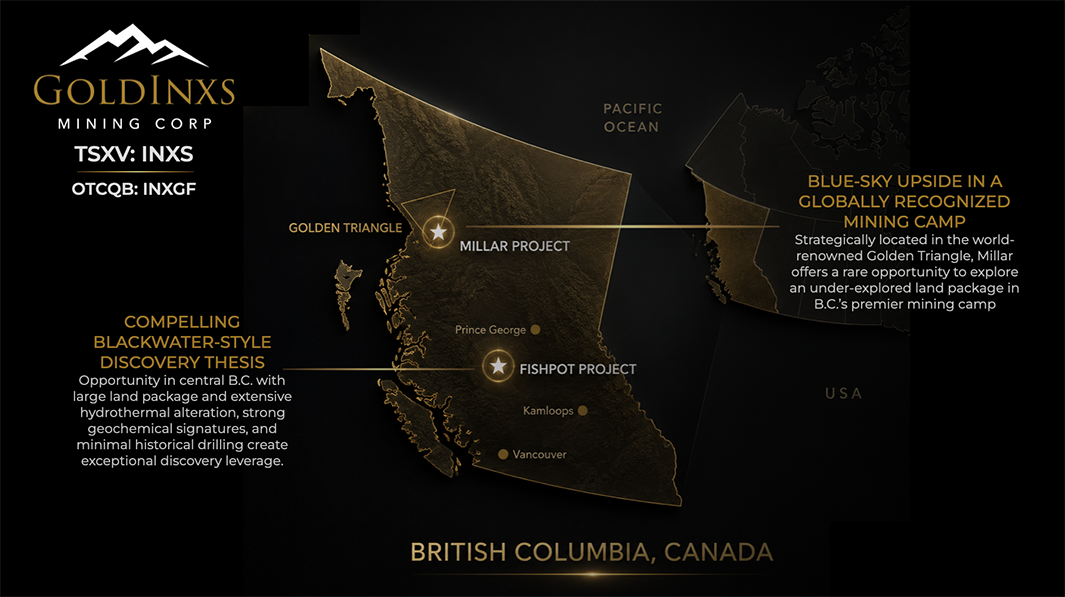
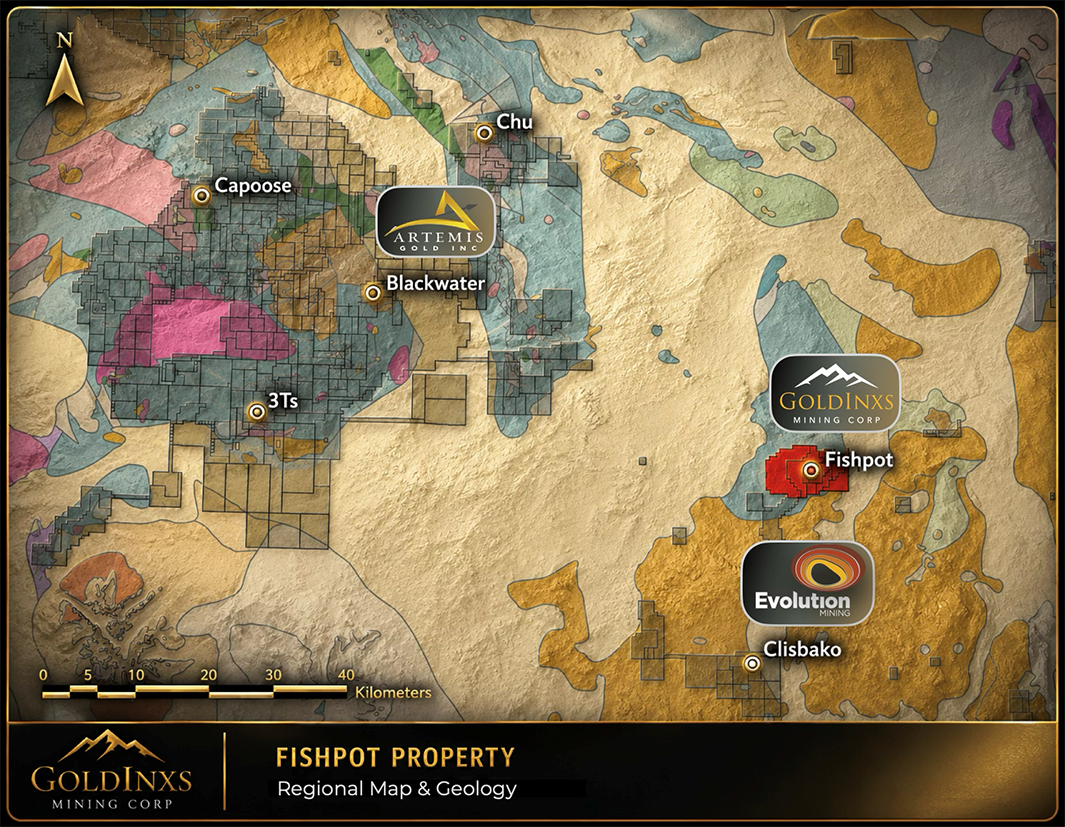
The Company’s portfolio is anchored by two priority projects: the Fishpot Project in central British Columbia, interpreted as an emerging, large epithermal system with strong infrastructure access and jurisdiction quality as well as early indications of blackwater-style mineralization, and the non-core Millar Project in the prolific B.C Golden Triangle, a district renowned for world-class discoveries. While surrounding deposits attracted billions of dollars in investment, Fishpot received only sporadic historical exploration despite widespread hydrothermal alteration and numerous anomalous gold, silver and copper results. Artemis Gold’s Blackwater Mine has announced tripling production with an intended $1.56B investment, which sits only 65 km from the Fishpot property.
Backed by a management team with expertise in exploration, project development and capital markets, GoldInxs is positioned to rapidly advance its assets, deliver near-term exploration catalysts and create shareholder value through discovery and strategic growth.
Company Highlights
- Mining-friendly jurisdiction: Projects are in British Columbia, which ranked second in Canada and 20th globally in the 2025 Fraser Institute investment attractiveness rankings.
- Flagship and district-scale assets: Portfolio is anchored by the flagship Fishpot Project (“Fishpot”) in central B.C., showing strong geological indicators of mineralization, blackwater-style mineralization potential and immense exploration upside potential with only 378 meters of historical drilling. Fishpot is strategically located in the same region as Artemis Gold’s Blackwater Mine and Evolution Mining’s optioned Clisbako property.
- Clear path to 2026 catalysts: GoldInxs secured a drill permit for an upcoming maiden 2,000-metre drill program at Fishpot, near-term exploration programs are designed to define mineralized systems, outline blackwater-style potential and create shareholder value following the completion of a 3D IP survey and drill targeting.
Key Projects
Fishpot Project

The Fishpot Project represents the cornerstone asset within the GoldInxs portfolio. Covering up to 5,500 hectares in Central British Columbia, and located ~95 km north of Quesnel, Fishpot hosts a large hydrothermal alteration system that exhibits many of the geological characteristics observed in major epithermal and intrusion-related gold systems throughout the region. Fishpot encompasses five claim blocks, held under an option to acquire 100 percent subject to a 2 percent NSR, representing a significant exploration opportunity in a highly prospective region.
Fishpot represents a largely untested hydrothermal mineral system where multiple independent exploration datasets, including gold-silver-copper surface geochemistry, alteration and geology, airborne magnetics, 3D IP chargeability/resistivity and identified epithermal-to-potential-porphyry target environments, are converging to define drill targets, despite only 378 metres of historical drilling across two holes.
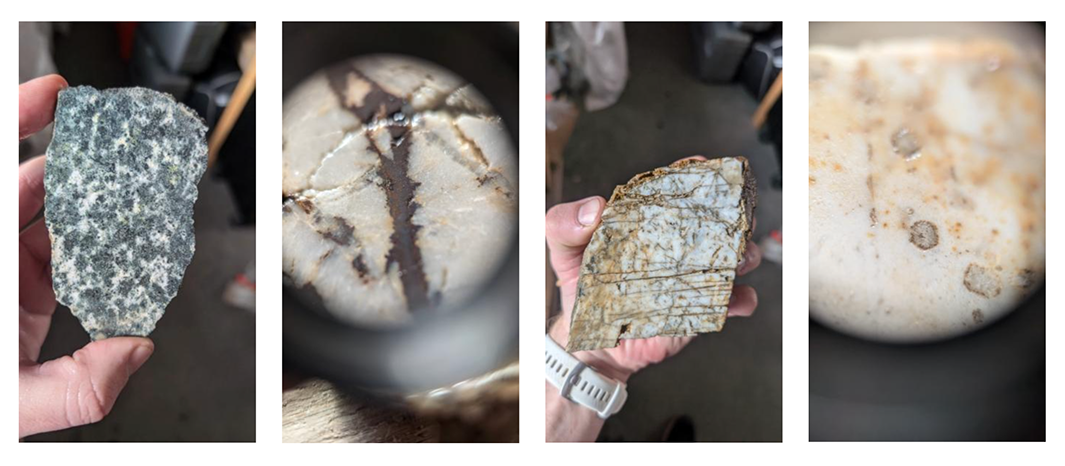
Fishpot is situated within the highly prospective Stikine Terrane and is underlain by Hazelton Group volcanic rocks and intrusive units comparable to those associated with several significant deposits in British Columbia. Extensive quartz-sericite alteration, hydrothermal brecciation, pyrite mineralization and multi-element geochemical anomalies support the interpretation of a robust mineralizing system. Fishpot is strategically positioned near active and historical mining operations, including Artemis Gold’s Blackwater Deposit, Newton Gold Project, Capoose and 3Ts Project, underscoring its large-scale discovery potential. Importantly, based on early-exploration results, Fishpot shares several regional geological characteristics commonly associated with Blackwater-style gold systems, including felsic volcanics, strong alteration, pyrite-rich mineralization and gold-silver geochemical associations. Despite the similarities the Company cannot yet make any formal connections to the surrounding properties, nor can they guarantee that such deposits exist on their ground.
Fishpot Exploration Technology: GoldInxs advanced its Fishpot targeting program by combining a conventional 3D IP survey with emerging Virtual DRILL™ remote-sensing technology as an additional targeting layer, using multiple geological, geochemical and geophysical datasets to refine and prioritize targets ahead of a planned ~2,000-metre drill program.
Fishpot Drill Permit & Expansion: GoldInxs has received the required drilling permits and expanded Fishpot to 5,509 hectares, positioning the Company to proceed with its inaugural ~2,000-metre modern drill program on a property that has seen very limited historical drilling, while refining targets through integrated geological, geochemical and geophysical data.
Despite multiple encouraging exploration indicators, Fishpot has been subjected to only two historic drill holes totaling 378 metres, leaving the broader mineral system largely untested and providing significant leverage to future exploration success.
Recent exploration completed by GoldInxs generated the highest reported gold value on Fishpot to date, returning up to 5.65 g/t Au from surface sampling, while airborne geophysical surveys identified multiple coincident magnetic and geochemical anomalies that have strengthened the Company's exploration model and target pipeline.
The 2025 program returned rock samples of up to 5.65 g/t Au, 11.35 g/t Ag and 0.42% Cu, while historical work reportedly returned up to 4.36 g/t Au and 3.2% Cu.
The property exhibits the potential low-sulphidation epithermal targets at Fishpot North, intermediate-sulphidation signatures at Fishpot East, and a large central magnetic high being evaluated for potential porphyry mineralization at depth. The Company is focused on finalizing drill targeting and preparing for the inaugural diamond drill campaign at Fishpot in the coming months following completion of the IP survey. GoldInxs is preparing to drill-test a 5,509-hectare, largely undrilled hydrothermal system in central British Columbia where high-grade surface gold-silver-copper results, Blackwater-style geological characteristics and multiple coincident geophysical targets have converged to define a portfolio of high-priority exploration targets.
Management Team
Nick Michael – President and CEO
Mr. Michael is a veteran mining executive and technical director with over 37 years of global experience spanning mine development, engineering and operational leadership. His expertise covers the full project lifecycle, including design, construction, technical due diligence and Independent Engineer assignments for institutional investors and project financiers. He also leads CJK Milling, a company focused on reprocessing historical mine waste to recover discarded gold decades ago, when it was less valuable.
Carlo Rigillo, CPA, Chief Financial Officer
Mr. Rigillo is an experienced Chartered Professional Accountant with over two decades of experience. He holds a Bachelor of Commerce from the University of Toronto.
Barry Miller – Executive Chairman and Director
Mr. Miller brings over 30 years of experience in public markets, including roles as a broker, consultant and financier. He is the founder of GoldInxs and has been actively involved in the resource sector through leadership positions, including as director of Tinova Resources Corp., an exploration company focused on tin and rare earth elements in British Columbia and Alaska.
Tara Asfour - Vice President, Corporate Development and Communications
An executive consultant with over 13 years of experience, Tara Asfour holds expertise in corporate development, capital markets, investor relations and strategic communications. She has led strategic financings, partnerships and offtake initiatives within the resource sector through previous corporate development and investor relations roles with multiple publicly listed companies.
Al Fabbro – Director
With over three decades of experience spanning both the mining and finance sectors, Mr. Fabbro previously led Yorkton Securities’ retail trading department and was part of its Natural Resources Group. He later served as Lead Director of Roxgold Inc. and currently holds executive leadership roles in the mining industry.
Darcy Vis, P.Geo. – VP Exploration and Director
Mr. Vis is an economic geologist with over 17 years of experience in mineral exploration. He has held senior technical roles across multiple exploration companies and is the President of Tripoint Geological Services Ltd. His expertise includes target generation, project evaluation and exploration program execution.
Stephen Soock, P.Eng., CFA – Director
Mr. Soock is a mining professional with nearly 20 years of experience spanning both technical operations and capital markets. He currently serves as Vice President, Investor Relations and Development at Heliostar Metals.
Christopher Kelly, PQS, FCIArb – Director
Mr. Kelly has over 15 years of experience in construction and natural resources. He holds a BSc in Construction Economics and Management and an MSc in Construction Law and Dispute Resolution, and runs Trachtala Consulting Ltd.
Learn about our editorial policies.