The Conversation (0)
Jun. 20, 2025 01:50PM PST

bluebay2014 / Adobe Stock
In the face of geopolitical strife, oil and gas prices were able to register moderate gains through H1 2025, although the second half of the year is likely to be punctuated with continued unrest and supply chain fragility.
Oil benchmarks ended the first quarter slightly off their 2025 start positions, with Brent crude coming in at US$76.08 per barrel and West Texas Intermediate (WTI) hitting US$72.87 per barrel before headwinds began sending values lower.
In early May, both benchmarks dropped sharply, Brent slipping nearly 6 percent to US$60.48 while WTI fell to US$57.42, a near two year low. The decline was driven by a combination of weak demand and rising supply as OPEC+ signaled plans to boost production in July, adding to existing oversupply concerns after a surge in global inventories.
Additionally, signs of cooling economic growth in China and renewed trade war anxiety between the US and China further pressured market sentiment. As concerns over a trade war and energy tariffs subsided, prices were able to rally through the rest of May and June to hold in the US$78.42 and US$77.19 range for Brent and WTI, respectively.
Now approaching year-to-date highs, global strife and potential supply constraints are adding support.
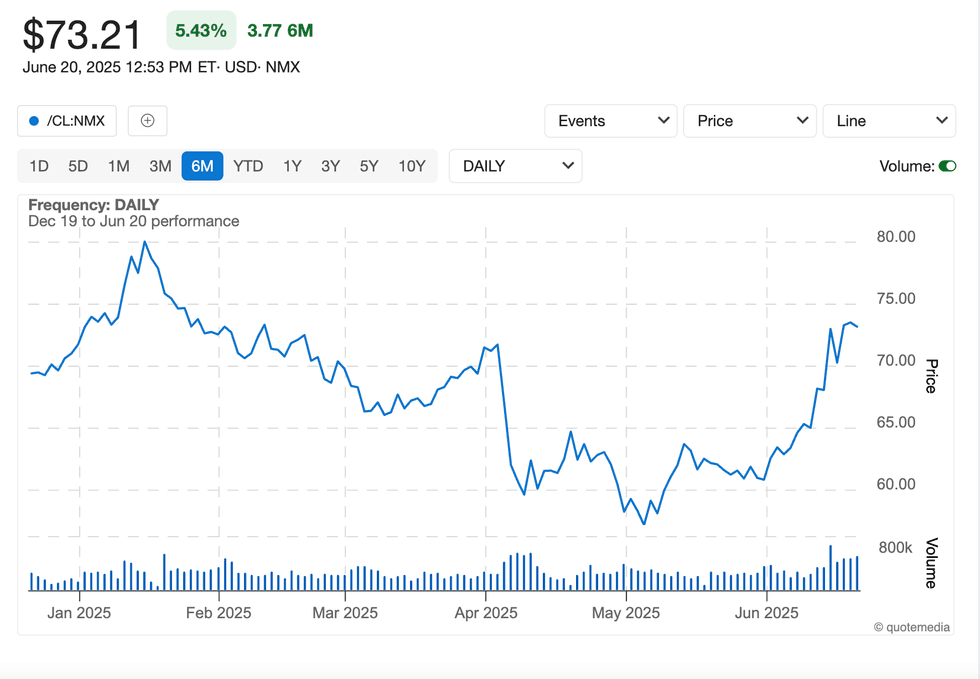
WTI price performance, December 19, 2024, to June 19, 2025.
Chart via the Investing News Network.
During an International Energy Agency (IEA) presentation, Fatih Birol, executive director of the IEA, addressed the current challenges in the global landscape, particularly the mounting conflict in the Middle East.
“The situation is still unfolding, and there are many uncertainties (about) how and if it is going to have structural impacts on the oil and energy markets,” he said, noting that the IEA would not be speculating.
However, Birol did underscore Iran’s position in the global oil market.
“According to our oil market report, currently, Iran produces about 4.8 million barrels per day (mb/d) of crude, condensate and NGL and exports are around 1.8 mb/d of crude oil and 800,000 b/d of products,” he said. “For now, when we look at the markets, we do not see a major supply disruption.”
Oil supply seen outpacing demand
Although the regional conflicts have infused uncertainty into the oil market, longer-term fundamentals like supply and demand trends are painting a volatile picture. As the IEA notes in a recently released report titled Oil 2025: Analysis and Forecast to 2030, supply is likely to outpace demand this year and next.
“Our expectations for demand growth are much less than the supply growth,” said Birol.
“We expect demand this year to grow about 700,000 barrels per day, whereas the supply growth we expect is more than double, about 1.8 million barrels per day (mb/d).”
More broadly, the IEA report forecasts that global oil demand will rise by 2.5 mb/d between 2024 and 2030, reaching 105.5 mb/d by the decade’s end. However, most of that growth will occur early in the period, with gains slowing after 2026 and dipping slightly by 2030. Weaker economic growth and a shift away from oil use in transportation and power generation are the main factors behind the long-term slowdown.
Much of the demand forecast is dominated by powerhouse countries US and China which account for 20 mb/d and 13 mb/d respectively, comprising 33 percent of global demand.
As such, changes to either country's oil market can have a large sale effect across the sector.
“When we look at the supply side, global oil production in the last 10 years or so, more than 90 percent of the growth came from the United States. And on the demand side, more than 60 percent of the global oil demand growth came from China,” said Birol. “This came almost parallel and simultaneously.”
Now, again working in tandem, US oil production growth is slowing due to economic and geological factors, while China’s oil demand is losing momentum as its economy shifts and its transportation sector evolves, as per Birol.
Economic headwinds impeding oil demand
Economic concerns are also an issue across the globe, and historically GDP is heavily correlated to oil demand.
Global GDP is expected to grow at an average annual rate of 3 percent through 2030, but that growth is uneven. OECD countries will see slower expansion at 1.8 percent, while non-OECD nations are projected to grow at 3.9 percent.
This global pace falls short of the 2010s trend, with factors like aging populations and reduced globalization weighing on long-term growth and trade. China’s slowdown is particularly sharp, with its annual GDP growth nearly four percentage points lower than in the previous decade due to structural economic and demographic challenges.
While GDP remains a key driver of oil demand, its influence is fading.
Oil consumption is set to rise in 2025 and 2026, increasing in line with economic growth, but from 2027 onward demand is expected to plateau and then slightly decline. That shift is being driven by the growing use of alternatives in transportation and power generation.
US oil supply growth slowing
Despite a projected decline in US output, the IEA expects oil supply to remain robust in other regions.
“We expect between now and 2030, about 5 mb/d of additional production capacity,” Birol remarked.
“A big chunk of it is coming from what we call the American quintet, namely US, Brazil, Canada, Guyana and Argentina. These five countries will bring a lot of oil to the markets.”
Providing a more detailed look at the oil supply picture, Toril Bosoni, head of the IEA's oil industry and markets division, reiterated that global oil supply is on track to outpace demand through 2030, offering a stabilizing force in an otherwise uncertain energy landscape. As Bosoni explained, supply of the fuel is expected to grow by 1.8 mb/d in 2025, a trend largely being driven by non-OPEC+ countries, particularly in the Americas.
Additionally, natural gas liquids are playing an increasingly important role in this growth, as US shale production shifts focus and Saudi Arabia expands its gas-linked output.
“Looking into the next year, from 2025 until 2030 we can see that the United States is still a big source of supply growth, but the pace of growth is much slower than what we have seen for the past decade, and it's largely driven by gas liquids, as activity in the shale patch is slowing down and getting more into the gas side,” said Bosoni.
IEA data projects total global oil supply capacity to rise by about 5 mb/d by the end of the decade.
Most of this growth will come from outside OPEC, and is closely aligned with rising demand for petrochemical feedstocks, such as ethane and naphtha, which bypass the traditional refining process.
However, traditional crude supply is expected to see only modest gains unless additional projects — many of which have yet to reach a final investment decision — move forward.
The refining sector, meanwhile, may face increasing pressure as fuel demand flattens and high-cost plants, particularly in Europe and parts of Asia, become less competitive.
Despite slowing demand, the coming years are expected to bring ample supply — helping to buffer against geopolitical shocks and lending some reassurance to markets amid broader global economic headwinds, Bosoni added.
Natural gas market faces volatility
The natural gas market faced heightened volatility through H1, driven by several key factors.
A milder-than-expected winter in major consuming regions like the US and Europe led to weaker heating demand, pushing prices lower early in the year. However, the second quarter of the year saw a rebound as unseasonably hot weather in Asia and parts of North America boosted cooling demand. Supply disruptions, including maintenance delays at major LNG export facilities in the US and Australia, further tightened markets.
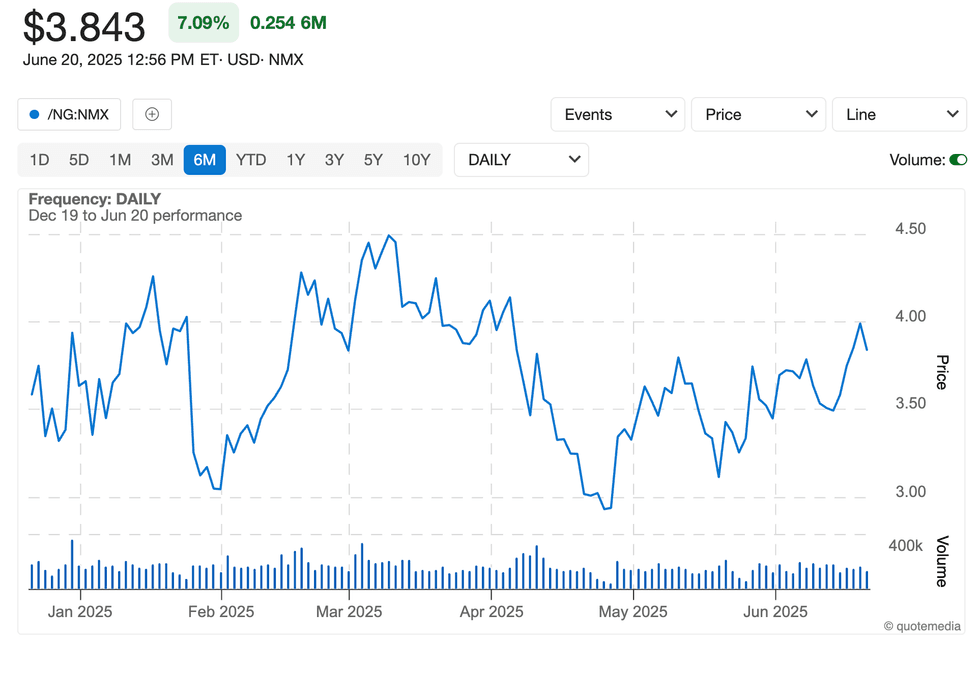
Natural gas price performance, December 19, 2024, to June 19, 2025.
Chart via the Investing News Network.
Starting the year at US$3.65 per million British thermal units, prices rose to a first-half high of US$4.49 in March, before falling to an H1 low of US$2.99 in late April.
Geopolitical tensions, particularly instability in the Middle East affecting shipping routes, added upward pressure through May and June pushing prices back above US$4 by mid-June.
Natural gas liquids increasingly key
Natural gas liquids (NGLs) are emerging as a major driver of global oil supply growth through the end of the decade, with output forecast to rise by 2 mb/d to 15.5 mb/d by 2030, according to the IEA.
Much of this increase will come from North America and the Middle East, which are expected to account for nearly half of all global supply gains over the next five years. As noted in the organization's report, the surge is being fueled by rising production from lighter, gas-rich fields and unconventional reserves.
The US, already the top NGL producer, will increase output from 6.9 mb/d in 2024 to 7.8 mb/d in 2030. Saudi Arabia is set to boost production from 1.4 mb/d to 2 mb/d over the same timeframe, while Canada will add 300,000 b/d.
This expanding supply is feeding demand for petrochemical feedstocks like ethane, propane and butane, vital in the production of everything from plastics to clean cooking fuel. Ethane demand alone is expected to climb by 610,000 b/d to 5.2 mb/d by 2030, while liquefied petroleum gas (LPG) consumption is forecast to rise by 1.3 mb/d to 11.8 mb/d.
Asia, led by China and India, will account for more than 65 percent of global LPG demand growth.
The rise of NGLs also poses a long-term challenge to traditional refining, as many of these products bypass refining altogether. With petrochemical demand outpacing that for transportation fuels, refiners may face margin pressure and shutdown risks, particularly in high-cost regions like Europe and parts of Asia.
Despite slower year-over-year growth, the IEA sees NGLs playing an increasingly vital role in shaping the future energy mix. This is supported by the 216 percent increase in production the NGL sector has seen over the past decade.
“From 2014 to 2024, global NGLs production grew by 4.3 mb/d to 13.6 mb/d," the report outlines.
NGLs will rise by a further 2 mb/d to 15.5 mb/d in 2030, with average annual growth slowing to 2.3 percent over the forecast period, from 3.9 percent during the previous decade."
Much of the IEA’s outlook falls in line with short-term price projections that the US Energy Information Administration released in May — these outline an average price for Brent crude of US$66 in 2025 and US$59 in 2026.
Natural gas prices are seen rising from an average of US$4.10 in 2025 to US$4.80 in 2026.
Don’t forget to follow us @INN_Resource for real-time updates!
Securities Disclosure: I, Georgia Williams, hold no direct investment interest in any company mentioned in this article.
From Your Site Articles
- Have We Reached Peak Oil? ›
- How to Invest in Oil and Gas ›
- Top 10 Oil-producing Countries ›
- Oil Price and Inflation: What’s the Correlation? ›
Related Articles Around the Web
https://x.com/INN_Resource
https://www.linkedin.com/in/georgia-williams-15845447/
gwilliams@investingnews.com

Featured Oil and Gas Investing Stocks
Investor Insight
Coelacanth Energy is a pure-play Montney oil and natural gas company advancing one of the largest contiguous land positions in the Montney light oil window of northeastern British Columbia. Supported by a substantial discovered and undiscovered hydrocarbon resource base, growing production, established infrastructure and a management team that has built and sold six successful energy companies, Coelacanth is executing a strategy focused on increasing both near-term cash flow and long-term resource value.
Overview
Coelacanth Energy (TSXV:CEI) is a Canadian oil and natural gas exploration and development company focused on the Montney Formation in northeastern British Columbia. The company controls over 150 contiguous sections in the Two Rivers region, a strategically positioned acreage block within the Montney light oil window. As one of the largest landholders in this highly prospective area, Coelacanth has assembled a large-scale resource platform with significant development potential.

The company’s asset base is supported by substantial petroleum initially-in-place estimates prepared by GLJ. These include 6.9 billion barrels of discovered oil PIIP and 8.3 billion barrels of undiscovered oil PIIP, alongside 5.9 Tcf of discovered gas PIIP and 7.1 Tcf of undiscovered gas PIIP. The resource spans multiple Montney intervals, including the Upper, Lower, Basal and Middle Montney, providing extensive opportunities for future development and delineation.
Coelacanth’s strategy combines near-term production growth with long-term resource value creation. The company has secured critical infrastructure, contracted gas takeaway and processing capacity, and advanced development activities across its Two Rivers assets. Average production reached 7,632 boe/d in Q2 2026, reflecting continued progress in transitioning from delineation and infrastructure buildout toward scalable production growth.

A key differentiator for Coelacanth is its leadership team. Management has successfully built and sold six previous public energy companies and has demonstrated an ability to create value through multiple commodity cycles. Supported by deep operational, geological and financial expertise, the team is focused on disciplined execution of the company’s Montney growth strategy.
Company Highlights
- Premier Montney land position: Controls over 150 contiguous sections in the Two Rivers region of northeastern British Columbia, making Coelacanth the largest landholder in the Montney light oil window.
- Substantial hydrocarbons in place: GLJ estimates 6.9 billion barrels of discovered oil PIIP, 8.3 billion barrels of undiscovered oil PIIP, 5.9 Tcf of discovered gas PIIP, and 7.1 Tcf of undiscovered gas PIIP across the company’s Montney acreage.
- Infrastructure-led growth strategy: Key infrastructure, including facilities, pipelines, processing agreements and gas takeaway capacity, has been secured to support scalable production growth.
- Growing production base: Average production reached 7,632 boe/d in Q2 2026, supported by ongoing development at the Two Rivers project.
- Multiple productive Montney horizons: The asset base includes the Upper, Lower, Basal and Middle Montney intervals, providing extensive development opportunities across multiple zones.
- Strong market access: Secured 100 mmcf/d of gas takeaway capacity and up to 60 mmcf/d of processing capacity, with access to major pipeline networks and potential LNG Canada connectivity through Coastal GasLink.
- Proven value-creation team: Management has built and sold six successful energy companies and brings extensive operational, technical and financial expertise to Coelacanth’s development strategy.
Key Project
Two Rivers Montney Development

The Two Rivers project forms the cornerstone of Coelacanth’s growth strategy and encompasses the company’s extensive Montney land position in northeastern British Columbia. The project hosts multiple productive horizons, including the Upper, Lower, Basal and Middle Montney intervals, supporting a multi-zone development approach across the acreage. Geological delineation has been completed, providing a strong technical foundation for future drilling and development.
The project has demonstrated commercial productivity through successful drilling and testing programs. Coelacanth established proof of commerciality at both Two Rivers East and Two Rivers West, while development at the 5-19 and 10-08 pads confirmed productivity across multiple Montney benches. All 12 wells on the 5-19 pad were onstream by April 1, 2026, marking a significant milestone in the project’s progression.

Infrastructure development has been a major focus of the company’s execution strategy. Coelacanth has secured infrastructure financing, completed key facility and pipeline construction, contracted up to 100 mmcf/d of gas takeaway capacity and secured processing capacity of up to 60 mmcf/d. These initiatives establish the infrastructure foundation required to support future production growth.
The Two Rivers asset also benefits from strong market access. The company’s production can access major regional pipeline systems, including NGTL, Westcoast and Alliance, while its acreage is directly connected to LNG Canada through the Coastal GasLink system for potential future delivery. Coelacanth Energy said the long-term view for LNG expansion in British Columbia is very positive for its land, believing that lands with scale and direct access as such will trade at a premium once they are delineated and the resource is proven for development.
Combined with a commodity mix of approximately 31 percent oil and liquids and 72 percent natural gas, the project offers exposure to multiple energy markets.
Management Team
Rob Zakresky – President, CEO and Director
Rob Zakresky is a veteran energy executive who previously served as president and CEO of Leucrotta Exploration, Crocotta Energy, Chamaelo Exploration, Chamaelo Energy, Viracocha Energy and Bellator Exploration. He has a proven track record of building and monetizing public energy companies and leads Coelacanth’s strategic growth and value creation initiatives.
Nolan Chicoine – Vice President of Finance and CFO
Nolan Chicoine previously served as CFO and vice-president finance at Leucrotta Exploration, Crocotta Energy and Chamaelo Exploration, and was controller at Chamaelo Energy and Viracocha Energy. He is responsible for financial strategy, reporting and capital management.
Jody Denis – Vice President of Operations
Jody Denis is a former drilling, engineering and operations engineer at Leucrotta Exploration. His previous experience also includes senior operational and drilling leadership roles with Black Swan Energy, ARC Resources and Birchcliff Energy. He formerly led Coelacanth Energy’s drilling and completions activities.
John Fur – Vice President of Geosciences
John Fur previously served as manager of exploration at Leucrotta Exploration and held senior geophysical positions with Crocotta Energy, Chamaelo Energy, Viracocha Energy, Canadian Natural Resources, Post Energy, Amber Energy and Husky Oil. He oversees geological evaluation and resource delineation across the company’s Montney assets.
Jonathon Hanson — Vice President of Engineering
Jonathon Hanson has 20 years of industry experience. He previously served as manager for exploitation at Spartan Dela Corp, and was a senior exploitation engineer for companies Vermilion Energy, Lynx Energy and Saguaro Resources. He will focus on exploitation and reservoir management for Coelacanth Energy.
Investor Insight
Syntholene Energy is advancing a proprietary synthetic fuel production platform designed to produce high-performance, low-cost synthetic hydrocarbons using renewable electricity, geothermal heat and captured carbon. Following successful prototype-scale validation in 2022, the company is now operating its Iceland demonstration facility as it plans commercial-scale production capable of serving aviation, transportation, industrial energy and other hard-to-abate fuel markets.
Overview
Syntholene Energy ((TSXV:ESAF,FSE:3DD0, OTC:SYNTF) is a synthetic fuel production company company focused on developing high-performance, low-cost synthetic liquid fuels. The company is commercializing its proprietary Hybrid Thermal Production System, which combines renewable electricity, geothermal heat, water and captured carbon to produce synthetic hydrocarbons that can serve as direct replacements for conventional petroleum-derived fuels.

Unlike many alternative energy solutions that require extensive changes to existing infrastructure, synthetic fuels can be transported, stored and utilized through today’s fuel supply chains. The resulting fuels are molecularly pure, free from many contaminants associated with conventional fuels and compatible with existing engines, turbines, storage systems and transportation infrastructure. Produced using renewable electricity, hydrogen and captured carbon, the fuels can deliver over 90 percent lower lifecycle emissions while maintaining the energy density and performance characteristics required across multiple industries.
At the core of the company’s platform is its Hybrid Thermal Production System, which combines high-temperature solid oxide electrolysis with industrially proven fuel synthesis reactors. By incorporating low-cost thermal energy into critical production stages, Syntholene seeks to reduce electricity consumption, the largest cost component for most eFuel producers. This approach underpins the company’s targeted 70 percent cost advantage relative to competing technologies and supports its objective of producing cost-competitive synthetic fuels at commercial scale.

The technology builds upon advancements in high-temperature electrolysis, including work undertaken at Idaho National Laboratory. Following successful prototype-scale validation in 2022, Syntholene is progressing toward field-scale demonstration in Iceland. The company believes a successful demonstration will support future commercial deployment across a range of synthetic fuel applications.
Market demand for low-emission liquid fuels continues to expand across multiple sectors. Sustainable aviation fuel represents Syntholene’s initial commercial focus, supported by increasing airline decarbonization commitments, regulatory mandates, and fuel-blending requirements. Beyond aviation, the broader global eFuel market is projected to grow from US$8.89 billion in 2024 to more than US$215 billion by 2032, creating opportunities across transportation, shipping, industrial energy, and other sectors that depend on liquid hydrocarbon fuels.
Syntholene’s leadership team combines expertise across climate technology, synthetic fuels, industrial engineering, energy infrastructure, project development and resource industries. Recent additions to the advisory board, including former Shell and Suncor executive Marc Mageau and energy industry veteran HY Lee, further strengthen the company’s capabilities as it advances toward commercialization.
Company Highlights
- Addressing a multi-layered growth opportunity: The company is initially targeting sustainable aviation fuel while developing a technology platform capable of serving a substantially larger global liquid fuels market spanning transportation, industrial energy and other hard-to-electrify sectors.
- Proprietary hybrid thermal production system: Syntholene’s technology integrates high-temperature solid oxide electrolysis with industrially proven fuel synthesis reactors, utilizing both electricity and thermal energy to improve efficiency and reduce production costs.
- Targeting a 70 percent cost advantage: By introducing low-cost thermal energy into critical stages of production, the company aims to produce synthetic fuels at 70 percent lower cost than competing eFuel technologies.
- Pathway to cost-competitive synthetic fuels: The company believes its technology provides a credible pathway toward producing synthetic fuels that can compete economically with conventional petroleum-derived fuels at scale.
- High-performance fuel characteristics: Synthetic fuels are molecularly pure and free from many contaminants associated with conventional fuels, including sulfur, nitrogen and heavy metals, while remaining compatible with existing infrastructure.
- Over 90 percent lower lifecycle emissions: Synthetic fuels produced from renewable electricity, hydrogen and captured carbon can deliver over 90 percent lower lifecycle emissions than conventional alternatives.
- Prototype validation completed: The company’s production process was successfully demonstrated at prototype scale in 2022 and is now operating a world-first geothermally-integrated demonstration facility in Husavik, Iceland.
- Demonstration facility advancing ahead of schedule: The Húsavík, Iceland facility is now operating, with efficiency and technoeconomic results expected in Q4 2026.
- Strategic geothermal platform: The Iceland project benefits from low-cost geothermal electricity, thermal energy, industrial infrastructure, deep-water port access and an existing 200 MW+ regional grid expansion permitting framework.
- Scalable commercial development strategy: Following demonstration, the company intends to advance a 20,000-tonne-per-year commercial facility design and subsequently scale production through facilities ranging from tens to hundreds of megawatts.
Flagship Project
Húsavík Demonstration Facility, Iceland

Syntholene’s flagship project is its geothermal-integrated demonstration facility located in Húsavík, northern Iceland. The facility is designed to validate the integration of geothermal heat, high-temperature solid oxide electrolysis and synthetic fuel production technologies under real-world operating conditions. Construction has advanced six months ahead of schedule, with first operations initiated on June 22nd 20266 and efficiency and technoeconomic results expected in Q4 2026.
The project leverages northern Iceland’s abundant geothermal resources, providing access to both low-cost electricity and high-temperature steam. Unlike intermittent renewable energy sources, geothermal energy offers reliable baseload power and thermal energy that can be utilized continuously throughout the fuel production process. The location also benefits from established industrial infrastructure, a skilled workforce, proximity to a deep-water port and a favorable regulatory environment.

A key objective of the demonstration facility is to validate the company’s thermal integration strategy and confirm that efficiencies achieved during laboratory and prototype testing can be replicated under commercial operating conditions. The facility incorporates Syntholene’s proprietary Thermal Coupling technology, which converts geothermal steam into high-purity industrial steam suitable for use throughout the fuel production process. Management believes this technology is central to achieving the targeted 70 percent cost advantage relative to competing synthetic fuel pathways.
The project also benefits from significant expansion potential. Iceland has completed environmental permitting associated with a 200 MW regional grid expansion, supporting future industrial development in the region. Following a successful demonstration, Syntholene intends to advance a 20,000-tonne-per-year commercial facility design and subsequently scale production through facilities ranging from tens to hundreds of megawatts. Management believes the Húsavík location alone has the potential to support development capable of generating approximately US$500 million in annual revenue.
Management Team
Dan Sutton – Chief Executive Officer
Dan Sutton has spent the last 15 years founding and leading sustainable infrastructure businesses. As founder and CEO of Tantalus Labs, he designed, built and operated SUNLAB, scaled the company to 150 employees and grew annual revenue to approximately US$20 million. His expertise spans infrastructure deployment, project development, government relations, public markets and executive leadership.
Steve Oldham – Director
Steve Oldham is a globally recognized leader in carbon management and climate technology commercialization. As former CEO of Carbon Engineering, he helped establish direct air capture as a commercial industry and led the company through its acquisition by Occidental Petroleum at a US$1.6 billion valuation. He currently serves as CEO of Captura.
Canon Bryan – Director
Canon Bryan is a founder and company builder with more than 25 years of experience across advanced energy and resource development. He co-founded Terrestrial Energy, Uranium Energy and NioCorp and brings expertise in finance, corporate development, economic modelling and strategic planning.
John Kutsch – Chief Engineer
John Kutsch leads the integration and optimization of Syntholene’s fuel production platform. He brings more than 30 years of experience across industrial systems design, chemical processing, advanced energy technologies and reactor development, including work supporting high-temperature synthetic fuel systems.
Jack Williams – Head Engineer
Jack Williams specializes in high-temperature and high-pressure reactor systems and synthetic fuel technologies. His research at the University of Cambridge focused on electrolysis systems, catalytic reactor design, CO₂ capture and synthetic fuel production processes.
Grant Tanaka – Chief Financial Officer
Grant Tanaka has more than 15 years of senior financial leadership experience across the global natural resources sector. His background includes senior finance roles at Teck Resources, New Gold and Copper Mountain Mining, combining financial discipline with operational performance management. He was also appointed Corporate Secretary in May 2026.
Anna Pagliaro – Director
Anna Pagliaro is a senior commercial and risk management executive with extensive experience across the energy and mining sectors. Her career includes leadership positions at Vizsla Silver, Ausenco, NexGen Energy and Integra Gold, where she focused on governance, commercial strategy, negotiations and risk management.
Marc Mageau – Advisory Board Member
Marc Mageau joined the Advisory Board in June 2026. He brings more than three decades of operational leadership experience from Shell and Suncor, including expertise in refining, oil sands operations, logistics, infrastructure development and industrial asset management.
HY Lee – Advisory Board Member
HY Lee joined the Advisory Board in May 2026, adding further industrial, operational and strategic expertise as Syntholene advances toward commercial deployment of its synthetic fuel platform.

Learn about our editorial policies.