The Conversation (0)

Jul. 27, 2026 01:30PM PST
Fact CheckedThis article has been reviewed and updated according to INN's rigorous fact-checking process. Our staff editors verify all articles against information and data from primary sources, reputable publishers and experts.
seksan94 / Adobe Stock
The electric vehicle (EV) sector is navigating a complex landscape in 2026, characterized by evolving regional growth, ongoing affordability hurdles and shifting legislative environments.
Here the Investing News Network (INN) takes a look at how the market performed in the first half of 2026, as well as which EV industry trends to watch for the remainder of the year.
How did the EV market perform in H1 2026?
Global EV sales reached 9.6 million units in the first six months of 2026, according to battery and critical minerals research firm Benchmark Mineral Intelligence. That's up only 2 percent compared to the first half of 2025.
Although China’s domestic EV market accounted for more than 51 percent of total global EV sales over the period, the nation is no longer in the driver's seat when it comes to EV sales growth by region.
So far this year, Europe is “the main engine of growth” in the global EV market, with 2.5 million units sold in the first half. That’s a 27 percent increase from the same period last year.
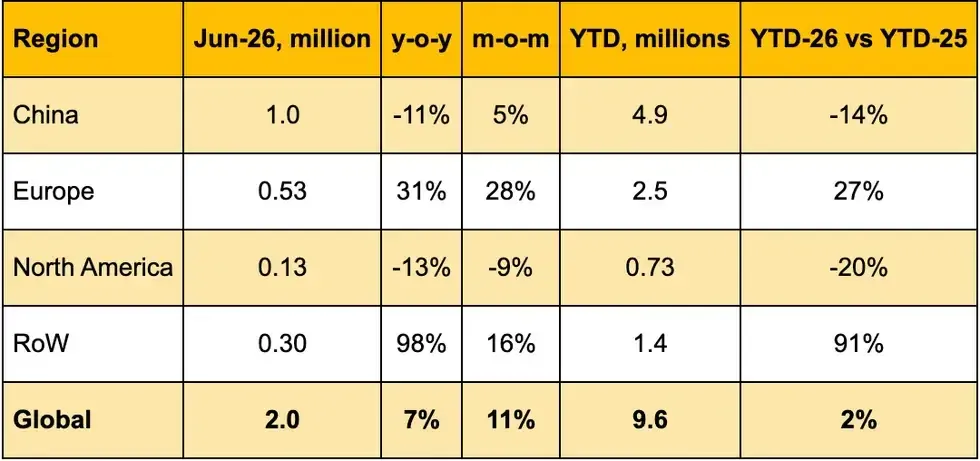
H1 2026 EV sales by region.
Chart via Benchmark Mineral Intelligence.
Chinese EV makers pivot to exports amid domestic demand slowdown
At 4.9 million units bought over the period, EV sales in China were down 14 percent year-on-year in H1, according to Benchmark. As a result, China’s EV makers are looking to foreign markets to pitch their products.
"China’s vehicle manufacturers continue to accelerate their EV export pivot,” explained George Whitcombe, senior EV analyst at Benchmark. “These manufacturers are increasingly looking to expand further into the global market to offset the subdued domestic environment.”
On the global stage, Chinese auto manufacturers benefit from their nation’s dominance in the global battery supply chain, as well as from lower-cost materials, which allow them to produce some of the world’s cheapest EVs.
“Those advantages continue to put pressure on manufacturers in Europe and North America, where smaller production volumes and less integrated supply chains keep battery costs higher,” notes BloombergNEF.
Europe emerges as global EV growth engine
EV sales in Europe experienced a record month in June, up 28 percent month-on-month and 31 percent year-on-year.
A closer look at individual countries in the region shows that this record month of sales was due in large part to booming EV markets in France, Denmark, Spain and Portugal, all of which achieved all-time high monthly sales in June.
“This growth is supported by legislative drivers, subsidies and elevated fuel prices,” stated Whitcombe.
EV Volumes, part of JD Power, said Germany, the region’s biggest EV market, has reintroduced sizable EV consumer subsidies; meanwhile, Spain launched the Auto+ Program incentive as part of its Spain Auto 2030 plan.
The Iran war and the subsequent blockade of the Strait of Hormuz — responsible for 20 percent of global oil transits — has increased prices at the pump for European drivers.
As a result, EVs have grown in popularity among the region’s car buyers in recent months.
“For the first quarter of 2026, it's Europe leading the way, and actually supporting the EV market at a time when domestic sales in China have fallen in the quarter year-on-year, and similarly the US is continuing to see struggles,” said Rob Searle, senior analyst, battery raw materials, at Fastmarkets.
“Europe has actually seen a support of its EV sales, predominantly due to higher fuel prices as a result of what's happening in the Middle East now," he added at the Fastmarkets Global Lithium, Battery & Critical Materials conference.
Despite subsidies, affordability continues to be one of the biggest roadblocks to wider EV adoption, and that has allowed lower-cost Chinese EVs to make inroads into European markets. However, this trend is shifting as government regulations and consumer preferences for domestic products take hold.
While Chinese battery EVs have been subject to countervailing duties since late 2024, Benchmark reported in June that the European Commission is conducting an anti-subsidy investigation into Chinese plug-in hybrid EVs (PHEVs) and considering extending countervailing duties to PHEVs made in China as well.
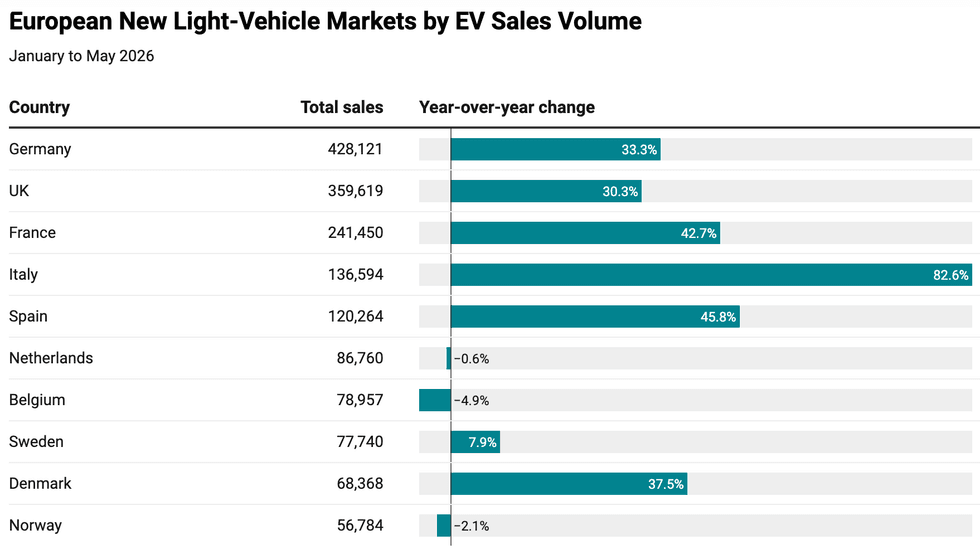
European new light-vehicle markets by EV sales volume, January to May 2026.
Chart via JD Power/EV Volumes.
Automakers are tackling the affordability challenge with smaller EV models.
For example, Volkswagen (ETR:VOW3,OTCPL:VLKAF) has launched a new suite of “Electric Urban Car Family” EVs in Europe, including the Volkswagen ID.Polo, Cupra Raval and Skoda Epiq.
On the consumer side, French car buyers are choosing domestic brands over Chinese EVs, with Renault (EPA:RNO,OTCPL:RNSDF) having a 20 percent EV market share and four of the country's five top-selling EV brands.
“Renault’s recently released small segment EVs are proving popular, with the new Twingo being France’s third best-selling EV in June despite only starting meaningful deliveries in March,” states Benchmark.
North American EV market faces contraction amid policy shifts
North American EV sales totaled 0.73 million units in the first six months of 2026, down 20 percent year-on-year.
The Canadian government has made some compromises to its tariff policies concerning Chinese-made EVs by lowering the 100 percent import tariff to 6.1 percent. The nation's quota is initially set at 49,000 vehicles per year, and will increase annually over five years to reach to 70,000 units by 2030.
“Amid weaker legislative drivers and the removal of the EV tax credit in the US in September, the contraction of the North American EV market persists,” according to Benchmark. “In the USA, all-electric vehicle sales by GM and Ford are down YTD more than all-electric vehicle sales in the market as a whole.”
As part of the July 2025 passage of the One Big Beautiful Bill Act under the Trump administration, federal fuel economy enforcement was effectively gutted, and the US$7,500 tax credit on EVs expired on September 30, 2025.
Carmakers such as Ford Motor (NASDAQ:F), Stellantis (NYSE:STLA), Volkswagen and Nissan Motor (TSE:7201,OTCPL:NSANF) have reacted by pulling some of their EV models off the market, as well as by delaying or scrapping planned EV models.
The US government, under both former President Joe Biden and current President Donald Trump, has also cracked down on sales of China-made EVs entering the market. Hence, Polestar (NASDAQ:PSNY), which is based in Sweden, but Chinese majority owned, is exiting the US market this year after the Department of Commerce decided not to grant the company authorization to sell its vehicles, as reported by Benchmark.
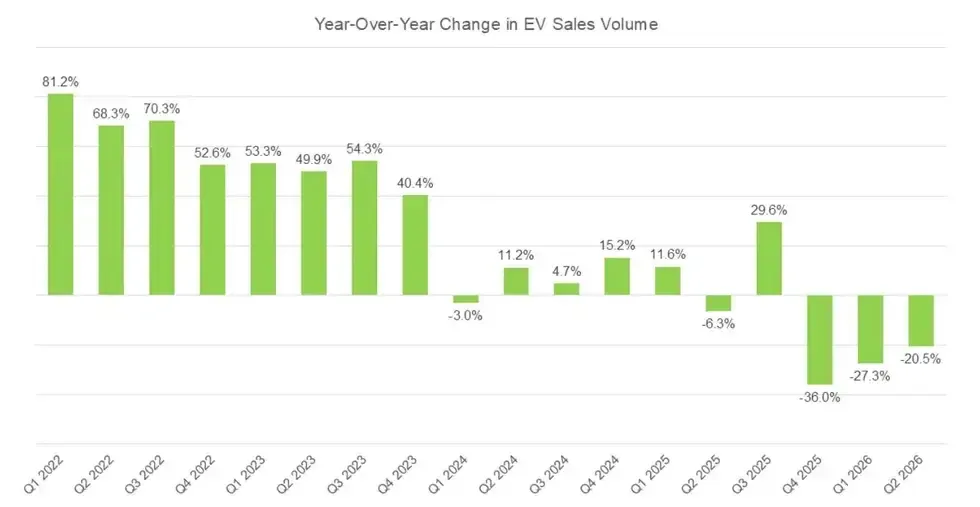
US EV sales volume year-on-year, Q1 2022 to Q2 2026.
Chart via Cox Automotive.
Cox Automotive has a more glass-half-full perspective on the US EV market, noting that its sales performance in the second quarter (-20.5 percent year-on-year) is an improvement over the sharp declines in the first quarter of 2026 (-27.3 percent), as well as the last quarter of 2025 (-36 percent). “Sales performance in Q2 suggests the market may be stabilizing after the sharp correction,” states the firm in a July 10 report.
Tesla (NASDAQ:TSLA) still dominates the US EV market, accounting for about half of all sales. Cox Automotive data shows the automaker sold 242,100 units in H1, down by 10.9 percent compared to the same period in 2025.
General Motors (NYSE:GM) brands Chevrolet and Cadillac took second and fifth place, respectively, in terms of best-selling US brands. For the first half of the year, Chevrolet EV sales were down by 40.7 percent, to 28,267 units, while Cadillac sales jumped 10.1 percent, to 21,767 units.
Hyundai Motor's (KRX:005380,OTCPL:HYMTF) namesake brand ranks third at 26,936 units sold, down 5.4 percent for the period. Fourth place goes to Toyota Motor (NYSE:TM,TSE:7203), up an impressive 136.3 percent to 21,855 units.
What’s the EV market outlook for 2026?
More than 23 million new EVs, including battery and plug-in hybrids, are projected to hit the road this year, says BloombergNEF in its EV Outlook 2026 report. That’s up 11 percent year-on-year. EVs are set to account for 27 percent of unit sales in the overall global passenger vehicle market for the year.
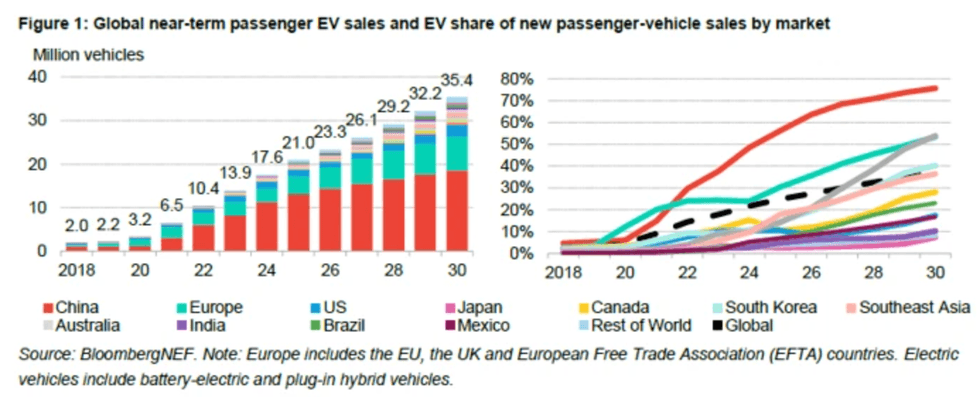
Forecast of global EV sales and auto market share by region.
Chart via BloombergNEF.
Although global EV sales figures are growing at a slower pace in 2026 compared to the 20 percent growth experienced last year, Paul Lusty, head of battery raw materials at Fastmarkets, stated during his firm’s June conference that the market’s “strong structural trajectory remains intact."
Despite China’s domestic EV market suffering from subsidy reforms, its EV exports are still surging and in turn driving growth in emerging markets. For example, BloomberNEF reports that Singapore and Thailand are seeing impressive growth as low-cost Chinese EVs make the transition away from ICE vehicles more affordable for consumers.
“As China's domestic EV sales have softened, it's certainly pivoted hard to exports, with exports roughly doubling this year in May relative to (2025),” Lusty told the audience.
“China isn't slowing production, it's very much just redirecting vehicles to receptive markets."
He added that even if China’s EV demand at home is lagging, downstream demand for battery metals such as lithium remains supported by demand for Chinese EVs abroad.
Looking over at the European market, Lusty sees “tighter emission standards” and the “recent oil price tailwinds” as highly supportive for wider EV adoption rates in the region for 2026.
For its part, EV Volumes is forecasting a 23 percent year-on-year growth rate for European EV sales at just shy of 5 million units, or 32.2 percent of overall auto sales.
As for the US market, the firm expects EV sales to fall by 15.5 percent this year, to 1.3 million units. If this forecast bears out, EVs will only represent 8.2 percent of the overall auto market in the country.
This means that EVs will have lost market share in the US not only by 2025 levels (9.4 percent share), but also less than the 9.8 percent share captured in 2024.
Don’t forget to follow us @INN_Technology for real-time news updates!
Securities Disclosure: I, Melissa Pistilli, hold no direct investment interest in any company mentioned in this article.
https://x.com/INN_Resource
https://www.linkedin.com/in/melissa-pistilli-865271a9/
mpistilli@investingnews.com

Featured Cleantech Investing Stocks






Learn about our editorial policies.