The Conversation (0)
Jul. 11, 2013 04:30AM PST
Athabasca Nuclear Corp (TSXV:ASC), Skyharbour Resources (TSXV:SYH), Noka Resources (TSXV:NX) and Lucky Strike Resources (TSXV:LKY) have entered into a formal agreement to carry out uranium exploration in the Athabasca Basin.

Athabasca Nuclear Corp (TSXV:ASC), Skyharbour Resources (TSXV:SYH), Noka Resources (TSXV:NX) and Lucky Strike Resources (TSXV:LKY) have entered into a formal agreement to carry out uranium exploration in the Athabasca Basin. The newly formed group is called the Western Athabasca Syndicate and combined it will be working on the development of a 287,130 hectare claim of land, known as the Western Athabasca Syndicate Project (WASP) — the largest mineral claim on the western side of the Athabasca Basin controlled by one single group.
Charles Downie, President, CEO and Director of Athabasca Nuclear, the operator of WASP, spoke with Uranium Investing News about the syndicate and what it means for the companies involved.
Downie explained that over the years he has been involved in similar types of deals, however, they were focused on claim staking. As far as companies planning work on a claim, the syndicate is rather unique.
“I’ve never seen a deal like this where they are actually going forward to do work,” he said. “At the end of the agreement, once we’ve all earned 25 percent, we’ll be in a joint venture stage. Depending on what we’ve found— if we make a big discovery— it will be really easy to take that Athabasca syndicate property and put it into another company that we all have 25 percent of.”
The way that the syndicate is structured, two companies, Athabasca Nuclear and Skyharbour are bringing the land to the table, which, Downie clarifies, “is getting pooled together as one project.” Lucky Stroke and Noka, on the other hand, are more focused on the financing. Both companies are also involved in an option deal on the land to earn an interest in it. At the end of the two-year agreement, assuming that everyone has met their commitments, everyone will get 25 percent of the land package.
Per the agreement, Lucky and Noka have to spend $2 million each over the next two years, while Athabasca and Skyharbour have to spend $1 million each over the next two years to make up the total $6 million. Furthermore, Athabasca and Skyharbour will also receive shares and cash because they are bringing the land to the table.
Despite the division of the assets, there is undoubtedly a benefit to a deal syndicate of exploration companies with such a large land package.
“The huge benefit however, is in the way that the deal is structured. Collectively, we are only spending $6 million over the next two years. It’s a way to leverage big exploration expenditures on to that one big piece of ground.” Downie explained, “Ideally what will happen is that we will find three or four compelling targets that are really good and we will spend a couple of million each on those targets and see where we are once everyone has earned their 25 percent.”
Compared to undertaking this task alone, a company would be looking at going to the market with a huge piece of ground to raise $6 million in exploration costs. “On your own there is no way you could do it without hammering your share structure,” Downie said.
Also, by partnering, the companies are spreading the risk around. “Because as you know exploration is a very risky business. Sure, we end up with a decreased share, but if we make a discovery, 25 percent of a discovery is a great thing.”
The property
The WASP property located near Patterson Lake is a vastly under-explored chunk of land.
“We don’t know a lot about the geology yet, because there hasn’t been enough work done,” said Downie. According to Downie, through little is known about the property, there are some earmarks of Patterson Lake in so far as “high uranium values in lake sediment and a few granitic conductors with uranium in it on parts of the property.”
The way he sees it, “it’s where Patterson Lake was about six or seven years ago in terms of development.”
One thing that Downie emphasized in his conversation with UIN is the importance of a technical team because uranium exploration is different than other types of hard rock.
“Athabasca has access to a really good exploration team that has been working in the Eastern part of the Athabasca Basin since 2005. We have a really good technical team that has made one discovery, which is a good part of the story,” he said.
As far as work on the project so far, the first phase of the airborne survey has been completed as well as the VTEM survey. Investors can expect the syndicate to follow up with a radiometric survey in the near term.
” Then we are going to use that, plus an advanced targeting matrix (to rate all the different anomalies) to do the follow up field work which hopefully is going to start at the end of August.”
Investors can look forward to a steady flow of news in the coming weeks; the preliminary results for the airborne survey should be out in the next 10 days.
Downie explained that having read the Alpha/Fission technical report, the syndicate will be following the same methodology of slow, systematic exploration. “Because you will end up with a lot of anomalies when you do big airborne surveys and the trick is to find out which ones are real and which ones aren’t so that when you get the drill in there, that you have a real good shot at finding something.”
In the end, Downie is enthusiastic about the deal. “This is an interesting way to structure a deal, especially for a big project like this where you have so much ground that you have to evaluate, to be able to put in $6 million over two years is really great.”
Securities Disclosure: I, Vivien Diniz, hold no investment interest in any of the companies mentioned.
Featured Energy Investing Stocks
Investor Insight
Generation Uranium offers investors high-leverage exposure to a potential major discovery in Canada’s underexplored and resource-rich Thelon Basin, led by a management team with a proven track record of securing high-value exits.
Overview
Generation Uranium (CSE:GEN, OTCQB:GENR, FRA:W85) is a Canadian exploration company focused on wealth creation through discovery within the uranium sector. The company’s primary strategy is to build a high-caliber exploration team that can rapidly test and drill high-potential targets, de-risking projects for potential takeover by larger producers. Currently centered in the prolific Thelon and Angikuni Basins of Nunavut, the company is also actively evaluating additional project acquisitions in the Athabasca Basin to expand its portfolio.
The company is led by a veteran management team with nearly 30 years of experience in mineral development. CEO Michael Collins has a significant track record of building and exiting public companies, including the co-founding of Bluerock Resources, a conventional uranium producer during the 2000-2008 cycle. This expertise is paired with a focused business model that leverages modern geophysical targeting to accelerate exploration timelines and reduce costs, ensuring the company can deliver results quickly in a bullish uranium market.
Company Highlights
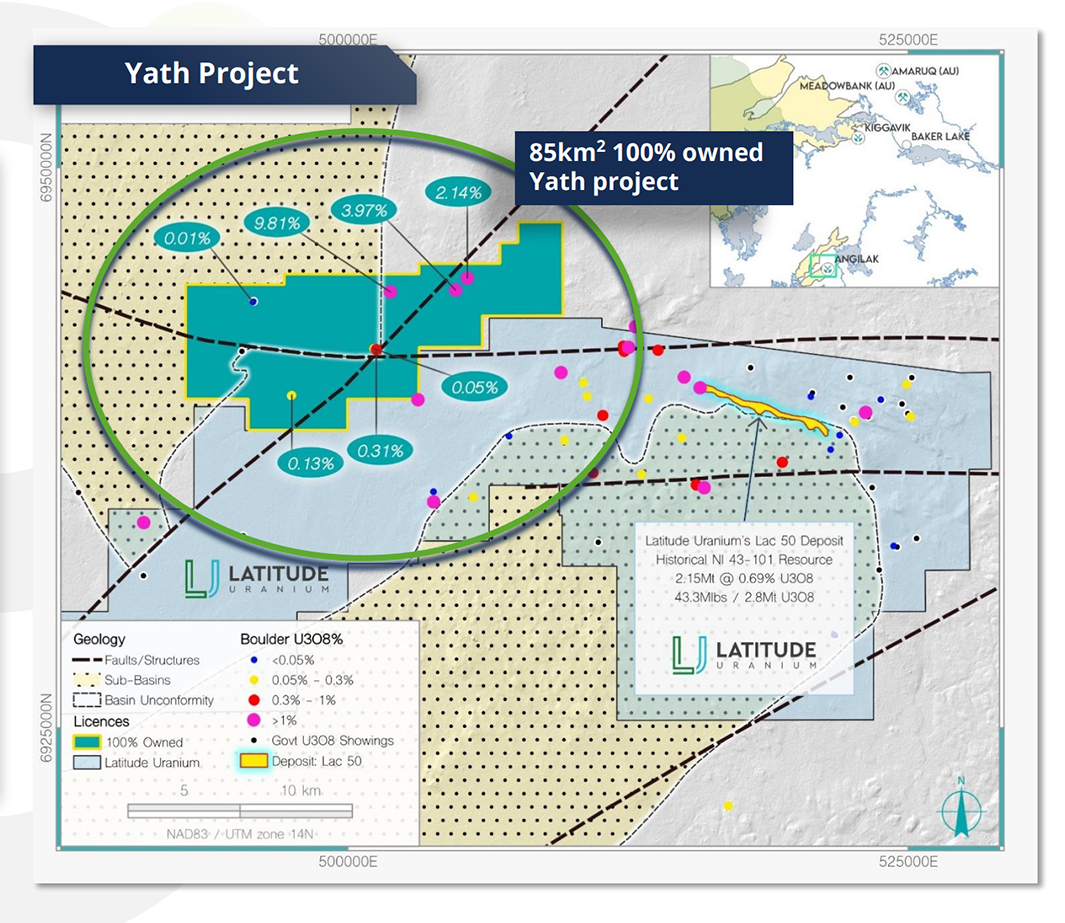
- Strategic Location in a Premier Uranium District: The flagship Yath Project is located in Nunavut’s Thelon Basin, contiguous to ATHA Energy’s Angilak Project, which hosts the high-grade Lac 50 deposit.
- High-Grade Discovery Potential: Historical surface sampling at the Yath Project has yielded exceptional uranium grades, including boulders testing at 9.81 percent, 3.95 percent, and 2.14 percent U3O8.
- Expert Management with Exit Experience: Led by CEO Michael Collins, the team has decades of experience in mineral exploration and a history of co-founding companies that were later acquired, such as Prime Mining and Nuclear Fuels.
- Low-Cost, Rapid Exploration Strategy: By leveraging modern geophysics and extensive historical data, the company aims for a "short road to discovery," de-risking projects quickly to maximize shareholder value.
- Bullish Market Fundamentals: Generation Uranium is well-positioned to meet the growing global demand for carbon-free nuclear power, supported by a projected supply deficit and increased interest from major tech companies seeking clean energy.
Key Project
Yath Project - Nunavut, Canada
The Yath Project is Generation Uranium’s flagship project. This 100 percent owned property covers about 120 square kilometers within the underexplored Thelon Basin in Nunavut, Canada. The project is located where the Yathkyed and Angikuni sub-basins meet, which is a region known globally for high-grade uranium potential. It sits directly along the same trend as the Angilak Project owned by ATHA Energy (TSXV:SASK, OTCQB:SASFK, FWB:XSU.F), which contains the Lac 50 deposit, one of the highest-grade uranium resources found outside of the Athabasca Basin with a historical mineral resource estimate of 43.3M lbs at an average grade of 0.69 percent U3O8.
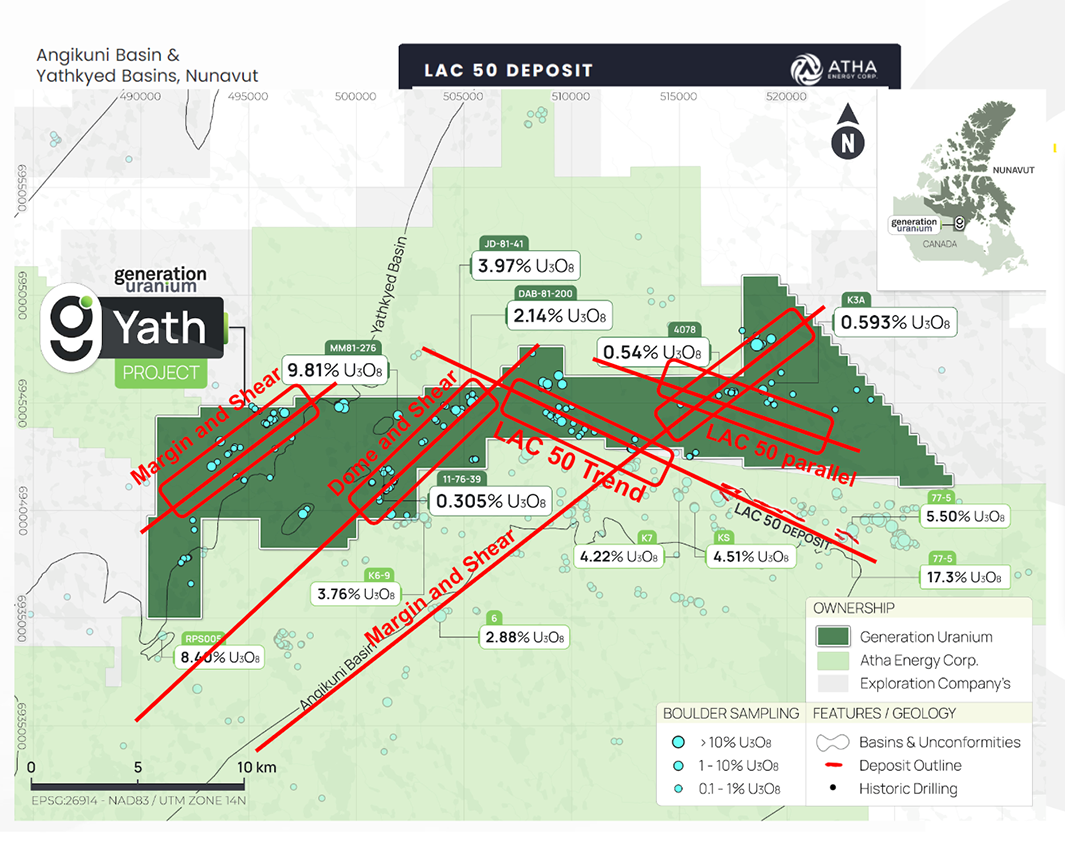
The Yath Project is contiguous to the Lac 50 trend and is crossed by several regional faults and basin boundaries. Past exploration work has already identified high priority targets, while surface sampling in the area has produced uranium grades from boulders, with some testing at 9.81 percent, 3.95 percent, and 2.14 percent U3O8.
The company has commenced its initial field program at the site, set to define and rank drill targets. Historic showings will be combined with new anomalies from the MMT geophysics survey, preparing the project for an anticipated drill permit.
Management Team
Michael Collins - CEO & Director
Michael Collins is a professional geoscientist with nearly 30 years of experience in mineral exploration. He has co-founded several public companies, including Exploits Discovery, Prime Mining (acquired in 2025), and Nuclear Fuels (merged with Premier American Uranium in 2025). He is also currently a director of First Atlantic Nickel.
Christoph Bruening - Director
Christoph Bruening is the founder and managing partner of Value Relations GmbH, a full-service investor relations and public relations agency in Frankfurt with over 25 years of excellence, focusing on mining, exploration, biotech and health care. In addition, he has listed over 600 companies on the Frankfurt Stock Exchange and is a speaker and author of several publications, including on rare earths and uranium.
Dallas Miller - Director
Dallas Miller has been working within the international mining industry for over 15 years, working with BHP and Santos Ltd. He has experience on the ground from an operational standpoint, as well as being an integral part of raising millions of dollars in capital funding for both private and public companies in recent years.
Roger Leschuk - VP Corporate Development
Roger Leschuk has been in corporate management for over two decades, with the past 15 years dedicated to corporate development and investor relations. He has experience participating in and assisting with mergers and acquisitions, and was an investment advisor for various services such as stocks, mutual funds and tax-sheltered investments. He is a Chartered Investment Manager and a Fellow of the Canadian Securities Institute.
Monty Sutton - CFO
Monty Sutton brings over 35 years of experience in public markets and corporate governance. He previously served as CFO for Nuclear Fuels from its IPO through its acquisition.