
The Conversation (0)
Nov. 25, 2026 01:05PM PST
Fact CheckedThis article has been reviewed and updated according to INN's rigorous fact-checking process. Our staff editors verify all articles against information and data from primary sources, reputable publishers and experts.

Ozgurluk Design / Adobe Stock
Get the latest insights on Bitcoin, Ether and altcoins, along with a round-up of key cryptocurrency market news.
Here's a quick recap of the crypto landscape for Wednesday (November 25) as of 10 p.m. UTC.
Bitcoin price update
Bitcoin (BTC) was priced at US$59,954.78, trading 0.2 percent higher over the past 24 hours.
Bitcoin's spot price has remained pinned below US$60k. Last week’s realized losses reached levels unseen since FTX’s 2022 collapse, marking what Glassnode termed the downturn’s first major capitulation in its latest weekly report.
Glassnode analysts called Bitcoin “the canary in the coal mine” for stocks, pointing to Monday’s pop when Nvidia brought back Jensen Huang as an example. Bitcoin gave up its gains within hours, while the Nasdaq-100 (INDEXNASDAQ:NDX) held on to most of its rise.
The firm said Bitcoin is moving more closely with tech stocks than at any time since 2022, and expects the currency to struggle to recover without help from stocks.
Glassnode added that a price band between US$62,000 and US$66,000, which had held Bitcoin up since the summer, now works as a ceiling instead.
Additionally, Glassnode pointed to a retreat among US buyers, noting that US spot Bitcoin funds recorded their sharpest 20-day outflows since inception ahead of the report. Selling has been especially pronounced among Coinbase users.
Still, the firm sees potential relief. Forced selling has largely cleared, as most leveraged bullish bets near current prices were liquidated.
If Bitcoin closes below US$58,000, Glassnode said it could slide toward US$53,200.
Bitcoin price chart
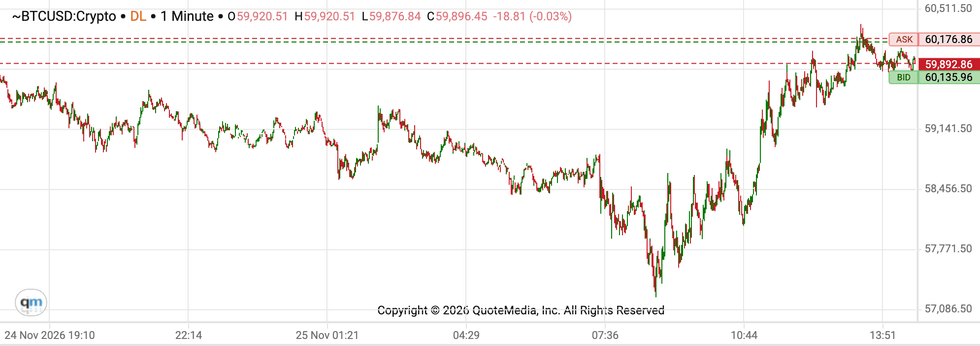
Bitcoin price performance, November 25, 2026.
Chart via the Investing News Network.
Ether and altcoin price update
- Ethereum (ETH) was priced at US$1,682.54, trading 0.4 percent higher over the last 24 hours.
- XRP (XRP) was priced at US$0.94, trading 2.1 percent higher over the past 24 hours.
- Solana (SOL) was trading at US$70.25, trading 1.6 percent lower over the past 24 hours.
Today's crypto news to know
Read on for a round-up of the biggest crypto market news:
- Crypto fear gauge sinks to "extreme fear"
- CFTC staff let exchanges count crypto toward reserves
- SEC staff clears way for Molecule’s research tokens
- Ethereum Foundation picks Keccak-256 for quantum-safe future
- SBI, SMFG launch Solana venture for stablecoins and tokenization
- South Korea drafts bill to end 2017 ICO ban
Crypto fear gauge sinks to "extreme fear"
CoinMarketCap's crypto Fear and Greed Index now reads 8 out of 100, deep in extreme fear territory, as stocks and digital assets give back part of the rally that followed Jensen Huang's return to NVIDIA (NASDAQ:NVDA).
Three months ago, the gauge hit its yearly high of 82. On Tuesday (November 24), it sat at 9, matching Friday's reading and its lowest level since February.
Nvidia's board reinstated Huang as CEO on Monday (November 23), and the stock closed up 31.5 percent. The chipmaker had lost nearly half its market value from its October highs before he came back. By Tuesday, the Nasdaq and S&P 500 were trading lower again, giving back part of Monday's gains.
Bitcoin traded around US$59,500 on Tuesday, down 2.74 percent from the session's open, while total crypto market capitalization fell 4.44 percent to US$2.04 trillion, according to CoinMarketCap.
Doubts about AI spending sit at the center of the selloff as investors are questioning whether the hundreds of billions of dollars going into AI infrastructure will bring in enough revenue to pay off. In Bank of America's (NYSE:BAC) November fund manager survey, 52 percent of respondents said they expect at least one major cloud company to announce spending cuts within six months.
The Nasdaq lost about 10 percent last week, its worst week since 2020, erasing its gains for the year. The S&P 500 entered correction territory after falling more than 10 percent from its October peak.
CFTC staff let exchanges count crypto toward reserves
CFTC-regulated exchanges and clearinghouses can now count Bitcoin, Ether and Payment stablecoins toward the 12 months of operating costs they must hold in reserve, but they still need cash-like assets to pass a separate liquidity test, according to a staff advisory issued this week.
The guidance carries no legal force, setting no new rules, granting no enforceable rights, and offering no no-action protection. It also may not reflect the view of the Commission itself, where Chair Mike Selig currently serves as the only sitting commissioner.
The CFTC's Division of Market Oversight and Division of Clearing and Risk, through the advisory issued jointly, covers swap execution facilities, designated contract markets, and derivatives clearing organizations.
The 12-month requirement aims to ensure that a troubled venue can stay open or close in an orderly way. Crypto can now count toward that buffer subject to "appropriate haircuts," a markdown that reflects the assets' price swings.
The liquidity rule sets a higher bar. Under Generally Accepted Accounting Principles, digital assets do not qualify as "cash" or "highly liquid securities," so platforms cannot use them to show they can pay obligations quickly. A venue that keeps bitcoin as part of its long-term backstop must still hold traditional cash-like instruments alongside it.
The CFTC has previously cleared perpetual futures on individual stocks, granted no-action relief that lets crypto apps offer regulated derivatives, and floated a plan to bring crypto exchanges under federal oversight.
Overall, the commission's makeup could soon face an overhaul. President Donald Trump has sent a bipartisan slate of nominees to fill vacant CFTC and SEC seats, and his CFTC picks, Matthew Rowland and Nathan Anonick, faced the Senate Agriculture Committee last week.
SEC staff clears way for Molecule’s research tokens
Swiss company that uses crypto tokens to help fund biotech research has received a no-action letter from the US Securities and Exchange Commission’s Division of Corporation Finance on Tuesday (November 24) saying it would not recommend enforcement action if a company behind Molecule’s research projects sells its project tokens without registering them, as long as it follows the terms Molecule set out.
The tokens are built around what Molecule calls its “Coin-to-Company” model. Token holders get access to research tools and data, plus advisory votes on projects. Any stake in a company would need a separate securities offering.
Token holders who want a stake in the company can lock up their tokens, pass identity checks and then apply for shares, which the company has full discretion to approve. Any shares are issued under existing US securities rules that are separate from the token sale.
The letter covers only the facts Molecule described and does not approve the tokens for trading on exchanges, and it is not a formal ruling. It reflects the view of SEC staff and applies only to the setup Molecule described.
“Molecule AG and the Coin-to-Company No Action Letter [bring] together the best of blockchains with traditional equity structures to accelerate the production and commercialization of science in the US, Europe and worldwide,” said Benjamin Snipes, Molecule’s chief legal officer.
Ethereum Foundation picks Keccak-256 for quantum-safe future
The Ethereum Foundation has recommended Keccak-256 as the building block for Ethereum’s move to quantum-safe security. It made the call in a blog post on Tuesday (November 24).
Keccak-256 is a hash function, a math tool that turns any piece of data into a short, fixed-length fingerprint, which Ethereum plans to use to protect user accounts, validators and network data from future quantum computers. A powerful enough quantum computer could break the digital signatures that secure most crypto wallets today.
The researchers compared five options: Poseidon/Poseidon2, BLAKE3, BLAKE2, SHA2-256 and Keccak-256. They chose Keccak-256 mainly for its track record. It has been studied for nearly two decades and has a large security margin. Ethereum also already uses it for addresses and other core parts of the network.
However, Keccak-256 is slower than BLAKE3 and slower than SHA2-256 on its own terms, and the researchers said they accept that cost for the extra security and track record.
Earlier this week, Ethereum’s next major upgrade, Glamsterdam, was pushed back to 2027. Developers are also debating whether to shrink the upgrade after it to keep quantum-safety work on schedule.
SBI, SMFG launch Solana venture for stablecoins and tokenization
Two of Japan's biggest financial groups, SBI Holdings and Sumitomo Mitsui Financial Group (SMFG), have launched a joint venture with the Solana Foundation to bring stablecoin payments and tokenized assets to Japan and the rest of Asia.
In a joint release, the three parties said they had completed the agreements for a three-party joint venture, and that SBI R3 Japan now operates as SBI Solana Global. The company has now begun full-scale operations.
The venture will focus on three main areas:
- Payments using stablecoins, which are crypto tokens tied to a regular currency.
- Turning traditional assets into digital tokens, including bonds, funds, loans and commodities.
- Managing investments on the blockchain.
The companies said they will first build real use cases in Japan, then expand across Asia.
The deal was first announced in July. SBI R3 Japan had been built on Corda, a private blockchain made for banks. The new venture moves fully to Solana, a public network. In July, SBI said the venture would support yen-backed stablecoins, including its own JPYSC.
The Solana Foundation says SBI and SMFG have more than US$2.3 trillion in combined assets and over 80 million customers. The companies have not shared how much each owns, how much money is going in, or when specific products will launch.
South Korea drafts bill to end 2017 ICO ban
South Korean crypto projects could sell tokens to the public at home for the first time since 2017 under a draft law the Financial Services Commission (FSC) released on Tuesday (November 24).
Before any sale, issuers would have to file a "digital asset white paper" with the FSC setting out the project, planned use of proceeds, token supply and risks. False or missing information would expose issuers and their executives to civil damages, fines and possible criminal charges, mirroring the liability rules for stock offerings.
The bill, the Act on Digital Asset Industry Innovation and User Protection, reaches well beyond token sales. It would limit won-backed stablecoin issuance to consortiums in which commercial banks hold a majority stake, cap any single major shareholder's stake in a crypto exchange at 20 or 34 percent under certain conditions, and apply market manipulation rules to crypto-to-crypto trades.
Regulators banned ICOs in September 2017, citing fraud, speculation and investor losses. The FSC has since concluded that the ban mainly drove Korean projects to set up entities abroad and run their token sales remotely.
The bill now goes to the National Assembly, which must approve it before any changes take effect. There is no timeline yet, and the final rules could still change.
Don't forget to follow us @INN_Technology for real-time news updates!
Securities Disclosure: I, Giann Liguid, hold no direct investment interest in any company mentioned in this article.
Securities Disclosure: I, Meagen Seatter, hold no direct investment interest in any company mentioned in this article.
https://x.com/giannliguid
https://www.linkedin.com/in/giannliguid/


Learn about our editorial policies.
Learn about our editorial policies.