The Conversation (3)

May. 27, 2026 01:55PM PST
Fact CheckedThis article has been reviewed and updated according to INN's rigorous fact-checking process. Our staff editors verify all articles against information and data from primary sources, reputable publishers and experts.
VladKK / Shutterstock
Platinum-group metals (PGMs) include platinum, palladium, rhodium and other metals, all of which are prized for their durability, resistance to corrosion and excellent catalytic properties. However, just a handful of countries produce these precious metals.
The automotive industry is the world’s largest consumer of these metals, which among other things are used in catalytic converters for vehicle exhaust systems in cars with internal combustion engines (ICE). A rebound and continued growth in auto production is projected in the coming years, particularly in developing markets, and this should increase demand for PGMs, especially when it comes to platinum and palladium.
On the supply side, the platinum market remained at a significant deficit in 2025, with a shortfall of 692,000 ounces, and is expected to stay at a deficit through 2026. These fundamentals, alongside a run in precious metals, led platinum prices to an all-time high of US$2,913.36 per ounce on January 26, 2026.
When it comes to palladium, the market is even more dependent on the automotive sector. Although 2025 recorded a 415,000 ounce supply deficit, analysts at UBS suggest that this could turn around to oversupply due to sales growth in the EV sector. Palladium prices reached an all-time high of US$3,221 per ounce on March 8, 2022.
Prices for the metal have declined in recent years on waning demand from the auto sector, and have been trading in the US$1,300 to US$2,000 range in 2026.
But where do platinum and palladium come from? The list of the world’s top palladium- and platinum-mining countries is a short one, and most PGMs come from South Africa and Russia. Russia's ongoing war in Ukraine and electricity shortages in South Africa are expected to seriously hamper the ability of these nations to bring PGMs to market.
We dive into the miners, markets and regulations affecting the top platinum and palladium countries below, and you can also learn more about the companies mining them in our guides on how to invest in platinum and palladium here.
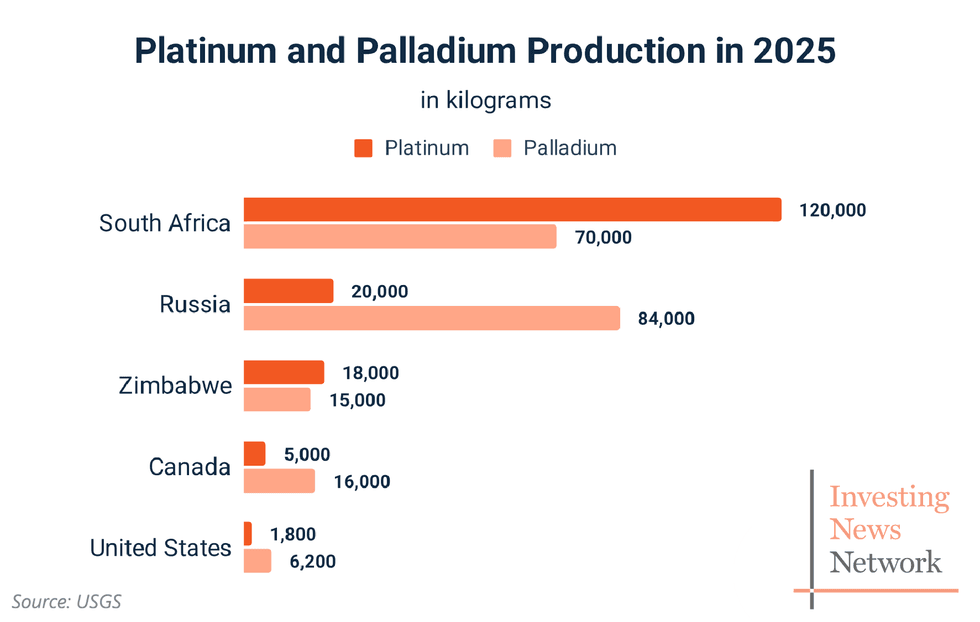
So what other countries are platinum and palladium producers, and which countries hold the most platinum and palladium reserves? Below is a list of the five top producers in 2025, as per the latest data from the US Geological Survey.
1. South Africa
Platinum production: 120,000 kilograms
Palladium production: 70,000 kilograms
PGM reserves: 63 million kilograms
South Africa is top of the list of the world’s top platinum producers, with production of 120,000 kilograms in 2025. South Africa is also a major producer of palladium, taking second place globally with 70,000 kilograms last year.
Combined 2025 production of PGMs in South Africa decreased 9 percent compared to 2024, when the country produced 126,000 and 82,600 ounces of platinum and palladium respectively. The USGS attributed this to "declining palladium prices, higher costs associated with deep-level mining, and ongoing disruptions to the supply of electricity."
South Africa holds the largest-known reserves of PGMs globally at 63 million kilograms, accounting for about 83 percent of known global reserves.
The Bushveld Complex is the largest PGMs resource in the world, and represents a large majority of annual global production of platinum and palladium. Impala Platinum Holdings (OTCQX:IMPUF,JSE:IMP), commonly called Implats, is a significant producer in the complex, which hosts the company's Impala Rustenburg mine, Marula mine, Bafokeng and Two Rivers joint venture.
Another major platinum miner operating in the Bushveld Complex is Valterra Platinum (LSE:VALT,JSE:VAL,OTCPL:AGPPF), which was de-merged from Anglo American (LSE:AAL,OTCQX:NGLOY) in May 2025. Valterra is the world's largest platinum producing company.
2. Russia
Platinum production: 20,000 kilograms
Palladium production: 84,000 kilograms
PGM reserves: 11 million kilograms
Despite being the world’s second biggest platinum-mining country, Russia’s annual production trails behind South Africa’s by a large margin, coming in at 20,000 kilograms for 2025. That said, Russia was the world's top palladium producer in 2025, putting out 84,000 kilograms last year — 14,000 kilograms higher than South Africa’s output.
Russian mining company Norilsk Nickel (MCX:GMKN) is the world’s largest palladium producer, and it plans to invest US$35 billion in infrastructure upgrades between 2021 and 2030, which will ultimately result in higher metals output.
While Russia held its spot as the top palladium producer last year, its palladium production came in below the 89,000 kilograms in 2024. The USGS attributed the drop to "lower metal grades and ore recovery, geopolitical and investor uncertainty related to the Russia-Ukraine conflict, and the introduction of new mining equipment at one operation."
3. Zimbabwe
Platinum production: 18,000 kilograms
Palladium production: 15,000 kilograms
PGM reserves: 1.3 million kilograms
Zimbabwe is a major producer of both platinum and palladium, producing 18,000 and 15,000 kilograms of the precious metals respectively in 2025. The country holds 1.3 million kilograms of PGM reserves.
Zimplats Holdings (ASX:ZIM), which is 87 percent owned by Implats, is the biggest platinum miner in the country.
In October 2022, Zimbabwe introduced a policy that allows it to stockpile physical metals, including PGMs. A change to the country's existing cash royalties on miners, the rules require mining companies to instead pay the royalties based on their production in a 50/50 combination of cash and refined metals.
The policy currently applies to PGMs, gold, diamonds and lithium. However, it is dynamic, with the option to add or subtract affected metals and change royalty percentages based on factors such as geological scarcity and demand trends.
In January 2025, the Government of Zimbabwe officially implemented a 5 percent levy on unbeneficiated platinum exports, which it had postponed to allow mining companies time to build refining capacity.
In line with the government's goal of adding value to the country's platinum products, Zimplats has expanded its smelting capacity and is making slow progress on a US$190 million refurbishment of its mothballed base metals refinery to process concentrates into PGM mattes. The company expects commissioning at the plant to begin early in its fiscal year 2027, which begins July 1, 2026.
4. Canada
Platinum production: 5,000 kilograms
Palladium production: 16,000 kilograms
PGM reserves: 310,000 kilograms
Canada’s strong palladium production of 16,000 kilograms makes it the third highest producer globally in 2025. Canada's platinum production last year was also significant at 5,000 kilograms. The North American country's palladium and platinum production were both nearly on par with the previous year.
Canada only holds 310,000 kilograms of known reserves of platinum group metals — the lowest total reserves on this list — but companies continue to explore for PGMs in Canada in search of more deposits.
Canadian PGM production takes place mainly in the province of Ontario, but PGMs output also comes out of Québec and Manitoba.
The country has one primary palladium mine, the Lac des Iles palladium mine in Western Ontario, which is owned by Implats Canada. Last year, Implats revealed it would be shuttering the mine due to market conditions, but changed course after the palladium price saw large gains late in 2025 that supported extending the mine life into 2027.
The remainder of the country's PGM production is as a by-product of Canada’s nickel mines.
5. United States
Platinum production: 1,800 kilograms
Palladium production: 6,200 kilograms
PGM reserves: 590,000 kilograms
The United States produced 6,200 kilograms of palladium and 1,800 kilograms of platinum in 2025. The US holds 590,000 kilograms of identified PGM reserves.
Sibanye Stillwater's (NYSE:SBSW,JSE:SSW) Stillwater Complex in Montana is the only primary producer of PGMs in the US. The company also maintains a smelter, refinery and laboratory in Montana and recovers PGMs from spent catalytic convertor material from vehicles.
Low palladium prices forced Sibanye Stillwater to curtail production and layoff about 700 employees at the Stillwater Complex in 2024.
The company has pointed to Russia flooding the palladium market to depress prices. On July 30, 2025, Sibanye Stillwater and related industry participants filed antidumping and countervailing duty petitions with the US Department of Commerce and the US International Trade Commission (ITC) on imports of unwrought palladium from Russia.
In September 2025, the ITC determined there is a reasonable indication the industry was "materially injured" by the Russian imports, and commenced the final phase of investigations. In January 2026, the ITC sided with Sibanye Stillwater and imposed a 132 percent tariff on Russian palladium imports to the United States.
FAQs for investing in palladium and platinum
What is platinum?
Platinum is a precious metal that belongs to the platinum-group metals category. Platinum has a silverish-white hue and is represented by the symbol Pt and atomic number 78 on the periodic table of elements.
What is platinum used for?
Platinum has several uses, including playing a large role in the auto industry for its ability to reduce emissions. Additionally, platinum is in high demand for jewelry and as an investment metal.
Platinum is also benefiting from growing demand from the hydrogen fuel cell sector. The metal is a key catalyst in the process that converts hydrogen into electricity.
What is palladium metal?
Palladium fits into the precious metals category and is a PGM. It is represented by the symbol Pd and atomic number 46 on the periodic table of elements. Palladium has a silvery-white color and is prized for its rarity, as well as its role in catalytic convertors for vehicles.
What is palladium used for?
The automotive sector is the primary end user of palladium. The metal is a key component in the catalytic convertors of internal combustion engine vehicles, where it is used to reduce emissions.
Like platinum, palladium is used in jewelry and valued as an investment. It has other smaller-scale uses, and is consumed in various ways by the medical and dental fields, among others.
What is the best way to invest in palladium?
While there is no single best way to investing in palladium, those interested in gaining exposure to this market have a variety of options. Investors who prefer more tangible assets can add physical palladium to their portfolios, including palladium bullion and coins.
Palladium exchange-traded funds such as the Sprott Physical Platinum and Palladium Trust Unit (ARCA:SPPP) and the Aberdeen Standard Physical Palladium Shares (ARCA:PALL) offer another route. Palladium-focused stocks are yet another option, with pure-play palladium miners including Sibanye-Stillwater and Impala Platinum Holdings.
Why are metals like gold, platinum and palladium so expensive?
Precious metal gold has long been valued as a form of currency and a store of wealth, all of which have built up its high intrinsic value. Platinum and palladium are 30 times rarer than gold, much harder to mine and are in high demand due to their important industrial uses.
Don’t forget to follow us @INN_Resource for real-time news updates!
Securities Disclosure: I, Dean Belder, hold no direct investment interest in any company mentioned in this article.
From Your Site Articles
- Palladium Price Forecast: Top Trends for Palladium in 2026 ›
- Platinum Price Forecast: Top Trends for Platinum in 2026 ›
- WPIC: Platinum to Record Third Annual Deficit as Supply Fails to Meet Demand ›
- How to Invest in Platinum Stocks, Bullion and More ›
- 3 Ways to Invest in Palladium | INN ›
Related Articles Around the Web
https://x.com/INN_Resource
https://www.linkedin.com/in/deanbelder
dbelder@investingnews.com

Featured Precious Metals Investing Stocks
Learn about our editorial policies.