Overview
Greenlane Renewables (TSX:GRN) is a leading global provider of biogas-upgrading systems that are capable of contributing to decarbonizing the natural gas grid and transportation network. The company’s systems produce clean, low-carbon, renewable natural gas (RNG) from organic waste sources such as landfills, wastewater treatment plants, farms and food waste facilities. The RNG is then used as fuel for vehicles, such as those adopted by UPS (NYSE:UPS), or for injection into the natural gas grid.
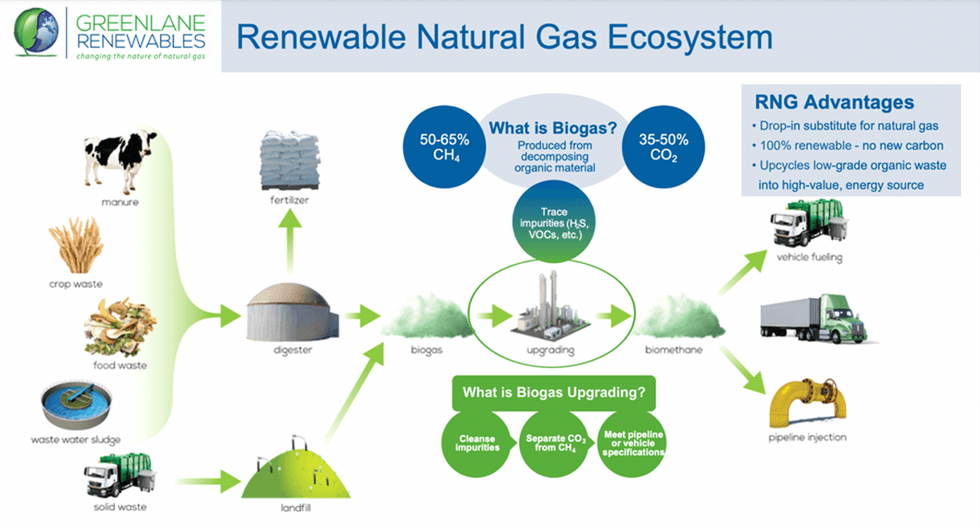
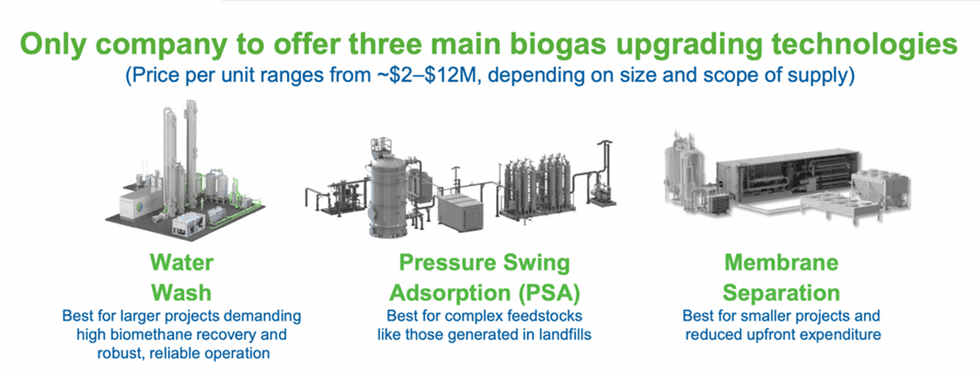
In response to end-user demands for a lower carbon footprint and renewable fuels, Greenlane Renewables is the only RNG pure-play that offers the three main biogas upgrading technologies. These technologies remove impurities and separate biomethane in raw biogas to create clean RNG for pipeline injection, liquefaction or direct use as a vehicle fuel. The company works with customers from around the globe to find the right solutions for the type and scope of the project.
Focused on providing turnkey solutions for its clients, Greenlane Renewables offers three technologically advanced solutions to its clients: its patented water-wash system, pressure swing adsorption (PSA) and membrane separation. All three are designed to meet project specifications without breaking the budget. More than that, Greenlane Renewables brings core competency and outright expertise built on decades of experience to get the job done. Units are priced from $2 million to $12 million depending on the size and scope of the project, generating more than $71 million in revenue for the company in 2022.
Greenlane Renewables has installed over 140 units in 19 countries across the globe. The company has installed one of the largest RNG operations in both Europe (Germany) and Canada (Quebec). Greenlane Renewables has also completed a project in California that upgrades and injects RNG into the SoCalGas (OTCMKTS:SOCGP) (part of the Sempra group of utilities) natural gas pipeline network.
In August 2022, Greenlane Renewables signed new contracts with a combined value of $13.5 million to supply its biogas-upgrading technology for two landfill RNG projects in South America. Greenlane will provide two water-wash upgrading systems capable of processing enough landfill gas to produce up to approximately 850,000 MMBTU. The company also secured a US contract for C$8.7 million for a project to convert dairy manure to RNG and an $11.4 million contract with a single customer for the supply of its pressure swing adsorption biogas upgrading systems for new food-waste-to-RNG projects across three US states. Most recently, Greenlane was awarded a $7.2 million contract through Synthica St. Bernard LLC for a food-waste-to-pipieline renewable natural gas project in Ohio. Greenlane will supply an integrated sulphur removal and water wash system for upgrading biogas generated from food waste streams into pipeline-spec renewable natural gas for direct injection into the local natural gas pipeline network.
In an effort to accelerate the development of renewable natural gas projects, Greenlane Renewables announced two development capital deployments in 2022, with a combined total of up to US$1.8 million. The two capital deployments — one for a company developing RNG projects based on a dairy cluster model in California, and the other for a company developing landfill gas-to-RNG projects in the US midwest — support Greenlane Renewables’ effort to accelerate RNG projects to ready-for-construction phase.
With over 35 years of industry experience, patented technology and over 140 biogas units installed in 19 countries, Greenlane Renewables is committed to help eliminate waste and provide a greener future for generations to come.
Greenlane Renewables is also one of the founding members of the Integrated Biogas Alliance (IBA), an organization designed to help provide the global biogas industry with unique and fully-integrated organic waste to renewable energy solutions.
Company Highlights
- Greenlane Renewables is a market leader in upgrading low-energy biogas to RNG.
- The company has 14 patents and 28 device titles.
- The company offers three patented biogas-upgrading technologies to customers across the globe.
- Each technology unit is worth between $2 million and $12 million.
- Revenue generated in 2022 totaled more than $71 million.
- The company has installed more than 140 units in 19 countries.
- Expanding beyond equipment sales, Greenlane Renewables has embarked on two deployment capital agreements in 2022, in an effort to accelerate projects to the construction phase.
- The company is composed of industry leaders with more than 30 years of experience.
- Insiders own approximately 10 percent of the company’s shares.
- Greenlane Renewables acquired Airdep S.R.L., a provider of biogas desulfurization and air deodorization products based in Vicenza, Italy.
- Greenlane Renewables has a robust sales pipeline worth $900 million.
Get access to more exclusive Cleantech Investing Stock profiles here
Latest News
Latest News
Outlook Reports world
Featured Cleantech Investing Stocks
Investor Insight
With a clear, execution-driven strategy, Homerun Resources is positioning itself as a vertically integrated leader in advanced materials for the global energy transition, leveraging one of the world’s highest-quality high-purity quartz (HPQ) silica districts in Bahia, Brazil, to supply premium raw materials for processed industrial silica, solar glass, advanced materials like silicon carbide, and thermal particle energy storage.
Overview
Homerun Resources (TSXV:HMR,OTC:HMRFF,FSE: 5ZE) is executing a three-phase strategic plan to become a leading global supplier and processor of high-purity silica, transforming it into high-value products for the renewable energy and advanced materials markets. Phase 1 secured the Belmonte Silica District and logistics pathway; Phase 2 is advancing construction of processing and solar glass facilities; Phase 3 will integrate downstream verticals which include energy storage, perovskite PV and AI-driven energy solutions.

The company’s competitive advantage begins with its raw material, which includes some of the world’s purest quartz silica sand, with minimal iron and other impurities, paired with its location, infrastructure access and a government partnership that expedites typical permitting timelines.
Homerun is targeting multiple industries where demand is surging, supply is constrained and pricing remains strong. Brazil currently imports all solar glass and advanced silica components. Global solar glass demand is forecasted to surge from US$13 billion in 2024 to ~US$197 billion by 2034 (31 percent CAGR), while HPQ is essential to meet efficiency and purity standards. Coupled with industrial tariffs and tax incentives in Brazil, Homerun’s full‑stack model, from silica sand to solutions, sets it up to disrupt Chinese‑dominated supply chains and fund its continued growth in downstream verticals from projected strong internal margins.
Company Highlights
- Vertically Integrated Growth Model: Multiple profit centers across HPQ silica, advanced materials, solar glass and perovskite PV on glass, energy storage and AI-driven energy management solutions.
- Flagship Resource Advantage: Exclusive 40-year leases with the government of the State of Bahia over the Santa Maria Eterna silica sand deposit in Brazil with over 63.9 Mt combined measured and inferred at >99.6 percent silicon dioxide (SiOâ‚‚) and low iron impurities, enabling direct feed into solar glass.
- Latin America’s First Solar Glass Facility: Planned 365,000 tpa plant adjacent to the resource, supported by LOIs with Brazil’s largest solar module manufacturers and a large competitive COGS and subsequent pricing advantage over Chinese imports.
- HPQ Processing Plant Near-Term: 120,000 tpa initial capacity for ultra-pure (>99.99 percent SiOâ‚‚) silica, with rapid scalability and low relative capex and projected ROI.
- Breakthrough Energy Storage Partnership: Collaborating with the US Department of Energy’s NREL on a thermal energy storage system using Homerun’s silica with ancillary revenue from purified product output.
- Government-backed Execution: MOU with Bahia State Government and Municipality of Belmonte includes a 64.5-hectare land grant, tax incentives, expedited permitting, infrastructure upgrades and workforce training.
- Strong Financing Pipeline: Advancing funding discussions with Brazil’s development bank, innovation agency, institutional investors and announced plan for a UK main board listing.
Key Projects

Santa Maria Eterna Silica Sand Lease

Site of Homerun’s industrial facilities in Belmonte, Brazil
Homerun’s cornerstone asset in Belmonte, Brazil is a 40-year lease agreement with Companhia Baiana de Pesquisa Mineral (CBPM) over the Santa Maria Eterna (SME) deposit. The NI 43-101 MRE defines 25.56 Mt measured and 38.35 Mt inferred at >99.6 percent silicon dioxide (SiO₂). This sand’s unique low-iron chemistry enables direct use in solar glass furnaces without expensive, high-energy impurity removal, capable of delivering a significant cost advantage.
The project has extraction rights already in place on its silica sand and working toward environmental permits for advanced processing, and a low minimum royalty (R$26/ton). The deposits at SME are located beside a major roadway, within trucking distance of the Port of Ilhéus, with future local port expansion potential through Veracel Celulose in the State of Belmonte.
​
HPQ Silica Processing Facility
The first commercial development priority, the HPQ silica plant will process 120,000 tpa of ultra-pure silica (>99.99 percent SiOâ‚‚), with expansion capability. Capex is estimated at approximately US$30 million, subject to final engineering by Dorfner Anzaplan, which is underway. Test work at UC Davis, NREL Labs and Anzaplan has already achieved +99.99 percent SiOâ‚‚ purity. At UC Davis, these high purities were achieved using new femtosecond laser purification technology without chemical reagents, paving the way for zero-waste, zero-emission production. The processing facility will serve global energy and high-tech markets including solar, silicon carbide, and advanced ceramics and glass.
Solar Glass Manufacturing Facility
Planned as Latin America’s first dedicated high-efficiency solar glass plant, this facility will produce up to 365,000 tpa. Brazil’s solar market is the largest outside China, with over 113 GW of capacity in pre-construction. Recent government tariffs (25 percent on imported solar components) and tax incentives for domestic supply create a strong market backdrop. Homerun has signed LOIs totaling 120,000 tpa at US$750/t with major module producers Sengi Solar and Balfar Solar, plus an LOI with a German development group for the full 365,000 tpa. German engineering firms Horn Glass and SORG have provided approximate +/- €150 million budgetary CAPEX estimates.
Enduring Energy Storage System – Partnership with US DOE’s NREL
Through a cooperative research and development agreement with the US Department of Energy’s National Renewable Energy Laboratory and Babcock & Wilcox, this first-of-its-kind thermal energy storage (TES) system uses Homerun’s silica to store renewable heat for long-duration power release. The design enables an ancillary revenue stream by purifying the silica during use, producing high-purity products for sale. TES offers a 30-year lifespan, lower CAPEX/OPEX than batteries, and scalability from MWh to GWh applications. The first pilot is under construction in Colorado.
Solar Glass and AI Energy Management Solutions

Through the creation of Homerun Energy (acquisition of Halocell (Europe) and planned capitalization of SeisSolar (Spain), Homerun has secured 15 years of perovskite R&D expertise and access to over 2,800 active alternative energy hardware customers. Perovskite solar cells promise higher efficiency and lighter, flexible panels, with full integration into Homerun’s planned solar glass development. The company is also commercializing its AI-driven energy management platform to optimize generation, storage and consumption, adding high-margin SaaS revenue streams to alternative hardware solutions.
Additional Silica and Quartz Assets in Brazil
Beyond Santa Maria Eterna, Homerun holds:
- Belmonte Concessions (Brazil): 7,930 ha, drilled to an average 99.23 percent SiOâ‚‚, targeting more than 200 Mt resource.
- Canide Quartz (Brazil): 29,241 ha, 47 samples grading >99 percent SiOâ‚‚; targeting 500 Mt.
Management Team
Brian Leeners – CEO and Director
Brian Leeners has more than 30 years’ experience in venture company management. He is the founder of Nexvu Capital, directly responsible for raising over US$125 million in the materials and tech sectors. Leeners is the architect of Homerun’s vertically integrated strategy.
Antonio Vitor – Country Manager, Brazil
Antonio Vitor is a mining executive with 10+ years in project development and extensive government, banking and industry connections in Brazil. He has held roles at Transpetro, PwC and Shell.
Armando Farhate – COO
With 37 years of industry experience, including 13 in mining across Brazil, Canada, Namibia and Botswana, Armando Farhate’s expertise is in operations, engineering and mineral resource development.
Nancy Zhao – CFO
Nancy Zhao is a CPA with 9+ years in public company finance. She is the former CFO of First Hydrogen and Neo Battery Materials. She has a background in chemical engineering and procurement for Sinopec.
Dr. Mauro Cesar Terence – CTO
Dr. Mauro Cesar Terence has a PhD in nuclear technology, with 25 years in academic R&D, specializing in polymers, nanomaterials and graphene. He is a former coordinator at MackGraphe Research Center.
Tyler Muir – Investor Relations
Tyler Muir is the founder of TMM Capital Advisory, experienced in capital markets strategy, corporate communications and investor engagement.
Investor Insight
In an increasingly eco-conscious global market, Carbonxt presents a compelling investment case, leveraging a growing addressable market driven by strategic partnerships and regulatory changes that are set to drive demand for activated carbon through 2029.
Overview
Activated carbon, derived from materials like wood, coconut husks and coal, is a critical tool for filtering contaminants from air and water. Its effectiveness comes from a unique oxidation process that creates a vast network of microscopic pores, dramatically increasing surface area. This versatility makes activated carbon essential across industries, including healthcare, agriculture, oil and gas, food processing, and environmental remediation.
For large-scale industrial applications, activated carbon is available in powdered, pelletized and granular forms, with prices ranging from US$2,000 to US$6,000 per ton – presenting a significant and growing market opportunity.

Carbonxt Group (ASX:CG1) is positioned to capitalize on this demand. As an innovative manufacturer of custom activated carbon, Carbonxt has expanded its production footprint in the United States through a joint venture with Kentucky Carbon Processing, forming NewCarbon. This partnership enhances the company’s gross margins and improves access to high-quality raw materials.
A key driver of Carbonxt’s growth is its newly commissioned Inez Power Activated Carbon Plant in Kentucky, which focuses on liquid-phase applications, particularly for PFAS water treatment – a segment twice the size of the air-phase market. PFAS, known as “forever chemicals,” are persistent in the environment and linked to a range of health risks including cancer and developmental disorders.
The EPA’s 2024 National Primary Drinking Water Regulations and federal infrastructure funding are accelerating the need for advanced PFAS treatment solutions. Carbonxt’s premium-grade granular and pelletized activated carbon is designed to meet this demand, enabling US water utilities to achieve compliance and improve water quality.
With more than 50,000 water utilities across the US, including 4,000 serving populations greater than 10,000, Carbonxt is strategically positioned to supply this rapidly expanding market segment and compete with incumbent providers.
In addition to theKentucky facility, Carbonxt operates two other US-based plants: the Black Birch Powdered Activated Carbon Facility in Georgia, and the Arden Hills Pelletization Plant in Minnesota. These three sites have a combined production capacity of 13,500 tons per annum, with an expansion pathway to 43,500 tons by 2027.
Company Highlights
- Environmental Market Opportunity: Carbonxt operates in the US activated carbon market valued at over US$1 billion, with its products addressing both air and water-phase applications. Regulatory changes, including the EPA’s 2024 NPDWR for PFAS – are expected to triple market size in the next five years to more than US$2 billion.
- Cutting-edge Manufacturing Footprint: The company now operates three US-based production plants with a combined current capacity of 13,500 tons and a path to expand this to 43,500 tons by 2027.
- NewCarbon JV Strength: The strategic partnership with Kentucky Carbon Processing through the NewCarbon JV is enabling the successful commissioning of the Inez Power AC plant in Kentucky. The plant positions Carbonxt as a premium supplier in the PFAS-focused water treatment market.
- Product Differentiation: Carbonxt produces powdered, pelletized and granular activated carbon. Notably, its Inez carbon achieved a 99 percent PFOA removal rate, surpassing competitors in early trials. Meanwhile, its PAC products are non-brominated, reducing corrosiveness and improving plant safety.
- Strong Demand Outlook: Tightening federal and state regulations on mercury and PFAS emissions are accelerating the adoption of Carbonxt's technologies. Water utilities in more than 11 US states have adopted enforceable PFAS limits, with others expected to follow.
Core Product
High-performance Activated Carbon
Carbonxt designs and manufactures high-performance activated carbon products for customers in the industrial, utility and municipal sectors. The company's product range includes powdered, pelletized and granular activated carbon, engineered for optimal efficiency in air purification and water treatment. Carbonxt’s non-brominated, oxidizing formulations are non-corrosive and maintain performance throughout their lifecycle, reducing plant wear and lowering operational costs.

Although listed in Australia, Carbonxt’s operations are focused in the United States, with production based out of three strategically located facilities. These enable Carbonxt to meet rising US demand for clean technology solutions in compliance-driven industries.
A major catalyst for growth is the newly commissioned Inez Power Activated Carbon Plant in Kentucky, developed through Carbonxt’s joint venture with Kentucky Carbon Processing (NewCarbon). The facility produces granular and pelletized activated carbon targeting the liquid-phase water treatment market, particularly PFAS removal. This segment is expected to drive a larger share of Carbonxt’s future revenue mix, with early product samples showing 99 percent PFOA removal and 92 percent geosmin removal – outperforming leading competitors.
Highlights:
- Strong Market Outlook: Demand for activated carbon – especially for PFAS treatment and industrial air control – continues to rise amid tightening EPA regulations and state-level mandates.
- Pricing Trends: Average pricing for granular activated carbon in municipal bids has risen steadily, with recent public tenders ranging from US$2.34 to US$2.57/lb.
- Looking Up: Carbonxt’s H1 FY25 gross margin rose to 49 percent, up from 44 percent in H1 FY24, driven by higher product pricing and cost efficiency at its Georgia and Minnesota plants.
- Market Momentum: Early samples from the Kentucky plant have been well received by target customers. The company is actively negotiating offtake agreements with several large US water utilities.
- Use Cases:
- Powdered Activated Carbon – For mercury, acid gas and flue gas removal in coal-fired power stations, cement plants and industrial incinerators. Products include MatsPAC, AquaPAC and CEMPAC.
- Pelletized Activated Carbon – Used for VOC and hydrogen sulphide removal from air and gas streams. Tailored for emissions-heavy industries and energy applications.
- Granular Activated Carbon (GAC) – Designed for PFAS, taste and odor removal in municipal drinking water systems. Developed at the Inez plant with superior performance metrics.
- Contract Agreements: In 2025, Carbonxt secured a US$4.3 million purchase order from Wisconsin Public Service for activated carbon supply. The company also extended a four-year supply agreement with Reworld Waste, valued at approximately AU$6 million per annum, for premium powdered activated carbon products.
Production Facilities

Carbonxt operates three U.S.-based production facilities, each specializing in a key segment of the activated carbon market.
Inez Power Activated Carbon Plant (Kentucky)
Carbonxt’s newest and most advanced facility, Inez has reached full mechanical completion and is currently in the commissioning phase. It produces granular and pelletized activated carbon, specifically formulated for PFAS removal and drinking water treatment. Early product samples have demonstrated 99 percent PFOA removal efficiency and 92 percent geosmin removal, outperforming key competitors. The plant’s initial capacity of 6,000 tons will scale to 10,000 tons, positioning Carbonxt as a premium GAC supplier in the North American water treatment market.
Black Birch Powdered Activated Carbon Facility (Georgia)
This facility manufactures wood-based powdered activated carbon, supporting industrial applications including mercury and flue gas control. It produces specialized products such as MatsPAC, AquaPAC and CEMPAC, with an annual capacity of 6,000 tons, expandable to 10,000 tons. Cost-reduction initiatives at this site have contributed to Carbonxt’s improved gross margins in FY25.
Arden Hills Pelletization Plant (Minnesota)
Focused on pelletized wood and lignite-based carbons, Arden Hills supplies products like NAQ-ACP and CTC-ACP, used in mercury removal, tolling arrangements and VOC capture. The facility currently operates at 7,500 tons per annum.
Capacity Expansion Outlook
Combined, Carbonxt’s facilities currently operate at 13,500 tons of annual production, with an established path to expand to 43,500 tons by 2027. The diverse geographic locations provide resilience against weather disruptions and ensure uninterrupted supply across markets.
Management Team
David Mazyck – President, NewCarbon and Director of Technology
Dr. David Mazyck is a world-leading expert on activated carbon (AC) and its applications including mercury capture. He has developed AC products for major multinational AC manufacturers and has regularly consulted them on technical issues. Mazyck is the former chairman of the Activated Carbon Standards Committee for the American Waterworks Association and has developed products for NASA.
He received his PhD in environmental engineering from Penn State University, where he also earned a PhD minor in fuel science.
Matthew Driscoll - Chairman
Matthew Driscoll has significant experience across several industries, including online technologies, financial services, fintech, cleantech, property and resources. He has more than 30 years’ experience in capital markets and the financial services industry and is an accomplished company director in roles across listed and private companies.
He has significant experience in international business growth, mergers and acquisitions, equity and debt raisings and building strategic alliances. His current directorships include NED Energy Technologies, NED Blina Minerals, NED Eco Systems, and NED Smoke Alarms Holdings.
Warren Murphy - Managing Director
Warren Murphy has led a large number of acquisitions and financings across the energy, resources and infrastructure sectors. This includes the development of over 2,000 MW of Greenfields power stations and the acquisition of over 3,000 MW of generation assets.
He was co-head of the Australian Infrastructure & Project Finance Group and Head of Energy at Babcock & Brown based in the Sydney office and led the development of Babcock & Brown’s energy sector capability in Australia and New Zealand, including the founding of Infigen Energy and its unlisted predecessor, Global Wind Partner, where he served as a director from inception until June 2009.
Murphy was also a director of the ASX-listed Alinta and Sydney Gas, as well as the unlisted Coogee Resources.
Nicholas Andrews – Independent Director
Nicholas Andrews has held the role of executive chairman and CEO at Magontec (ASX:MGL), an established business in the global magnesium sector. He is a member of the executive committee and serves on the board of the International Magnesium Association. Prior to his executive career, Andrews held several senior roles in the financial services sector across both investment management and investment banking.
Investor Insight
Provaris Energy is at the forefront of developing integrated compressed hydrogen and liquid COâ‚‚ storage and transport infrastructure. With proprietary technology, a capital-light license model, and a growing portfolio of European hydrogen supply chain projects, Provaris is well-positioned to support global decarbonization efforts.
Company Highlights
- Proprietary tank IP and vessel designs enable scalable, low-cost storage and transport solutions.
- Compression technology offers the lowest cost for regional hydrogen supply.
- Term sheet signed with Uniper Global Commodities for 42,500 tpa hydrogen supply; binding Hydrogen SPA targeted mid-2025.
- Second MoU signed in March 2025 for 30,000 tpa hydrogen supply from Norway to Germany; term sheet expected Q2 2025.
- Early cash flow via license and origination fees; no capex required for Provaris to participate in shipping infrastructure.
- Partnership with Yinson Production AS to deliver new liquid COâ‚‚ tank designs targeting maritime, floating, and onshore storage.
- High-volume inbound interest (>150 ktpa) from Nordic and Spanish developers confirms market demand.
- Prototype compressed hydrogen tank in construction, with class approvals expected Q3 2025.
Overview
Provaris (ASX:PV1) offers innovative storage and transport infrastructure essential to lowering the cost of hydrogen and COâ‚‚ supply chains. With offices in Sydney and Oslo, the company is strategically focused on Europe, where decarbonization goals and energy security demand scalable and efficient clean energy solutions.
Provaris has developed a proprietary compressed hydrogen shipping solution designed to deliver “ready-to-use” green hydrogen with the lowest delivered cost for regional markets. Compression has been validated as the most energy- and cost-efficient method for hydrogen delivery, eliminating the need for complex conversion to carriers like ammonia. Studies show Provaris’ model delivers ~50 percent more hydrogen at ~20 percent lower cost compared to ammonia, with emissions well below EU RED II thresholds.
The company's “capital lite” model enables early cash flow and long-term recurring revenue through license and origination fees, without requiring ownership of ships or infrastructure. Each hydrogen supply project can generate ~US$34 million in total revenue for Provaris, including a technology license fee of ~US$16.5 million per project.
With binding commercial milestones targeted for 2025, including two supply agreements with German utilities totaling over 70,000 tonnes per annum of hydrogen, Provaris is well positioned to enable Europe’s transition to clean hydrogen. Europe's hydrogen import needs are forecast to reach 7 million tonnes (Mt) by 2030, with less than 1 percent of that currently supplied by low-carbon sources.
The company is also pioneering bulk liquid CO₂ tank technology in partnership with Yinson Production AS, opening a second stream of licensing revenue and addressing bottlenecks in carbon capture and storage infrastructure. This innovation aligns with Provaris’ mission to enable practical, efficient, and scalable zero-carbon energy supply chains across Europe and beyond.
Advanced Supply Chain Project Pipeline in Europe
Provaris is advancing several green hydrogen export projects from the Nordics to continental Europe:
- Norway: Two hydrogen export projects under MoUs with German utilities (Uniper and a second unnamed utility).
- Germany: Import infrastructure collaboration with utilities; aligned with TSO build-out and industrial decarbonization targets.
- Spain: Ongoing discussions with developers and offtake partners for hydrogen export hubs.
- Finland: Working with local partners to identify export-capable hydrogen production sites.
- The Netherlands: Joint pre-feasibility with Global Energy Storage (GES) for 40,000 tpa hydrogen import terminal in Rotterdam.
These projects underpin a cumulative pipeline of over 150 ktpa and demonstrate Provaris’ ability to meet Europe’s growing hydrogen demand.

Key Features and Benefits of Compressed Hydrogen
- Enhanced Safety: Provaris’ compressed hydrogen technology prioritizes safety in storage and transportation.
- Cost-effectiveness: By eliminating the need for complex liquefaction or ammonia synthesis processes, the company's solutions reduce overall costs.
- Scalability: The technology is adaptable to various project sizes, from regional supply chains to large-scale international exports.
- Environmental Sustainability: Compressed green hydrogen aligns with global efforts to reduce carbon emissions and transition to cleaner energy sources.

Multiple studies reaffirm the simplicity and efficiency of compressed hydrogen enables low-cost supply for Europe.
Innovative Hydrogen Vessel Designs: H2Neo Carrier and H2Leo Barge for export efficiency
Complementing its proprietary compressed hydrogen technology, Provaris is progressing the final design and classification approval phases of two purpose-built vessel types—the H2Neo Carrier and H2Leo Barge—designed to safely and efficiently transport compressed hydrogen across regional maritime routes.
These vessels are central to Provaris' strategy to unlock flexible and cost-effective green hydrogen supply chains. The H₂Neo Carrier is engineered with a cargo capacity of 27,000 cubic meters (equivalent to 450 tonnes of hydrogen at 250 bar pressure) and features a closed containment system that eliminates boil-off losses and minimizes emissions. FEED level design has been completed and approved by classification societies, including safety studies. Final Class approval is expected in 2025, aligning with the company’s targeted project final investment decisions in 2026.

H2Neo carrier solution together with barge storage for loading and discharge sites
The combination proprietary tank technology, automated shipbuilding processes, and flexible infrastructure options, Provaris offers a lower total cost of ownership and faster deployment compared to alternative hydrogen carriers such as ammonia or liquid hydrogen. These innovations position Provaris as a first mover in delivering safe, scalable, and cost-competitive maritime transport for green hydrogen across Europe.
Innovating CO2 Storage and Transport
As part of its commitment to sustainable energy solutions, Provaris is expanding its portfolio in 2024 to include CO₂ storage. This strategic move commenced with a ground-breaking partnership with Norway’s Yinson Production AS to bring innovation to liquid CO₂ storage and transport, for both maritime and onshore applications. Yinson is a US$3 billion global energy infrastructure leader in FPSOs and renewable technologies, having raised US$1.6 billion in late-2024 for growth funding, including the establishment of CO₂ supply chains.
A Joint Development Agreement (JDA) to develop new bulk liquid COâ‚‚ (LCO2) tank designs for floating, onshore and ship-based storage applications, solves an industry bottleneck for COâ‚‚ tank capacity limited to ~7,500 cbm. Targeting major gains in storage volume and reduced storage costs, tank designs at low pressure and temperature maximise storage and efficiency to reduce storage and transport costs.
Aligned with its technology license model for hydrogen, Yinson is funding Provaris’ development of new tank designs to be jointly owned and then licensed to owners of floating storage, shipping and land-based storage solutions, which will include Yinson.
In March 2025, Provaris completed a concept design for a large-volume, low-pressure tank solution, unlocking a new stream of license fee revenue. The initial license fee of US$200,000 has already been received, and further payments are anticipated as development progresses.
Milestones for June 2025 include the completion of Phase 2 of the JDA which will include a type rating approval of a LCO2 tank and integrated with Yinson’s development of a Floating Storage Injection Unit (FSIU) proposed for the use in offtshore CCS injection projects under development in Europe and Asia.
Management Team
Martin Carolan – Managing Director & CEO
Greg Martin – Chairman
Andrew Pickering – Non-executive Director
David Palmer – Non-executive Director
Per Roed – Chief Technical Officer
Mats Fagerberg – Business Development, Europe
Garry Triglavcanin – Product Development Director
Norman Marshall – Group Commercial Manager
John Stevenson – Group Financial Controller
Jessica Roed – Operations Manager, Norway
Investor Insight
Leveraging its long-history and reputation as a cable manufacturer, Energy Technologies’ (EGY) push to capitalize on the growing renewable energy sector through strategic global partnerships present a compelling investment opportunity.
Overview
Australia-based Energy Technologies (ASX:EGY) has a strong foothold in the manufacture and distribution of copper-insulated cables through its wholly owned subsidiary, Bambach Wires and Cables. Since its acquisition by Energy Technologies, the company has served as a cornerstone of the company’s operations. Founded in 1936, the company is the oldest cable manufacturer in Australia, and its extensive history underpins a reputation for reliability and quality. With a manufacturing facility in Rosedale, Victoria, and sales offices in New South Wales, Western Australia, and Victoria, the company provides comprehensive solutions tailored to the needs of critical sectors including infrastructure, renewable energy, defense and mining. Energy Technologies’ commitment to supporting Australian industry is reflected in its products. Over 90 percent of raw materials used for its cable products, like copper and plastic, are locally sourced.
Energy Technologies employs a balanced strategy of manufacturing and purchasing cables for sale. The company focuses its factory operations on higher-margin product lines, while lower-margin cables are sourced from strategic manufacturers located around the globe, coupled with a wholesale distribution department, which capitalises on complimentary products & services in strategic market segments. This approach enhances cash flow management and operational efficiency.
The company’s Rosedale facility is a significant upgrade in its manufacturing capabilities. Situated on 122 acres, this location provides ample space for future expansion. The plant’s high level of automation supports production efficiency, processing up to 250 tonnes of copper monthly, with room for additional capacity if demand rises.

Strategic Review of Business Operations
Energy Technologies has focused on building strong partnerships to expand its product range and market reach. A key strategy for growth is to develop alliances with larger entities to enable Bambach to scale its distribution and provide specialized products to niche markets.
One such alliance is with Gantner Instruments, a full-service photovoltaic (PV) monitoring and control supplier for utility scale PV power plants. Under the distribution agreement with Gantner, Bambach supplies the renewable energy sector with certified, specialized low-voltage cables, connectors, weather stations and DC combiner boxes. These products are essential for delivering power from solar panels to inverters, which is a critical component in renewable energy infrastructure.
According to projections, the annual spending on utility-scale solar farms in Australia will reach AU$6 billion over the next decade. This growth is segmented into three phases:
- Initial surge (2024 to 2026): AU$2.5 billion to $3.5 billion annually.
- Accelerated growth (2027 to 2029): AU$3.5 billion to $5 billion annually.
- Mature market phase (2030-2034): AU$4.5 billion to $6 billion annually.
Another critical partnership for Energy Technologies is with Tratos Group, a leading Italian cable manufacturer. This agreement has significantly expanded Energy Technologies’ product portfolio, allowing the company to offer medium- and high-voltage cables, as well as solutions for subsea transmission lines, offshore and onshore wind turbines, and mining operations. These additions bolster the company’s ability to address the growing demand in the renewable energy and mining sectors, while also diversifying its market reach.
Manufacturing and Purchased Sales Strategy

Energy Technologies employs a dual approach to sales through a combination of manufactured and purchased products. Its factory in Rosedale focuses on high-margin, specialized cable products that cater to sectors such as renewable energy, rail road, and infrastructure.
For FY25, the company is forecasting manufactured gross margins exceeding 23 percent. To complement its manufacturing capabilities, the company also engages in purchased sales by sourcing lower-margin products from rigorously vetted suppliers throughout the globe. This approach ensures Energy Technologies can meet market demand without overextending its manufacturing resources. Purchased sales for FY25 are projected to contribute an additional AU$6.7 million to the company’s revenue.
Company Highlights
- Energy Technologies produces low-, medium-, and high-voltage cables, with over 90 percent of its materials sourced locally in Australia.
- The company is strategically aligned with electrification and renewable energy trends, catering to infrastructure, solar, wind and mining industries.
- Key partnerships with Gantner Instruments and Tratos Group expand its product offerings for solar farms, wind turbines and subsea transmission lines.
- The company’s partnerships position it as a comprehensive supplier for large-scale renewable energy projects, projected to grow to AU$6 billion annually by 2034.