The Conversation (1)

Mar. 26, 2026 01:40PM PST
Fact CheckedThis article has been reviewed and updated according to INN's rigorous fact-checking process. Our staff editors verify all articles against information and data from primary sources, reputable publishers and experts.
Oselote / Shutterstock
Oil markets and oil producing countries have been thrust into the spotlight in 2026 after escalating conflict between the US, Israel and Iran led Iran to disrupt shipments through the Strait of Hormuz, a critical corridor that typically carries about 20 percent of global oil supply.
The shock sent benchmark Brent crude prices surging toward US$120 per barrel in mid-March — a near four-year high — and raised concerns that the market could shift from an anticipated surplus into a supply deficit.
Analysts say the market is now less focused on short-term disruptions and more on how long supply constraints could persist, particularly as reduced tanker traffic and production curtailments continue across key exporting nations.
On March 12, the International Energy Agency reported that global crude oil production was being curtailed by at least 8 million barrels per day, with significant drops from Iraq, Qatar, Kuwait, the UAE and Saudi Arabia.
In terms of demand, the OPEC Monthly Oil Report for March 2026 projects a “healthy” level of demand through 2026.
“The global oil demand growth forecast for 2026 remains at a healthy 1.4 mb/d, y-o-y, unchanged from last month’s assessment,” the report read. “The OECD is forecast to grow by 0.15 million barrels per day (bpd), while the non-OECD is forecast to grow by about 1.2 million bpd.”
With futures markets signaling the potential for sustained higher prices and geopolitical risks unresolved, attention is increasingly turning to the world’s largest oil-producing countries — and their ability to stabilize supply in an increasingly uncertain energy landscape.
Given these and other recent market events, many investors are curious to know the top oil producing countries.
Top oil production by country
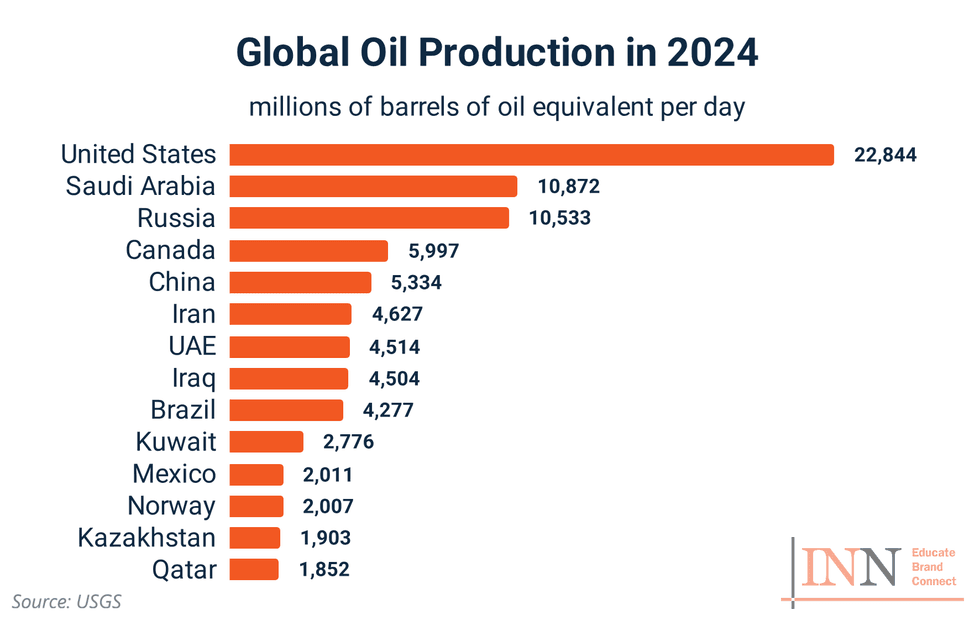
Read on for a look at the 10 top oil producing countries, including the US, Saudi Arabia, Russia and Canada. The top 10 countries combined for 76.28 million bpd out of the total global output of 103.32 bpd in 2024.
Statistics are from the Energy Information Administration (EIA) and include total production of petroleum and other liquids. This is the most current EIA annual data at the time of publication.
1. United States
Production: 22.84 million barrels per day (includes crude oil and liquids)
The US is the largest oil-producing country in the world, with output of 22.84 million barrels per day in 2024, taking the spot for the seventh year in a row. The US has been described as a swing producer because its production fluctuates alongside market prices. Texas leads the way as the biggest oil-producing state in the nation, with output more than three times as high as the second biggest oil-producing state, New Mexico.
In addition to being the largest oil producer in the world, the US is a big consumer of oil. EIA data from late 2025 showed that US demand for petroleum products was likely to average 20.59 million bpd in 2025, which would be an 18 year high according to sector spectators.
2. Saudi Arabia
Production: 10.88 million barrels per day (includes crude oil and liquids)
Saudi Arabia’s oil output came in at 10.88 million bpd in 2024, making it the top producer in OPEC by far. The country possesses 17 percent of the world’s proven petroleum reserves and is the largest petroleum exporter. Its oil and gas sector accounts for around 40 percent of its gross domestic product and over 70 percent of its export earnings.
Saudi Arabia has played a key role in OPEC’s decisions to curb oil output in recent years. In 2022, the country's US relations soured to the point that the country was unwilling to increase production in an effort to bring down rising gasoline prices.
The conflict in Iran has severely impacted Saudi Arabia’s oil production in 2026. In March, the country cut its daily output from a record setting 10 million bpd to 8 million bpd, a 20 percent drop, because of its inability to export through the Strait of Hormuz.
3. Russia
Production: 10.53 million barrels per day (includes crude oil and liquids)
Russia's oil production totaled 10.53 million bpd in 2024. Most of Russia’s reserves are located in West Siberia, between the Ural Mountains and the Central Siberian Plateau, as well as in the Urals-Volga region, extending into the Caspian Sea.
As part of sanctions in response to Russia’s war in Ukraine, the EU, the G7 countries and Australia embargoed imports of Russian oil. This has reshaped Russia's export strategy, with greater reliance on a “shadow fleet” and increased shipments to Asian countries.
In 2021, European countries accounted for over 50 percent of Russia's crude petroleum exports; as of 2024, this had fallen to under 6 percent, while China and India combined for more than 92 percent.
At the same time, logistical bottlenecks and limited storage capacity have added pressure to production.
Looking ahead, Moscow is prioritizing the development of harder-to-recover reserves, particularly in the Arctic, to support longer-term supply.
4. Canada
Production: 5.997 million barrels of oil (includes crude oil and other liquids)
Next on this list of the top 10 oil-producing nations is Canada. Canada’s annual oil production rose to 5.997 million barrels per day in 2024, up 237,000 bpd from 2023. Nearly all of Canada’s proven oil reserves are located in Alberta in the form of oil sands.
The vast majority of Canada’s total energy exports are to the US. In fact, in 2023, 60 percent of US crude imports originated from Canada compared to 33 percent in 2013.
However, because of economic and political considerations, Canada is developing ways to diversify its trading partners, especially by expanding ties with emerging markets in Asia. In 2024, operations started at the Trans Mountain pipeline expansion in Western Canada.
Canadian oil production is set to increase by 140,000 bpd starting in April 2026, as part of Ottawa’s pledge to contribute 23.6 million barrels to a coordinated IEA oil release to help increase oil supply impacted by the war.
According to Global News, officials emphasized the volumes will come from planned production increases from the oil sands rather than emergency measures.
As a net exporter, Canada is the only G7 country without strategic oil reserves, a status permitted under IEA rules.
5. China
Production: 5.33 million barrels per day (includes crude oil and other liquids)
China’s annual oil output was 5.33 million barrels per day in 2024. The nation is the world’s second largest consumer of oil and moved from being the second largest net importer of oil to the largest in 2014.
China is the world’s most populous country and has a rapidly growing economy, factors that have driven its high overall energy demand. The Asian country is the top consumer of oil, bringing in more than 11 million barrels per day, over 70 percent of its consumption, with the majority of its imports coming from OPEC member countries Russia, Saudi Arabia and Iraq.
Unsurprisingly, Chinese demand can strongly influence the oil market.
Imports surged in early 2026, underscoring strong demand even as domestic output from mature fields like Daqing continues to decline. To help mitigate supply risks and buffer against price volatility, Beijing has built up substantial reserves of oil estimated at 1.2 billion barrels by Kpler.
6. Iran
Production: 4.62 million barrels per day (includes crude oil and other liquids)
Iran ranks sixth in the world for oil production, and its total oil output grew to 4.62 million bpd in 2024, a significant jump from 3.66 million bpd in 2023. The increase made it OPEC's second-largest oil producer for the year.
According to the EIA, Iran holds the world’s third largest proven oil reserves, as well as the world’s second largest natural gas reserves. The majority of its 1.4 million bpd in oil exports in 2023 went to China.
US sanctions and regional disputes have all weighed on Iran’s energy production sector. Despite its abundant reserves, Iran’s total oil production is still below the 4.95 million bpd the country produced back in 2017, before renewed sanctions were introduced.
In response to the US and Israel launching a war against the nation in February 2026, Iran closed passage through the Strait of Hormuz, a major global oil transport corridor, for all other countries.
In mid-March 2026, the US Trump administration issued a temporary 30 day waiver allowing limited purchases of Iranian crude already at sea in an attempt to reduce oil prices.
7. United Arab Emirates
Production: 4.51 million barrels per day (includes crude oil and other liquids)
The United Arab Emirates (UAE), another OPEC member, has ranked among the world's top 10 oil-producing countries for decades. The UAE's oil production in 2024 averaged 4.51 million bpd, a significant increase over 4.16 million the previous year.
The country has proven oil reserves of 111 billion barrels, with most of those reserves located in Abu Dhabi.
The Abu Dhabi National Oil Company upped its crude oil output capacity to 4.85 million bpd in early May 2024 and has a planned target of 5 million bpd by 2027. However, its production was limited to 2.91 bpd of crude oil in the first half of 2024.
Drone attacks on oil infrastructure and the Strait of Hormuz blockage have reduced the UAE’s daily output by half, according to media reports from March 2026.
8. Iraq
Production: 4.5 million barrels per day (includes crude oil and other liquids)
Iraq's oil production totaled 4.50 million bpd in 2024, a small increase from 4.44 million the prior year. However, Iraq lost its position as the second-largest oil producer in OPEC after being overtaken by Iran in 2024.
Iraq holds 145.02 billion barrels of proven oil reserves based on 2023 OPEC data, representing 11.7 percent of global reserves.
Iraq has seen a sharp drop in oil production amid escalating regional tensions, with output from its main Southern oilfields falling from typical levels to as low as 800,000 bpd by late March 2026.
Disruptions to exports through the Strait of Hormuz and a growing storage bottleneck have forced operators to curb production at major fields, including Rumaila and Zubair. With oil revenues central to Iraq’s economy, prolonged shipping constraints could trigger further cuts and deepen fiscal pressure.
9. Brazil
Production: 4.28 million barrels per day (includes crude oil and other liquids)
Brazil's oil production in 2024 averaged 4.28 million bpd, largely flat year-over-year.
According to the IEA, total primary energy consumption in Brazil has nearly doubled in the past decade due to sustained economic growth. The largest share of Brazil’s total energy consumption is oil and other liquid fuels, followed by hydroelectricity and natural gas.
Brazil is reportedly on track to become the world's fourth largest oil producer in the coming years. In 2024, the country's oil output is expected to contribute significantly to global oil supply growth.
The country's top oil producer, Petrobras, is making efforts to extract as much oil as it can from its existing fields while searching for new deposits, BNN Bloomberg reported. Additionally, Brazil has one of the world’s lowest-carbon offshore oil industries.
10. Kuwait
Production: 2.78 million barrels per day (includes crude oil and other liquids)
Last on this list of the top 10 oil-producing countries is Kuwait, which produced 2.78 million barrels per day in 2024. The country has struggled in recent years to bring its oil output back up to 3.5 million bpd, with reports that key infrastructure projects have been delayed by internal political strife.
Kuwait’s oil and gas sector accounts for about 50 percent of the country’s GDP, and an even larger share of its export revenues at around 90 percent. New oil discoveries have given the country hope of increasing its oil output in the coming years. In February 2026, Kuwait Oil Company awarded SLB a US$1.5 billion contract to develop the Mutriba oil field.
However, Kuwait's output has plummeted to roughly 500,000 bpd amid escalating threats from Iran. Drone strikes have targeted its refineries, and with exports through the Strait of Hormuz largely halted, state-owned Kuwait Petroleum Corporation has declared force majeure.
Officials estimate a three-to-four-month recovery window once security is restored.
FAQs for oil investing
What is crude oil?
Crude oil is a naturally occurring mixture of hydrocarbon deposits and other organic materials that exists in liquid form in underground reservoirs. This raw natural resource is a globally important commodity that can be traded both on the spot market and via derivatives contracts.
What is crude oil used for?
Once extracted from the Earth, crude oil is refined to make several products, including gasoline, jet fuel and other petroleum products such as kerosene, paraffin, petrochemical feedstocks, solvents and lubricants.
What country uses the most oil?
The US is by far the world’s largest oil consumer, using about the same amount of the fossil fuel as the next three largest oil consumers (China, India and Japan) combined.
How many years of oil are left?
The question of peak oil is a prominent one. However, it is difficult to correctly determine the exact amount of oil left to be extracted in the world, or to accurately predict the level of demand for the energy fuel over the coming years. New technologies may yet unlock future resources, or economic events may lead to serious shocks in demand.
That being said, based on current known reserve estimates and best-case demand scenarios, roughly 47 years of oil are currently thought to be left. However, that has been the prediction for decades now as it is calculated by dividing the current known reserves by the annual global demand. As new oil discoveries and development are consistently replacing consumed reserves, that approximate 50-year time frame has remained the same.
What is OPEC?
Founded in 1960, OPEC, or the Organization of the Petroleum Exporting Countries, is a group of 12 countries headquartered in Vienna, Austria. Led by Saudi Arabia, it controls production, supply and pricing in the global petroleum market.
OPEC was created at the Baghdad Conference in 1960, with the five founding members Iran, Iraq, Kuwait, Saudi Arabia and Venezuela. Its mission statement is as follows:
“To co-ordinate and unify petroleum policies among member countries, in order to secure fair and stable prices for petroleum producers; an efficient, economic and regular supply of petroleum to consuming nations; and a fair return on capital to those investing in the industry.”
Currently OPEC has 12 member nations: Algeria, Congo, Equatorial Guinea, Gabon, Iran, Iraq, Kuwait, Libya, Nigeria, Saudi Arabia, the United Arab Emirates and Venezuela.
Where does Canada get its oil?
While Canada ranks fourth in annual production, the country still imports a large amount of oil annually from countries such as the US, Saudi Arabia, Russia, the UK, Azerbaijan, Nigeria and Côte d'Ivoire. It is estimated that half of the oil used in Québec and Atlantic Canada is purchased offshore. Canada spent roughly C$19.5 billion on oil imports in 2023.
Where does the US get its oil?
The US is the top producer of oil, according to the IEA, but the nation sources oil from as many as 80 countries around the globe. The top five sources of foreign oil for the US are Canada, Mexico, Saudi Arabia, Iraq and Brazil.
Why does the US import oil?
Although the US is the world’s largest oil producer, its domestic oil consumption far outpaces its homegrown output. To meet its own oil demand, the US must rely on oil imports from countries. In March 2022, the US government announced a ban on imports of oil, liquefied natural gas and coal from Russia in response to the invasion of Ukraine.
Why was US oil production down in 2022?
In September 2022, Bloomberg reported that US oil production was down because the country’s shale producers were prioritizing dividend payouts to shareholders rather than investing record profits from surging oil prices into growing their production capacity. This trend began to abate in 2023, and the EIA reported a new annual output record for the year.
How much oil does the US have in reserve?
According to the most recent data from the EIA, US crude oil and lease condensate proved reserves stood at 46.4 billion barrels at year-end 2023.
Who is the largest supplier of oil to Europe?
In 2022, the US replaced Russia as the largest supplier of oil to Europe, and it remains the largest supplier of oil to the EU. Since Russia’s invasion of Ukraine, European Union countries have dramatically cut their imports of Russian oil in favor of US oil imports. Norway and Kazakhstan are also major oil suppliers for the region.
Why can't Venezuela produce oil?
Venezuela’s oil industry has been suffering under the weight of political instability, government corruption and US sanctions. “The national oil company PDVSA is incapable of mustering the immense amounts of capital required to rebuild Venezuela’s heavily corroded energy infrastructure,” as per Matthew Smith, OilPrice.com's Latin America correspondent.
Venezuela's oil production saw a rebound in 2023's fourth quarter as the Biden administration eased US sanctions on the promise of fair elections in 2024. However, the US reimposed those sanctions in April 2024 following Maduro's failure to honor election promises.
Don’t forget to follow us @INN_Resource for real-time news updates!
Securities Disclosure: I, Georgia Williams, hold no direct investment interest in any company mentioned in this article.
https://x.com/INN_Resource
https://www.linkedin.com/in/georgia-williams-15845447/
gwilliams@investingnews.com

Featured Oil and Gas Investing Stocks




Learn about our editorial policies.