The Conversation (5)

Jun. 10, 2026 01:55PM PST
Fact CheckedThis article has been reviewed and updated according to INN's rigorous fact-checking process. Our staff editors verify all articles against information and data from primary sources, reputable publishers and experts.
Sadovnikova Olga / Shutterstock
Battery metal cobalt has been in focus in recent years for its role as a cathode material in lithium-ion batteries, bringing attention to the top cobalt producing countries.
One of the metal’s main catalysts is the increasing demand for electric vehicles and energy storage systems. Some forms of the lithium-ion batteries that power electric vehicles and energy storage require lithium, graphite and cobalt, among other raw materials, and demand for these key electrification commodities is expected to keep rising as the shift toward clean technologies continues at a global scale.
Additionally, the metal is predominantly produced as a by-product during copper and nickel mining, two other metals that are important for the green transition.
However, in recent years supply growth in many of the battery metals out scaled near-term demand, leading to price pullbacks from highs seen in 2022.
The cobalt market began to recover during the second quarter of 2025, after the world's top cobalt producer, the Democratic Republic of Congo (DRC), implemented a four month export ban in February in an effort to combat the low price environment. In June, the shipment halt was extended until September 2025.
As prices moved higher, the African nation opted to loosen restrictions and instead implement an export quota system, allowing 87,000 metric tons of cobalt to leave the country for 2026 and 2027.
However, the system to oversee the quota created shipment delays during the first quarter of 2026, adding to an already tight market.
“The DRC’s quota system will result in market deficits this year and next. We expect market tightness to be particularly severe in Q1 2026 since material from the DRC is unlikely to reach China during this period,” Fastmarkets Analyst Olivier Masson wrote in a March note.
At the same time, supply concerns were raised surrounding mixed hydroxide precipitate (MHP) production out of the world’s second largest cobalt producing country, Indonesia. “If the (Indonesian) government seeks to squeeze nickel mining in a bid to impose some supply discipline on the sector, then by-product cobalt supply could also come under pressure,” the March Fastmarkets report noted.
All these issues were further compounded by the war in the Middle East raising concerns of a sulfur shortage, which is weighing on the DRC’s copper sector, where cobalt is a by-product.
Added to the potential supply challenges are the logistical disruptions the Strait of Hormuz blockade have caused, including an impending shortage of sulfur shipments to Indonesia’s nickel sector.
“The risk of a further supply squeeze from Indonesia could tighten the market even further,” Masson added. “The longer prices remain elevated, the greater the incentive for EV battery consumers to minimize the cobalt content in their batteries.”
Investors interested in the sector should learn the top cobalt producers by country, as dynamics and policies in these countries can have strong impacts on the market as a whole.
According to the US Geological Survey's 2026 Mineral Commodity Summary, world cobalt production has increased significantly in recent years. In 2025, global cobalt production reached 310,000 metric tons (MT), a 2.65 percent increase from 302,000 MT in 2024. That modest year-over-year rise follows a much steeper jump from 2023, when production totaled 238,000 metric tons, marking a 27 percent increase over two years.
Read on for a closer look at where cobalt is mined and which countries lead in cobalt production.
Top cobalt producers by country
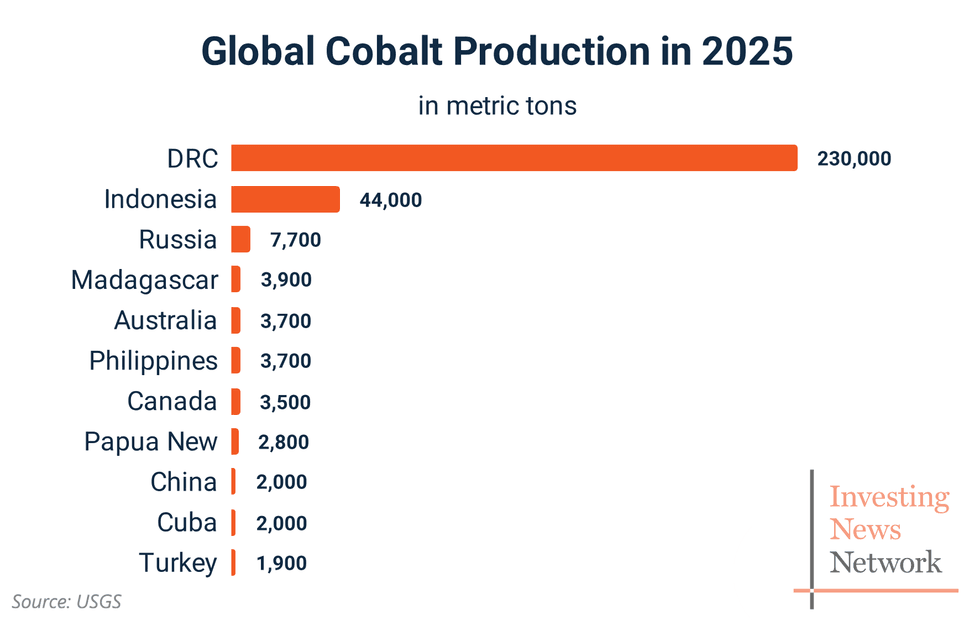
1. Democratic Republic of the Congo
Cobalt production: 230,000 metric tons
In 2025 the Democratic Republic of the Congo (DRC) produced 230,000 metric tons of cobalt, making it the world’s largest producer of cobalt, by far. Annual output from the country accounted for roughly 84 percent of all global production.
The DRC has been the top producer of the metal since 2003, and is likely to remain a crucial supplier to the cobalt market for the foreseeable future. However, cobalt mining in the DRC is plagued by human rights abuses and child labor due to widespread unregulated artisanal mining.
Efforts to regulate the sector and increase safety include the 2019 creation of state-owned Entreprise Générale du Cobalt, which struggled initially but secured exclusive mining rights to five areas through a 2024 agreement with state miner Gecamines.
Aside from that, the DRC's mines minister formally approved the ASM Cobalt Standard in 2022, and plans for assessing its effectiveness at pilot sites are being developed. The framework for a regulated artisanal mining sector was drafted by the Responsible Minerals Initiative, in cooperation with both global and local stakeholders.
Outside the DRC's artisanal mining sphere, cobalt is largely produced as a by-product of copper mines, including the Tenke Fungurume mine, owned by the CMOC Group (OTCPL:CMCLF,HKEX:3993); and the Mutanda mine and Katanga complex, which are majority owned by Glencore (LSE:GLEN,OTCPL:GLCNF). Another significant producer is the Metalkol Roan Tailings Reclamation mine, a tailings processing operation owned by Eurasian Resources Group.
As detailed in the introduction, in 2025, the DRC enacted a cobalt export ban followed by strict export quotas of 87,000 MT annually for 2026 and 2027.
In early 2026, a 51/49 joint venture between US-based Virtus Minerals and India-based Lloyd Metals and Energy finalized the acquisition of Congolese mining company Chemaf. The deal secured control of the Etoile and Mutoshi copper-cobalt mines, which have the capacity to account for roughly 5 percent of global cobalt production, in the DRC’s Katanga region.
The US$700 million deal marks a strategic win for Washington over Beijing after more than two years of competition for the assets, which China had pursued the company since Chemaf was put up for sale in 2023.
2. Indonesia
Cobalt production: 44,000 metric tons
Indonesia's cobalt production topped 44,000 metric tons in 2025. Mined supply has steadily increased in the country, growing by 1,500 percent since 2021, when annual output sat at 2,700 MT.
Indonesia's battery metals sector grew rapidly after its 2020 nickel ore export ban, which attracted Chinese investment in Indonesian battery metals processing. Increased cobalt production stems from four new high-pressure acid leaching (HPAL) facilities processing ore into mixed hydroxide precipitate for export.
The first two HPAL operations came online in 2021 as part of the existing Indonesia Morowali Industrial Park: one run by Huayue, a partnership between Zhejiang Huayou Cobalt (SHA:603799), Tsingshan Holding Group and CMOC Group; and one run by Halmahera Persada Lygend, owned by Lygend Resources (HKEX:2245) and Trimegah Bangun Persada (IDX:NCKL).
In late 2022, a third HPAL facility entered production, this one developed by QMB New Materials, a joint venture between Tsingshan, GEM (SZSE:002340), CATL (SZSE:300750,HKEX:3750) and Hanwa (TSE:8078).
Huayou Cobalt also launched the Huafei HPAL facility in 2023, which has an annual capacity of 15,000 MT of cobalt.
Huayou temporarily halted production at some of Huafei's production lines effective May 1, 2026, citing the rising cost of sulfur. Several other Indonesian nickel HPAL producers operated by Huayou, Lygend Resources and Tsingshan Group cut output by at least 10 percent since March as soaring sulfur prices pressure operations.
The disruption at the Huafei plant is among the clearest signs yet that a global sulfur shortage is affecting Indonesia’s high-pressure acid leach (HPAL) nickel industry, which relies on sulfuric acid to process laterite ore into mixed hydroxide precipitate.
According to a market report released in May 2024 from the Cobalt Institute, Indonesia has the potential to triple its 2023 cobalt output by 2030. In the same vein, the report estimates that Indonesia's 2030 cobalt output will make up 16 percent of global production compared to 1 percent in 2021 and 5 percent in 2022. The country is on pace to accomplish this, as in 2025, Indonesia's production already accounted for 14.2 percent of global cobalt.
International concerns have been mounting about the impact of increased mining activity on the nation’s marine ecosystems. Much of the apprehension stems from mining activity in Raja Ampat Regency, a group of tropical islands near West Papua. The area houses 75 percent of the world's coral species and more than 1,500 fish species. It was designated a UNESCO Global Geopark in 2023.
3. Russia
Cobalt production: 7,700 metric tons
Russia’s cobalt production slipped year-over-year after tallying 8,000 MT in 2024, output sat at 7,700 MT in 2025, a 3.75 percent decrease. Although production has slipped the country boasts large cobalt reserves of 800,000 MT.
Large Russian miner Norilsk Nickel is the country’s sole cobalt producer and is among the world’s top five biggest cobalt miners.
Cobalt refining at Norilsk’s Kola Mining and Metallurgical Complex facility in the Murmansk region was disrupted in 2022 due to a fire. In December 2025, the company finished reconstruction of the cobalt refining operations, and raised capacity to 3,000 MT per year, compared to its previous capacity of 2,500 MT.
As part of the push for domestic sourcing of critical minerals, some automakers had been calling for increased electric vehicle battery production in Europe. While there was once hope that this push could increase Russia's future cobalt production, the country's war against Ukraine turned away many trade partners.
In April 2022, the US hit Russian cobalt with a 45 percent duty. The sanctions on Russian and Belarusian cobalt were extended in June 2024. Similarly, in December 2023, the UK government expanded its sanctions targeted at Russia to include an embargo of several critical metals, including tungsten, cobalt and tantalum.
4. Madagascar
Cobalt production: 3,900 metric tons
Madagascar’s cobalt production rose to 3,900 metric tons in 2025, a 26 percent increase from 2024’s 3,100 MT. The country currently hosts just 100,000 MT of economic cobalt reserves.
Much of Madagascar’s cobalt production comes from the Ambatovy nickel-cobalt mine, which has faced production and profitability issues.
Until May 2026, the mine was owned by a joint venture between Japanese company Sumitomo (OTCPK:SSUMF,TSE:8053) and the Korean state-owned company Korea Mine Rehabilitation and Mineral Resources. That month, Sumitomo transferred its 54.2 percent ownership to UK-based Ambatovy Mineral Resources Investment Holding Company.
In August 2024, the companies submitted a debt restructuring plan to a London court. According to media reports at that time, Sumitomo, the project's major shareholder, had accumulated 410 billion yen in losses stemming from the project, including a 265.5 billion yen total impairment loss.
Ambatovy, the subsidiary that manages the namesake mine, announced that the site had been impacted by a cyclone in February 2026. Subsequently, production was halted at the project after the processing plant was damaged during the storm. As of early June, the company has begun gradually resuming nickel and cobalt production.
5. The Philippines
Cobalt production: 3,700 metric tons
The Philippines is now tied for the fifth largest cobalt producer in the world with production of 3,700 MT in 2025, up from 3,100 MT in 2024. The Asian country is also a top nickel producer.
The fate of mining in the Philippines was up in the air for a while as the government under former president Rodrigo Duterte called for a shutdown of all mines in the country based on environmental concerns. However, Duterte seemed to have a change of heart in early 2021, lifting a ban on new mine permits in an effort to boost revenues.
His successor, President Bongbong Marcos, has ordered the country's Department of Environment and Natural Resources to enforce stricter guidelines and safety protocols on both small- and large-scale mines. He hopes to bring illegal mining operations into compliance so they can operate legally and with safer conditions for employees.
In April 2024, the US reaffirmed plans for a supporting grant for Eramen Minerals to develop a nickel and cobalt processing plant in the Philippines, boosting the country’s downstream mineral industry.
As noted by the USGS, the Philippines holds the sixth largest cobalt reserves globally at 260,000 MT. This mineral wealth is expected to gain more international attention as supply chains look to fortify supply and processing capacity away from China.
5. Australia
Cobalt production: 3,700 metric tons
Australia’s annual cobalt production fell to 3,700 metric tons in 2025, contracting 22.6 percent percent from 4,780 MT in 2024, tying it for fifth place. The island nation's cobalt reserves are the second largest in the world at 1.7 million MT.
As is the case for many other countries on this list, cobalt is produced in Australia as a by-product of copper and nickel mining. The country’s nickel mines are located in the western part of the country, mostly around the Kalgoorlie and Leonora regions.
Additionally, the Australian government has sent geologists to search for cobalt in mine waste, an effort that bore fruit when Queensland geologist Anita Parbhakar-Fox tested a copper mine waste sample that graded 7,000 parts per million cobalt. The state has significant amounts of copper mine tailings containing cobalt.
The CEO of Australian company Cobalt Blue Holdings (ASX:COB,OTCPL:CBBHF) described the discovery as a game changer to the Financial Times, estimating at the time there could be up to 300,000 MT of cobalt in Australian mine waste.
Another important cobalt project in the country under Cobalt Blue is the Broken Hill project, which will allow for cobalt production on-site, rather than extracted as a by-product of nickel. The company's planned Kwinana facility will produce battery-grade cobalt sulfate from third-party feedstock as well as Broken Hill ore.
In the March 2026 quarterly report, the company reported it was moving closer to a final investment decision for the Kwinana facility.
7. Canada
Cobalt production: 3,500 metric tons
Canada produced 3,500 MT of cobalt in 2025, with most mined supply originating from nickel mines in the provinces of Ontario, Newfoundland and Labrador, and Québec. The nation has an estimated 220,000 MT of cobalt reserves.
Vale (NYSE:VALE) and Glencore are two of the largest cobalt producers in Canada, producing the metal as a byproduct at several mines each.
Canada currently has three operating cobalt refineries, located in the provinces of Alberta, Ontario, and Newfoundland and Labrador. Looking forward, Electra Battery Materials (TSXV:ELBM,NASDAQ:ELBM) is advancing construction of North America's first battery-grade cobalt sulfate refinery, with commercial production scheduled for Q4 2027.
The refinery, located in Temiskaming Shores, Ontario, will have an initial annual production capacity of approximately 5,120 MT of battery-grade cobalt, and the company plans to increase that to 6,500 MT. In May 2026, Electra penned a binding investment agreement with the Canadian federal government for C$20 million to support the construction and commissioning of the refinery
In 2022, Canada released its Critical Minerals Strategy, which included cobalt in its list of 31 minerals and metals the country had deemed critical for the energy transition, national defense and economic growth.
According to the Canadian government, while exports by volume were down just 4 percent, low cobalt prices in 2024 led the value of cobalt and cobalt-containing exports to fall by 40 percent year-over-year in 2024 to C$344 million, down from C$563 million in 2023. Key export destinations included Norway (25 percent), China (17 percent), the Netherlands (15 percent) and the US (15 percent).
8. Papua New Guinea
Cobalt production: 2,800 metric tons
In 2025, Papua New Guinea produced 2,800 metric tons of cobalt. The country hosts 84,000 metric tons of cobalt reserves.
Like other nations on the list, the small country off the coast of Australia produces cobalt as a by-product of nickel mining.
The country’s main cobalt producer is the Ramu nickel mine near Madang, managed by Ramu NiCo Management, an 85/8.56/6.44 joint venture between private Chinese company MCC, Nickel 28 Capital (TSXV:NKL,OTCPL:CONXF) and the Papua New Guinea government.
In April 2026, Nickel 28 reported that Ramu NiCo submitted applications for a US$1.6 billion expansion at the Ramu mine that would aim to double annual output.
9. Cuba
Cobalt production: 2,000 metric tons
Cuban cobalt production totaled 2,000 metric tons in 2025, shedding 42 percent from 2024’s 3,450 MT. The island nation hosts the world's fifth highest cobalt reserves at 500,000 metric tons.
The country’s Moa region is home to the Moa joint venture nickel-cobalt operation held by Canadian firm Sherritt International (TSX:S,OTCPL:SHERF) and the General Nickel Company of Cuba.
Moa uses an open-pit mining system to produce lateritic ore, which is processed into mixed sulfides containing nickel and cobalt using high-pressure acid leaching. The country’s state-owned nickel miner is the sole operator of the Che Guevara processing plant at Moa.
In 2026, the US levied a series of sanctions on Cuba, prompting Sherritt to curtail its participation in joint venture operations due to a lack of fuel shipments. In mid-May, the company reversed plans to dissolve its joint venture participation in Moa, but warned it is facing acute operational, financial and legal difficulties, including potential breaches of debt covenants, until the matter is resolved.
Just days later, Sherritt announced a deal that could see Gillon Capital, a family office owned by Trump associate Ray Washburne, take a 55 percent controlling stake in the company.
10. Turkey
Cobalt production: 1,900 metric tons
In 2025, Turkey produced 1,900 metric of cobalt, contracting from 2,200 MT produced in 2024 after several years of gains. The nation also holds cobalt reserves totaling 91,000 MT.
A 2021 report from the British Geological Survey underscored the importance of Turkey's cobalt potential amid the energy transition, noting “the greatest cobalt resource potential lies in laterite deposits in the Balkans and Turkey and in magmatic and black shale-hosted deposits in Fennoscandia.”
It went on to point out that in the Balkans and Turkey, 27 nickel laterite deposits are known to contain cobalt in significant quantities, with several deposits holding over 10,000 MT of cobalt metal. Currently, only nickel is extracted from these deposits, but advancements in processing technologies like high-pressure acid leaching may allow for cobalt recovery in the future.
The country's Meta nickel-cobalt mine in Gördes is one of only a few nickel mines in Europe, making it important to the European Union's ability to meet European demand for electric vehicle battery materials. In 2024, the planned expansion of the mine sparked local resistance, as community members raised concerns that the project was destroying forests, draining water and harming agriculture.
FAQs for cobalt production
What is the most common source of cobalt?
As cobalt is only found in a chemically combined form, it must be separated from mined ore. Most commonly, cobalt is produced as a by-product at copper or nickel mines. According to Benchmark Minerals, currently three-quarters of cobalt is produced from copper-primary mines and 25 percent is produced from nickel-primary mines. The agency forecasts that by 2030, cobalt production from copper-primary mines will fall to 57 percent, while that from nickel-primary mines will rise to 41 percent.
How rare is cobalt on Earth?
Cobalt is the 32nd most common element on Earth, according to the Cobalt Institute, meaning it isn't particularly rare. According to the USGS, the world hosts 12 million metric tons of economic cobalt reserves. However, only a handful of countries have cobalt reserves over 300,000 MT, with the DRC coming in first place at 6 million MT, Australia in second at 1.7 million MT and Russia coming in third place with 800,000 MT. In fact, the DRC's cobalt reserves are equivalent to the rest of the world combined.
How many years of cobalt are left?
How long it will take to deplete cobalt reserves and resources depends on the approach and speed with which electrification and a fully renewable society is approached, according to a 2019 study. Another factor is whether or not lithium-ion battery formulas that require cobalt will continue to be the norm in the future. If widespread cobalt substitution does take place, that will ease demand pressures on the metal.
Why is cobalt so valuable?
Cobalt has risen in recent years due to supply chain difficulties and the metal's necessity in many lithium-ion battery cathodes, with prices peaking in March and April 2022 at over US$80,000 per MT. Although prices had fallen since then, and sat around the US$21,500 mark as of February 2025, as of 2026 they're back above US$50,000. The EV story has led to increased cobalt supply, meaning that there will be short-term price pressures due to oversupply as demand continues to rise in the coming years.
What is the problem with cobalt mining?
Most cobalt production takes place in the Democratic Republic of Congo, which is known for artisanal mining. Artisanal miners are adults and children who are not employed by mining companies, but mine independently using their own tools or just their hands.
A 2023 ABC news report on the country's artisanal mining industry estimates that 200,000 artisanal miners are working on cobalt deposits; unfortunately, a lack of oversight and safety measures means injuries and death are more frequent than in regulated mining. While organizations are working to keep the supply chain transparent, it is hard to fully avoid cobalt that is sourced through child labor and human rights abuses.
Other countries are not exempt from concerns related to mining cobalt — Indonesia's burgeoning cobalt production comes with the vast environmental concerns that plague the nation's nickel industry.
Don’t forget to follow us @INN_Resource for real-time news updates!
Securities Disclosure: I, Georgia Williams, hold no direct investment interest in any company mentioned in this article.
From Your Site Articles
- How to Invest in Cobalt ›
- Cobalt Stocks: 5 Biggest Producers ›
- Top Cobalt Reserves by Country | INN ›
- 5 Largest Cobalt Mines in the World | INN ›
- Cobalt Uses: Batteries and More | INN ›
Related Articles Around the Web
https://x.com/INN_Resource
https://www.linkedin.com/in/georgia-williams-15845447/
gwilliams@investingnews.com

Featured Cobalt Investing Stocks
Learn about our editorial policies.