The Conversation (0)

Jul. 14, 2026 02:00PM PST
Fact CheckedThis article has been reviewed and updated according to INN's rigorous fact-checking process. Our staff editors verify all articles against information and data from primary sources, reputable publishers and experts.
herraez / Adobe Stock
Oversupply continued to be the big story for nickel in the second quarter of 2026; however, tailwinds during the period briefly pushed the metal's price to its highest level in more than two years.
The situation is twofold. High supply, particularly from Indonesia, is meeting soft demand from traditional stainless steel consumers in the manufacturing and construction sectors.
Meanwhile, demand growth in the electric vehicle (EV) sector has plateaued as more Chinese producers shift from nickel-manganese-cobalt (NMC) batteries to the more affordable lithium-iron-phosphate (LFP) chemistry.
Read on to learn what experts see coming for the nickel market as the second half of the year begins.
What happened to the nickel price in Q2?
The standard three month nickel contract on the London Metal Exchange opened the quarter at US$17,250 per metric ton (MT) on April 1, but quickly climbed, reaching US$18,560 by April 17.
After a slight pullback, it regained momentum and closed the month at US$19,475 on April 30.
The start of May saw nickel's gains continue, with the price rising to a two year high of US$19,675 on May 6. It remained volatile for the rest of the month, bottoming out at US$18,460 on May 18.
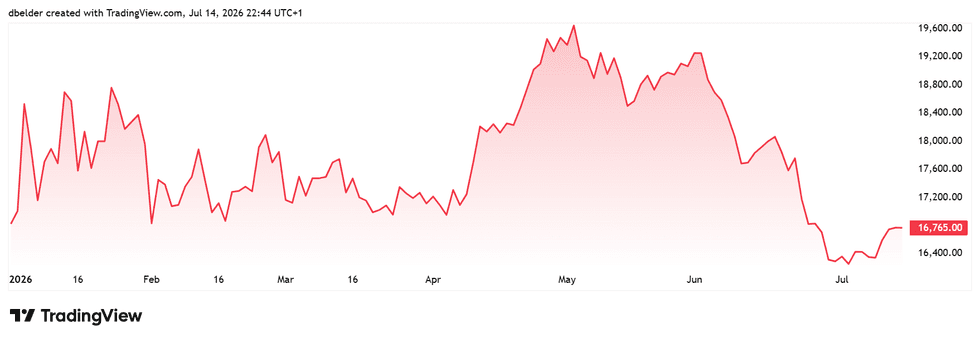
Nickel price, January 1 to July 14, 2026.
Chart via TradingView.
The price of nickel climbed back to US$19,325 on June 2, but faced significant headwinds throughout the month.
Nickel plunged to US$16,400 on June 30, and the price continued in decline as the third quarter of the year began. The base metal reached a new year-to-date low of US$16,220 on July 2.
Nickel price rises to two year highs...
As in past years, the nickel market has largely been defined by a significant supply surplus in 2026, and the biggest contributing factor continues to be Indonesian mining output.
The government tried to tighten market conditions in February by reducing work plan and budget (RKAB) quotas to between 260 million and 270 million wet MT. However, by the start of Q2, those efforts didn't appear to be having much impact, with the metal trading in the US$17,000 range for most of the February to April period.
Other factors at play during that time contributed to the price surge in late April and early May, including the fallout from the US-led war against Iran, which caused global energy prices to skyrocket.
On top of higher energy inputs, the war pushed sulfur prices to all-time highs — they reached the US$815 to US$820 per MT range for Middle East products, and rose even higher for Brazilian sulfur.
Sulfur is a critical component in the high-pressure acid leaching process that extracts nickel from limonite ores, converting it into a mixed hydroxide precipitate, which is further upgraded to battery-grade nickel.
In an interview with the Investing News Network (INN) on June 30, Adrian Gardner, nickel market analyst at Wood Mackenzie, said he doesn’t see a tidy or quick end to the disruption in the sulfur supply chain.
“If you said to me, 'Everything in the Middle East is fine tomorrow,' I still think that there would be a six to nine month delay in sulfur supply and availability,” he explained during the conversation.
According to Gardner, the crux of the issue is that prices have gone from US$300 to US$400 before hostilities began in February to up to US$1,100 paid by Indonesian miners currently.
“If the strait opens in a planned way and more products are able to get through, I can see those prices coming down to maybe US$600 or US$700 within the next two to three months," he said.
"But even so, that’s potentially double what they were paying just five months ago."
The expert added that he believes nickel prices will likely linger at current levels for some time, at least through the end of the year and possibly into next year. However, that’s contingent on a peace deal being signed, which has become less likely since the US and Iran began a fresh round of hostilities on July 8.
Overall, the effect of lower quotas and higher prices ultimately pushed nickel briefly to two year highs.
... and then falls back down
After that strong performance, why did the nickel price fall back down in May and June?
For the most part, it’s been the result of the rumor mill.
In May, concerns began to grow that Indonesia would raise RKAB quotas to 360 million MT. However, the government has denied those rumors, a point that Gardner was adamant about.
“It is purely the rumor mill coming out of Indonesia. All of those rumors have been flatly denied by Jakarta,” he said.
However, Gardner noted that if Indonesia was to decide on an increase, it would happen between July and August. He also said the government could consider the different types of ore and make more targeted decisions.
He explained that the majority of nickel produced in Indonesia comes from laterite ores, which are further broken down into limonite and saprolite ores. Limonite is primarily used to produce battery-grade metal, while saprolite is used in nickel pig iron and in the production of stainless steel for construction and manufacturing.
“Nickel pig iron goes towards stainless steel smelting, and that portion of the market is doing reasonably well. There is a tightness in nickel pig iron brought on by the RKAB allocation," he said.
"The limonite portion of the business, which is leached rather than treated pyrometallurgically, is leached and gives you a mixed hydroxide precipitate intermediate product that’s got different problems right now."
The suggestion is that, for limonite production, the economics just aren’t there, with soft downstream demand from the battery sector and rising upgrading costs due to high sulfur prices. For that reason, companies that were expecting expansion projects to come online later this year have pushed plans back into early 2027.
What Gardner could see happening is the Indonesian government allowing an increase in saprolite production to ease some of that tightness, while maintaining current levels of limonite output.
He emphasized that this is just speculation at this point, reaffirming the government's stance that so far any increases are just rumors: “All I can see is that mining companies are unhappy; they don’t have enough ore to process. Some of the mines have already closed and are awaiting new RKABs to restart operations. People aren’t working. Meanwhile, the government is having budgetary issues; it needs to raise money."
Nickel battery demand softens
Against that backdrop is less demand growth for nickel from Chinese EV batteries.
The country is the world’s largest manufacturer of EVs, and according to Gardner, 70 percent of producers have moved away from the nickel-based batteries that were dominant just a few years ago.
Instead, they’ve shifted to LFP batteries, which are cheaper. In addition, recent advancements have improved their energy density and, by extension, the range of the EVs that they power.
According to the International Energy Agency, LFP battery prices fell by over 15 percent in 2025, while NMC battery costs declined by just 5 percent, making LFP batteries 40 percent cheaper than their nickel-based counterparts.
It’s not just cars that are seeing a shift; the lower costs of LFP batteries and their improved safety compared to NMC are increasingly driving the use of this chemistry in grid-scale storage.
Explaining the consequences for demand, Gardner said that previously EVs and energy storage were expected to push the need for battery-grade nickel to 1.2 million to 1.5 million MT by 2030.
“Now we’re looking at 800,000 MT of nickel demand by 2030 globally, so there is still growth, but it’s not the double-digit growth that we were all looking at a few years ago. The market changed, and initially the discussion was between high-price nickel versus cheap lithium," he explained to INN.
The expectation then was that LFP chemistry would be hampered by its technological shortcomings, but those flaws have largely been solved, making it a much harder case for the higher costs of nickel.
Nickel price forecast for 2026
Steel remains the primary use case for nickel, and nickel is primarily produced from saprolite ores. Demand has been relatively sluggish due to weak real estate and manufacturing markets in China and Europe.
In a report published on June 4, the Organization for Economic Co-operation and Development predicts that steel excess capacity will continue to grow through 2028 despite weak demand for finished products. It also notes that the industry is facing headwinds from a challenging trade environment and increased steel industry subsidies.
For now, there probably isn’t much change on the horizon for nickel producers.
Indonesian miners are facing challenges, and even if Indonesian officials are able to make meaningful adjustments to RKAB quotas, that may have little effect on western producers in the short term.
Gardner pointed out that it will likely take nickel prices moving north of US$20,000 sustainably before companies begin to restart operations or development projects.
Don’t forget to follow us @INN_Resource for real-time news updates!
Securities Disclosure: I, Dean Belder, hold no direct investment interest in any company mentioned in this article.
Editorial Disclosure: The Investing News Network does not guarantee the accuracy or thoroughness of the information reported in the interviews it conducts. The opinions expressed in these interviews do not reflect the opinions of the Investing News Network and do not constitute investment advice. All readers are encouraged to perform their own due diligence.
NASDAQ:F
https://x.com/INN_Resource
https://www.linkedin.com/in/deanbelder
dbelder@investingnews.com

Featured Nickel Investing Stocks




Learn about our editorial policies.