The Conversation (0)

jijomathai / Adobe Stock
Here's a quick recap of the crypto landscape for Monday (March 9) as of 9:00 p.m. UTC.
Get the latest insights on Bitcoin, Ether and altcoins, along with a round-up of key cryptocurrency market news.
Bitcoin (BTC) was priced at US$68,989.11, up by 2.6 percent over the last 24 hours.
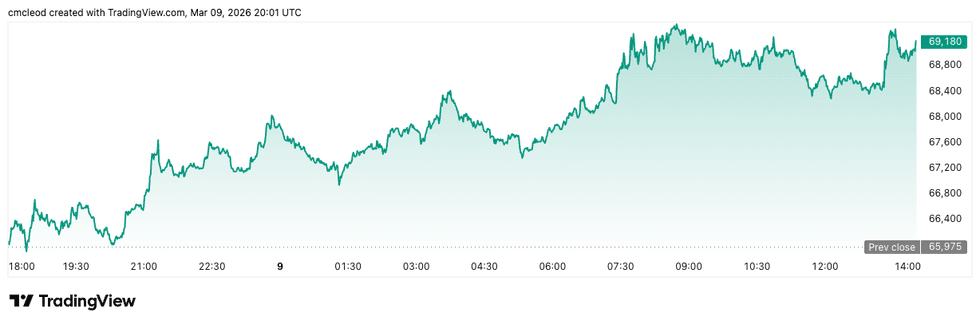
Bitcoin price performance, March 9, 2026.
Chart via TradingView.
Linh Tran, senior market analyst at XS.com, wrote in an email that current market sentiment is primarily cautious and bearish in the short term, maintaining a conditional outlook for a medium-term recovery.
Tran told the Investing News Network that the market is facing pressure from unstable capital flows, evidenced by four consecutive declining sessions and a failure to sustain momentum above US$74,000, with escalating geopolitical tensions and a strengthening US dollar proving significant headwinds
While on-chain data shows a positive signal, with 32,000 BTC withdrawn from exchanges interpreted as long-term storage, she noted that this is “not sufficient to confirm the start of a new bullish cycle,” and may simply reflect re-accumulation amid volatility. Potential for a medium-term recovery exists only if the price can maintain consolidation above key support near US$60,000. Failure could result in “deeper downside pressure toward the US$50,000 region."
Ether (ETH) was priced at US$2,034.34, up by 3.7 percent over the last 24 hours.
Altcoin price update
- XRP (XRP) was priced at US$1.37, up by 1.2 percent over 24 hours.
- Solana (SOL) was trading at US$85.98, up by 4.4 percent over 24 hours.
Today's crypto news to know
Nasdaq, Boerse Stuttgart announce partnership
Nasdaq (NASDAQ:NDAQ) has formed a partnership with Seturion, a new digital settlement platform from Germany’s Boerse Stuttgart Group, to modernize how financial trades are finalized in Europe with blockchain-based tech..
Seturion is a digital system developed to complete post-trade settlements. It supports any type of asset, works with public and private blockchains and allows payments in central bank money or digital, on-chain cash. Nasdaq will link its European trading platforms to Seturion, allowing investors to trade tokenized securities directly on Seturion.
The initiative will start with structured financial products before broadening to more asset types and institutions.
"As an open industry solution, Seturion contributes to (overcoming) current national settlement infrastructure silos to turn a unified European capital market into reality," said Dr. Matthias Voelkel, CEO of Boerse Stuttgart.
“Tokenization has the potential to unlock the benefits of an always-on financial ecosystem – enhancing how investors access markets, how issuers engage with shareholders," said Tal Cohen, president of Nasdaq.
"We believe that public companies should always remain at the center of the equity market ecosystem. This issuer‐sponsored approach for tokenized equity securities is designed to empower public companies and enhance global accessibility to US equity markets," he added.
Coinbase marks expansion with two announcements
Coinbase Global (NASDAQ:COIN) has made two major crypto announcements in the past few days.
On March 6, Coinbase’s institutional platform, Coinbase Prime, announced that it is expanding into a full prime brokerage stack by adding regulated futures contracts and a shared collateral pool that allows institutions to make both regular crypto buys and futures trades via its futures commission merchant.
Then, on Monday, Coinbase rolled out futures contracts on Coinbase Advanced for users in 26 European countries, including perpetuals and term contracts on Bitcoin, Ether and Solana, plus equity indexes with up to 10x leverage, marking the first regulated derivatives access via a MiFID II entity.
Amina becomes first regulated bank to sponsor 21X
Amina Bank, a crypto bank regulated by the Swiss Financial Market Supervisory Authority, has become the first regulated bank to serve as a listing sponsor on 21X, the EU's inaugural fully regulated trading and settlement system for distributed ledger technology, according to an announcement made on Monday.
This partnership integrates Amina's institutional-grade custody for traditional assets with Tokeny’s tokenization platform and 21X’s regulated trading infrastructure onPolygon and Stellar blockchains.
It creates an end-to-end pathway from asset custody to on-chain issuance and secondary market liquidity, aiming to address barriers to institutional tokenization adoption.
Treasury pushes legal authority to freeze suspicious crypto funds
The US Department of the Treasury is urging lawmakers to create a new legal framework allowing crypto platforms to temporarily freeze funds tied to suspected criminal activity. The proposal appears in a report submitted to Congress under the GENIUS Act, the legislation that established the first federal framework for stablecoins.
Under the recommendation, exchanges and financial institutions would receive a legal “safe harbor” enabling them to hold suspicious digital assets while investigators review potential illicit activity.
Today, cryptocurrency firms often identify questionable transfers through blockchain analytics, but lack clear authority to pause those assets without risking legal exposure.
The proposed hold law would create a defined window during which platforms could delay suspicious transactions before funds are moved through additional wallets or converted to other assets.
US judge dismisses terrorism lawsuit against Binance
A federal judge in the US has dismissed a lawsuit accusing Binance of facilitating terrorism financing, dealing a legal victory to the world’s largest cryptocurrency exchange.
The case was brought by more than 500 plaintiffs who were victims of, or related to victims of, attacks carried out by militant groups including Hamas, Hezbollah and ISIS between 2016 and 2024. The plaintiffs argued that Binance knowingly allowed transactions linked to sanctioned entities, indirectly enabling funds to reach terrorist organizations.
However, US District Judge Jeannette Vargas ruled that the complaint failed to establish a direct connection between the exchange’s conduct and specific attacks cited in the case. Awareness of potential misuse alone, the court said, does not meet the legal threshold required under the Justice Against Sponsors of Terrorism Act.
While the judge dismissed the case, she gave plaintiffs 60 days to amend their filing with more specific evidence tying individual transactions and wallet addresses to particular attacks.
Binance welcomed the decision, calling it a “complete vindication” of what it described as unfounded allegations.
Don't forget to follow us @INN_Technology for real-time news updates!
Securities Disclosure: I, Meagen Seatter, hold no direct investment interest in any company mentioned in this article.
Securities Disclosure: I, Giann Liguid, hold no direct investment interest in any company mentioned in this article.
Editorial Disclosure: The Investing News Network does not guarantee the accuracy or thoroughness of the information reported in the interviews it conducts. The opinions expressed in these interviews do not reflect the opinions of the Investing News Network and do not constitute investment advice. All readers are encouraged to perform their own due diligence.
https://twitter.com/INN_Technology
https://www.linkedin.com/in/meagen-seatter-23675b193/
mseatter@investingnews.com