The Conversation (0)

May. 26, 2026 01:55PM PST
Fact CheckedThis article has been reviewed and updated according to INN's rigorous fact-checking process. Our staff editors verify all articles against information and data from primary sources, reputable publishers and experts.
Harris Pinkham / Adobe Stock
Supply chains for critical minerals like antimony have emerged as hot-button economic and infrastructure policy issues in recent years.
The antimony supply chain in particular has gained considerable attention since China introduced export controls on its antimony in 2024, banning any exports to the US.
Antimony’s primary use is in the production of fire-retardant materials, representing approximately 45 percent of global demand. It can also be found in the production of semiconductors, polymers and throughout the defense sector, particularly in the manufacturing of ammunition.
Despite its importance, antimony is not typically produced as a primary product, and is instead largely produced as a byproduct of gold, silver, lead and copper mining in stibnite deposits.
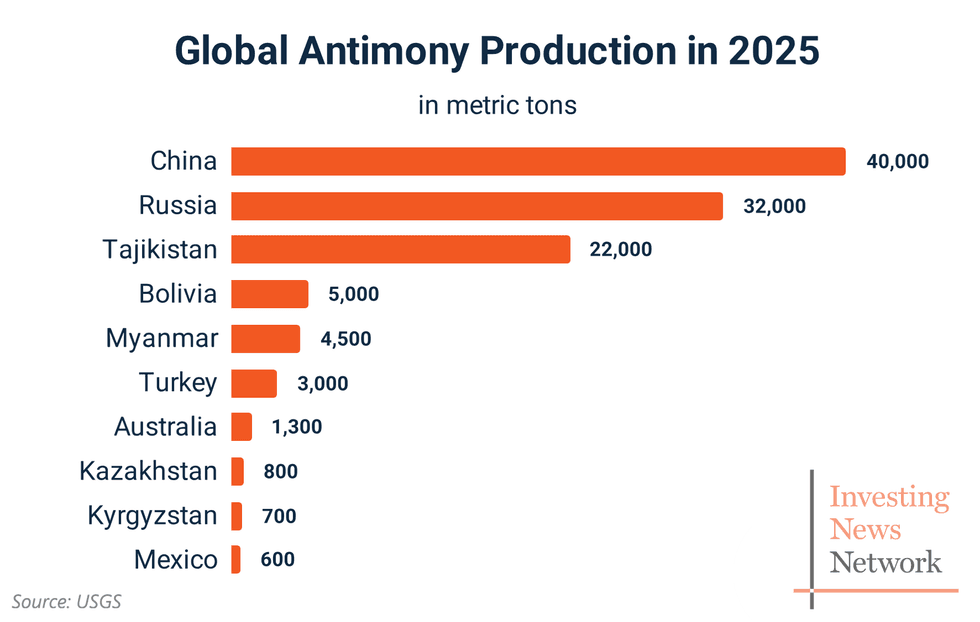
Global antimony production reached 110,000 metric tons in 2025, according to the United States Geological Survey's (USGS) 2026 Mineral Commodity Summary, marking a significant decline from 153,000 metric tons just five years earlier.
The majority of antimony production comes from countries in Asia, with China leading the way in terms of mining output and total reserves.
Meanwhile, production from Western nations remains minimal. Concerns about Western supply chain security in the last decade prompted countries like the United States, Canada and Australia to include antimony as part of their new critical mineral strategies.
While production data was withheld by the USGS, a US antimony mine in Montana entered production last year, breaking the country's decades long run without domestic antimony production. The country is also home to Perpetua Resources' (TSX:PPTA,NASDAQ:PPTA) Stibnite gold-antimony project in Idaho, which has received significant government support.
Canada's sole antimony mine, Beaver Brook in Newfoundland and Labrador, has been idled since 2023. Projects in Canada with a significant focus on producing antimony include Canagold Resources' (TSX:CCM,OTCQB:CRCUF) New Polaris project in British Columbia and Antimony Resources' (CSE:ATMY) Bald Hill project in New Brunswick.
So which countries are the world's top antimony miners and which countries hold the top antimony reserves? The top seven antimony countries by production all mined more than 1,000 metric tons of the critical metal in 2025, according to the most recent USGS 2026 Mineral Commodity Summary. Learn about the countries and their antimony mines below.
1. China
Antimony production: 40,000 metric tons
Antimony reserves: 830,000 metric tons
China is the world’s top producer of antimony, and in 2025, it produced 40,000 metric tons, on par with its output from the previous year. The country's production accounted for 36 percent of global antimony output last year. In addition to being the world’s top producer, China hosts the world's largest antimony reserves at 830,000 metric tons.
China’s antimony production levels steadily decreased for more than a decade before plateauing over the last several years.
In 2012, the country produced 145,000 metric tons of antimony, with its output accounting for 83 percent of global production that year. By 2018, that had slipped to just under 90,000 metric tons, or 61 percent, as operations scaled back or closed due to governments implementing stricter environmental standards, according to the USGS. In 2022, China's antimony output had fallen to the current level of just 40,000 metric tons per year.
The country is home to the world’s largest known antimony deposit at the Xikuangshan mine in China’s Hunan province. The attached mine is operated by Hsikwangshan Twinkling Star and produces approximately 30,000 metric tons of refined antimony per year.
In 2024, the Chinese government placed export restrictions barring antimony shipments to the US. The move resulted in rapidly rising antimony prices and fears around supply chain security for Western countries due to the metal's role in the defense industry.
2. Russia
Antimony production: 32,000 metric tons
Antimony reserves: 350,000 metric tons
In 2025, Russia produced 32,000 metric tons of antimony, 8,000 metric tons less than it produced in 2024.
The country’s output has seen considerable gains since 2010, when it produced just 3,000 metric tons of the metal, rising to 30,000 metric tons by 2018. Since then, Russian output has remained in the 30,000 to 40,000 metric ton range.
The majority of Russian antimony production comes from the Sarylakh-Surma and Sentachan deposits in the Sakha Republic, with GeoProMining being the main operator.
Other major producers in Russia include Novoangarsky Mining at the Udereyskoye deposit in Krasnoyarsk and Polyus at its Olimpiada gold mine, which produces antimony as a by-product.
Like other commodities, Russian antimony has been subjected to sanctions following Russia’s invasion of Ukraine in 2022 with restrictions on the metal going to and from the country. However, several reports have documented companies working to circumvent sanctions.
In terms of reserves, Russia was second only to China with 350,000 metric tons of antimony.
3. Tajikistan
Antimony production: 22,000 metric tons
Antimony reserves: 60,000 metric tons
In 2025, Tajikistan accounted for approximately one-fifth of global antimony production, outputting 22,000 metric tons, on par with the previous year.
Like Russia, Tajikistan has seen a considerable rise in antimony production, rising from just 2,000 metric tons in 2010 to as high as 28,000 metric tons in 2020.
Tajikistan's antimony reserves total 60,000 metric tons, according to the USGS. The country's antimony deposits are found in the Dzheitun and Konchok mineral fields of Tajikistan’s north. Mining from the Dzheitun field is carried out at the Anzob mining and processing plant, owned by US-based Comsup Commodities.
Company Talco Gold is currently constructing a plant with processing capacity of 20,000 metric tons of ore per year, with resulting antimony produced all planned for export markets.
While its output may be high, Tajikistan only has 60,000 metric tons of proven economic antimony reserves.
4. Bolivia
Antimony Production: 5,000 metric tons
Antimony reserves: 310,000 metric tons
Bolivian antimony production totaled 5,000 metric tons in 2025. While the country’s output is significantly lower than the top three producing countries on our list, Bolivia has the third-largest reserves at 310,000 metric tons.
In recent years, Bolivia has emerged as a key supplier of antimony to Western markets as they diversify from Chinese supply.
In January 2026, United States Antimony (NYSEAMERICAN:UAMY) revealed its involvement in funding and developing a hydrometallurgical antimony processing facility in Bolivia, which expanded production at the site by 15 times. Antimony produced at the facility will be shipped to the company’s Thompson Falls smelter in Montana, US, with shipments reportedly commencing earlier this year.
Other emerging projects in Bolivia include CleanTech Vanadium Mining's (TSXV:CTV,OTCQB:CTVFF) El Triunfo gold-silver-zinc project; the site is prospective for antimony, with some drill results showing grades up to 1 percent.
5. Myanmar (Burma)
Antimony production: 4,500 metric tons
Antimony reserves: 140,000 metric tons
In 2025, Myanmar’s antimony production totaled 4,500 metric tons, the same as its mine output the previous year. Production peaked in 2019 at 6,000 metric tons, then fell to just 2,200 metric tons in 2020.
Despite the country seeing a coup d’etat and significant civil upheaval in 2021, antimony output from Myanmar reached 4,000 metric tons and has since remained relatively stable in the 4,000 to 4,500 metric ton range.
Primary antimony production is carried out in the Kayin state at the Byu Mine, operated by the Tha Byu Mining company.
Additionally, Myanmar sits on considerable reserves of 140,000 metric tons.
The US government refers to the country as Burma, meaning its mining data in USGS reports can be found under that name.
6. Turkey
Antimony production: 3,000 metric tons
Antimony reserves: 99,000 metric tons
Turkey's antimony production has fluctuated over the last decade. In 2025, the country produced 3,000 metric tons of antimony, higher than the 2,000 metric tons it produced in 2020, but less than the 4,500 metric tons in 2015.
Approximately one third of the country’s total production comes from the Haliköy mine, owned by Eti Bakir, which outputs around 1,100 metric tons of antimony concentrate annually.
Another major Turkish mining company is Lepoteknik, which operates mines in the Kütahya and Balıkesir provinces, where it produces antimony ingots and trisulfides. This downstream processing capacity allows Turkey to supply antimony metal and chemicals to Western countries without their own processing infrastructure.
Turkey also hosts 99,000 metric tons of reserves.
7. Australia
Antimony production: 1,300 metric tons
Antimony reserves: 110,000 metric tons
Australia produced 1,300 metric tons of antimony in 2025, a slight uptick from the 1,270 metric tons in 2024. However, the country's output last year represents a considerable decline from 2020, when it produced 2,000 metric tons of antimony.
The Government of Australia recognizes the importance of developing domestic supply chains for critical minerals such as antimony and, in January 2026, announced a AU$1.2 billion investment to create a critical mineral reserve.
According to a 2019 report from Geoscience Australia, the bulk of the country’s antimony production is centered at the Costerfield gold-antimony mine in Victoria, which produced 763 metric tons of antimony in 2025. The operation is owned by Alkane Resources (ASX:ALK,TSX:ALK,OTCQX:ALKEF) following its mid-2025 merger with Mandalay Resources.
Given antimony’s connection to gold and Australia's status as a top gold country, it could be expected that Australia would produce more of the critical mineral. As Australia holds 110,000 metric tons of antimony reserves, it has plenty of room to raise production.
In terms of future growth, Australia is home to several exploration and development projects, including Larvotto Resources' (ASX:LRV,OTCPL:LRVTF) Hillgrove project. The site, located in New South Wales, hosts a proven and probable mineral reserve estimate of 35,800 metric tons of antimony.
Don’t forget to follow us @INN_Resource for real-time news updates!
Securities Disclosure: I, Dean Belder, hold no direct investment interest in any company mentioned in this article.
From Your Site Articles
- How to Invest in Antimony Stocks ›
- China Tightens Grip on Strategic Minerals with New Antimony Export Controls ›
- CSIRO Calls for Reevaluation of Australia's Stibnite Reserves Amid Global Antimony Demand Surge ›
- America's Antimony Problem and Why Investors Should Care ›
- Antimony: Lesser Known, Yet Highly Critical ›
Related Articles Around the Web
https://x.com/INN_Resource
https://www.linkedin.com/in/deanbelder
dbelder@investingnews.com

Learn about our editorial policies.