

The Conversation (0)
FawwazMedia / Adobe Stock
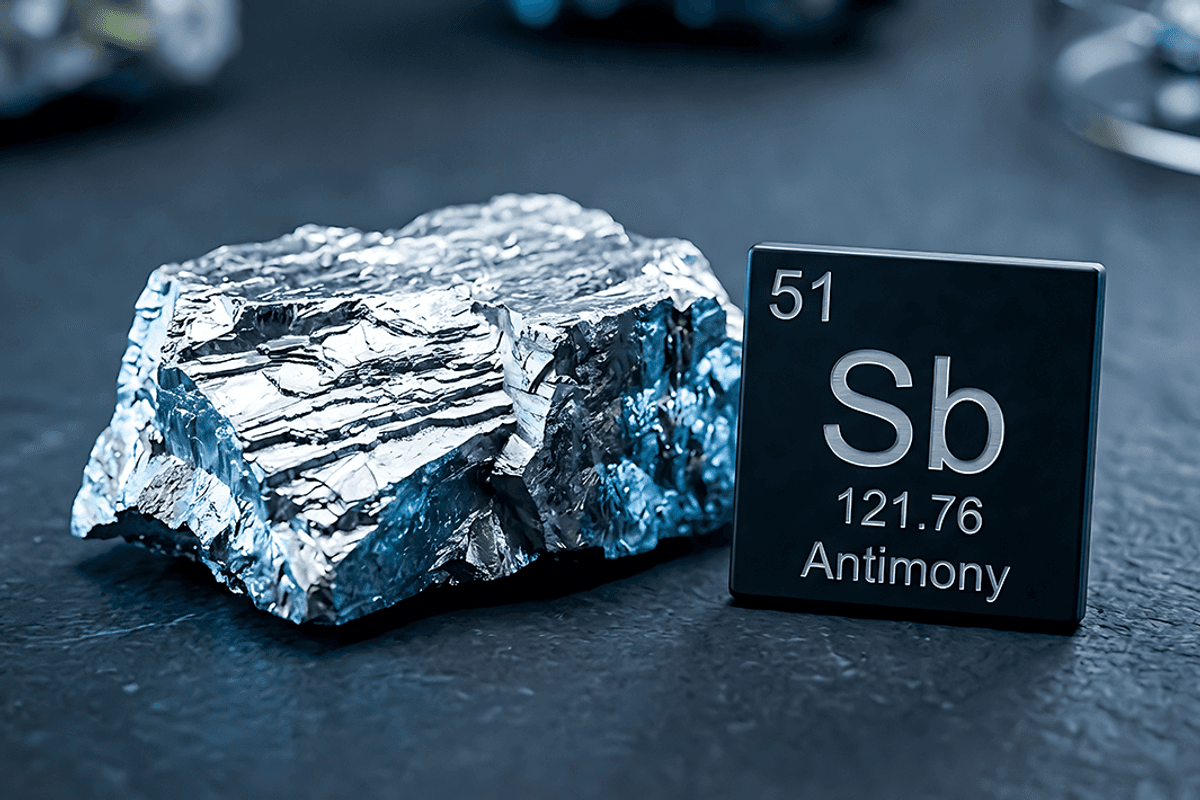
Antimony, a critical mineral, is gaining strategic importance due to its role in defense and energy. With China dominating supply, western nations and investors are focusing on securing alternative sources.
As global powers race to secure the raw materials needed to fuel their energy transition goals, strengthen national defense and maintain technological leadership, a once-overlooked element is stepping into the spotlight as the next strategic opportunity: antimony.
Antimony has a long-established traditional role in flame retardants and semiconductors, but this critical mineral is now at the center of geopolitical and supply chain security strategies. China, Russia and Tajikistan currently account for the majority of global supply, and western governments, including the US, are scrambling to build domestic capacity.
Case for securing supply chains
Antimony is a silvery, brittle metalloid with a surprisingly wide range of uses. It’s best known for its role in flame retardants, which fall under the metal products category that makes up around 49 percent of US consumption. It is also a key ingredient in semiconductors, lead-acid batteries and several defense applications including night-vision goggles and armor-piercing ammunition, with antimonial lead and ammunition accounting for a further 40 percent of US use.
The metal’s heat-resistant properties make it indispensable in products that need to withstand high temperatures, from electronic components to military equipment. Recognizing this importance — and the risks associated with concentrated supply chains — the US Department of the Interior has designated antimony a critical mineral, meaning it’s essential to economic and national security and has a high risk of supply disruption.
Like many critical minerals, global antimony supply is heavily concentrated. China, Russia and Tajikistan together account for roughly 85 percent of world mine production in 2025. US Geological Survey data shows that out of 110,000 tonnes, China and Russia produced around 40,000 tonnes each, while Tajikistan followed with 22,000 tonnes.
This dominance has increasingly come under scrutiny and highlighted a global supply vulnerability.
In August 2024, Beijing introduced export restrictions on antimony, followed by a ban on shipments to the US in December 2024. Although China halted the US-bound ban in November 2025, the suspension is currently set to expire on November 27, 2026. The US relied on imports for an estimated 91 percent of its antimony consumption in 2025, up from 86 percent in 2024, with domestic mining only restarting in 2025.
Outside the top three countries, global production is limited, with smaller contributions from countries such as Burma, Bolivia and Turkey. That concentration has left Western economies vulnerable to supply disruptions and has prompted new initiatives to develop domestic or allied sources of critical minerals.
Investment landscape
As governments push to secure critical minerals supply chains, and investors increasingly look beyond headline commodities like lithium and rare earths, antimony is emerging as a niche but strategic investment theme.
Antimony prices have surged on the back of tightening supply.
The US Geological Survey states that the average antimony price in 2025 was around US$25 per pound, more than double the 2024 average. A peak of US$27.50 was seen in June, followed by a decrease to $20.30 per pound in November. While prices have retreated from those highs as trade flows partly normalize, they remain well above the levels seen before China's export restrictions took hold, and the pending expiry of China's export suspension remains a key factor to watch.
Amid the strong prices, the size of the global antimony market is expected to grow from US$1.12 billion in 2025 to US$1.85 billion in 2034. This combination of a strong market price, rising strategic demand and constrained supply is creating a favorable environment for junior exploration companies with antimony resources in stable jurisdictions.
Spotlight on QEM: Strategic exposure to US critical minerals
For investors looking to gain exposure to antimony in secure jurisdictions, QEM Limited (ASX:QEM) offers a compelling case. QEM has expanded its critical minerals portfolio to the US through its newly acquired projects in Idaho: the Big It and Garden Valley (formerly known as Columbite) projects.
Big It is a past-producing tungsten mine with demonstrated tungsten-antimony-gold mineralization, while Garden Valley covers a cluster of historically recognized rare element pegmatite prospects with historical production and is described by the company as a highly prospective US rare metal pegmatite project.
The location of the projects makes a strong case, as Idaho is a state where US antimony resources are concentrated. It is home to the likes of the Galena complex in Silver Valley, a joint venture between Americas Gold and Silver (TSX:USA,NYSEAMERICAN:USAS) and United States Antimony (NYSEAMERICAN:UAMY), as well as Perpetua Resources’ (TSX:PPTA,NASDAQ:PPTA) Stibnite gold project, making it an ideal setting for policymakers as they seek to build domestic supply chains for critical minerals.
The company’s new Idaho portfolio gives investors early stage exposure to antimony alongside tungsten, tantalum and niobium at a time when governments are actively incentivizing local production.
“We see a unique potential for QEM to address the U.S. critical minerals supply chain crisis … (Our recent US) acquisition represents a highly strategic step for QEM, providing exposure to a portfolio of past-producing U.S. critical mineral assets with exceptional upside potential,” Managing Director Robert Cooper shared.
Investor takeaway
Antimony is quickly moving from an obscure industrial mineral to a strategic resource at the heart of geopolitics, national defense and the clean energy transition.
With supply concentrated in China, Russia and Tajikistan and western governments ramping up efforts to secure their own sources, the stage is set for antimony to gain more attention from investors.
For those looking to diversify their critical minerals exposure, early movers in stable jurisdictions could be well placed to benefit. Companies like QEM, with emerging antimony potential alongside tungsten and other critical minerals at its US projects, highlight how strategic positioning can create new avenues for value in a rapidly shifting resource landscape.
This INNspired article is sponsored by QEM Limited (ASX:QEM). This INNspired article provides information which was sourced by the Investing News Network (INN) and approved by QEM Limited in order to help investors learn more about the company. QEM Limited is a client of INN. The company’s campaign fees pay for INN to create and update this INNspired article.
This INNspired article was written according to INN editorial standards to educate investors.
INN does not provide investment advice and the information on this profile should not be considered a recommendation to buy or sell any security. INN does not endorse or recommend the business, products, services or securities of any company profiled.
This INNspired article contains forward-looking information, including statements regarding planned activities, timelines, business objectives, and market conditions. Forward-looking information is based on assumptions and is subject to known and unknown risks and uncertainties that may cause actual results to differ materially from those anticipated. Readers should not place undue reliance on forward-looking information, which reflects the views of the profiled company as of the date of this profile and is not updated by INN.
The information contained here is for information purposes only and is not to be construed as an offer or solicitation for the sale or purchase of securities. Readers should conduct their own research for all information publicly available concerning the company. Prior to making any investment decision, it is recommended that readers consult directly with QEM and seek advice from a qualified investment advisor.
QEM:AU
Alert Options
No alert set
INN Article Notification
Alert Option
You will be notified when this event occurs. No additional settings needed.
Latest News
Outlook Reports world
Featured Battery Metals Investing Stocks
Browse Companies
MARKETS
COMMODITIES
CURRENCIES