• Connect with us
    • Information
      • About Us
      • Contact Us
      • Careers
      • Partnerships
      • Advertise With Us
      • Authors
      • Browse Topics
      • Events
      • Disclaimer
      • Privacy Policy
    • Australia
      North America
      World
    Login
    Investing News NetworkYour trusted source for investing success
    • North America
      Australia
      World
    • My INN
    Videos
    Companies
    Press Releases
    Private Placements
    SUBSCRIBE
    • Reports & Guides
      • Market Outlook Reports
      • Investing Guides
    • Button
    Resource
    • Precious Metals
    • Battery Metals
    • Base Metals
    • Energy
    • Critical Minerals
    Tech
    Life Science
    Energy Market
    Energy News
    Energy Stocks
    • Energy Market
    • Energy News
    • Energy Stocks
    uranium investing

    Dev Randhawa of Fission Uranium: Hopeful for a Uranium Turnaround

    Written by Jocelyn Aspa
    |
    Mar. 14, 2017 04:25PM PST

    Dev Randhawa, CEO of Fission Uranium, discusses what the company has been up to and shares his thoughts on the uranium market moving forward.


    It’s a tumultuous time to be in the uranium space, but at this year’s Prospectors & Developers Association of Canada (PDAC) conference in Toronto, one couldn’t help but feel a sense optimism in the sector.
    Speaking to the Investing News Network (INN) at the show, Dev Randhawa, CEO of Fission Uranium (TSX:FCU), said there has been a positive change in the sector already, and commented on what his company has been up to lately.
    In particular, Randhawa spoke about Fission’s winter drilling program at Paterson Lake South, which was expanded in February. He also touched on results from 10 holes at the property.
    Other highlights of the conversation include:

    • Randhawa’s thoughts on how a Trump presidency will impact the uranium sector
    • his expectations for the uranium market moving forward
    • more of Fission Uranium’s plans

    Below is a transcript of the interview. It has been edited for clarity and brevity. To listen to the interview, please scroll to the top of the article.


    INN: In February, Fission Uranium expanded its winter drill program by 29 new drill holes to a total of 63 holes. How has the drill program been impacted since the announcement? 
    DR: We really felt a move the needle. There’s only two things that I believe can for us — this is based on feedback from our shareholders and our board — to find new areas away from where we’ve already found uranium. Secondly, the spot price. I don’t control the spot price, but I think to take more shots on exploration ideas, we’re trying to treat the property — at least parts of it — like an exploration project. Where can we look for a new blob of uranium if we didn’t have this particular wonderful big section of land. The footprint is pretty big now. It’s bigger than anything in the basin, but we haven’t connected yet. Our hope is to find more areas and really grow this because it’s a big, big property. We’ve only touched a small part of it.
    INN: Following that release, the company announced results from 10 holes at the Paterson Lake South property. They will potentially be included in a resource estimate this year. Are there any more details that can be shared regarding the estimate?
    DR: Not really, because anything that’s material has to be told to everybody, not to an interview. Number one, compliance, number two, really the way you find uranium, it’s vectoring in on something, and the first thing you look for is a conductor, then you look for alteration, then your drill hole starts and you’re looking for chemistry. With the right chemistry you know you’re in the right area. We ticked off all those boxes and now we’ve got something pretty decent grade, but now we need to find the blob of uranium that’s a source of it.
    INN: US President Donald Trump has made some questionable comments about uranium, saying, “lots of things are done with uranium, including some bad things, but nobody talks about that.” How do you think a Trump presidency will impact the sector?
    DR: You have to have a logistical software to keep track of everything Trump says about everything, and he changes his mind the next day. Like the travel ban gets changed dramatically from the one he started. Overall I think it’s really, really good for uranium because he seems far more interested in making sure America has lots of cheap energy, which is how you get a competitive edge. That’s one of the reasons I don’t think Japan does as well. They’ve shut down the nuclear reactors and they’re using gas plants. Their CO2 emissions have gone through the roof, and their cost of business goes up. Manufacturers need to keep their costs low.
    I think what Trump is … for business. I don’t personally like the way he does a lot of things, but he at least understands how to create jobs. He knows that to do that you’ve got to create lower taxes. Generally I’m in view of what he’s doing, and I don’t count on anyone to do anything positive at all, because to me the real story in uranium is China and India … those places. For every one that might shut down, they’re going to finish five this year in China, they’ve got eight more being built, eight more starting. So you’re talking about 21, and people will catch all the news about one in Japan. So I think too often the media is at fault at this for focusing on one or two of the negative stuff that is said. But good news doesn’t sell, so I don’t blame them.

    INN: That said, many are hopeful about a turnaround in the uranium market. What are your expectations for the sector moving forward? 
    DR: I think we have seen a turnaround. We’re down to $17, now we’ve jumped up. Again, there are two things in terms of supply and demand. Well, one: demand keeps going up. More and more reactors. In fact, in the next 10 years, there’s 800 million pounds that need contracts and there’s no contracts for them. So overall, no doubt. The question is, what happens in the next three years? When will utilities start to contract? Unfortunately, they act like lemmings so we don’t know. Uranium went from $7 to $140, and if you can believe this, utilities waited until it was $100. Everyone with common sense said, “oh, maybe we should buy it at $20, $30, $40, $50, $60” — nope. They waited until it went to $100. They act like lemmings, which is sad. It causes huge fluctuations. But I think demand is there, it’s supply. Having this week, and the last two weeks, we’ve seen Cameco (TSX:CCO,NYSE:CCJ) say, “we’re going to revisit our numbers, maybe we could drop production even more.” Secondly, the big one is the Kazakhs. Cameco’s cutbacks impact the long-term price more than the short term. Because the Kazakhs dump all the uranium at the spot price, their announcement means more.
    And really, at $17, $25 they have no money left to say, “okay, we take the money up, but they’ve got to reinvest it.” In solution mining — ISL — you have to continue like oil wells. You’ve got to continue to add wells, otherwise you have a decline in production. So they’re not doing any new drilling at all. We really need them to cut back. If they were to cut back 20 percent, it would get rid of all the overhang on the spot price. All of it would be gone … the average cost of a mine is $60, and you cannot have your long-term price at $30. I’ll plagiarize Cameco: they say today’s prices are unsustainable and irrational. And that’s where they are today. Investors want to make money, you buy stuff, quality companies that are cashed up with good management track records, and own them and hold them. When it turns, you’ve seen what happens. You saw Denison Mines (TSX:DML,NYSEMKT:DNN) go from $0.49 to $1.10. It was double in a month. The easy money is gone. Now people are having to grind for nickels again, so I’m hopeful for it.
    INN: On that note, are there any other plans Fission has this year that investors should know about?
    DR: Well for us, definitely. We’re always looking to look at doing deals. It would make sense for shareholders, but at the same time we know our main asset. We own 100 percent of it. We have a great, great partner in CGN. They’re the mothership in the uranium industry. People look to them for leadership and developing nuclear plants and uranium projects. They’re the ones that are really more entrepreneurs out of China. I think we might do more things with them, who knows.
    But right now, we’re pretty happy to have a project that is very high grade in Saskatchewan, but starts at 50 meters. That’s the thing that people forget: you can’t compare apples to oranges. To compare a project that’s mineable at 50 meters versus 500, it’s night and day. So … other projects that are deeper and even higher grade, but nothing is shallow. If you go back to the history of the basin, anything that was shallow like Key Lake, Cluff Lake, boom, they’re gone. It’s not a fluke; it’s because they’re easy to mine, and also when you do open pit less risk in mining — and more importantly, you get every pound. When you’re going underground, you don’t know what you’re always going to get. So you get every pound when you’re open-pit mining, you don’t get that when you’re underground.

    Don’t forget to follow us @INN_Resource for real-time news updates!

    Securities Disclosure: I, Jocelyn Aspa, hold no direct investment interest in any company mentioned in this article.
    Editorial Disclosure: The Investing News Network does not guarantee the accuracy or thoroughness of the information reported in contributed article. The opinions expressed in these interviews do not reflect the opinions of the Investing News Network and do not constitute investment advice. All readers are encouraged to perform their own due diligence.

    FCU:CA
    uranium investingchinacanadadonald trumpindia
    The Conversation (4)
    Investor Last Name
    Investor Last Name
    15 Mar, 2017
    "In solution mining — I sell mining" The inset should likely be "ISL mining", not "I sell mining" [ISL = in-situ leaching].
    1 Reply Hide replies
    Jocelyn Aspa
    Jocelyn Aspa
    15 Mar, 2017
    thanks for pointing that out, the error has been corrected.
    Show More Replies
    Investor Last Name
    Investor Last Name
    15 Mar, 2017
    "In solution mining — I sell mining" The inset should likely be "ISL mining", not "I sell mining" [ISL = in-situ leaching].
    1 Reply Hide replies
    Jocelyn Aspa
    Jocelyn Aspa
    15 Mar, 2017
    thanks for pointing that out, the error has been corrected.
    Show More Replies

    Go Deeper

    AI Powered
    Canadian flag next to uranium ore.

    5 Best-performing Canadian Uranium Stocks in 2026

    Glowing line graph overlays power plant with cooling towers and smokestacks against a moody sky.

    Uranium Price Trends: Q3 2026 Review and Forecast

    Latest News

    Oil & Gas Virtual Investor Conference Agenda Announced for November 5th

    Aetherion to Issue Q3 2026 Financial Results on November 12, 2026

    Alvopetro Announces Timing of Q3 2026 Results and Earnings Call

    Metals.io Launches Copper, Unlocking Access to the Critical Metal at the Heart of Electrification

    SAGA Metals Positions Wolverine Heavy REE Project Alongside Strange Lake and Tanbreez in Geological Peer Comparison

    More News

    Outlook Reports world

    Resource
    • Precious Metals
      • Gold
      • Silver
    • Battery Metals
      • Lithium
      • Cobalt
      • Graphite
    • Energy
      • Uranium
      • Oil and Gas
    • Base Metals
      • Copper
      • Nickel
      • Zinc
    • Critical Metals
      • Rare Earths
    • Industrial Metals
    • Agriculture
    Tech
      • Artificial Intelligence
      • Cybersecurity
      • Gaming
      • Cleantech
      • Emerging Tech
    Life Science
      • Biotech
      • Cannabis
      • Psychedelics
      • Pharmaceuticals

    Featured Energy Investing Stocks

    Skyharbour Resources

    Skyharbour Resources (SYH:CC)
    SYH:CC

    Generation Uranium

    Generation Uranium (GEN:CC)
    GEN:CC

    Investor Insight

    Generation Uranium offers investors high-leverage exposure to a potential major discovery in Canada’s underexplored and resource-rich Thelon Basin, led by a management team with a proven track record of securing high-value exits.

    Overview

    Generation Uranium (CSE:GEN, OTCQB:GENR, FRA:W85) is a Canadian exploration company focused on wealth creation through discovery within the uranium sector. The company’s primary strategy is to build a high-caliber exploration team that can rapidly test and drill high-potential targets, de-risking projects for potential takeover by larger producers. Currently centered in the prolific Thelon and Angikuni Basins of Nunavut, the company is also actively evaluating additional project acquisitions in the Athabasca Basin to expand its portfolio.
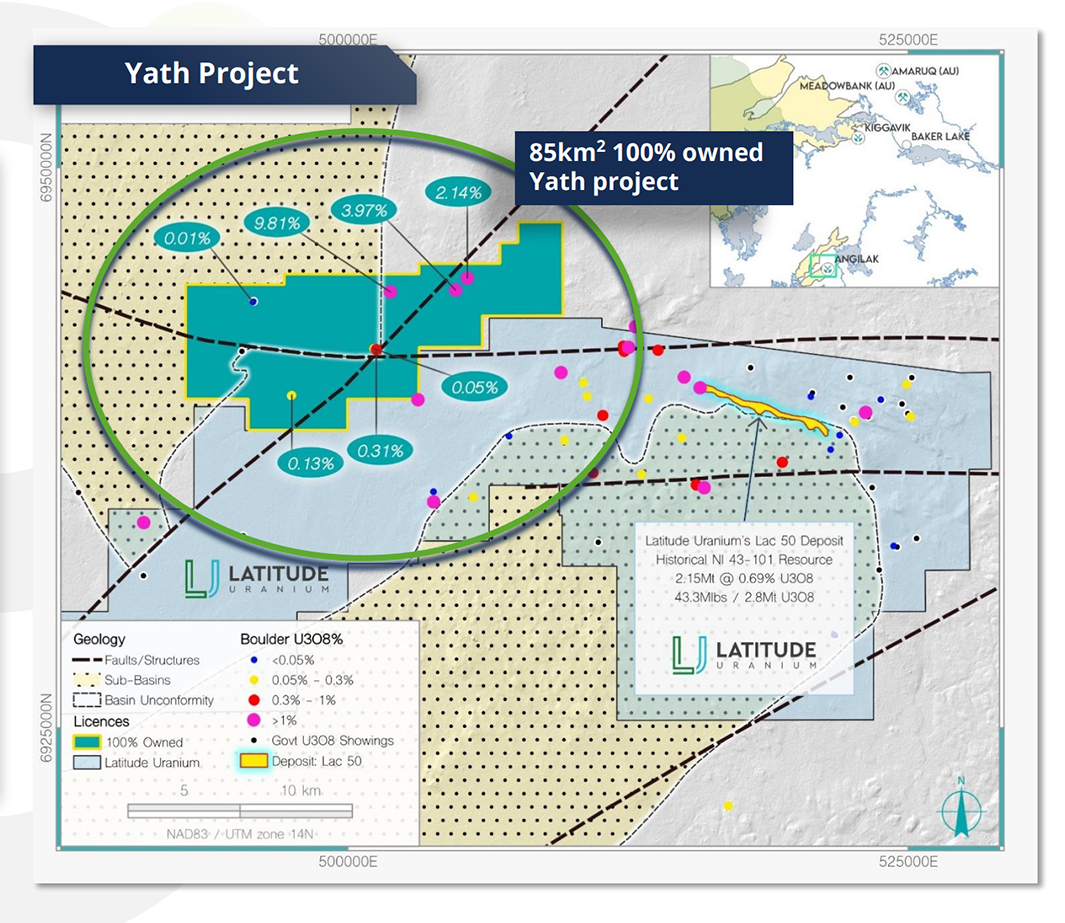
    Generation Uranium Yath Project

    The company is led by a veteran management team with nearly 30 years of experience in mineral development. CEO Michael Collins has a significant track record of building and exiting public companies, including the co-founding of Bluerock Resources, a conventional uranium producer during the 2000-2008 cycle. This expertise is paired with a focused business model that leverages modern geophysical targeting to accelerate exploration timelines and reduce costs, ensuring the company can deliver results quickly in a bullish uranium market.

    Company Highlights

    • Strategic Location in a Premier Uranium District: The flagship Yath Project is located in Nunavut’s Thelon Basin, contiguous to ATHA Energy’s Angilak Project, which hosts the high-grade Lac 50 deposit.
    • High-Grade Discovery Potential: Historical surface sampling at the Yath Project has yielded exceptional uranium grades, including boulders testing at 9.81 percent, 3.95 percent, and 2.14 percent U3O8.
    • Expert Management with Exit Experience: Led by CEO Michael Collins, the team has decades of experience in mineral exploration and a history of co-founding companies that were later acquired, such as Prime Mining and Nuclear Fuels.
    • Low-Cost, Rapid Exploration Strategy: By leveraging modern geophysics and extensive historical data, the company aims for a "short road to discovery," de-risking projects quickly to maximize shareholder value.
    • Bullish Market Fundamentals: Generation Uranium is well-positioned to meet the growing global demand for carbon-free nuclear power, supported by a projected supply deficit and increased interest from major tech companies seeking clean energy.

    Key Project

    Yath Project - Nunavut, Canada

    The Yath Project is Generation Uranium’s flagship project. This 100 percent owned property covers about 120 square kilometers within the underexplored Thelon Basin in Nunavut, Canada. The project is located where the Yathkyed and Angikuni sub-basins meet, which is a region known globally for high-grade uranium potential. It sits directly along the same trend as the Angilak Project owned by ATHA Energy (TSXV:SASK, OTCQB:SASFK, FWB:XSU.F), which contains the Lac 50 deposit, one of the highest-grade uranium resources found outside of the Athabasca Basin with a historical mineral resource estimate of 43.3M lbs at an average grade of 0.69 percent U3O8.
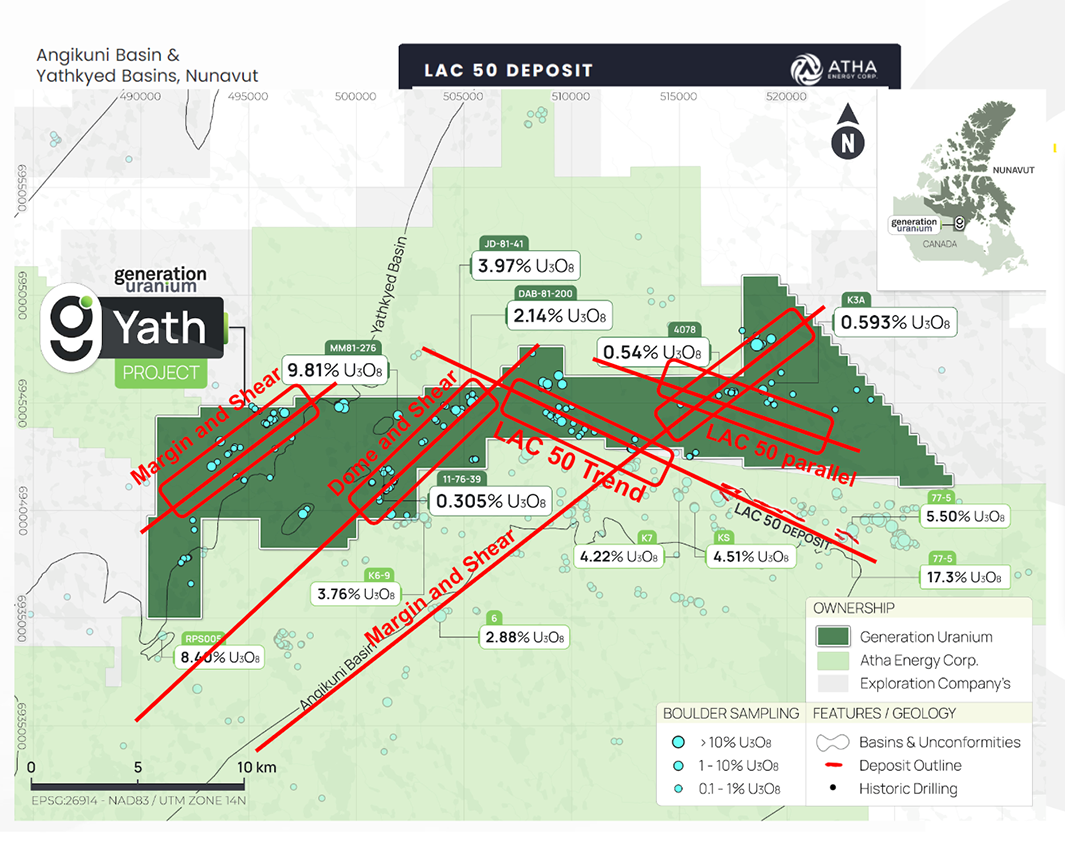
    Generation Uranium Yath Project

    The Yath Project is contiguous to the Lac 50 trend and is crossed by several regional faults and basin boundaries. Past exploration work has already identified high priority targets, while surface sampling in the area has produced uranium grades from boulders, with some testing at 9.81 percent, 3.95 percent, and 2.14 percent U3O8.

    The company has commenced its initial field program at the site, set to define and rank drill targets. Historic showings will be combined with new anomalies from the MMT geophysics survey, preparing the project for an anticipated drill permit.

    Management Team

    Michael Collins - CEO & Director

    Michael Collins is a professional geoscientist with nearly 30 years of experience in mineral exploration. He has co-founded several public companies, including Exploits Discovery, Prime Mining (acquired in 2025), and Nuclear Fuels (merged with Premier American Uranium in 2025). He is also currently a director of First Atlantic Nickel.

    Christoph Bruening - Director

    Christoph Bruening is the founder and managing partner of Value Relations GmbH, a full-service investor relations and public relations agency in Frankfurt with over 25 years of excellence, focusing on mining, exploration, biotech and health care. In addition, he has listed over 600 companies on the Frankfurt Stock Exchange and is a speaker and author of several publications, including on rare earths and uranium.

    Dallas Miller - Director

    Dallas Miller has been working within the international mining industry for over 15 years, working with BHP and Santos Ltd. He has experience on the ground from an operational standpoint, as well as being an integral part of raising millions of dollars in capital funding for both private and public companies in recent years.

    Roger Leschuk - VP Corporate Development

    Roger Leschuk has been in corporate management for over two decades, with the past 15 years dedicated to corporate development and investor relations. He has experience participating in and assisting with mergers and acquisitions, and was an investment advisor for various services such as stocks, mutual funds and tax-sheltered investments. He is a Chartered Investment Manager and a Fellow of the Canadian Securities Institute.

    Monty Sutton - CFO

    Monty Sutton brings over 35 years of experience in public markets and corporate governance. He previously served as CFO for Nuclear Fuels from its IPO through its acquisition.
    Saga Metals

    Saga Metals (SAGA:CC)
    SAGA:CC

    Metals.io

    Metals.io (:)
    :

    Jaguar Uranium

    Jaguar Uranium  (JAGU)
    JAGU

    Premier American Uranium

    Premier American Uranium (PUR:CC)
    PUR:CC
    More featured stocks

    Browse Companies

    Resource
    • Precious Metals
    • Battery Metals
    • Energy
    • Base Metals
    • Critical Metals
    Tech
    Life Science
    MARKETS
    COMMODITIES
    CURRENCIES