• Connect with us
  • Information
    • About Us
    • Contact Us
    • Careers
    • Partnerships
    • Advertise With Us
    • Authors
    • Browse Topics
    • Events
    • Disclaimer
    • Privacy Policy
  • NORTH AMERICA EDITION
    Australia
    North America
    World
Login
Investing News NetworkYour trusted source for investing success
  • NORTH AMERICA EDITION
    North America
    Australia
    World
  • My INN
Videos
Companies
Press Releases
Private Placements
SUBSCRIBE
  • Reports & Guides
    • Market Outlook Reports
    • Investing Guides
  • Button
Resource
  • Precious Metals
  • Battery Metals
  • Base Metals
  • Energy
  • Critical Minerals
Tech
Life Science
Battery Metals Market
Battery Metals News
Battery Metals Stocks
  • Battery Metals Market
  • Battery Metals News
  • Battery Metals Stocks
lithium investing

Lithium-air Battery Goes Viral

Written by Vivien Diniz
|
Nov. 18, 2013 04:00AM PST
Lithium Investing
play icon

A virus is never a good thing — or is it?

Nobody likes a virus, but that’s not to say a virus can’t be good for something. This week, researchers at MIT looked to a genetically modified virus to improve the durability of lithium-air batteries.

Lithium-air batteries have been gaining popularity in recent years because they offer something that lithium-ion batteries do not. In comparison to lithium-ion batteries, lithium-air batteries are lighter and have a better power density per pound, making it possible to increase the driving range seen in today’s electric vehicles.

However, according to io9, engineers have been struggling to create the durable materials required for the batteries’ electrodes. As a result, it has been hard for them to increase the number of charging cycles the batteries can withstand.

Virus cathodes

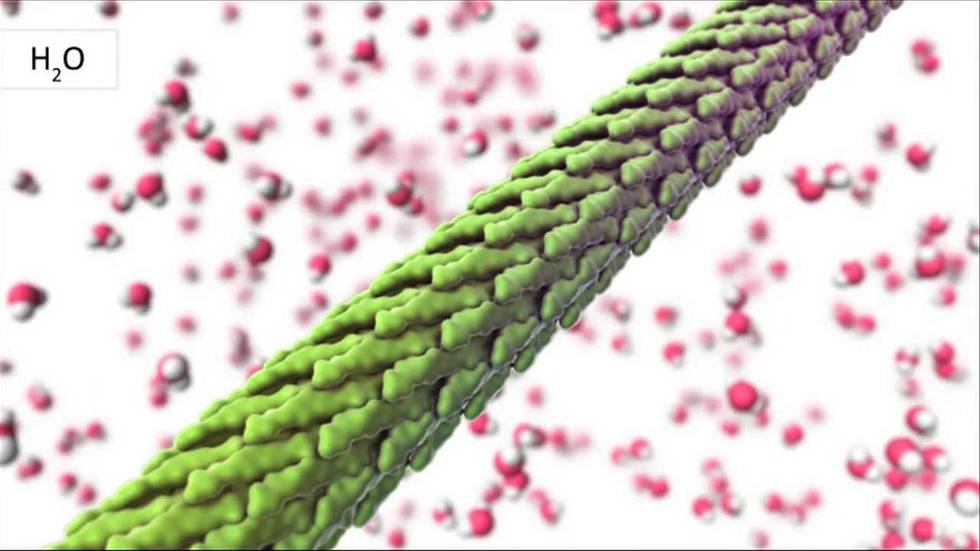
Looking to find solutions to lithium-air batteries’ charge problem, MIT turned to biology — a genetically modified benign virus — for answers. MIT is using an engineered virus called M13, that “works by increasing the surface area of the wire, which in turn increases the area where electrochemical activity takes place when batteries are charged or discharged.”

Angela Belcher, the W.M. Keck Professor of Energy and a member of MIT’s Koch Institute for Integrative Cancer Research, likens the biosynthesis process of the nanowires to the way an “abalone grows its shell.”


By capturing molecules of metals from water and binding them into structural shapes, the surface area of the nanowire array can be increased.

Using a manganese oxide, a common cathode material of lithium-ion batteries, the virus built wires that have rough, spiked surfaces. Because the wires have spikes as opposed to a flat surface, there is more surface area for a chemical reaction to occur. “This process also creates a cross-linked 3D structure, rather than isolated wires, making for a more stable electrode. Adding to its advantages, the viral process is water-based and done at room temperature,” Gizmag wrote.

According to the research team, the new development in lithium-air technology could be a big advantage for charging and discharging. Belcher explained that the developments are “a great contribution to guide the research on how to effectively manipulate catalysis in lithium-air batteries.” Furthermore, the new approach could act as a stepping stone for other lithium-air batteries. “The template introduced in this work is also readily adaptable for other catalytic systems,” Belcher said.

While still in its early stages, 50 charge cycles have been documented so far using the cathode. Core components, including the electrolyte, are still being looked at, as per MIT. MIT estimated that its work could improve battery energy density by two to three times.


Securities Disclosure: I, Vivien Diniz, hold no investment interest in any of the companies mentioned. 

manganese oxide lithium investing cancer research
The Conversation (0)

Latest News

Spartan Metals Expands Past-Producing Tungstonia Mine Mineralization Footprint More Than 13-Fold, Defining 5.7 km2 of Tungsten-Silver Veins with Assays up to 5.18% WO3

High-Grade Copper-Gold Extends Red Hill To 550m Strike

SAGA Metals Reports Assays from R-0047 to R-0049 with Intercepts Including 53.72% Fe2O3, 7.32% TiO2, 0.431% V2O5 from 2026 Drilling at Trapper South, Radar Critical Minerals Project in Labrador

Ridgeline files Early Warning Report in Respect of Spartan Metals Corp.

Western Uranium & Vanadium Provides Update on Mill License Application

More News

Outlook Reports

Resource
  • Precious Metals
    • Gold
    • Silver
  • Battery Metals
    • Lithium
    • Cobalt
    • Graphite
    • Electric Vehicles
  • Agriculture
  • Base Metals
    • Copper
    • Nickel
    • Zinc
  • Critical Metals
    • Rare Earths
  • Energy
    • Uranium
    • Oil and Gas
Tech
    • Artificial Intelligence
    • Cybersecurity
    • Robotics
    • Crypto
    • Cleantech
Life Science
    • Biotech
    • Cannabis
    • Pharmaceuticals

Featured Battery Metals Investing Stocks

Atlantic Lithium

Atlantic Lithium (A11:AU)
A11:AU

Galan Lithium

Galan Lithium (GLN:AU)
GLN:AU

American Salars Lithium

American Salars Lithium (USLI:CC)
USLI:CC

Lithium Universe

Lithium Universe (LU7:AU)
LU7:AU

Chariot Corporation

Chariot Corporation (CC9:AU)
CC9:AU

Stardust Power

SDST
More featured stocks

Browse Companies

Resource
  • Precious Metals
  • Battery Metals
  • Energy
  • Base Metals
  • Critical Metals
Tech
Life Science
MARKETS
COMMODITIES
CURRENCIES