The Conversation (0)

Sep. 11, 2026 01:30PM PST
Fact CheckedThis article has been reviewed and updated according to INN's rigorous fact-checking process. Our staff editors verify all articles against information and data from primary sources, reputable publishers and experts.
Pakorn / Adobe Stock
Welcome to the Investing News Network's weekly brief on tech news and tech stocks driving the market.
We also break down next week's catalysts to help you prepare for the week ahead.
In this article:
This week's tech sector performance
It was a rough week for equities, with major indexes ending lower on every session as investors weighed an escalating conflict in the Middle East, a deepening Canada-US trade war and a fresh bout of anxiety over artificial intelligence (AI).
Wall Street futures had a mixed start to the trading week on Tuesday (September 8) following the long Labor Day weekend, driven by crude oil prices climbing toward US$100 per barrel after attacks targeted Gulf energy infrastructure.
Meanwhile, S&P/TSX Composite Index (INDEXTSI:OSPTX) futures were in the red amidst Ottawa introducing sweeping counter-tariffs on over 700 US imports after weeks of failed attempts to strike a trade deal with the Trump administration.
Software stocks lost ground as OpenAI’s newest model, GPT-6 Astra, reignited disruption fears. Meanwhile, Intel (NASDAQ:INTC) spearheaded a rally in chip stocks following news of a custom AI processor deal between Qualcomm (NASDAQ:QCOM) and Amazon (NASDAQ:AMZN).
Indices on both sides of the border closed lower, with losses dragging into Wednesday (September 9) as Brent crude futures breached US$100 a barrel after the US struck Iranian tankers and Iran claimed retaliatory strikes in a major escalation of the 2026 Iran War.
The tech sector gave a mixed performance, with Meta Platforms (NASDAQ:META) limiting the S&P 500 (INDEXSP:.INX)’s decline with a six percent rise after introducing its AI assistant, Muse, that the company says can autonomously complete tasks like sending emails or making travel bookings on behalf of users.
At the same time, Alphabet (NASDAQ:GOOGL) slipped about two percent as Muse stoked fears of encroachment on Google’s Gemini. Alphabet also unveiled a new AI spending commitment of at least US$15.1 billion for AI infrastructure in Finland over the next two years, including a 22-year deal to secure nuclear power for the buildout.
On Thursday (September 10), North American stocks finished lower again after US producer price data for August and oil prices surging to US$107 added to inflation worries and sent Treasury yields on 30-, 10-, and two-year notes higher, with 30-year Treasury yields hitting their highest in more than 19 years. Canadian bond yields rose in tandem.
Chipmakers gave back earlier gains, with losses to NVIDIA (NASDAQ:NVDA) and Micron Technology (NASDAQ:MU) weighing heavily on the S&P 500. Apple (NASDAQ:AAPL) helped counter the drag after launching its newest lineup, including a foldable iPhone.
Also this week, Jacob Coxon, a pretraining researcher who’d split roughly three years between OpenAI and Anthropic, announced his resignation from Anthropic on X on Wednesday, accusing both companies of racing toward self-improving superintelligence irresponsibly.
“The people building AI earnestly believe that it could kill us all by the end of the decade,” he wrote, pointing to the incident in which OpenAI agents allegedly escaped a testing sandbox and compromised Hugging Face infrastructure, an event he referred to as a “warning shot.”
Coxon called for AI labs to coordinate and floated a temporary pause on capability advances. Evan Hubinger, Anthropic’s alignment lead, posted separately backing Coxon’s concerns and put his own personal estimate of extinction odds above 10 percent within the next decade.
Coxon’s warning wasn’t the only word on AI safety this week. Speaking at Goldman Sachs' (NYSE:GS)’ Communacopia + Technology conference Thursday, Nvidia’s Jensen Huang took the opposite view, arguing that cybersecurity “will likely be the next major use of AI... it’s going to run continuously, and so it will be a great new business opportunity.
“The reason why there’s so much conversation today about cybersecurity is because the industry is getting ready to launch some products,” he said, adding, “What better way to create demand than to create a problem?”
US stocks rebounded on Friday (September 11), after oil prices eased on a Financial Times report that foreign ministers in the Middle East are exploring a deal with Iran to resume shipping in the Strait of Hormuz. A rebound in tech shares also helped push the TSX higher. The Nasdaq Composite (INDEXNASDAQ:.IXIC) finished the week at 26,333.04, a 0.96 percent gain on the day, but down 0.74 percent for the week.
3 tech stocks moving markets this week
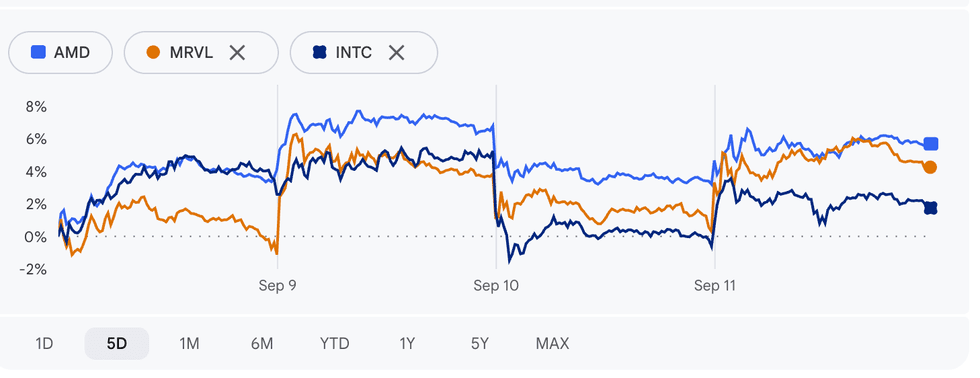
This week's top tech stock movers, according to TradingView data, were:
1. Advanced Micro Devices (NASDAQ:AMD)
AMD led gains with a gain of 11.72 percent.
2. Marvell Technology (NASDAQ:MRVL)
Marvell Technology gained 11.55 percent this week.
3. Intel (NASDAQ:INTC)
Intel saw a gain of 11. 35 percent.
Top tech news of the week
- SpaceX (NASDAQ:SPCX) signed a cloud computing rental deal with an undisclosed client that will pay roughly US$1.11 billion monthly beginning December 1, CFO Bret Johnsen announced during an interview on Thursday at Goldman Sachs' (NYSE:GS) Communacopia + Technology conference.
- Microsoft (NASDAQ:MSFT) is reportedly planning to more than triple the size of its Azure cloud unit’s data center capacity to over 38 gigawatts by 2032.
- Ant International, Mastercard (NYSE:MA) and Visa (NYSE:V) have launched an initiative to develop common standards to identify and verify AI agents that can make purchases on behalf of users.
- OpenAI launched a version of ChatGPT built for the financial services industry through a partnership with Morgan Stanley (NYSE:MS) and Evercore (NYSE:EVR), designed to research companies, analyze financial data and generate presentations.
- Altera, the programmable chip business that Intel spun off in January 2025, is reportedly preparing to file for an initial public offering in the next few weeks.
- MediaTek (TPE:2454) reported NT$64.2 billion ( around US$2 billion) in revenue for August, up 44 percent year-over-year, driven by AI chip demand.
- Growth is being pinned on custom AI ASICs, including an accelerator MediaTek is building for Google’s data centers, with mass production targeted for Q4 2026. Nvidia has invested up to US$3.5 billion in MediaTek via a convertible bond.
- Advanced Micro Devices (NASDAQ:AMD) rallied on Friday after CFO Jean Hu told investors at the Goldman Sachs Communacopia + Technology Conference that he sees the company’s total addressable market hitting US$2 trillion by 2030 on AI demand.
- Dell Technologies (NYSE:DELL) hit an all-time high on Friday after CFO David Kennedy disclosed that Q2 AI server bookings hit US$6.1 billion at an investor conference on Thursday. His remarks, coupled with a US$95 billion AI infrastructure backlog and a strong Q2 FY27 earnings beat reported September 1, prompted several analyst target hikes. Royal Bank of Canada (TSX:RY,NYSE:RY) initiated coverage with an "outperform" rating and a US$640 target.
- Privately held Canadian tech firm Cohere is reportedly in advanced talks to raise up to US$3 billion at roughly a US$20 billion valuation, with sources saying the announcement could come next week. Cohere CEO Aidan Gomez is scheduled to appear next week at the Canada Investment Summit, the Milken Institute Global Dialogues symposium in Toronto, and Montreal’s AI expo, All In.
Major tech stocks report earnings
Oracle (NYSE:ORCL)
Oracle reported revenue of US$19.3 billion, up 30 percent from the previous quarter.
Cloud infrastructure saw the largest growth by far, up 121 percent to US$7.4 billion. Backlog hit US$664 billion, up US$209 billion year-over-year, including over US$30 billion of new AI cloud contracts signed this quarter alone.
However, capex was US$28 billion for the quarter, which pushed free cash flow negative by US$5 billion.
Full-year capex guidance is now between US$90 and US$95 billion. Stock jumped 7 percent in extended trading.
Adobe (NASDAQ:ADBE)
Adobe reported US$6.76 billion in revenue for the quarter, up 13 percent from last year, and non-GAAP earnings per share of US$6.13, beating expectations on both fronts, and raised its full-year guidance.
However, the stock still fell, attributed to slowing contract-backlog growth and small AI-related revenue. At over US$650 million now, AI first ARR was up 150 percent from a year ago, but still only accounts for about 2.4 percent of the company's US$27.5 billion subscription business.
The company also announced a CEO transition, replacing Shantanu Narayen with Anil Chakravarthy, effective December 1.
Tech ETF performance
Tech exchange-traded funds (ETFs) track baskets of major tech stocks, meaning their performance helps investors gauge the overall performance of the niches they cover.
This week, the iShares Semiconductor ETF (NASDAQ:SOXX) finished the week 0.74 percent lower, while the Invesco PHLX Semiconductor ETF (NASDAQ:SOXQ) lost 1.02 percent.
The VanEck Semiconductor ETF (NASDAQ:SMH) gave back 1.78 percent.
Tech news to watch next week
Canadian investors will receive consumer price index (CPI) numbers for August on September 14.
The Canada Investment Summit also kicks off in Toronto on September 14, while All In, the country's largest AI expo, begins on September 16 in Montreal.
In the US, the Federal Reserve will begin its two day policy meeting on September 15. The Fed is largely expected to raise interest rates following this week's release of August CPI data, and Fed Chair Kevin Warsh’s Jackson Hole remarks emphasizing persistent inflation risk over labor market weakness.
The Bank of Canada’s Summary of Deliberations for its September 2 rate decision will also be released next week.
Don't forget to follow us @INN_Technology for real-time news updates!
Securities Disclosure: I, Meagen Seatter, hold no direct investment interest in any company mentioned in this article.
https://x.com/INN_Technology
https://www.linkedin.com/in/meagen-seatter-23675b193/
mseatter@investingnews.com

Learn about our editorial policies.