The Conversation (0)
Aug. 17, 2026 01:40PM PST
Elkha / Adobe Stock
Global production of molybdenum is important to watch due to the metal's role in steel production, renewable energy technology and the defense sector, which has earned it a spot on many countries' critical mineral lists.
Prices for molybdenum have climbed significantly in 2026, with molybdenum oxide Platts futures rising from about US$21 to US$33 per pound as of August. Futures prices had largely held below US$25 since it pulled back from a spike to record highs in February 2023 on strong demand and deficits in key supply sources.
Molybdenum is primarily produced as a by-product of copper, a sector that itself faces growing supply concerns as few new mines enter production. Additionally, top producer China implemented export controls on molybdenum powder in February 2025, introducing further strain on supply.
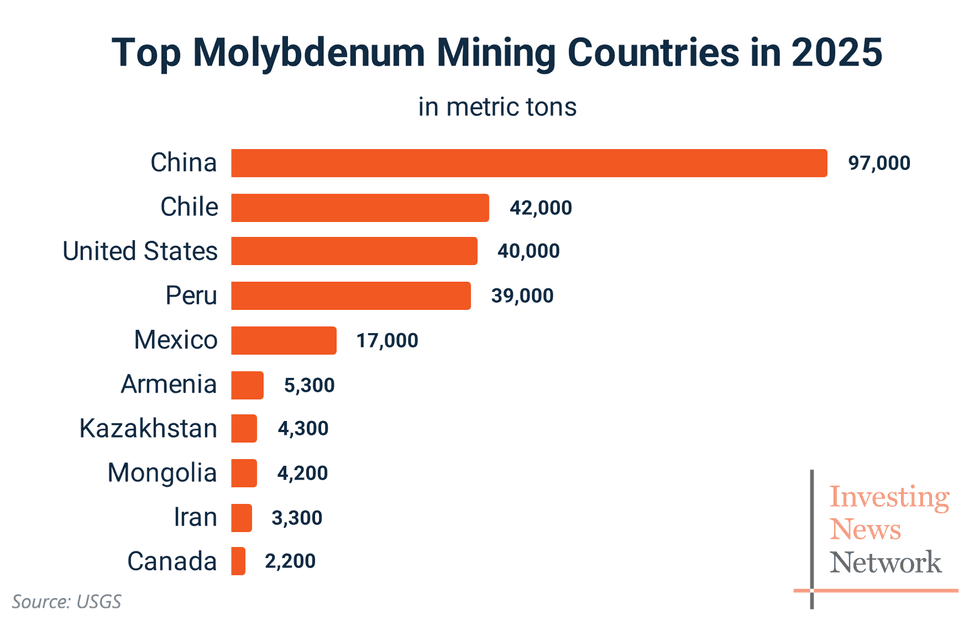
Worldwide molybdenum production totaled 260,000 metric tons in 2025, up slightly from 256,000 metric tons in 2024. The vast majority of global molybdenum comes from the top five countries. So which countries are the top molybdenum producers? Here’s a look at which nations put out the most of the metal in 2025, as per the latest data from the US Geological Survey's (USGS) 2026 Mineral Commodity Summary.
1. China
Molybdenum production: 97,000 metric tons
Molybdenum reserves: 7.8 million metric tons
China produces the vast majority of the world’s molybdenum supply by a significant margin, more than doubling Chile's in 2025. The country’s molybdenum production totaled 97,000 metric tons in 2025, just slightly below its 100,000 metric tons in 2024. China holds the world's top molybdenum reserves as well, with 7.8 million metric tons of economic molybdenum identified in its soil.
The molybdenum market as a whole is closely tied to China, and not just because the country produces so much of the metal. China also has a massive industrial sector that requires huge amounts of molybdenum to make steel.
China's molybdenum industry has seen increased consolidation and regulation in recent years after China began tightening its mining standards in 2018 to curb environmental damage. Molybdenum facilities that did not pass inspections had to either upgrade them to meet these standards or shut down, leading to a significant drop in production from the 130,000 metric tons of molybdenum the country produced between 2016 and 2019.
China is one of only two countries on this top five list with operations mining primary molybdenum deposits instead of only producing it as a byproduct of copper mining. CMOC Group (OTCPL:CMCLF,HKEX:3993), previously named China Molybdenum Company, is one of the country's top producers of the metal. CMOC operates the Sandaozhuang molybdenum-tungsten mine and the Shangfanggou molybdenum-iron mine, both located in Henan province.
In February 2025, the country placed export controls on molybdenum powder and production materials and technologies for molybdenum-related items alongside products and technologies for several other metals.
2. Chile
Molybdenum production: 42,000 metric tons
Molybdenum reserves: 2.6 million metric tons
Chile is the world's second highest molybdenum producer, producing 42,000 metric tons in 2025, up from 38,500 metric tons the prior year. The country is the world's top copper producer, and its molybdenum production comes as a byproduct of its extensive copper mining.
The South American country had held onto second place for much of the last decade since it passed the US in 2015, and reclaimed that position after falling below Peru in 2024. However, after starting the decade at 59,400 metric tons in 2020, Chilean molybdenum production has trended downwards in recent years, due in part to lower grades at its copper porphyry mines.
State-owned Codelco produces the bulk of Chile’s molybdenum from operations including El Teniente, Chuquicamata and Salvador. Significant copper-molybdenum mines operated by other companies include KGHM Polska Miedz' (FWB:KGHA.F) Sierra Gorda mine and Lundin Mining's (TSX:LUN,OTCPL:LUNMF) Caserones mine.
Chile holds the world's third highest molybdenum reserves at 2.6 million metric tons.
3. United States
Molybdenum production: 40,000 metric tons
Molybdenum reserves: 3.5 million metric tons
The United States' molybdenum production jumped significantly to 40,000 metric tons last year, up from 34,000 metric tons in 2024. The country holds the world's second highest reserves at 3.5 million metric tons of molybdenum in economic deposits.
Although the metal is often produced as a by-product, the US is one of the few countries that currently hosts active primary molybdenum mines: the Climax and Henderson mines in Colorado, both operated by Climax Molybdenum, a subsidiary of Freeport-McMoRan (NYSE:FCX). It is also produced as a byproduct at seven mines, four of which are in Arizona.
US consumption of molybdenum has risen steadily since 2022, coming in at 17,000 metric tons last year, according to the USGS. While exports of ore and concentrates rose slightly last year, exports of primary products continued a significant upward trend.
4. Peru
Molybdenum production: 39,000 metric tons
Molybdenum reserves: 1 million metric tons
Peru produced 39,000 metric tons of molybdenum last year, putting it neck-and-neck with Chile and the US. The country's molybdenum production has risen significantly over the last decade, more than doubling the 17,000 it mined in 2014, and it even took second place from Chile in 2024.
Peruvian copper mines that produce significant amounts of molybdenum as a byproduct include the Cerro Verde mine, operated by Freeport-McMoRan, and the Toquepala and Cuajone mines, operated by Southern Copper (NYSE:SCCO), a subsidiary of Grupo Mexico (BMV:GMEXICOB,OTCGMBXF:PL).
In terms of molybdenum deposits, Peru's reserves stand at 1 million metric tons.
The Peruvian Ministry of Energy and Mines has placed importance on increased investment in its mining sector. In the first half of 2026, mining investment reached a 12 year high of US$3.3 billion, up 42.7 percent year-on-year. In August 2026, Minister Guillermo Shinno announced its goal of promoting around US$40 billion in investments combined during the next five years.
5. Mexico
Molybdenum production: 17,000 metric tons
Molybdenum reserves: 130,000 metric tons
Mexico produced 17,000 metric tons of molybdenum in 2025, up 800 metric tons over 2024. Following more than a decade of growth for the country’s molybdenum-mining sector, the country's production has held above 16,000 since 2019.
Two major molybdenum-producing mines in the country are La Caridad and Buenavista, both operated by Grupo Mexico subsidiary Southern Copper. The mines produce molybdenum as a by-product of copper.
Mexico hosts the smallest economic molybdenum reserves of the top five countries in this list, with 130,000 metric tons of molybdenum in identified deposits.
Don’t forget to follow us @INN_Resource for real-time news updates!
Securities Disclosure: I, Lauren Kelly, hold no direct investment interest in any company mentioned in this article.
From Your Site Articles
- Top 10 Tungsten-producing Countries ›
- Top 10 Aluminum-producing Countries ›
- How to Invest in Aluminum ›
- 5 Major Molybdenum Uses ›
- How to Invest in Molybdenum | INN ›
Related Articles Around the Web
https://x.com/INN_Resource
https://www.linkedin.com/in/lauren-kelly-16a369b3
lkelly@investingnews.com

Featured Molybdenum Investing Stocks
Learn about our editorial policies.