Looking for profits in the oil and natural gas space? Look no further than shale plays, energy service companies and offshore oil drilling opportunities in the U.S., says Byron King of Agora Financial LLC. In this interview with The Energy Report, King discusses how dwindling exports to the U.S. from Latin America, Africa and the Middle East are shifting the supply and demand equation across the world. King also names companies in the service space with solid prospects for investors.
Source: JT Long of The Energy Report (6/11/13)
Looking for profits in the oil and natural gas space? Look no further than shale plays, energy service companies and offshore oil drilling opportunities in the U.S., says Byron King of Agora Financial LLC. In this interview with The Energy Report, King discusses how dwindling exports to the U.S. from Latin America, Africa and the Middle East are shifting the supply and demand equation across the world. King also names companies in the service space with solid prospects for investors.
The Energy Report: Byron, welcome. You recently attended the Platts Conference in London, which addressed shifting energy trade patterns in light of growing U.S. export prospects and dwindling exports from South America and Africa. Has OPEC’s role diminished?
Byron King: The short answer is yes. OPEC is struggling right now. The Middle East, the West African producers and Venezuela are struggling. The West African players and Venezuela have seen exports to the U.S. decline dramatically. In countries like Algeria, oil exports to the U.S. are essentially zero, while Nigeria’s exports to the U.S. are way down. The oil these countries export tends to be the lighter, sweeter crude, which happens to be the product that is increasing in production in the U.S. through fracking.
The east-to-west trade pattern for oil imports to the U.S. has essentially gone away. This does not mean that the oil goes away. It means these countries have to find new markets for their oil—which they are doing, in India and the Far East. But that disrupts trade patterns as well. Imports from the Middle East to the U.S. are falling as well. These barrels tend to be the heavier, sourer crude that U.S. refineries are geared to process.
As the U.S. imports less oil, our balance of trade gets better. The recent strengthening of the dollar has a lot to do with importing less oil. Strengthening the dollar decreases gold and silver prices, so there is some monetary blowback from the good news out of the oil patch. Strengthening the dollar increases the broad stock market for the non-resource, non-commodity and non-energy plays. There’s an astonishing dynamic at work.
TER: When it comes to countries like Venezuela, part of the reason for the decrease in exports is because it has not invested its profits in infrastructure.
BK: Good point. In Venezuela, the government has taken so much money out of the oil industry to use for social spending, military spending and government overhead that the sustaining capital is not there. Even with Hugo Chavez’s death and new leadership in Venezuela, it will require years of sustained and increased investment to get Venezuela’s output up. After 10 years of dramatically bad underinvestment, the infrastructure is worn out. It will take a lot of time, money and some seriously hard political decisions to redeploy capital inside a country like Venezuela.
TER: If OPEC can no longer control the price of oil through supply because it does not have as much control of supply, what is keeping it from flooding the market with oil to get more revenue?
BK: That would work both ways. If OPEC floods the market with more oil, it will drive the price of oil down. Then OPEC nations would get fewer dollars for each barrel. All of that extra output, if sold at a lower price, might still yield less money, which is not a good thing if you are an oil exporter and need the funds.
The big swing producer is still Saudi Arabia. Saudi has spare capacity, but I suspect not as much as it wants people to believe. It gets back to that idea of peak oil. We’ve discussed it before, and yes, I know—fracking is changing the game to some extent. But you still need to keep all the books about peak oil on your shelf. Fracking is what happens on the back side of the peak oil curve, when you need barrels, are willing to pay high prices and throw lots of capital and labor at the problem.
A country like Saudi Arabia could increase its output, but not for long and not in a heavily sustainable way. It would damage its oil fields. Beyond that, the trick for OPEC is going to be getting several countries to agree to cut output to make up for the extra output from North America, in the hope of keeping prices where they are right now.
Brent crude—which is what the posting is for much of the OPEC contracts—is about $103/barrel ($103/bbl). If OPEC wants to keep that number—or not let it fall too much further—it has to cut output, not increase output. That is a very difficult and politically charged issue within OPEC. The Middle Eastern countries can afford a minor amount of financial turmoil right now. The other OPEC countries absolutely cannot afford financial problems stemming from low oil prices.
TER: Is there informal price control going on in the shale oil fields? As the price of natural gas has dropped, the oil rig count has dropped—and once the price goes up, those oil rigs could start up again. Could there be an OPEC of North America?
BK: I do not see an organized North American OPEC because there are too many companies in the mix. Too many people have a bite at the apple for anybody to control things. It is more like a tangle of accidental circumstances driving production levels. We are seeing a slight drop in the oil rig count in the U.S. right now. Part of that has to do with the natural gas cutback, but part also has to do with the efficiency of the fracking model. Fracking can be energy inefficient, but also can be industrially efficient.
Five years ago and earlier, the idea of drilling wells was to look for oil fields. You were drilling into specific regions enriched with hydrocarbons that could flow into a well under reservoir energy or with just modest amounts of pumping or pressurization.
Today, with fracking, you are not really looking at oil fields. You are drilling into an entire formation. You are drilling into a large-scale resource and introducing energy into a formation to break up the rock and get the oil or natural gas out. To do that successfully is much more a manufacturing model than the traditional oil drilling model. This is why you see drilling pads that have room for 10 or 12 wells. You drill the wells directionally outward.
In western Pennsylvania I have seen some of the drilling maps for companies like Range Resources Corp. (RRC:NYSE). These companies have very efficient ways of corkscrewing pipe into the sweet spots of the formations with multistage fracks. They are draining the formations very efficiently. You see fewer rigs because each rig is being used in a manufacturing-type of process, as opposed to the olden days when drilling was similar to craftwork.
Modern drilling and fracking, at least in North America, is much more of an assembly line process. Companies are using the same drill pits over and over again. They are using the same drilling mud and the same fracking water. Much of the same equipment gets used multiple times on several different wells. In the olden days, each well was its own special unique construction. Of course, every oil or gas well is different, and the results depend on how you drill it.
TER: Which companies are doing this the best and are they actually making money?
BK: Five years ago, people would talk about how this well made money or how that well does not make money anymore. That’s harder to do today. The economics of the current fracking world are still up in the air.
The jury is out on many of these fracking plays. Companies are drilling a lot of wells and they are expensive. They are fracking the wells and that is very expensive. At a recent conference, a gentleman from Halliburton Co. (HAL:NYSE) said up to 50% of the different fracking stages on wells do not work. They either fail at the beginning or soon after they go into production due to many reasons—geotechnical failure; equipment failure; blockages in the holes, in the pipe, in the perforations; things like that. Once a company has put the steel in the ground, done its fracking and inserted its equipment, it is very difficult to get down there and fix what is broken.
Right now natural gas prices are so low that if a company is drilling for dry gas, it is almost a given that it is not making any money. If the company is drilling for wet gas and is producing, the gas helps pay for the investment. When you get into some of the oil plays in the Bakken formation in North Dakota, or the Eagle Ford down in Texas, you are starting to get a midcontinent price—or even better—for the gas plus associated oil or liquids. When I say midcontinent, I mean West Texas Intermediate; the WTI price as opposed to the Brent price.
Regarding the pricing structure within North America, the oil sands coming out of Alberta are selling at the low end of the market scale. If West Texas Intermediate is about $90/bbl, the Canadian sand oil might be $60/bbl. That is a one-third differential. Is that because the quality is so different? Not necessarily. The oil sand product quality is slightly lower than the WTI, but it is not a one-third difference in terms of molecules or energy content or refinability. The difference is in stranded infrastructure. The cheaper oil is geographically stranded up in the frozen north of Canada, and you have to get it out through pipelines and railcars. You cannot get it over the Rocky Mountains to the Pacific Coast. There are only a few places for that oil to go, so it comes south. In its first stop across the U.S. border, in North Dakota, it competes with the Bakken plays.
The great mover of midcontinent oil today is the North American rail system—the tanker cars. Back in the days of John D. Rockefeller, he could control oil markets with access to rails, rail shipping and tankers cars. Now you have to look at the cost of moving oil from midcontinent to another destination. If you are in North Dakota, you can move oil west to Washington or California, where there are refineries. Or you could move it to Chicago or farther east, to the refineries there. Or you could move it south, where you compete with imported oil at the Houston refineries. It is a very complex arrangement. And you must deal with the usual suspects—BNSF Railway Company and Union Pacific—the two biggies of hauling oil.
We’re seeing some truly astonishing developments here. Look at Delta Air Lines Inc. (DAL:NYSE), which spent $300 million buying the old Trainer refinery in Philadelphia. Actually, less than that when you take in the subsidy from the state of Pennsylvania. So now, Delta is importing oil from the Bakken to Trainer on railroad cars. Delta feeds its East Coast operations with jet fuel coming out of the Trainer refinery, including planes flying out of John F. Kennedy International Airport, which gives it a price advantage in the North Atlantic market. The price differential of just a few pennies a gallon on jet fuel is the difference between making or losing money on the North Atlantic routes.
Then, Delta can go to other airports where it operates, and beat up on the fuel supplier by threatening to bring in its own fuel. So Delta is extracting price concessions from vendors. It’s sort of an old-fashioned “gas war,” like when service stations used to see who could sell fuel the cheapest.
Midcontinent oil, midcontinent economics and transport by rail have completely altered the economics of other industries, including the rail and airline industries. North American shale oil plays have had an extensive ripple effect through the U.S. economy.
TER: Could building more pipelines to export facilities in the U.S. shrink those differentials?
BK: More pipelines will shrink the differential, but pipelines take time. In the environmentalist political world we live in today, it takes years to do all the permitting, and pretty much nobody wants to have a pipeline running through the backyard. Existing pipelines are golden because they are already there. Maybe they can be expanded, the pumps improved; we can tweak them or put additives in the fluid to make the product move faster. There are all sorts of possibilities with existing pipelines.
For the pipelines that are not built yet, you have the whole NIMBY (Not In My Backyard) issue. The railroad lobby and the lobbies of companies that build railroad cars also do not want to see new pipelines because these companies are more than happy to ship oil on railcars, even though in terms of energy efficiency safety and spillage, rail is less efficient overall.
TER: Based on this reality, how are you investing in shale space—or are you?
BK: Right now, I am investing in the shale space at the very fundamentals. It is a pick-and-shovel approach to investing. I focus on what I call the big three of the services companies—Halliburton, Schlumberger Ltd. (SLB:NYSE) and Baker Hughes Inc. (BHI:NYSE)—because these companies have people are out there in the fields with the trucks and equipment, doing the work and getting paid for it. Another company that I really like is Tenaris (TS:NYSE), one of the best makers of steel drill pipe. You could buy U.S. Steel Corp. (X:NYSE), for example, which is doing very well in tubular goods, but it is a big, integrated steel company with iron mines and coal mines. It owns railroads, and sells steel to the auto industry, the appliance industry and the construction industry. Tubular and oilfield goods are just a part of U.S. Steel. With a company like Tenaris, it is more of a pure play on the oilfield development.
TER: Are you are a fan of oil services companies at this point in time?
BK: Yes. In terms of a company that is actually out there doing the work, I have great admiration for Range Resources. Its share price seems bid up pretty high. In terms of the large caps, I am looking at global integrated players: BP Plc (BP:NYSE; BP:LSE), Royal Dutch Shell Plc (RDS.A:NYSE; RDS.B:NYSE), Statoil ASA (STO:NYSE; STL:OSE) and Total S.A. (TOT:NYSE), the French company. They are big, global and pay nice dividends. Even BP, for all of its troubles, is still paying a respectable dividend.
TER: Those are companies that also have exposure to the offshore oil area. Is that a growth area?
BK: Offshore is booming. Some companies are very good at what they do, and when you look at the pick-and-shovel plays, that would be companies like Halliburton, Schlumberger and Baker Hughes, among others. Transocean Ltd. (RIG:NYSE; RIGN:SIX), the big offshore drilling company, is making a nice comeback, as is Cameron International Corp. (CAM:NYSE), which is in wellhead machinery, blowout preventers and things like that. FMC Technologies (FTI:NYSE) is a fabulous subsea equipment builder, and Oceaneering International (OII:NYSE), which makes remote operating vehicles (ROVs), has done great the last couple of years and is still growing.
A couple of points about offshore. In the U.S. offshore space, in March and April 2010, right after the BP blowout, the U.S. government basically shut it down. The offshore space was utter road kill. By the second half of 2010, it was dead. It went from being a $20 billion ($20B)/year industry to about a $3B/year industry. Here we are, three years later, and the offshore industry in the U.S. is recovering. There is still growth.
If you look at the rest of the world’s coastlines, you see an increasing amount of concessions, leasing and acreage—whether it is in the Russian Arctic or the North Sea or off the coast of Africa. There are booming areas offshore of West Africa and East African plays, with companies like Anadarko Petroleum Corp. (APC:NYSE) and its huge natural gas discovery off of Mozambique. In the Far East, off of Australia, there is a whole liquefied natural gas (LNG) boom. Much of the Australia hydrocarbon story is in offshore LNG. These are huge plays involving great big companies, a lot of money, steel in the ground and lots of equipment that either floats on the water or sits on the seafloor. It is all good for the offshore space.
TER: Are there any particular projects that a BP or Shell is doing right now that you are excited about?
BK: Shell has a big play onshore in the U.S., part of the whole shale gale. Shell is a big global integrated explorer, but is backing away from the offshore East African plays because they are a little too expensive for the company’s taste. Shell has made investments in West Africa, off of Gabon, and also in South Africa, in the Orange Basin. I think Shell envisions itself as a future key player in South Africa, which is good because South Africa is a big, industrially developed country with a large population and big markets. South Africa has ongoing social problems, but it needs energy. So if Shell is successful in offshore South Africa, there’s a built-in market. Shell doesn’t have to tanker oil in or pipe it in or somehow move it halfway across the world.
TER: In light of what happened with BP, are these offshore oil plays riskier, since one accident can shut everything down. Or are large companies like Shell diversified enough that it doesn’t matter?
BK: I will never say that accidents do not matter. As we learned from the Gulf of Mexico, an offshore accident can be a company killer. BP literally went through a near-death experience. In the minds of some people, BP is still not out of the woods. The company has made settlement after settlement and it is still not done paying. It has divested itself of many attractive assets over the past couple of years to raise enough cash to pay settlements, fees and fines.
The good news about the aftermath of the accident is that, globally, there is a heightened sense of safety awareness in the oil industry. Companies have watched the BP issues very closely and learned every lesson they possibly can. All of the solid operators are hypersensitive and hypercautious toward offshore operations.
It all comes back to benefit some of the service players I mentioned earlier. The fact that many offshore drilling platforms had to upgrade blowout preventers to a much higher specification benefited the likes of Cameron and FMC Technologies. In the new environment, your subsea equipment must be built to a higher specification. So say thank you to FMC Technologies—which will gladly build it to that higher spec and charge you a higher price.
The numbers of inspections that companies must do when they work at the surface of the ocean are enormous. If a company has to inspect every 48 hours, it needs more ROVs. Who makes ROVs? That would be Oceaneering. There are other opportunities in other spaces, such as dealing with existing offshore platforms, existing offshore pipelines and existing offshore rig populations. One company that has done very well in our portfolio in the last couple of years is Helix Energy Solutions Group Inc. (HLX:NYSE). It deals with offshore repairs and servicing issues, and offers decommissioning services.
Individuals who go into these kinds of investments want to become educated about them. We are in these investments with a long-term, multiyear horizon because that is the investment cycle. From prospect to producing platform, these kinds of investments can take 10–15 years to play out. It’s like an oil company annuity for the well-run oil service guys.
The good news is that there is long-term reward, because large volumes of oil come from offshore. When looking at the shale gale, on the best day of the year in the Eagle Ford or the Bakken onshore, a really good well can produce 1,000 barrels per day (1 Mbbl/d). Six months from now that well could produce 400 (400 bbl/d), and a year from now it might produce 200 bbl/d. The decline rates are really steep. On some of the offshore wells, we are talking 15–20 Mbbl/d, which can be sustained for several years. The economics of a good well and a good play offshore are for the long term.
TER: It sounds like your advice is for people to do their homework and be in it for the long term.
BK: Yes. My newsletter, Outstanding Investments, talks about oil and oil investments all the time; subscribers receive my views over the long term. As an investor, you want to educate yourself about different companies in the space, what equipment is used in the space and what the processes are. You do not have to be a geologist or an engineer to invest, but you need to be willing to learn. There is an entire offshore vocabulary that you need to understand to appreciate the investment opportunities. You also need to be able to keep your sanity during times of tumult, when the rest of the market might be losing its grip. And you need to understand why you went into a certain investment in the first place and when it is time to get out.
TER: That is great advice. Thank you so much for taking the time to talk with me today.
BK: You are very welcome.
Byron King writes for Agora Financial’s Daily Resource Hunter and also edits two newsletters: Energy & Scarcity Investor and Outstanding Investments. He studied geology and graduated with honors from Harvard University, and holds advanced degrees from the University of Pittsburgh School of Law and the U.S. Naval War College. He has advised the U.S. Department of Defense on national energy policy.
Want to read more Energy Report interviews like this? Sign up for our free e-newsletter, and you’ll learn when new articles have been published. To see a list of recent interviews with industry analysts and commentators, visit our Streetwise Interviews page.
DISCLOSURE:
1) JT Long conducted this interview for The Energy Report. She or her family own shares of the following companies mentioned in this interview: None.
2) The following companies mentioned in the interview are sponsors of The Energy Report: Royal Dutch Shell Plc. Streetwise Reports does not accept stock in exchange for its services or as sponsorship payment.
3) Byron King: I or my family own shares of the following companies mentioned in this interview: None. I personally am or my family is paid by the following companies mentioned in this interview: None. My company has a financial relationship with the following companies mentioned in this interview: None. I was not paid by Streetwise Reports for participating in this interview. Comments and opinions expressed are my own comments and opinions. I had the opportunity to review the interview for accuracy as of the date of the interview and am responsible for the content of the interview.
4) Interviews are edited for clarity. Streetwise Reports does not make editorial comments or change experts’ statements without their consent.
5) The interview does not constitute investment advice. Each reader is encouraged to consult with his or her individual financial professional and any action a reader takes as a result of information presented here is his or her own responsibility. By opening this page, each reader accepts and agrees to Streetwise Reports’ terms of use and full legal disclaimer.
6) From time to time, Streetwise Reports LLC and its directors, officers, employees or members of their families, as well as persons interviewed for articles and interviews on the site, may have a long or short position in securities mentioned and may make purchases and/or sales of those securities in the open market or otherwise.
Streetwise – The Energy Report is Copyright © 2013 by Streetwise Reports LLC. All rights are reserved. Streetwise Reports LLC hereby grants an unrestricted license to use or disseminate this copyrighted material (i) only in whole (and always including this disclaimer), but (ii) never in part.
Streetwise Reports LLC does not guarantee the accuracy or thoroughness of the information reported.
Streetwise Reports LLC receives a fee from companies that are listed on the home page in the In This Issue section. Their sponsor pages may be considered advertising for the purposes of 18 U.S.C. 1734.
Participating companies provide the logos used in The Energy Report. These logos are trademarks and are the property of the individual companies.
The Conversation (0)
Latest News
Outlook Reports world
Featured Energy Investing Stocks

Investor Insight
Coelacanth Energy is a pure-play Montney oil and natural gas company advancing one of the largest contiguous land positions in the Montney light oil window of northeastern British Columbia. Supported by a substantial discovered and undiscovered hydrocarbon resource base, growing production, established infrastructure and a management team that has built and sold six successful energy companies, Coelacanth is executing a strategy focused on increasing both near-term cash flow and long-term resource value.
- YouTube
Enjoy the videos and music you love, upload original content, and share it all with friends, family, and the world on YouTube.
Overview
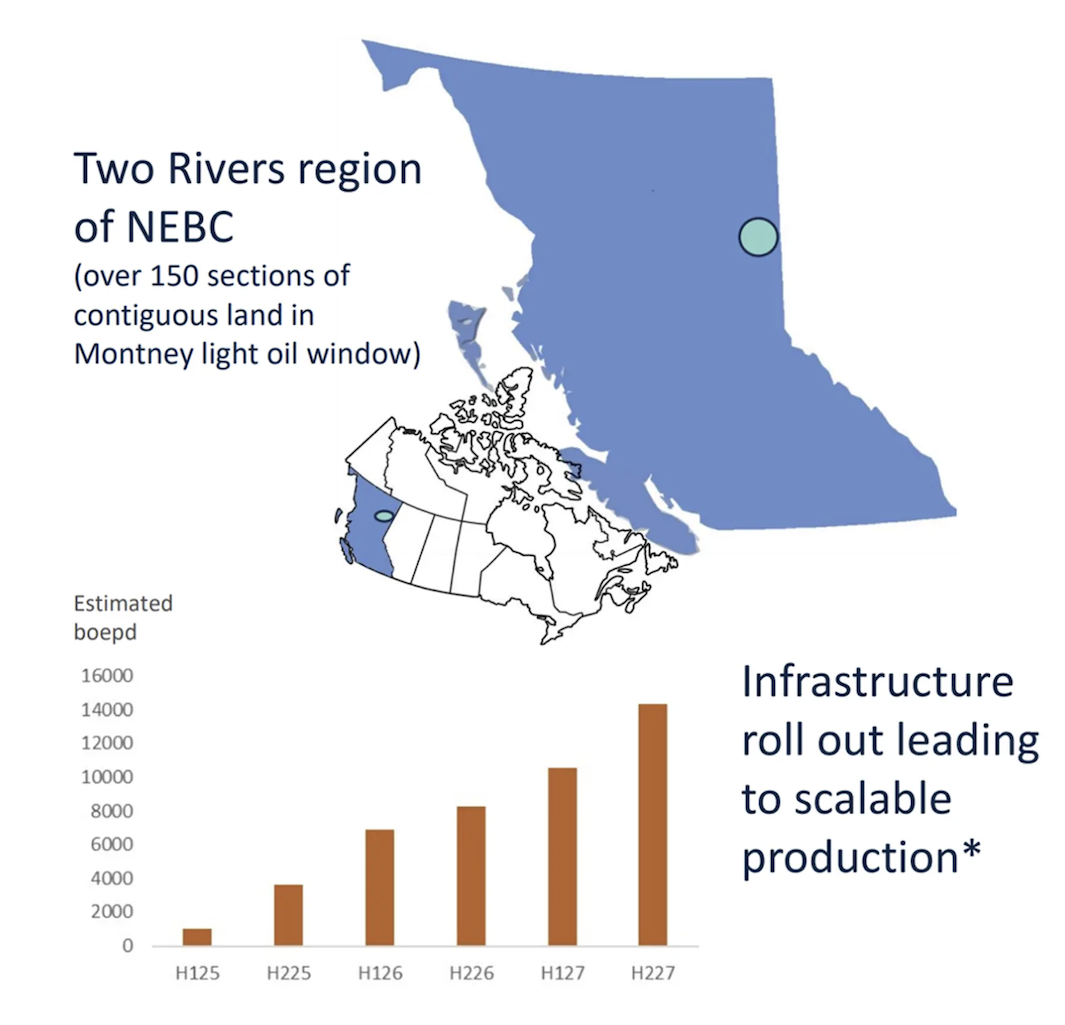
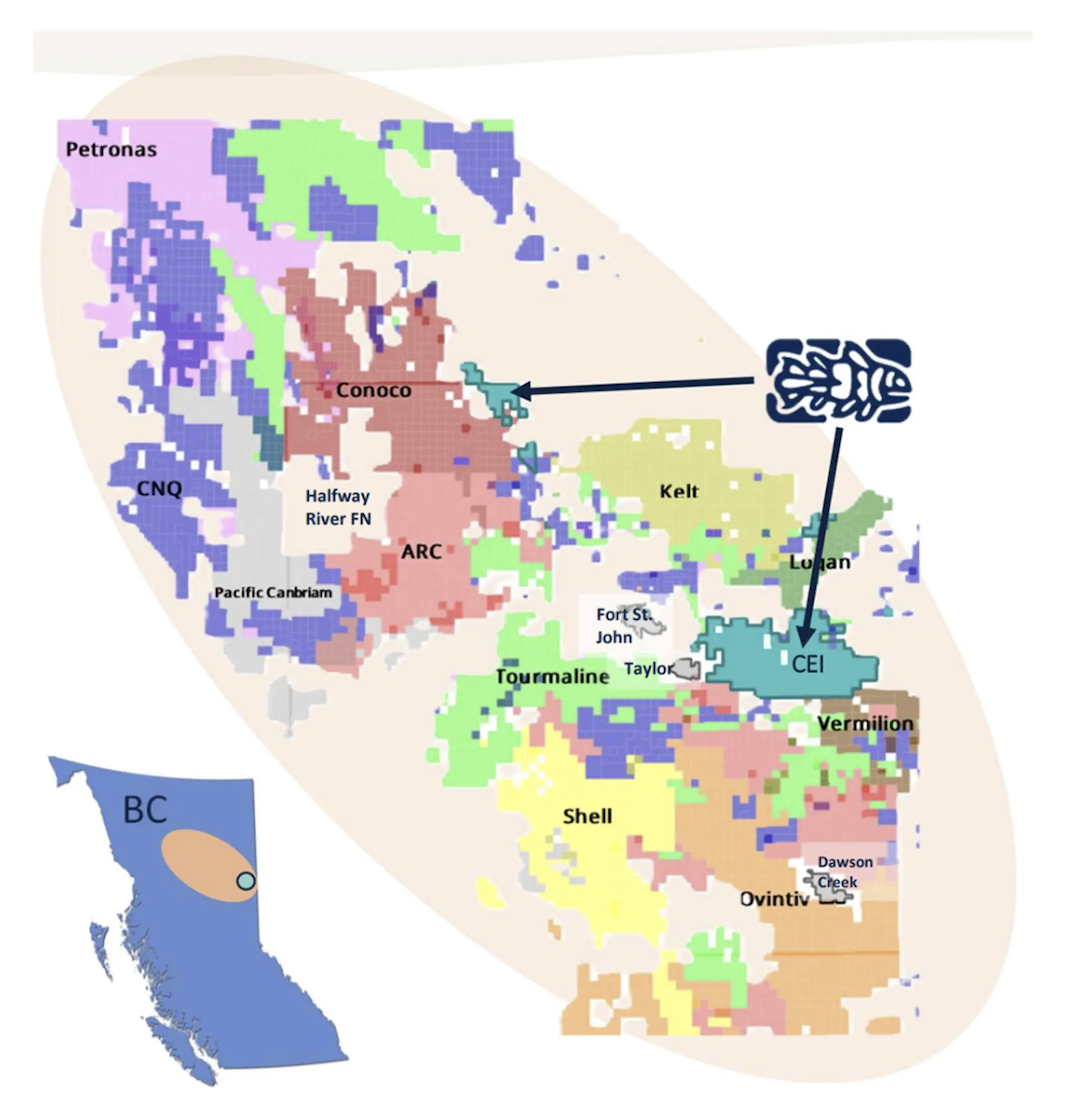
Coelacanth Energy (TSXV:CEI) is a Canadian oil and natural gas exploration and development company focused on the Montney Formation in northeastern British Columbia. The company controls over 150 contiguous sections in the Two Rivers region, a strategically positioned acreage block within the Montney light oil window. As one of the largest landholders in this highly prospective area, Coelacanth has assembled a large-scale resource platform with significant development potential.
The company’s asset base is supported by substantial petroleum initially-in-place estimates prepared by GLJ. These include 6.9 billion barrels of discovered oil PIIP and 8.3 billion barrels of undiscovered oil PIIP, alongside 5.9 Tcf of discovered gas PIIP and 7.1 Tcf of undiscovered gas PIIP. The resource spans multiple Montney intervals, including the Upper, Lower, Basal and Middle Montney, providing extensive opportunities for future development and delineation.
Coelacanth’s strategy combines near-term production growth with long-term resource value creation. The company has secured critical infrastructure, contracted gas takeaway and processing capacity, and advanced development activities across its Two Rivers assets. Average production reached 7,632 boe/d in Q2 2026, reflecting continued progress in transitioning from delineation and infrastructure buildout toward scalable production growth.
A key differentiator for Coelacanth is its leadership team. Management has successfully built and sold six previous public energy companies and has demonstrated an ability to create value through multiple commodity cycles. Supported by deep operational, geological and financial expertise, the team is focused on disciplined execution of the company’s Montney growth strategy.
Company Highlights
- Premier Montney land position: Controls over 150 contiguous sections in the Two Rivers region of northeastern British Columbia, making Coelacanth the largest landholder in the Montney light oil window.
- Substantial hydrocarbons in place: GLJ estimates 6.9 billion barrels of discovered oil PIIP, 8.3 billion barrels of undiscovered oil PIIP, 5.9 Tcf of discovered gas PIIP, and 7.1 Tcf of undiscovered gas PIIP across the company’s Montney acreage.
- Infrastructure-led growth strategy: Key infrastructure, including facilities, pipelines, processing agreements and gas takeaway capacity, has been secured to support scalable production growth.
- Growing production base: Average production reached 7,632 boe/d in Q2 2026, supported by ongoing development at the Two Rivers project.
- Multiple productive Montney horizons: The asset base includes the Upper, Lower, Basal and Middle Montney intervals, providing extensive development opportunities across multiple zones.
- Strong market access: Secured 100 mmcf/d of gas takeaway capacity and up to 60 mmcf/d of processing capacity, with access to major pipeline networks and potential LNG Canada connectivity through Coastal GasLink.
- Proven value-creation team: Management has built and sold six successful energy companies and brings extensive operational, technical and financial expertise to Coelacanth’s development strategy.
Key Project
Two Rivers Montney Development
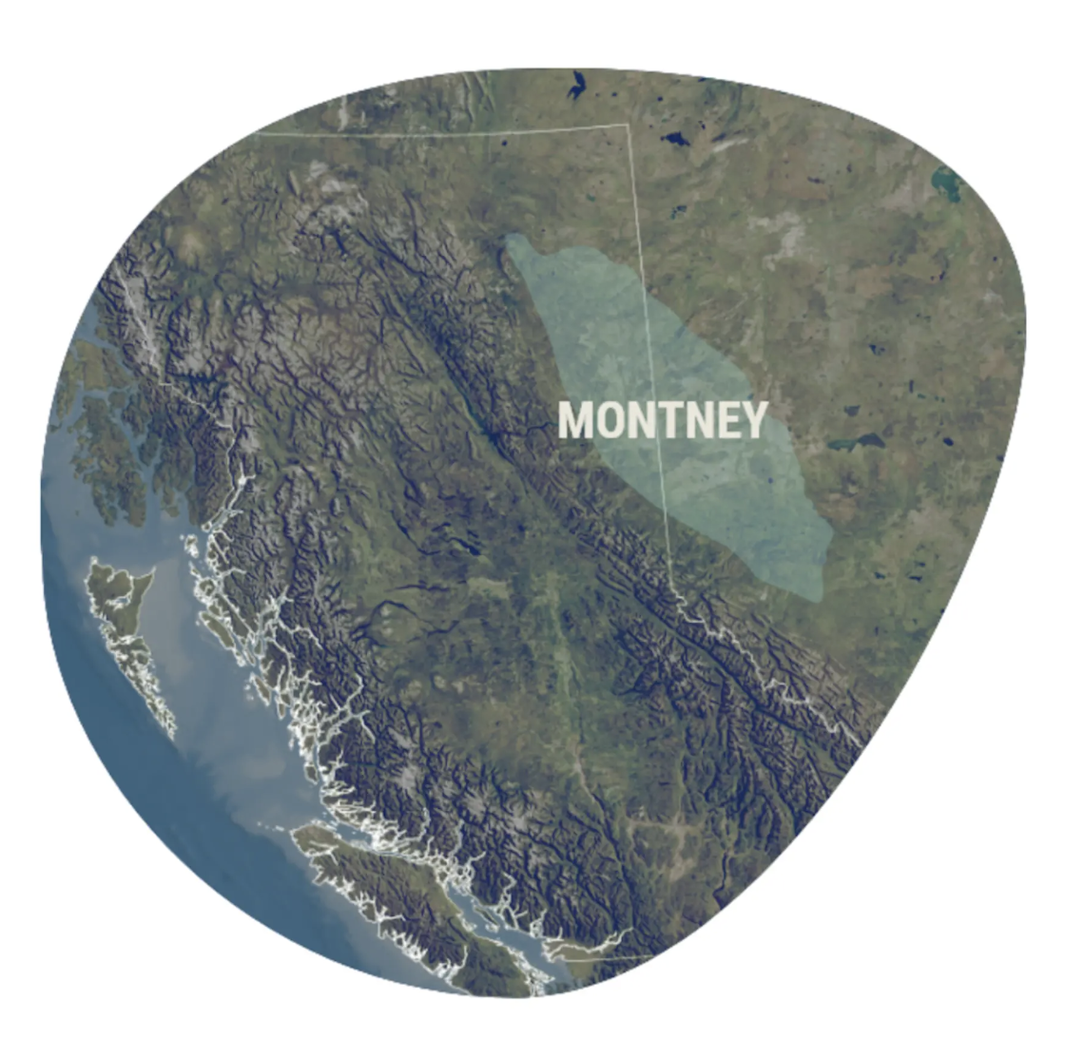
The Two Rivers project forms the cornerstone of Coelacanth’s growth strategy and encompasses the company’s extensive Montney land position in northeastern British Columbia. The project hosts multiple productive horizons, including the Upper, Lower, Basal and Middle Montney intervals, supporting a multi-zone development approach across the acreage. Geological delineation has been completed, providing a strong technical foundation for future drilling and development.
The project has demonstrated commercial productivity through successful drilling and testing programs. Coelacanth established proof of commerciality at both Two Rivers East and Two Rivers West, while development at the 5-19 and 10-08 pads confirmed productivity across multiple Montney benches. All 12 wells on the 5-19 pad were onstream by April 1, 2026, marking a significant milestone in the project’s progression.
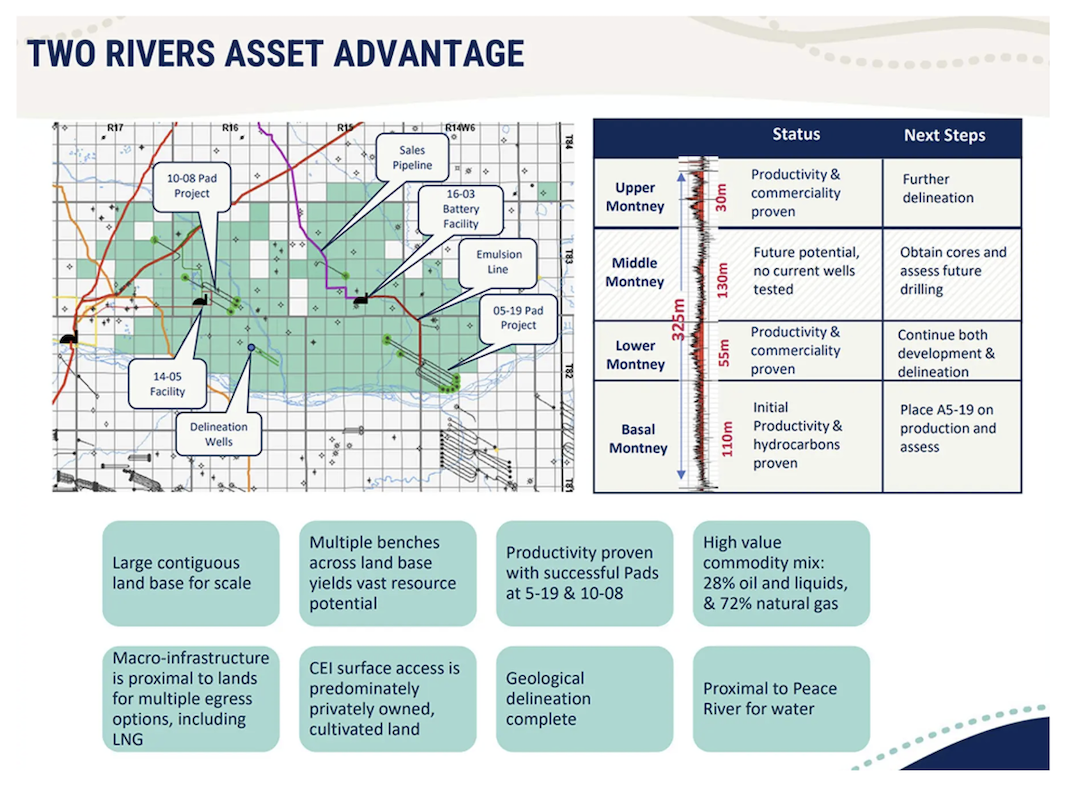
Infrastructure development has been a major focus of the company’s execution strategy. Coelacanth has secured infrastructure financing, completed key facility and pipeline construction, contracted up to 100 mmcf/d of gas takeaway capacity and secured processing capacity of up to 60 mmcf/d. These initiatives establish the infrastructure foundation required to support future production growth.
The Two Rivers asset also benefits from strong market access. The company’s production can access major regional pipeline systems, including NGTL, Westcoast and Alliance, while its acreage is directly connected to LNG Canada through the Coastal GasLink system for potential future delivery. Coelacanth Energy said the long-term view for LNG expansion in British Columbia is very positive for its land, believing that lands with scale and direct access as such will trade at a premium once they are delineated and the resource is proven for development.
Combined with a commodity mix of approximately 31 percent oil and liquids and 72 percent natural gas, the project offers exposure to multiple energy markets.
Management Team
Rob Zakresky – President, CEO and Director
Rob Zakresky is a veteran energy executive who previously served as president and CEO of Leucrotta Exploration, Crocotta Energy, Chamaelo Exploration, Chamaelo Energy, Viracocha Energy and Bellator Exploration. He has a proven track record of building and monetizing public energy companies and leads Coelacanth’s strategic growth and value creation initiatives.
Nolan Chicoine – Vice President of Finance and CFO
Nolan Chicoine previously served as CFO and vice-president finance at Leucrotta Exploration, Crocotta Energy and Chamaelo Exploration, and was controller at Chamaelo Energy and Viracocha Energy. He is responsible for financial strategy, reporting and capital management.
Jody Denis – Vice President of Operations
Jody Denis is a former drilling, engineering and operations engineer at Leucrotta Exploration. His previous experience also includes senior operational and drilling leadership roles with Black Swan Energy, ARC Resources and Birchcliff Energy. He formerly led Coelacanth Energy’s drilling and completions activities.
John Fur – Vice President of Geosciences
John Fur previously served as manager of exploration at Leucrotta Exploration and held senior geophysical positions with Crocotta Energy, Chamaelo Energy, Viracocha Energy, Canadian Natural Resources, Post Energy, Amber Energy and Husky Oil. He oversees geological evaluation and resource delineation across the company’s Montney assets.
Jonathon Hanson — Vice President of Engineering
Jonathon Hanson has 20 years of industry experience. He previously served as manager for exploitation at Spartan Dela Corp, and was a senior exploitation engineer for companies Vermilion Energy, Lynx Energy and Saguaro Resources. He will focus on exploitation and reservoir management for Coelacanth Energy.
Investor Insight
Syntholene Energy is advancing a proprietary synthetic fuel production platform designed to produce high-performance, low-cost synthetic hydrocarbons using renewable electricity, geothermal heat and captured carbon. Following successful prototype-scale validation in 2022, the company is now operating its Iceland demonstration facility as it plans commercial-scale production capable of serving aviation, transportation, industrial energy and other hard-to-abate fuel markets.
Overview
Syntholene Energy ((TSXV:ESAF,FSE:3DD0, OTC:SYNTF) is a synthetic fuel production company company focused on developing high-performance, low-cost synthetic liquid fuels. The company is commercializing its proprietary Hybrid Thermal Production System, which combines renewable electricity, geothermal heat, water and captured carbon to produce synthetic hydrocarbons that can serve as direct replacements for conventional petroleum-derived fuels.
Unlike many alternative energy solutions that require extensive changes to existing infrastructure, synthetic fuels can be transported, stored and utilized through today’s fuel supply chains. The resulting fuels are molecularly pure, free from many contaminants associated with conventional fuels and compatible with existing engines, turbines, storage systems and transportation infrastructure. Produced using renewable electricity, hydrogen and captured carbon, the fuels can deliver over 90 percent lower lifecycle emissions while maintaining the energy density and performance characteristics required across multiple industries.
At the core of the company’s platform is its Hybrid Thermal Production System, which combines high-temperature solid oxide electrolysis with industrially proven fuel synthesis reactors. By incorporating low-cost thermal energy into critical production stages, Syntholene seeks to reduce electricity consumption, the largest cost component for most eFuel producers. This approach underpins the company’s targeted 70 percent cost advantage relative to competing technologies and supports its objective of producing cost-competitive synthetic fuels at commercial scale.
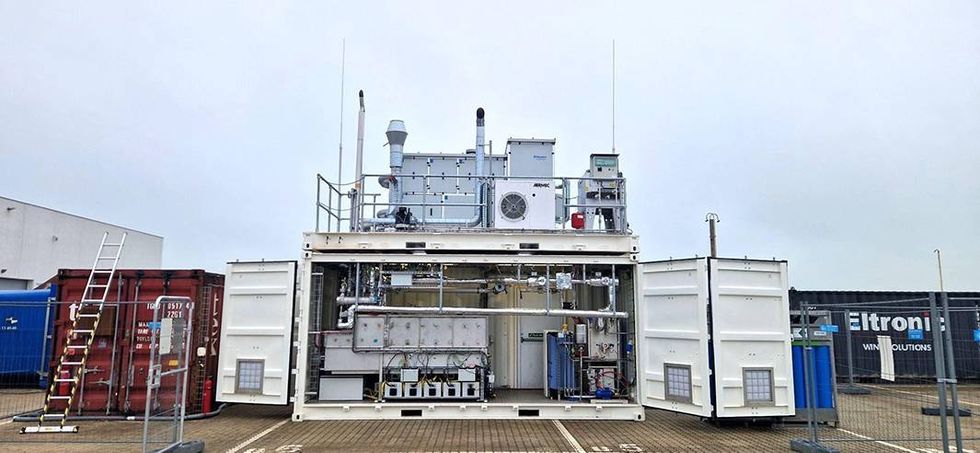
The technology builds upon advancements in high-temperature electrolysis, including work undertaken at Idaho National Laboratory. Following successful prototype-scale validation in 2022, Syntholene is progressing toward field-scale demonstration in Iceland. The company believes a successful demonstration will support future commercial deployment across a range of synthetic fuel applications.
Market demand for low-emission liquid fuels continues to expand across multiple sectors. Sustainable aviation fuel represents Syntholene’s initial commercial focus, supported by increasing airline decarbonization commitments, regulatory mandates, and fuel-blending requirements. Beyond aviation, the broader global eFuel market is projected to grow from US$8.89 billion in 2024 to more than US$215 billion by 2032, creating opportunities across transportation, shipping, industrial energy, and other sectors that depend on liquid hydrocarbon fuels.
Syntholene’s leadership team combines expertise across climate technology, synthetic fuels, industrial engineering, energy infrastructure, project development and resource industries. Recent additions to the advisory board, including former Shell and Suncor executive Marc Mageau and energy industry veteran HY Lee, further strengthen the company’s capabilities as it advances toward commercialization.
Company Highlights
- Addressing a multi-layered growth opportunity: The company is initially targeting sustainable aviation fuel while developing a technology platform capable of serving a substantially larger global liquid fuels market spanning transportation, industrial energy and other hard-to-electrify sectors.
- Proprietary hybrid thermal production system: Syntholene’s technology integrates high-temperature solid oxide electrolysis with industrially proven fuel synthesis reactors, utilizing both electricity and thermal energy to improve efficiency and reduce production costs.
- Targeting a 70 percent cost advantage: By introducing low-cost thermal energy into critical stages of production, the company aims to produce synthetic fuels at 70 percent lower cost than competing eFuel technologies.
- Pathway to cost-competitive synthetic fuels: The company believes its technology provides a credible pathway toward producing synthetic fuels that can compete economically with conventional petroleum-derived fuels at scale.
- High-performance fuel characteristics: Synthetic fuels are molecularly pure and free from many contaminants associated with conventional fuels, including sulfur, nitrogen and heavy metals, while remaining compatible with existing infrastructure.
- Over 90 percent lower lifecycle emissions: Synthetic fuels produced from renewable electricity, hydrogen and captured carbon can deliver over 90 percent lower lifecycle emissions than conventional alternatives.
- Prototype validation completed: The company’s production process was successfully demonstrated at prototype scale in 2022 and is now operating a world-first geothermally-integrated demonstration facility in Husavik, Iceland.
- Demonstration facility advancing ahead of schedule: The Húsavík, Iceland facility is now operating, with efficiency and technoeconomic results expected in Q4 2026.
- Strategic geothermal platform: The Iceland project benefits from low-cost geothermal electricity, thermal energy, industrial infrastructure, deep-water port access and an existing 200 MW+ regional grid expansion permitting framework.
- Scalable commercial development strategy: Following demonstration, the company intends to advance a 20,000-tonne-per-year commercial facility design and subsequently scale production through facilities ranging from tens to hundreds of megawatts.
Flagship Project
Húsavík Demonstration Facility, Iceland
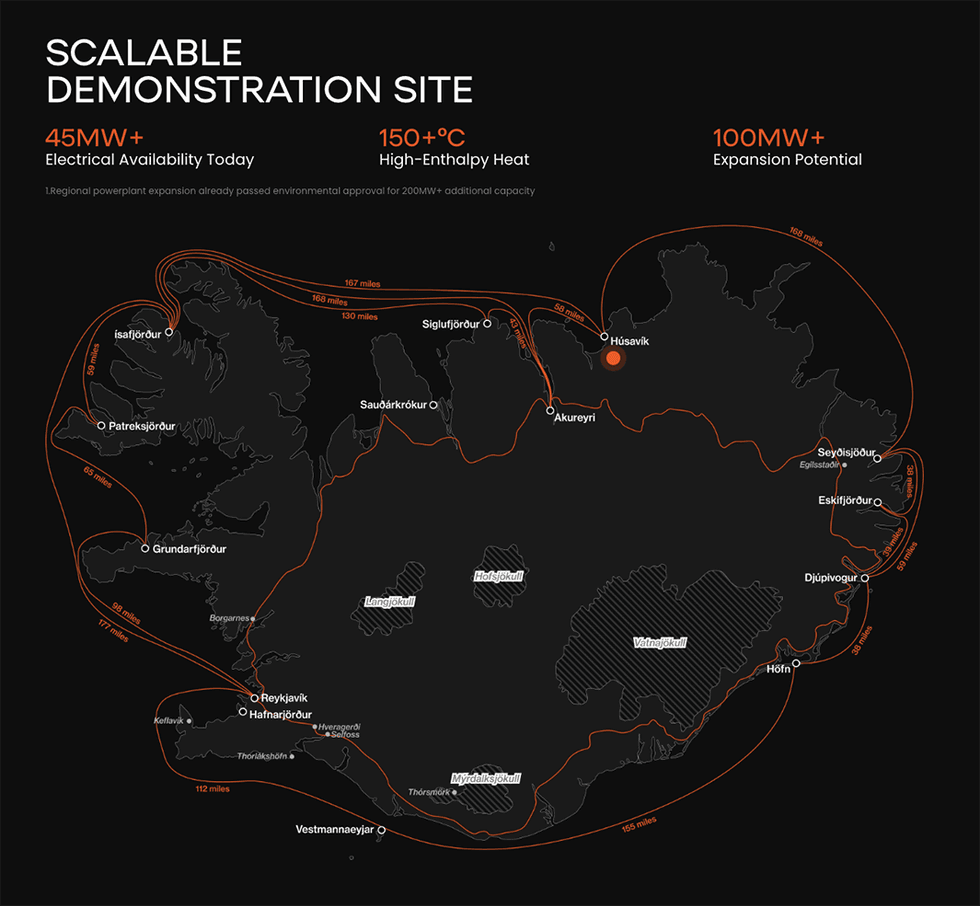
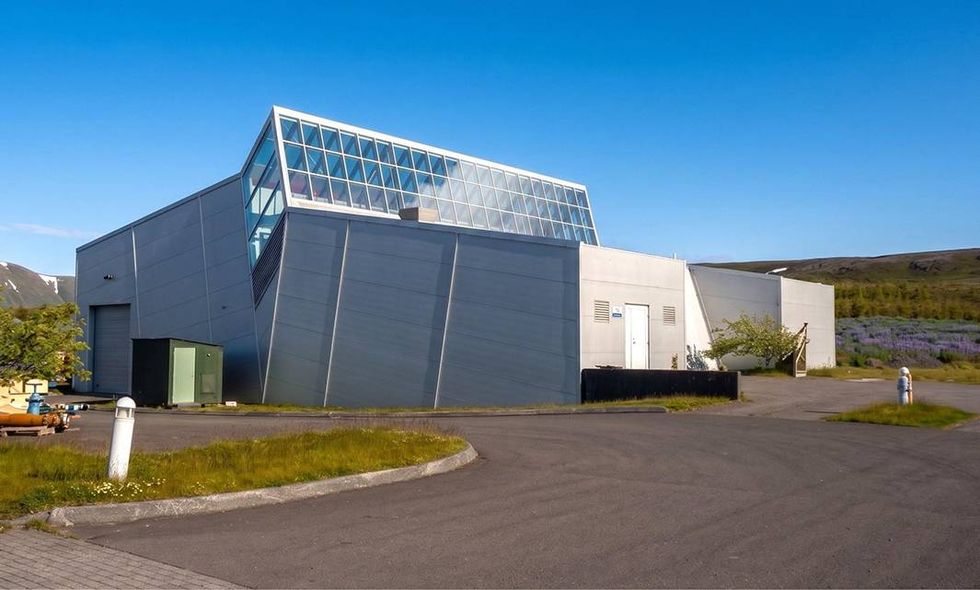
Syntholene’s flagship project is its geothermal-integrated demonstration facility located in Húsavík, northern Iceland. The facility is designed to validate the integration of geothermal heat, high-temperature solid oxide electrolysis and synthetic fuel production technologies under real-world operating conditions. Construction has advanced six months ahead of schedule, with first operations initiated on June 22nd 20266 and efficiency and technoeconomic results expected in Q4 2026.
The project leverages northern Iceland’s abundant geothermal resources, providing access to both low-cost electricity and high-temperature steam. Unlike intermittent renewable energy sources, geothermal energy offers reliable baseload power and thermal energy that can be utilized continuously throughout the fuel production process. The location also benefits from established industrial infrastructure, a skilled workforce, proximity to a deep-water port and a favorable regulatory environment.
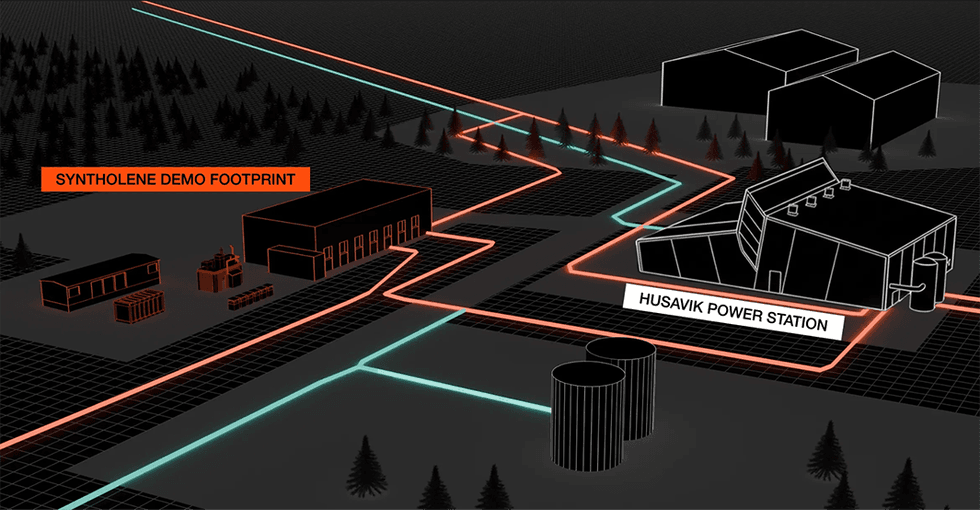
A key objective of the demonstration facility is to validate the company’s thermal integration strategy and confirm that efficiencies achieved during laboratory and prototype testing can be replicated under commercial operating conditions. The facility incorporates Syntholene’s proprietary Thermal Coupling technology, which converts geothermal steam into high-purity industrial steam suitable for use throughout the fuel production process. Management believes this technology is central to achieving the targeted 70 percent cost advantage relative to competing synthetic fuel pathways.
The project also benefits from significant expansion potential. Iceland has completed environmental permitting associated with a 200 MW regional grid expansion, supporting future industrial development in the region. Following a successful demonstration, Syntholene intends to advance a 20,000-tonne-per-year commercial facility design and subsequently scale production through facilities ranging from tens to hundreds of megawatts. Management believes the Húsavík location alone has the potential to support development capable of generating approximately US$500 million in annual revenue.
Management Team
Dan Sutton – Chief Executive Officer
Dan Sutton has spent the last 15 years founding and leading sustainable infrastructure businesses. As founder and CEO of Tantalus Labs, he designed, built and operated SUNLAB, scaled the company to 150 employees and grew annual revenue to approximately US$20 million. His expertise spans infrastructure deployment, project development, government relations, public markets and executive leadership.
Steve Oldham – Director
Steve Oldham is a globally recognized leader in carbon management and climate technology commercialization. As former CEO of Carbon Engineering, he helped establish direct air capture as a commercial industry and led the company through its acquisition by Occidental Petroleum at a US$1.6 billion valuation. He currently serves as CEO of Captura.
Canon Bryan – Director
Canon Bryan is a founder and company builder with more than 25 years of experience across advanced energy and resource development. He co-founded Terrestrial Energy, Uranium Energy and NioCorp and brings expertise in finance, corporate development, economic modelling and strategic planning.
John Kutsch – Chief Engineer
John Kutsch leads the integration and optimization of Syntholene’s fuel production platform. He brings more than 30 years of experience across industrial systems design, chemical processing, advanced energy technologies and reactor development, including work supporting high-temperature synthetic fuel systems.
Jack Williams – Head Engineer
Jack Williams specializes in high-temperature and high-pressure reactor systems and synthetic fuel technologies. His research at the University of Cambridge focused on electrolysis systems, catalytic reactor design, CO₂ capture and synthetic fuel production processes.
Grant Tanaka – Chief Financial Officer
Grant Tanaka has more than 15 years of senior financial leadership experience across the global natural resources sector. His background includes senior finance roles at Teck Resources, New Gold and Copper Mountain Mining, combining financial discipline with operational performance management. He was also appointed Corporate Secretary in May 2026.
Anna Pagliaro – Director
Anna Pagliaro is a senior commercial and risk management executive with extensive experience across the energy and mining sectors. Her career includes leadership positions at Vizsla Silver, Ausenco, NexGen Energy and Integra Gold, where she focused on governance, commercial strategy, negotiations and risk management.
Marc Mageau – Advisory Board Member
Marc Mageau joined the Advisory Board in June 2026. He brings more than three decades of operational leadership experience from Shell and Suncor, including expertise in refining, oil sands operations, logistics, infrastructure development and industrial asset management.
HY Lee – Advisory Board Member
HY Lee joined the Advisory Board in May 2026, adding further industrial, operational and strategic expertise as Syntholene advances toward commercial deployment of its synthetic fuel platform.
Browse Companies
MARKETS
COMMODITIES
CURRENCIES