The Conversation (0)

successphoto / Adobe Stock
Here's a quick recap of the crypto landscape for Wednesday (March 18) as of 9:00 a.m. UTC.
Get the latest insights on Bitcoin, Ether and altcoins, along with a round-up of key cryptocurrency market news.
Bitcoin (BTC) was priced at US$74,036.09, down by 1.3 percent over the last 24 hours.
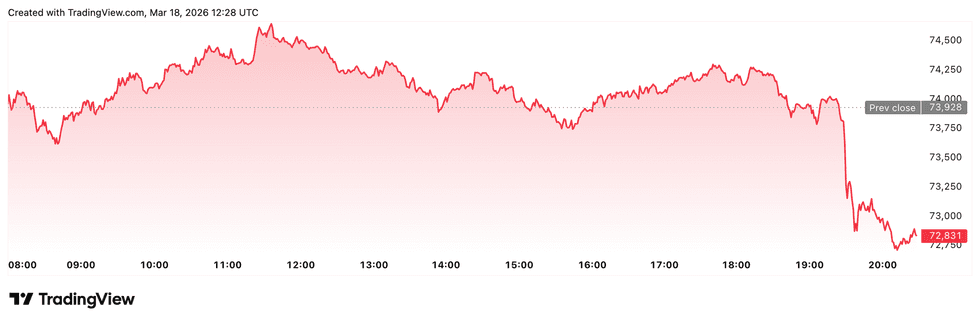
Bitcoin price performance, March 18, 2026.
Chart via TradingView.
Ether (ETH) was priced at US$2,322.44, down by 2.6 percent over the last 24 hours.
Altcoin price update
- XRP (XRP) was priced at US$1.52, down by 1.7 percent over 24 hours.
- Solana (SOL) was trading at US$94.09, down by 2.0 percent over 24 hours.
Today's crypto news to know
US regulators redefine crypto rules
US financial regulators have taken one of their clearest positions yet on digital assets, with the Securities and Exchange Commission (SEC) issuing a formal interpretation declaring that most crypto assets do not qualify as securities.
Backed by the Commodity Futures Trading Commission (CFTC), the clarification aims to resolve more than a decade of regulatory uncertaint and unclear market standards.
At the core of the guidance is a structured classification system that separates digital assets into categories such as digital commodities, collectibles, tools, stablecoins, and digital securities. This taxonomy is intended to help market participants determine which regulator has jurisdiction and what legal obligations apply.
Crucially, the interpretation acknowledges that a crypto asset may be tied to an “investment contract” at one stage, such as during fundraising, but can later transition out of securities classification once the network becomes sufficiently decentralized or functional.
“After more than a decade of uncertainty, this interpretation will provide market participants with a clear understanding of how the Commission treats crypto assets under federal securities laws. This is what regulatory agencies are supposed to do: draw clear lines in clear terms,” SEC Chairman Paul S. Atkins said in the official release.
The clarification is also expected to complement ongoing efforts in Congress to pass comprehensive crypto market structure legislation.
Mastercard to acquire BVNK in US$1.8 billion deal
Mastercard (NYSE:MA) is accelerating its expansion into digital assets with a definitive agreement to acquire stablecoin infrastructure provider BVNK in a deal valued at up to US$1.8 billion.
The company is betting that stablecoins and tokenized deposits will become a standard feature of modern financial services. With digital asset payment volumes already reaching hundreds of billions of dollars annually, Mastercard sees an opportunity to position itself at the center of this evolving ecosystem.
Through BVNK’s technology, the firm aims to provide financial institutions and fintech companies with tools to support a wide range of use cases, including cross-border remittances, peer-to-peer transfers, business payments, and real-time payouts.
The acquisition also builds on the company’s existing crypto initiatives, including partnerships with exchanges and wallet providers that allow users to spend digital assets through card networks.
Pending regulatory approval, the deal is expected to close before the end of the year.
Ripple deepens Brazil expansion
Ripple is significantly expanding its footprint in Brazil by rolling out a broader suite of services designed to meet the growing demand for institutional-grade digital asset infrastructure in Latin America.
The company announced new capabilities spanning payments, custody, liquidity management, and tokenization, positioning itself as a comprehensive platform for financial institutions operating in both traditional and blockchain-based markets.
Brazil has emerged as a strategic priority for Ripple due to its rapidly evolving regulatory environment and strong fintech adoption. The company confirmed plans to apply for a Virtual Asset Service Provider (VASP) license with the Central Bank of Brazil, aligning its operations with the country’s new digital asset framework.
Ripple’s payments network, which has processed over US$100 billion globally, is already being used by banks and fintech firms in Brazil to facilitate cross-border transactions.
Don't forget to follow us @INN_Technology for real-time news updates!
Securities Disclosure: I, Giann Liguid, hold no direct investment interest in any company mentioned in this article.
https://x.com/giannliguid
https://www.linkedin.com/in/giannliguid/