• Connect with us
    • Information
      • About Us
      • Contact Us
      • Careers
      • Partnerships
      • Advertise With Us
      • Authors
      • Browse Topics
      • Events
      • Disclaimer
      • Privacy Policy
    • WORLD EDITION
      Australia
      North America
      World
    Login
    Investing News NetworkYour trusted source for investing success
    • WORLD EDITION
      North America
      Australia
      World
    • My INN
    Videos
    Companies
    Press Releases
    Private Placements
    SUBSCRIBE
    • Reports & Guides
      • Market Outlook Reports
      • Investing Guides
    • Button
    Resource
    • Precious Metals
    • Battery Metals
    • Base Metals
    • Energy
    • Critical Minerals
    Tech
    Life Science
    Oil and Gas Market
    Oil and Gas News
    Oil and Gas Stocks
    • Oil and Gas Market
    • Oil and Gas News
    • Oil and Gas Stocks

    US Commercial Crude Oil Inventories Provide the Most Days of Supply Since 1985

    Written by Kristen Moran
    |
    Mar. 19, 2015 04:00PM PST

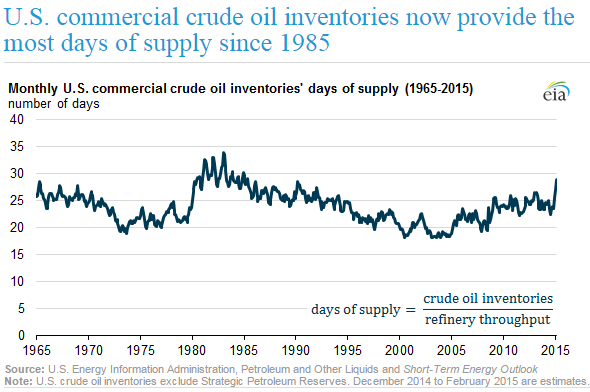
    The US Energy Information Administration reported that the U.S. commercial crude oil inventories at the end of February provided the most days of supply since the mid-1980s due to lower refinery runs and increases in domestic crude oil production.

    The US Energy Information Administration reported that the U.S. commercial crude oil inventories at the end of February provided the most days of supply since the mid-1980s due to lower refinery runs and increases in domestic crude oil production. The number of days is calculated by dividing the commercial crude oil inventory level at the end of the month by the forecast crude oil refinery runs in the following month and excludes government -held inventories.

    As quoted in the market news:

    The days-of-supply calculation is an indicator of how loose or tight oil markets are by showing the number of days current commercial inventories will last given the future consumption rate at refineries. Refinery runs (or throughput) are the amount of crude oil that refineries process and are used as a proxy to measure the consumption rate.

    Commercial crude oil inventories across all Organization for Economic Cooperation and Development (OECD) countries are also high, but to a lesser extent than U.S. inventories considered alone. OECD crude oil inventories in January were sufficient to supply almost 28 days of OECD crude oil demand. However, unlike in the United States, OECD inventories have exceeded 28 days of supply in several months over the previous two years.

    Click here to read the full US Energy Information Administration report.

    united states
    The Conversation (0)

    Go Deeper

    AI Powered

    2012 Oil Market Outlook

    Natural Gas Prices Under Pressure, but Could Recover Later This Year

    Latest News

    Westport to Issue Q1 2026 Financial Results on May 14, 2026

    Alvopetro Announces Q1 2026 Financial Results and Details for Our Upcoming AGM

    Angkor Resources Identifies Copper Drill Targets Adjacent To Canada Wall Copper Porphyry Project, Cambodia

    CHARBONE Annonce la Nomination de Gregory Fourel au Conseil d'Administration

    CHARBONE Announces the Appointment of Gregory Fourel to the Board of Directors

    More News

    Outlook Reports

    Resource
    • Precious Metals
      • Gold
      • Silver
    • Battery Metals
      • Lithium
      • Cobalt
      • Graphite
      • Electric Vehicles
    • Agriculture
    • Base Metals
      • Copper
      • Nickel
      • Zinc
    • Critical Metals
      • Rare Earths
    • Energy
      • Uranium
      • Oil and Gas
    Tech
      • Artificial Intelligence
      • Cybersecurity
      • Robotics
      • Crypto
      • Cleantech
    Life Science
      • Biotech
      • Cannabis
      • Pharmaceuticals

    Featured Stocks

    More featured stocks

    Browse Companies

    Resource
    • Precious Metals
    • Battery Metals
    • Energy
    • Base Metals
    • Critical Metals
    Tech
    Life Science
    MARKETS
    COMMODITIES
    CURRENCIES