The Conversation (0)
Aleksandr Rybalko / Shutterstock
Phosphate is mainly used in the form of fertilizer for crops and animal feed supplements. Only 5 percent of world phosphate production is used for other applications, such as corrosion prevention and detergents.
In its 2026 Mineral Commodity Summary, the US Geological Survey (USGS) states that global production of phosphate rock grew in 2025, totaling 250 million metric tons, while demand rose slightly as well.
"World consumption of P2O5 contained in fertilizers was estimated to have been 47.8 million tons in 2025 compared with 47.1 million tons in 2024," the USGS reported. "World consumption of P2O5 in fertilizers was projected to increase to 51.5 million tons by 2029. The leading regions for growth were expected to be Asia and South America."
Prices for the fertilizer mineral have been elevated over the past few years, due to supply disruptions during the COVID-19 pandemic in 2020 and Russia's invasion of Ukraine in 2022.
Phosphate prices have climbed even higher in 2026, and in April the average price of diammonium phosphate fertilizer rose above US$700 after exports of phosphate rock and sulfuric acid, a key refining component, were impacted by the closure of the Strait of Hormuz following the US-led war in Iran.
This list of the top phosphate countries by production is based on data from the USGS. Those interested in the phosphate mining sector will want to keep an eye on phosphate production data and mining companies in these countries.
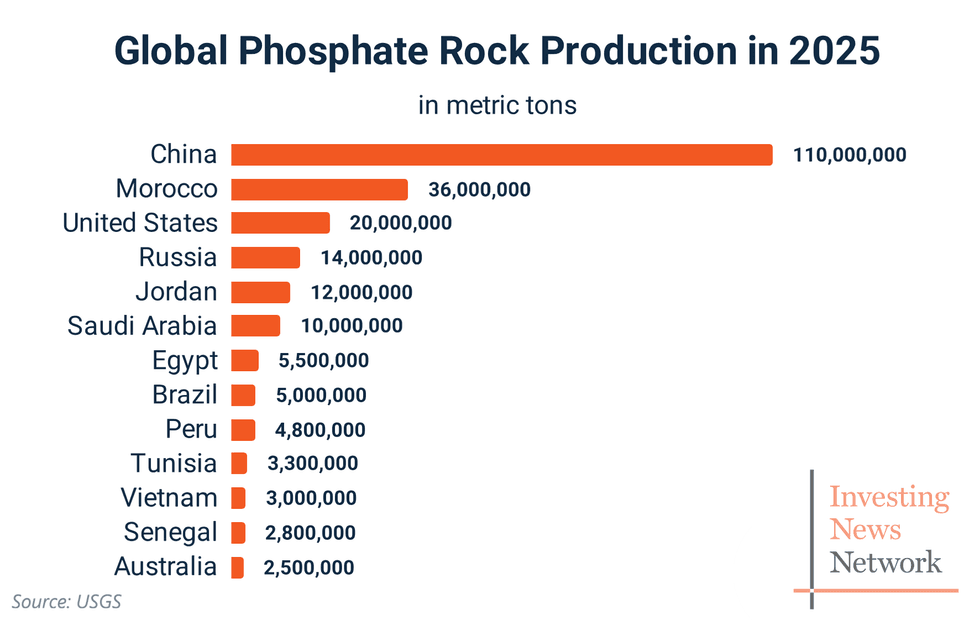
1. China
Phosphate production: 110 million metric tons
Phosphate reserves: 3.4 billion metric tons
China’s phosphate production totaled 110 million metric tons in 2025, accounting for 44 percent of global production. While China is far and away the world's top phosphate-producing country, it holds the second largest phosphate reserves in the world at 3.4 billion metric tons.
The rise in Chinese output came in despite of the nation’s environmental crackdown on the mining industry. China’s government has placed restrictions on phosphate exports in an effort to drive down domestic prices of the fertilizer with its own supply. In December 2024, China halted new export applications for phosphate due to the rising cost of sulfur. The material is critical in the separation of phosphates from rock.
The country is also the fourth largest producer of fellow fertilizer mineral potash.
2. Morocco
Phosphate production: 36 million metric tons
Phosphate reserves: 50 billion metric tons
As the second largest phosphate-producing country, Morocco produced 36 million metric tons of the fertilizer in 2025, up slightly from the 35.3 million metric tons in the previous year.
Morocco's phosphate production comes from state-owned fertilizer company OCP Group's mines, including its Khouribga and Gantour operations. Khouribga is one of the world's largest phosphate mining sites, producing 30.6 metric tons in 2025.
It is currently working to increase its production of fertilizer to 20 million metric tons and phosphate rock to 70 million tons per year by 2027.
Morocco holds the world's largest phosphate reserves by far at 50 billion metric tons, accounting for over 68 percent of total global phosphate reserves.
3. United States
Phosphate production: 20 million metric tons
Phosphate reserves: 1 billion metric tons
In 2025, US phosphate mining production totaled 20 million metric tons, up slightly by 600,000 metric tons from the previous year.
The nation's 10 producing phosphate mines are located across four states: Florida, North Carolina, Idaho and Utah. The two largest phosphate mining companies in the US are Mosaic (NYSE:MOS) and Nutrien (TSX:NTR).
Global giant Mosaic's US phosphates operations comprise three producing mines in Florida: Four Corners, South Fort Meade and Wingate. The mines produced a combined 9.5 million metric tons of phosphate rock last year.
Nutrien operates the Aurora mine in North Carolina and White Springs mine in Utah. In 2025, the mines produced 6.05 million metric tons of phosphate rock, with 4.66 metric tons of that coming from Aurora.
Most phosphate rock mined in the US is used for manufacturing phosphoric acid and superphosphoric acid, according to the USGS. These types of wet-process phosphate products are used for ammonium phosphate fertilizers and animal feed supplements. About a quarter of this is exported in the form of merchant-grade phosphoric acid, upgraded granular diammonium and monoammonium phosphate fertilizer, as well as other fertilizer products.
4. Russia
Phosphate production: 14 million metric tons
Phosphate reserves: 2.4 billion metric tons
Russia produced 14 million metric tons of phosphate in 2025, down by 400,000 metric tons from the previous year. Russia's phosphate reserves total 2.4 billion metric tons. Russia is also the second largest producer of potash.
A significant portion of Russia's phosphate is produced by PhosAgro subsidiary Apatit from apatite minerals at the Khibiny deposit, which is located east of Finland in Russia's Kola Peninsula. Phosphate operations are also found in Perm Krai at the Oleniy Ruchey apatite mine and processing facility owned by the Acron Group's North-Western Phosphorous Company.
European nations were previously Russia's biggest phosphate customers in the global market, but the country's war in Ukraine initially had an impact, directly influencing phosphate prices. Because of challenges reaching European markets, Russian phosphate exports were supported through increases in shipments to countries including India and Brazil.
Russia has implemented restrictions on fertilizer exports to prioritize domestic supply. The most recent extension to the restrictions, announced in April, places a limit of 20 million metric tons between June 1 and November 30. While this will mainly affect exports of nitrogen fertilizers and ammonium nitrate, it also extends to phosphate and potash fertilizers.
5. Jordan
Phosphate production: 12 million metric tons
Phosphate reserves: 820 million metric tons
Jordan’s phosphate production came in at 12 million metric tons in 2025, rising 500,000 metric tons from the previous year. Jordan's phosphate reserves stand at an estimated 820 million metric tons.
The country’s sole phosphate producer is state-owned Jordan Phosphate Mines Company, which operates as a phosphate miner and fertilizer producer. The company bills itself as the second largest phosphate exporter and the sixth largest producer of phosphate in the world, with combined production capacity between its three mines exceeding 11 million metric tons of phosphate annually.
6. Saudi Arabia
Phosphate production: 10 million metric tons
Phosphate reserves: 1 billion metric tons
Saudi Arabia produced 10 million metric tons of phosphate in 2025, and holds 1 billion metric tons of phosphate reserves. The Saudi Arabian Mining Company, also known as Ma’aden, produces up to 5 million metric tons of concentrated phosphate rock per year.
The Wa’ad Al Shamal Minerals Industrial City, an integrated phosphate fertilizer production complex, is a US$8 billion joint venture investment between Ma’aden at 85 percent, and chemical manufacturer Saudi Basic Industries (TADAWUL:2010) at 15 percent. Fertilizer giant Mosaic previously held a 25 percent stake in the operation, but the company sold its stake for US$1.5 billion to Ma'aden in January 2025.
7. Egypt
Phosphate production: 5.5 million metric tons
Phosphate reserves: 2.8 billion metric tons
Egypt’s phosphate-mining production in 2025 totaled 5.5 million metric tons in 2025, 200,000 metric tons more than in 2024. Egypt holds 2.8 billion metric tons of phosphate reserves, the third highest reserves of the mineral globally.
The phosphate company Misr Phosphate operates the Abu Tartour, the Sibaiya and the Red Sea mines, all of which host high grades of phosphate.
Egypt currently exports its phosphate as raw materials. However, in May 2026, the country announced plans to transition to manufacturing high-value fertilizer and chemical products, with the goal of both supplying domestic fertilizer demand and increasing the value of its exports.
8. Brazil
Phosphate production: 5 million metric tons
Phosphate reserves: 1.6 billion metric tons
Brazil produced 5 million metric tons of phosphate in 2025, down by 300,000 metric tons from its production in the previous year. The country hosts 1.6 billion metric tons of phosphate reserves.
Brazil has a booming agricultural sector and is one of the world's largest fertilizer consumers and importers. More phosphate production capacity in the country is expected to come online in 2027.
Mosaic is the country’s largest producer of both phosphate and nitrogen, and it also operates Brazil's only potash mine. In December 2025, the company idled its Fospar and Araxa operations for 30 days due to surging sulfur prices, and extended the curtailments by an additional 30 days in January.
In April, Mosiac announced that it was looking into divesting itself of the Araxa mining operations. The cessation of operations at Araxa is expected to reduce annual phosphate production by 1 million metric tons.
Swedish fertilizer company Eurochem launched a new US$1 billion phosphate fertilizer production facility in the State of Minas Gerais, Brazil, in April 2024. The facility has a phosphate mine and plant complex with an annual production capacity of 1 million metric tons of advanced phosphate fertilizers.
9. Peru
Phosphate production: 4.8 million metric tons
Phosphate reserves: 210 million metric tons
Peru produced 4.8 million metric tons of phosphate in 2025, matching its output from the previous year. The country holds phosphate reserves of 210 million metric tons.
About 98 percent of US phosphate imports originate from Peru, according to the USGS.
In May 2025, Peru's Miski Mayo, one of the largest phosphate producers in South America, announced a US$815 million investment in an expansion of its Bayóvar mine that would expand its mine life to 2061. This comes just a year after ProInversión led negotiations for a 10 year, US$940 million commitment to expand Fosfatos del Pacífico's Bayóvar mine in the Piura region, expected to produce an additional 2.5 million metric tons of phosphate rock annually.
10. Tunisia
Phosphate production: 3.3 million metric tons
Phosphate reserves: 2.5 billion metric tons
Tunisia’s phosphate output in 2025 totaled 3.3 million metric tons, up from the 2.8 million metric tons the previous year. Tunisia is home to the fourth highest phosphate reserves in the world at 2.5 billion metric tons.
Tunisia's phosphate industry is important to its economy, but its phosphate production had fallen significantly in the years since the 2011 revolution, which overthrew the dictatorship of Zine El Abidine Ben Ali.
The North African country has once again been rising among the ranks of the world's largest phosphate producing nations.
In 2023, Tunisia’s state-owned phosphate firm Gafsa Phosphate Company ramped up its production as part of its US$76 million investment program.
In March 2025, the government of Tunisia announced plans to increase phosphate production to 14 million metric tons by 2030 to help support the nation's economy amid rising phosphate prices.
FAQS for phosphate
What countries hold the largest phosphate reserves?
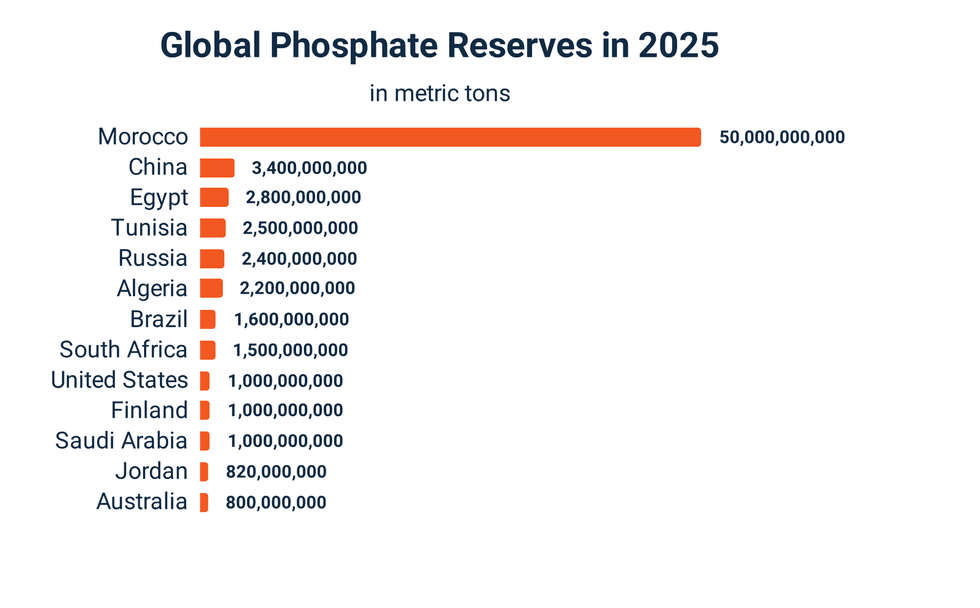
The countries with the largest phosphate reserves are Morocco, China, Egypt, Tunisia and Russia. Morocco holds the world's largest phosphate deposits; its phosphate rock reserves of 50 billion metric tons are significantly higher than those of any other country.
What are phosphates?
Phosphates are compounds that usually include phosphorous and oxygen, and can have one or more common elements, such as sodium, calcium, potassium and aluminum.
Where are phosphate compounds found?
Phosphate is mostly found in phosphate rock, a non-detrital sedimentary rock that contains high amounts of phosphate minerals. Phosphate rock can come in different forms such as quartz, calcite, dolomite, apatite, iron oxide minerals and clay minerals.
Is phosphate the same as phosphorus in fertilizer?
Phosphate is the natural source of phosphorous, which provides essential nutrients for plant growth and development.
Don’t forget to follow us @INN_Resource for real-time news updates!
Securities Disclosure: I, Dean Belder, hold no direct investment interest in any company mentioned in this article.
From Your Site Articles
- Agriculture Market Update: Q1 2026 in Review ›
- How to Invest in Phosphate ›
- Top 10 Potash Countries by Production ›
- Phosphate Mining in the US and Canada ›
Related Articles Around the Web
https://x.com/INN_Resource
https://www.linkedin.com/in/deanbelder
dbelder@investingnews.com

Featured Phosphate Investing Stocks
Learn about our editorial policies.