The Conversation (3)
- WORLD EDITIONAustraliaNorth AmericaWorld
May. 15, 2026 02:00PM PST
|Fact CheckedThis article has been reviewed and updated according to INN's rigorous fact-checking process. Our staff editors verify all articles against information and data from primary sources, reputable publishers and experts.
Explore the week's best-performing Canadian mining stocks on the TSX, TSXV and CSE, and dive into the Canadian and US news affecting commodities prices and stock markets.
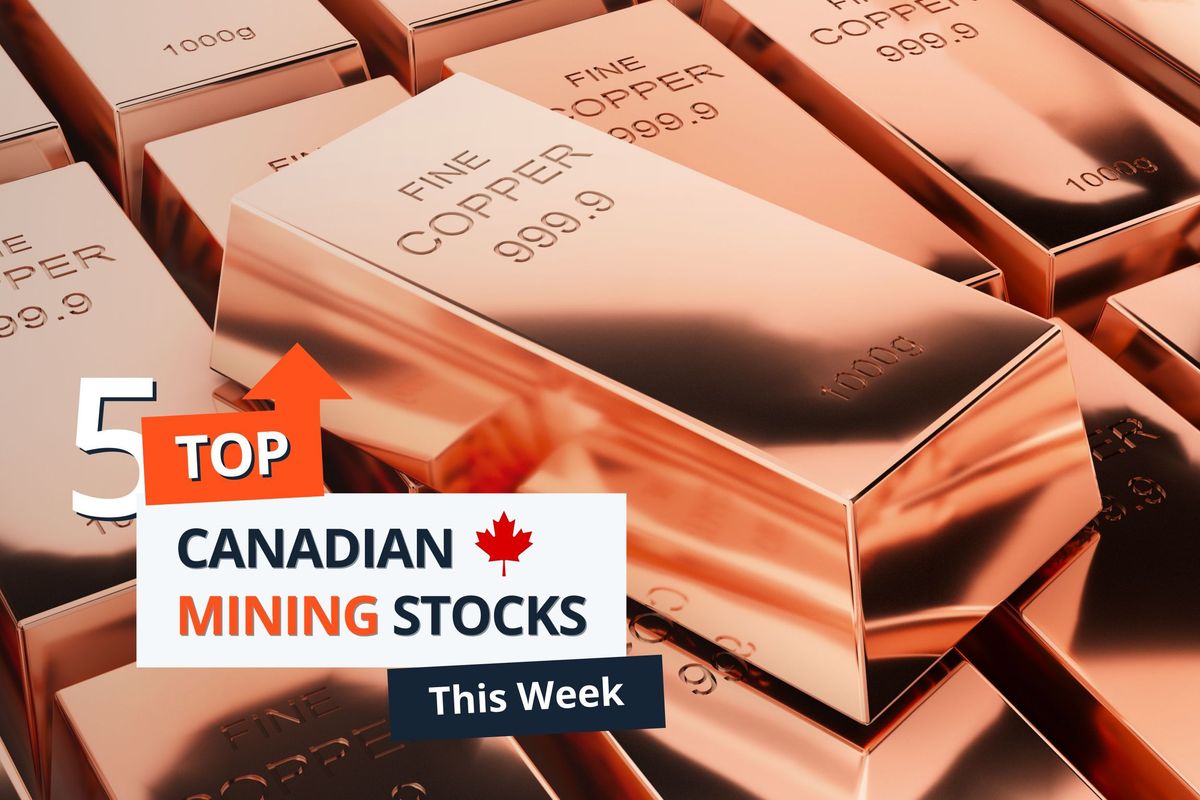
Welcome to the Investing News Network's weekly look at the best-performing Canadian mining stocks on the TSX, TSXV and CSE, starting with a round-up of Canadian news impacting the resource sector.
On Thursday (May 14) Canadian Prime Minister Mark Carney announced a new national electricity strategy. The proposal would effectively double Canada’s electrical grid capacity by 2050, with a focus on east, west and northern connections.
Additionally, the strategy would roll back some clean energy policies enacted by the Liberal government under then-Prime Minister Justin Trudeau and increase natural gas generation.
The plan is expected to cost more than C$1 trillion and will require 130,000 workers.
Carney’s announcement came on the same day that the province of British Columbia and the federal government reached an agreement over LNG Canada’s proposed Phase 2 expansion of its facility in Kitimat.
The agreement’s goals include collaborating with BC’s First Nations, creating a more competitive investment environment both provincially and federally and diversifying export markets with natural gas.
An agreement follows LNG Canada's approval of significant funding for scoping studies on May 1, as it works towards making a final investment decision on the expansion by the end of the year.
If the company decides to proceed with the project, it will be one of the largest investments into BC’s natural resource sector ever.
This week also saw some significant mergers and acquisitions in the Canadian resource sector.
On Tuesday (May 12), Keyera (TSX:KEY) closed a deal with US-based Plains All American Pipeline (NASDAQ:PAA) to acquire nearly all of Plains’ Canadian natural gas assets for US$5.3 billion.
Then, on Wednesday (May 13), Equinox Gold (TSX:EQX,NYSEAMERICAN:EQX) and Orla Mining (NYSE:ORLA) announced they had agreed to merge their businesses.
Once completed, the merger would create the second-largest gold producer in North America, with initial production of 1.1 million ounces of gold per year and a pathway to 1.9 million ounces. According to the release, it would have an implied total market cap of US$18.5 billion.
The deals are the second and third largest in the Canadian resource sector in 2026, after an April 27 agreement that would see Shell Canada (NYSE:SHEL) acquire ARC Resources (TSX:ARX,OTCPL:AETUF) for C$22 billion.
For more on what’s moving markets this week, check out our top market news round-up.
Markets and commodities react
Canadian equity markets were negative this week.
The S&P/TSX Composite Index (INDEXTSI:OSPTX) was largely flat, recording a decrease of just 0.37 percent over the week to close Friday at 33,833.35, while the S&P/TSX Venture Composite Index (INDEXTSI:JX) fell 1.3 percent to 988.81.
The CSE Composite Index (CSE:CSECOMP) slid 3.83 percent to 172.84.
The gold price lost 2.95 percent to close at US$4,546.14 per ounce on Friday at 4:00 p.m. EDT. The silver price saw similar changes, closing the week down 2.82 percent at US$76.29 on Friday.
In base metals, the Comex copper price saw significant gains mid-week, setting a record high of US$6.71 during intraday trading on Wednesday. The price moderated by the end of the week, posting a 3..08 percent increase to US$6.29 per pound.
The S&P Goldman Sachs Commodities Index (INDEXSP:SPGSCI) was up 3.61 percent to end Friday at 751.17.
Top Canadian mining stocks this week
How did mining stocks perform against this backdrop?
Take a look at this week’s five best-performing Canadian mining stocks below.
Stocks data for this article was retrieved at 4:00 p.m. EDT on Friday using TradingView's stock screener. Only companies trading on the TSX, TSXV and CSE with market caps greater than C$10 million are included. Mineral companies within the non-energy minerals, energy minerals, process industry and producer manufacturing sectors were considered.
1. Mogotes Metals (TSXV:MOG)
Weekly gain: 159.09 percent
Market cap: C$286.57 million
Share price: C$0.57
Mogotes Metals is an explorer working to advance its Filo Sur copper-gold-silver project, which straddles the border between Argentina and Chile in the Vicuña copper district.
The project covers an area of approximately 100 square kilometers and is surrounded by significant copper and gold projects, including the Lundin Mining (TSX:LUN,OTCPL:LUNMF) and BHP (ASX:BHP,NYSE:BHP,LSE:BHP) joint venture Filo Del Sol and NGEx Minerals' (TSXV:NGEX) Lunahuasi project.
The company is currently carrying out its first fully funded drill season at the project.
On Thursday, the company released assay results from the first 194 meters of a 454 meter diamond drill hole drilled during its current program at Filo Sur’s Albor target.
An 86 meter mineralized interval, which started at 108 meters of depth and ended in mineralization, showed average grades of 0.7 percent copper, 0.55 grams per metric ton (g/t) gold, 2.7 g/t silver and 169 parts per million (ppm) molybdenum, and included a 43 meter interval grading 1.1 percent copper, 0.82 g/t gold, 4 g/t silver and 281 ppm molybdenum.
Mogotes said the drill core contains mineralization with characteristics that paralleled mineralization at the Filo del Sol deposit, which is located along strike from the hole’s location.
“We have now made two significant copper-gold-silver-molybdenum discoveries at Cruz del Sur and at the Albor target, where we have just scratched the surface of something we believe will be significant,” Mogotes President and CEO Allen Sabet said.
2. Blende Silver (TSXV:BAG)
Weekly gain: 107.41 percent
Market cap: C$22.79 million
Share price: C$0.28
Blende Silver is an exploration company working to advance its flagship Blende zinc, lead and silver project in the Yukon, Canada.
The property consists of 260 quartz mining claims covering a total area of 5,346 hectares in the Keno Hill silver district. Exploration work since the 1980s has identified numerous deposits, including the West zone, along a 6 kilometer corridor.
Blende holds the Yukon’s largest carbonate-hosted silver-zinc-lead deposit. According to an updated resource estimate from May 2021, the project’s indicated resource includes in-situ metal content of 187 million pounds of zinc, 167 million pounds of lead and 4.53 million ounces of silver from 4.64 million metric tons of ore grading 1.82 percent zinc, 1.63 percent lead and 30.32 g/t silver.
Its inferred resources are estimated at 1.71 billion pounds of zinc, 1.51 billion pounds of lead and 37.32 million ounces of silver from 42.24 million metric tons grading 1.83 percent zinc, 1.62 percent lead and 27.48 g/t silver.
Blende has not released news since April 27, when it announced it would be carrying out a comprehensive geoscience program at the site following a review of 3D induced polarization survey of the property.
“The 3D IP survey appears to have delivered a clear calibration at the West Zone while revealing multiple untested chargeability anomalies in the Lower Central and New Mountain Top areas that are notably larger in scale than the West Zone response,” Blende President and CEO Andrew H. Rees said.
3. First Tellurium (CSE:FTEL)
Weekly gain: 68.09 percent
Market cap: C$35.61 million
Share price: C$0.395
First Tellurium is a vertically integrated exploration, development and technology company.
It holds a 50 percent interest in the Deer Horn property in West-central British Columbia, Canada, and the option to acquire the Klondike project in Colorado, US.
Deer Horn spans 5,133 hectares and hosts mineralization containing silver, gold and tellurium. A June 2018 preliminary economic assessment for the property reported an after-tax net present value of C$36.5 million, an internal rate of return of 42 percent, and a payback period of 1.6 years at a base gold price of US$1,300 per ounce.
First Tellurium is preparing for a 2026 diamond drill program at Deer Horn, according to the company's management discussion and analysis released on March 17. The program is being designed to test targets identified during an induced polarization survey conducted in 2024, while potentially expanding known mineralization at the property.
In addition to its mineral property, the company owns an 85 percent interest in its subsidiary PyroDelta, which produces flat- and tubular-thermoelectric generators for drones intended for industrial and defense applications.
The most recent news from its projects came on May 5, the company announced it would be participating in the US Defense Advanced Research Projects Agency (DARPA) Lift Challenge for drone innovation from August 2 to 9. The goal of the challenge is for a drone to lift twice its own weight.
This marks the second week in a row that First Tellurium lands in INN’s top 5 stocks of the week. The company acknowledged on Friday that it has seen increased media attention for its PyroDelta subsidiary, highlighting growing interest in its technologies.
4. Visionary Copper and Gold (TSXV:VCG)
Weekly gain: 64.18 percent
Market cap: C$20.89 million
Share price: C$1.10
Visionary Copper and Gold is an exploration company with a trio of projects in Canada. Its primary focus has been on its 262 hectare Point Leamington volcanogenic massive sulphide project in Newfoundland and Labrador.
Exploration work at the site began in 1953 by Newmont (NYSE:NEM,ASX:NEM) and has been carried out by various companies since, with Visionary taking over upon acquiring the asset in 2016.
A 2021 study determined an indicated mineral resource of 145,700 ounces of gold, 2 million ounces of silver and 60 million pounds of copper from 5.01 million metric tons of ore grading 0.9 g/t gold, 12.2 g/t silver and 0.54 percent copper.
An additional total inferred resource was estimated at 420,200 ounces of gold, 7.6 million ounces of silver and 123.5 million pounds of copper from 15.44 million metric tons grading 0.85 g/t gold, 15.3 g/t silver and 0.36 percent copper.
The most recent exploration results from the Point Leamington project came on Wednesday, when Visionary reported it encountered wide intersections of copper and gold at the new Kraken zone, including one hole intersecting average grades of 0.45 percent copper over 75.8 meters. The company said that all holes testing the zone encountered mineralization and that it was open in all directions.
On Thursday, Visionary announced that the Quaternary Group, headed by Ross Jennings, is now a significant shareholder in the company after Quaternary increased its stake in Visionary from 9.93 to 10.36 percent. “The Quaternary Group has a well-earned reputation for backing high-conviction critical-minerals stories with patient, long-term capital,” Visionary President and CEO Max Porterfield said.
5. Copper Fox Metals (TSXV:CUU)
Weekly gain: 45.45 percent
Market cap: C$375.2 million
Share price: C$0.80
Copper Fox Metals is a copper-focused exploration and development company with assets located in Canada and the US. Copper Fox’s primary projects include the Schaft Creek joint venture and its wholly owned Van Dyke copper project.
The company holds a 25 percent stake in the Schaft Creek copper porphyry project in Northwest BC, with the remainder being held by Teck Resources (TSX:TECK.A,TECK.B,NYSE:TECK).
A September 2021 preliminary economic assessment estimated the project's economics at an after-tax net present value of US$842 million, an internal rate of return of 12.9 percent, and a payback period of 4.4 years.
The Van Dyke copper oxide project is located within the Globe-Miami copper district of Arizona, US, and the company is considering near-term production using in-situ copper recovery. According to a December 2020 preliminary economic assessment, the brownfield project has an after-tax net present value of US$644.7 million, an internal rate of return of 43.4 percent and a payback period of 2.1 years.
On April 21, the company reported that it is currently working on updates to Van Dyke's mineral resource estimate and the preliminary economic assessment.
The most recent project news came on April 30, when Copper Fox reported that results from analysis of 11 historical diamond drill cores had been used to improve the definition of the copper envelope at Van Dyke. Results for 18 more cores are still pending. The company said the results could point to potential for increasing the asset's total soluble copper content.
FAQs for Canadian mining stocks
What is the difference between the TSX and TSXV?
The TSX, or Toronto Stock Exchange, is used by senior companies with larger market caps, and the TSXV, or TSX Venture Exchange, is used by smaller-cap companies. Companies listed on the TSXV can graduate to the senior exchange.
How many mining companies are listed on the TSX and TSXV?
As of March 2026, 906 mining companies and 71 oil and gas companies are listed on the TSXV, combining for 64 percent of the 1,524 total companies listed on the exchange.
The TSX is home to 176 mining companies and 50 oil and gas companies. The exchange has 2,149 companies listed on it in total.
Together, the TSX and TSXV host around 40 percent of the world’s public mining companies.
How much does it cost to list on the TSXV?
There are a variety of different fees that companies must pay to list on the TSXV, and according to the exchange, they can vary based on the transaction’s nature and complexity.
As of April 2026, the listing fee alone will most likely cost between C$10,000 to C$70,000, and accounting and auditing fees could rack up between C$25,000 and C$100,000. Legal fees are expected to be over C$75,000 and an underwriters’ commission may hit up to 12 percent.
The exchange lists a handful of other fees and expenses companies can expect, including but not limited to security commission and transfer agency fees, investor relations costs and director and officer liability insurance.
These are all just for the initial listing, of course. There are ongoing expenses once companies are trading, such as sustaining fees and additional listing fees, plus the costs associated with filing regular reports.
How do you trade on the TSXV?
Investors can trade on the TSXV the way they would trade stocks on any exchange. This means they can use a stock broker or an individual investment account to buy and sell shares of TSXV-listed companies during the exchange's trading hours.
Don't forget to follow us @INN_Resource for real-time updates!
Securities Disclosure: I, Dean Belder, hold no direct investment interest in any company mentioned in this article.
https://twitter.com/INN_Resource
https://www.linkedin.com/in/deanbelder
dbelder@investingnews.com

Dean has been writing in one form or another since penning stage plays in his youth. He is a graduate of both Emily Carr University and Simon Fraser University, with a BFA in photography and a BA in communications.
As a writer, Dean has traveled throughout BC and the Pacific Northwest covering cultural events, interviewing small business owners and working alongside fellow writers and photographers from publications like Rolling Stone Magazine, Spin and the Georgia Straight.
Dean has a keen interest in investing, and enjoys learning about the mining industry and better understanding the technical aspects of trading. In his spare time, Dean is an avid home chef, ponders the space-time continuum and makes his own cider. On weekends he can be found cycling the Seawall, exploring farmers markets or sampling the city’s local craft breweries.
As a writer, Dean has traveled throughout BC and the Pacific Northwest covering cultural events, interviewing small business owners and working alongside fellow writers and photographers from publications like Rolling Stone Magazine, Spin and the Georgia Straight.
Dean has a keen interest in investing, and enjoys learning about the mining industry and better understanding the technical aspects of trading. In his spare time, Dean is an avid home chef, ponders the space-time continuum and makes his own cider. On weekends he can be found cycling the Seawall, exploring farmers markets or sampling the city’s local craft breweries.
INN Article Notification
Latest News
Outlook Reports
Featured Copper Investing Stocks


Browse Companies
MARKETS
COMMODITIES
CURRENCIES
Dean has been writing in one form or another since penning stage plays in his youth. He is a graduate of both Emily Carr University and Simon Fraser University, with a BFA in photography and a BA in communications.
As a writer, Dean has traveled throughout BC and the Pacific Northwest covering cultural events, interviewing small business owners and working alongside fellow writers and photographers from publications like Rolling Stone Magazine, Spin and the Georgia Straight.
Dean has a keen interest in investing, and enjoys learning about the mining industry and better understanding the technical aspects of trading. In his spare time, Dean is an avid home chef, ponders the space-time continuum and makes his own cider. On weekends he can be found cycling the Seawall, exploring farmers markets or sampling the city’s local craft breweries.
Learn about our editorial policies.