The Conversation (1)
Minakryn Ruslan, Comet Design / Shutterstock
Copper has become a hot topic due to its role in the green energy transition and its necessity for urbanization. However, the lack of incoming supply in the long term has experts concerned.
Due to its importance in construction, energy transmission and new technologies, copper is a critical metal needed to power the future of our society. However, mined supply has not kept pace with demand, with few new operations coming online, and older mines facing decreasing grades and lower outputs.
The term “peak copper” was coined because some experts believe that copper reserves may be diminishing. According to the US Geological Survey (USGS), more than 700 million metric tons of copper have been mined throughout history.
Nearly all of that mined copper is still in circulation, as the red metal’s recycling rate is higher than that of any other engineering metal, but it is still not enough to keep up with escalating demand. As a result, it’s prudent to know the top copper reserves by country, especially when considering investing in the copper mining industry.
Current economic global copper reserves stand at 980 million metric tons.
Reserve data for this article was sourced from the USGS's 2026 Mineral Commodity Summary and supplemented with datasets from the UN Comtrade Database.
Top copper reserves by country
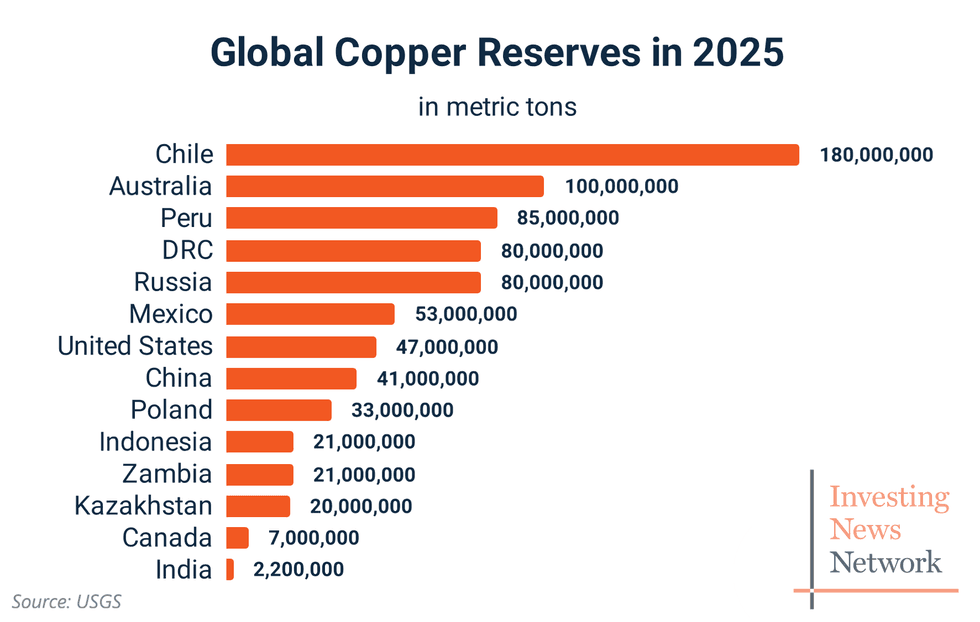
The countries with the largest copper reserves are Chile, Australia, Peru, the Democratic Republic of Congo (DRC) and Russia. These five countries hold more than 55 percent of the world’s total copper reserves and will be critical to a world with soaring demand for copper.
Read on to learn about these copper kingpins.
1. Chile
Copper reserves: 180 million metric tons
Chile holds the largest copper reserves globally at 180 million metric tons, nearly as much as Australia and Peru, the next two largest copper countries, combined. Chile is also the world's top copper producer, with its 5.3 million metric tons of copper in 2025 representing 23 percent of global output.
The mining industry is essential to the Chilean economy, making up more than 50 percent of the country's exports and contributing US$40 billion of its GDP in 2023. Copper alone accounting for more than US$29 billion of that total.
Due to the sheer quantity of copper in the country, it should come as no surprise that Chile is home to the world’s largest copper mine, Escondida. Escondida produced 1.27 million metric tons of copper in 2025 and sits atop proven and probable copper reserves of 8.68 million metric tons, according to Rio Tinto's (ASX:RIO,NYSE:RIO,LSE:RIO) 2025 annual report. The mine is a 57.5/30/12.5 joint venture between BHP (ASX:BHP,NYSE:BHP,LSE:BHP), Rio Tinto and Japan’s JECO.
2. Australia
Copper reserves: 100 million metric tons
Australian copper reserves are pegged at 100 million metric tons, making it the second largest country by copper reserves.
While the country hosts significant copper reserves, in terms of copper production, Australia takes eighth place globally with 730,000 metric tons in 2025, lagging behind the other countries on this list with similarly sized reserves.
More than a quarter of that came from BHP’s Olympic Dam mine in South Australia, which produced 221,600 metric tons of copper cathode in the 2025 calendar year. The polymetallic mine contains substantial proven and probable copper reserves totaling 10.68 million metric tons.
Another significant operation in Australia is Newmont's (TSX:NGT,NYSE:NEM,ASX:NEM) Cadia Valley mine, which hosts probable reserves of 2.9 million metric tons of contained copper. Cadia Valley produced 81,646 metric tons of copper in 2025.
The resource industry is an essential sector in Australia, and government reports expect it to contribute AU$383 billion during the 2025/2026 fiscal year, with copper accounting for AU$16 billion of that. This is expected to rise to AU$17.6 billion in 2026/2027.
3. Peru
Copper reserves: 85 million metric tons
Copper reserves in Peru stand at 85 million metric tons. Copper is an essential part of Peru’s economy, much like it is in neighbor Chile, accounting for US$28.13 billion of Peru's total US$61.85 billion in mining exports.
Peru also came in third place for copper production in 2025, producing 2.7 million metric tons of copper last year. The country is home to some of the world’s biggest mining operations, and two mines accounted for a third of its total copper output.
The top producer in the country is the Cerro Verde Complex, a 55/21/19.6 venture with Freeport-McMoRan (NYSE:FCX), Sumitomo Metal Mining (TSE:5713) and Minas Buenaventura (NYSE:BVN). Cerro Verde hosts hosts proven and probable reserves of 11.06 million metric tons of copper and produced 863 million pounds of copper metal in concentrate in 2025.
Not to be outdone, the second highest copper producing mine is Antamina, a 33.75/33.75/22.5/10 joint venture between BHP, Glencore (LSE:GLEN,OTCPK:GLCNF), Teck Resources (TSX:TECK.B,TSX:TECK.A,NYSE:TECK) and Mitsubishi (TSE:8058). Last year, output at the mine came in at 368,500 metric tons of copper in concentrate. Antamina hosts a proven and probable reserve of 4.53 million metric tons of contained copper.
The mine with the largest copper reserves in Peru is Southern Copper's (NYSE:SCCO) Toquepala mine, home to 13.62 million metric tons of copper in proven and probable reserves. The mine produced 224,870 metric tons of copper in concentrate last year.
4. Democratic Republic of Congo
Copper reserves: 80 million metric tons
Copper reserves in the Democratic Republic of Congo stood at 80 million metric tons in 2025, making it the fourth largest country by copper reserves tied with Russia. The DRC's economic copper reserves have seen a staggering rise in recent years, climbing from an estimated 19 million metric tons in 2019.
The mining sector has been critical to GDP growth in the DRC, with copper being the largest contributor. World Bank reports that the extraction sector has outpaced other segments of the DRC's economy, increasing 8 percent in 2025, led by a 10.5 percent increase in copper output which reached 3.4 million metric tons.
According to the most recent data from the United Nations, in 2023 the DRC exported US$17 billion in refined copper and unwrought alloys, a large jump from US$7.34 billion in 2019. The country's copper ore exports contributed US$2.16 billion in 2023, nearly double the US$1.11 billion four years prior.
Among the contributing factors in the rise in mining and export activity has been the development of the Lobito Corridor, which connects mineral-rich regions in Zambia, the DRC and Angola to the port at Lobito in Angola.
This link allows greater access for large-scale operations like Ivanhoe Mines (TSX:IVN) and Zijin Mining's (HKEX:2899,SHA:601899) Kamoa-Kakula complex in the Southern DRC. One of the largest copper operations in the world, Kamoa-Kakula hosts a probable reserve of 13.13 million metric tons of contained copper. The operations produced 388,838 metric tons of copper in 2025.
4. Russia
Copper reserves: 80 million metric tons
Russia's copper reserves are estimated to be 80 million metric tons, tying it with the DRC. In 2025, Russia produced 1.3 million metric tons of copper, an increase from the 1.02 million metric tons produced in 2024.
Among the main contributing factors was a ramp-up in production at Udokan Copper’s Udokan mine in Siberia, which produces 150,000 metric tons annually and, according to the mine's website, hosts a JORC-compliant copper resource of 26.7 million metric tons.
Russia has been under significant sanctions since it invaded Ukraine in February 2022, although its copper exports have not yet been sanctioned as of April 2026. According to the UN Comtrade Database, Russia's copper exports in 2021 were valued at US$5.98 billion.
Don’t forget to follow us @INN_Resource for real-time news updates!
Securities Disclosure: I, Dean Belder, hold no direct investment interest in any company mentioned in this article.
From Your Site Articles
- When Will Copper Go Up? ›
- 7 Basic Copper Facts for Investors ›
- How to Invest in Copper ›
- Top 10 Copper Producers by Country ›
- Top 10 Copper-producing Companies ›
Related Articles Around the Web
https://twitter.com/INN_Resource
https://www.linkedin.com/in/deanbelder
dbelder@investingnews.com

Featured Copper Investing Stocks




Learn about our editorial policies.