The Conversation (0)
(TheNewswire)
 | |||||||||
Vancouver, BC [October 27, 2026] TheNewswire Stellar AfricaGold Inc. (TSXV: SPX,OTC:STLXF, TGAT: 6YP, FSX: 6YP) ("Stellar" or the "Company") is pleased to report assay results from the Phase 1 trenching program at Zone D, the newest dyke target at its Tichka Est Gold Project, Morocco (see news release dated October 6, 2026). Five of the six sampled trenches returned gold above the 0.20 gt Au cut-off, and every one of the four dykes tested returned gold, three of them at grades above 5 gt Au.
Highlights
-
Gold mineralization in all four tested dykes. Five of the six sampled trenches returned intervals above the 0.20 g/t Au cut-off; three trenches in three different dykes returned assays over 5 g/t Au over 3 metres or more.
-
Dyke 3 – TR4-D-26: 9.53 g/t Au over 3.0 m, including 13.91 g/t Au over 2.0 m. Dyke 3 is a composite diorite–dolerite intrusion with an interpreted strike length of approximately 600 metres, based on preliminary field observations.
-
Dyke 4 – TR6-D-26: 5.81 g/t Au over 3.0 m, including 8.52 g/t Au over 2.0 m; TR5-D-26, also on Dyke 4, returned 1.24 g/t Au over the full trench length of 4 m, including 4.09 g/t Au over 1.0 m.
-
Dyke 1 – TR1-D-26: 5.99 g/t Au over 9.0 m, including 8.98 g/t Au over 2.0 m. TR1-D-26 is a channel along a road-cut exposure that runs sub-parallel to Dyke 1. The interval measures the along-strike extent of mineralized veins and faults within the dyke and is not a width across the mineralized zone (see "Interpretation" section below).
-
Dyke 2 – TR2-D-26: 0.51 g/t Au over 3.0 m, at the end of the trench.
-
QA/QC passed: all three certified reference materials and all three blanks returned acceptable values; two of three field duplicates were within tolerance and the third was marginally outside (+21% at ~3.5 g/t Au).
-
Next steps: the results will be used to finalize the five holes provisionally allocated to Zone D within the fully funded 24-hole, ~5,000-metre Phase II program. Hole orientations will be designed to cross both the dykes and the vein set.
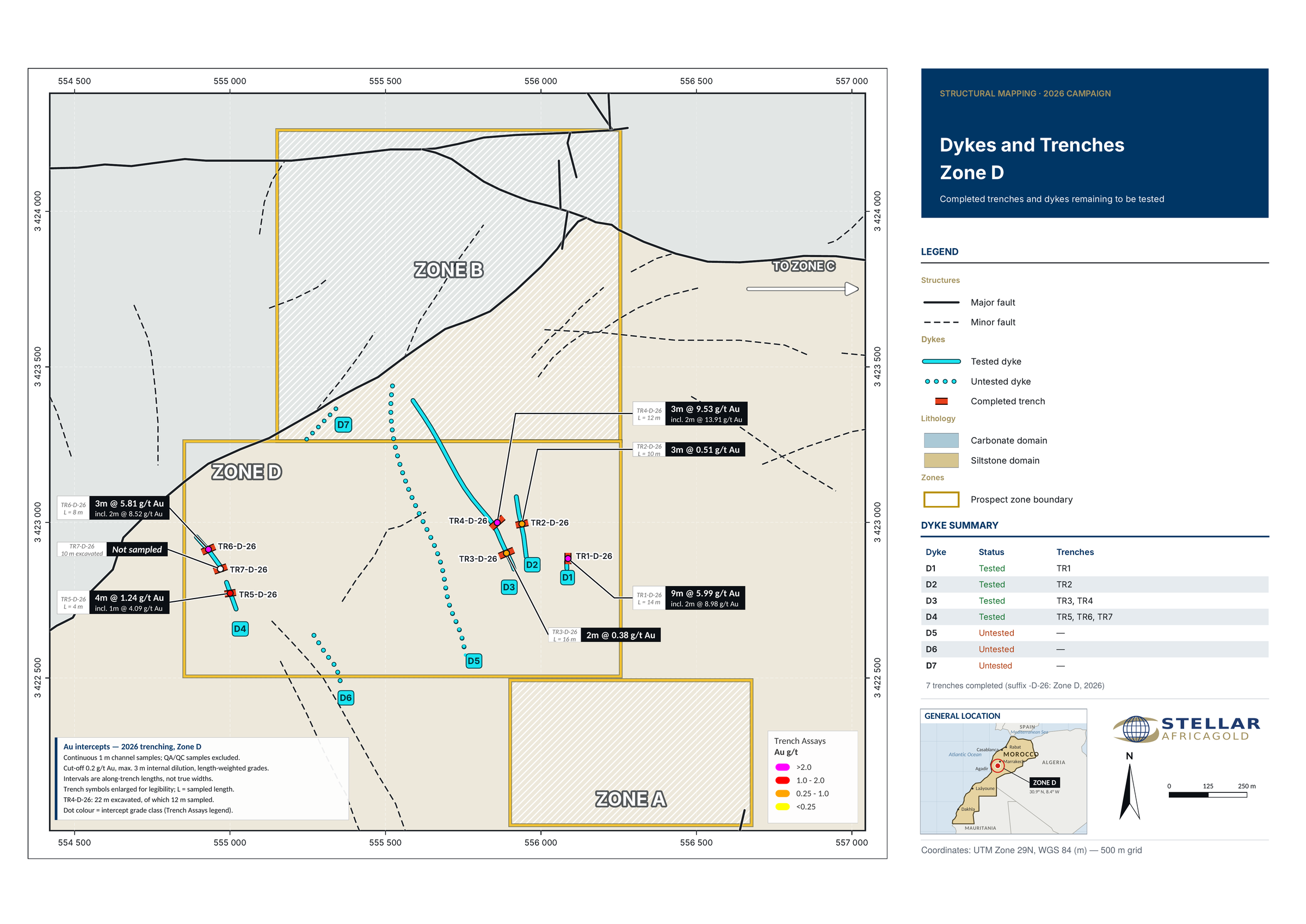
Click Image To View Full Size
Figure 1. Map view of the Tichka Est Gold Project showing the location of new Zone D and the preliminary outlines of the tested and untested dykes (Dykes 1 to 7) relative to Zones A and B. Dyke outlines are schematic.
Zone D Phase 1 Trench Results
Table 1. Zone D trench intercepts (Afrilab, Marrakech; 50 g fire assay, AAS finish).
| Dyke | Trench | Sampled length (m) | From (m) | To (m) | Interval (m)* | Au (g/t) | Including |
| D1 | TR1-D-26 † | 14 | 4.0 | 13.0 | 9.0 | 5.99 | 2.0 m @ 8.98 g/t from 8.0 m |
| D2 | TR2-D-26 | 10 | 7.0 | 10.0 | 3.0 | 0.51 | — |
| D3 | TR3-D-26 | 16 | 13.0 | 15.0 | 2.0 | 0.38 | — |
| D3 | TR4-D-26 | 12 | 3.0 | 6.0 | 3.0 | 9.53 | 2.0 m @ 13.91 g/t from 3.0 m |
| D4 | TR5-D-26 | 4 | 0.0 | 4.0 | 4.0 | 1.24 | 1.0 m @ 4.09 g/t from 1.0 m |
| D4 | TR6-D-26 | 8 | 1.0 | 4.0 | 3.0 | 5.81 | 2.0 m @ 8.52 g/t from 1.0 m |
| D4 | TR7-D-26 | — | — | — | — | — | Not sampled (no visible veining) |
* Intervals are measured along the trench floor and are not true widths; true widths are not known. Composites are length-weighted, uncut, at a 0.20 g/t Au cut-off with a maximum of 3 m of internal dilution, consistent with the Company's drill-hole reporting (see news release dated August 11, 2026). Quality-control samples are excluded.
† Sampled length is the channel-sampled portion of each trench. No sample below the 0.05 g/t Au detection limit falls inside any reported interval. See "Interpretation" section regarding the orientation of TR1-D-26.
Interpretation of Trenching Results
The results confirm that the quartz–arsenopyrite–pyrite veining observed in the trenches carries gold mineralization within each of the four dykes tested across the Zone D corridor. Gold mineralization is associated with these quartz veins and their selvages, and with fault structures cutting the dioritic dykes and their brecciated margins. In the cross-dyke trenches, higher grades occur over discrete 1 to 3 metre intervals: TR4-D-26 returned 12.99 and 14.82 g/t Au in consecutive metres, and TR6-D-26 returned 8.68 and 8.36 g/t Au, also in consecutive metres.
TR1-D-26 was cut along a cleaned road-cut exposure. The sampled section is oriented at approximately 170°–175°, sub-parallel to Dyke 1 and approximately perpendicular to the mineralized quartz–arsenopyrite veins. Its 9.0 metre interval therefore represents the along-strike extent of mineralized veins and faults within the dyke, not a width across a mineralized body. The width of Dyke 1 and the true width of the gold mineralized zones are not yet known. Veins and faults are distinguished separately in the TR1-D-26 section mapping, and the highest-grade samples (10.71 and 10.64 g/t Au) are associated with the vein zone and adjacent faulting. Contrary to the general description in the Company's news release of October 6, 2026, TR1-D-26 was not excavated across the trend of its dyke. The Company plans two short cross-trenches across the full width of Dyke 1 and both contacts, with separate sampling of individual veins, to define the geometry before drilling.
Gold mineralization in TR5-D-26 and TR2-D-26 is bounded by the contact with siltstone, which is not mineralized; both trenches ended just after cutting the siltstone on either side of the dyke, so these intercepts are closed at the contacts rather than open at the trench ends.
Sampling Coverage
The seven trenches totalling 84 metres were excavated as announced on October 6, 2026, with the exception of the orientation of TR1-D-26 (see "Interpretation" section). Following field review of the exposures, channel sampling was concentrated on the mineralized sections: 64 metres were sampled continuously at 1-metre intervals in six trenches. TR7-D-26 exposed no visible veining and was not sampled, and unmineralized trench ends were not sampled. The sample counts reported on October 6 are unchanged: 64 channel samples and nine quality-control samples.
Sampling, Analysis and Quality Control
Each trench was geologically mapped, and the sampled sections were channel-sampled continuously on 1-metre intervals along the trench floor. Each channel sample weighed approximately 2.3 to 4.3 kg. Samples were delivered under chain of custody to Afrilab (Marrakech, Morocco), an ISO/IEC 17025-accredited laboratory independent of the Company. Samples were analyzed for gold by 50 g fire assay with atomic absorption (AAS) finish, with a detection limit of 0.05 g/t Au. As a check, the nine samples above 5 g/t Au are being re-assayed by fire assay with gravimetric finish; the Company will report the results if they differ materially from those reported here. Assay certificates R-11603-26 to R-11608-26 are dated October 15, 2026.
Nine quality-control samples (12.3% of the 73-sample stream) were inserted blind: three certified reference materials (OREAS 284 ×2 and OREAS 286 ×1), three blanks and three field duplicates. All three reference materials returned values within one standard deviation of their certified values (z-scores +0.23 to +1.00). All three blanks returned less than 0.05 g/t Au. Two of the three field duplicates were within the ±20% acceptance limit (+10.2% at ~9 g/t Au; both values below detection for the other); the third differed by +21% (3.94 vs 3.19 g/t Au), consistent with normal short-range gold variability. Twelve laboratory pulp repeats agreed closely with the original results. The Qualified Person has reviewed the QA/QC data and considers the assay results suitable for disclosure.
Next Steps
The trench results, structural mapping and the planned cross-trenches at Dyke 1 will be used to finalize collar positions and orientations for the five Zone D drill holes provisionally allocated within the fully funded 24-hole, ~5,000-metre Phase II program. Subject to weather conditions, drilling of Zone D is expected to follow the initial holes at Zone B.
The PROGREM high-resolution drone magnetic survey, which includes the Zone D target area, was mobilized on October 20, 2026, and test flights began on October 21, 2026 and are ongoing. The magnetic survey will help refine the structural interpretation of the dyke corridor ahead of drilling. Follow-up trenching is planned on the dykes already tested, followed by first trenches on the three untested dykes shown on Figure 1 (Dykes 5, 6 and 7), together with systematic mapping of the Zone D dyke corridor.
Phase II Program Status
Preparation for mobilization of CMFM's drill rigs and crews is complete. Final mobilization to site is pending receipt of administrative authorization in the normal course, and the Company will announce the commencement of drilling. Drill platforms and access are in place, and the program remains fully funded.
Management Commentary
"We are pleased that every dyke trenched and assayed at the new Zone D carried gold mineralization, and that three of the four dykes returned grades above 5 g/t Au, including 9.53 g/t Au over 3.0 metres and 5.81 g/t Au over 3.0 metres. And even though Trench 1 was cut along the strike of the dyke rather than across it, it too delivered a grade of 5.99 g/t gold," said Stellar President and CEO J. François Lalonde.
"As this recent assay data is added to the Tichka Est integrated data bank, the team's next task will be to interpret all of the existing and new data including the assay data from the planned cross-trenches on Dyke 1 and, once completed, the drone magnetic survey prior to spotting drill holes at Zone D."
About the Tichka Est Gold Project
The Tichka Est Gold Project comprises five research permits and one exploitation licence covering 82 km² in the High Atlas region of Morocco, approximately 90 km south of Marrakech. Under an earn-in agreement with Morocco's Office National des Hydrocarbures et des Mines (ONHYM), Stellar can earn an 85% interest in the project by incurring US$2.39 million in exploration expenditures over three years. Gold mineralization is currently recognized in four zones: Zone A; Zone B, the most advanced area following recent drilling; Zone C; and the newly identified Zone D where recent trenching has returned gold mineralization in four dykes. Much of the overall 82 km² project area remains unexplored or only superficially explored.
Mineralization at Tichka Est is at an early exploration stage. Insufficient exploration has been undertaken to define a mineral resource, and it is uncertain whether further exploration will result in the delineation of a mineral resource. Trench intervals are measured along the trench floor and are not true widths. Rock (grab) samples previously reported from this area are selective in nature and may not be representative of overall mineralization.
About Stellar AfricaGold Inc.
Stellar AfricaGold Inc. is a Canadian precious metals exploration company focused on North and West Africa, with active exploration programs in Morocco and Côte d'Ivoire. The Company's principal projects are the Tichka Est Gold Project in Morocco, where Stellar is advancing a gold discovery with a fully funded 5,000-metre diamond drilling program scheduled for the fall and winter of 2026–2027, and the Zuénoula Gold Project in Côte d'Ivoire, operated under an earn-in and joint venture agreement with MetalsGrove Mining Limited where a fully funded 10,000-metre auger drilling program is the planned next step. Stellar trades on the TSX Venture Exchange (TSXV: SPX,OTC:STLXF), the Tradegate Exchange (TGAT: 6YP) and the Frankfurt Stock Exchange (FSX: 6YP). The Company maintains its head office in Vancouver, BC, and its in-country office in Marrakech, Morocco.
Qualified Person — The technical content of this press release has been reviewed and approved by Mr. Yassine Belkabir, MSc, DIC, CEng, MIMMM, a Stellar director and a Qualified Person as defined in National Instrument 43-101.
Stellar's President and CEO J. François Lalonde can be contacted at +1 514-994-0654 or by email at lalondejf@stellarafricagold.com. Additional information is available on the Company's website at www.stellarafricagold.com.
On Behalf of the Board
J. François Lalonde
President & CEO
Forward-Looking Statements — This news release contains "forward-looking statements" within the meaning of applicable Canadian securities laws, including statements regarding the interpretation of trench results, the results of gravimetric check assays, planned cross-trenching, follow-up trenching and mapping, the design, finalization and timing of drill holes at Zone D, the timing and reporting of assay results, the finalization of drill plans, the timing and receipt of administrative authorizations, the timing of contractor mobilization, the commencement of drilling, and the conduct and timing of geophysical surveys. Forward-looking statements are based on current expectations and are subject to known and unknown risks and uncertainties, including laboratory turnaround, contractor scheduling, administrative processes, weather and access conditions, and results of exploration, as well as the risk factors set out in the Company's most recent Management's Discussion and Analysis available on SEDAR+ at www.sedarplus.ca.
Forward-looking statements are not guarantees of future performance and should not be unduly relied upon. Except as required by law, the Company undertakes no obligation to update or revise any forward-looking statements contained herein.
Neither the TSX Venture Exchange nor its Regulation Services Provider (as that term is defined in the policies of the TSX Venture Exchange) accepts responsibility for the adequacy or accuracy of this release.

Copyright (c) 2026 TheNewswire - All rights reserved.