The Conversation (0)

Australian Rare Earths Limited (ASX: AR3) is pleased to provide an update on the chemical assays received from samples recovered from the shallow calcrete hosted intersections in drill hole OV047.
Highlights:
AR3 Managing Director and CEO, Travis Beinke, said:
“These assay results from the first hole where the occurrence of shallow calcrete-hosted uranium was discovered underscore the significant potential of the Overland project. The search for both shallow calcrete-hosted uranium, and sedimentary hosted, ISR amenable targets, continues in this frontier uranium play.
“We look forward to providing further updates on our ongoing drill program and sharing assay results as AR3 pursues active uranium exploration activity at Overland.”
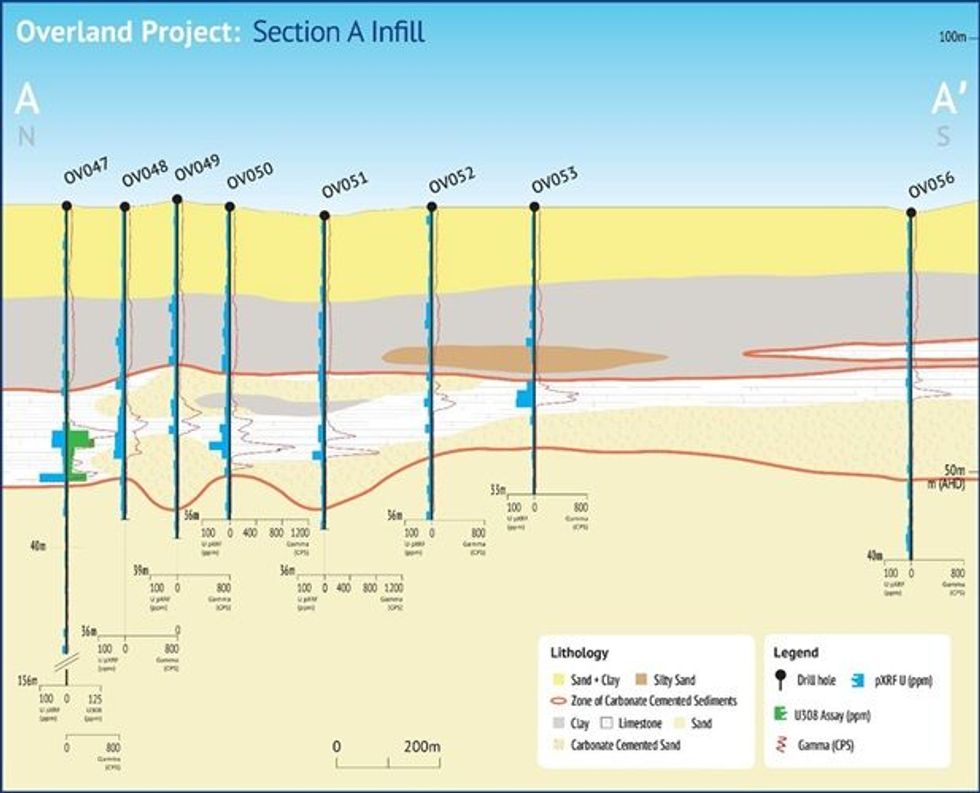 Figure 1: Section A- A’ displaying lithology interpretation, natural gamma responses (cps) and pXRF uranium responses (ppmU). In relation to the disclosure of pXRF results, the Company cautions that estimates of uranium elemental abundance from pXRF results should not be considered a proxy for quantitative analysis of a laboratory assay result. Assay results are required to determine the actual widths and grade of the mineralisation. The company uses an Olympus Vanta M Series portable X-ray Fluorescence (pXRF) analyzer to screen Air Core drilling samples for mineralization prior to submitting samples to a commercial laboratory for assay. This provides an initial understanding of the mineralization distribution before sampling, ensuring submitted samples are representative of the targeted mineralization. While pXRF confirms the presence of mineralization, it does not accurately determine elemental concentrations due to limitations such as a small analysis window, uneven distribution, shallow penetration depth, and irregular surfaces. The pXRF results are indicative and the pXRF readings are subject to confirmation by chemical analysis from an independent laboratory.
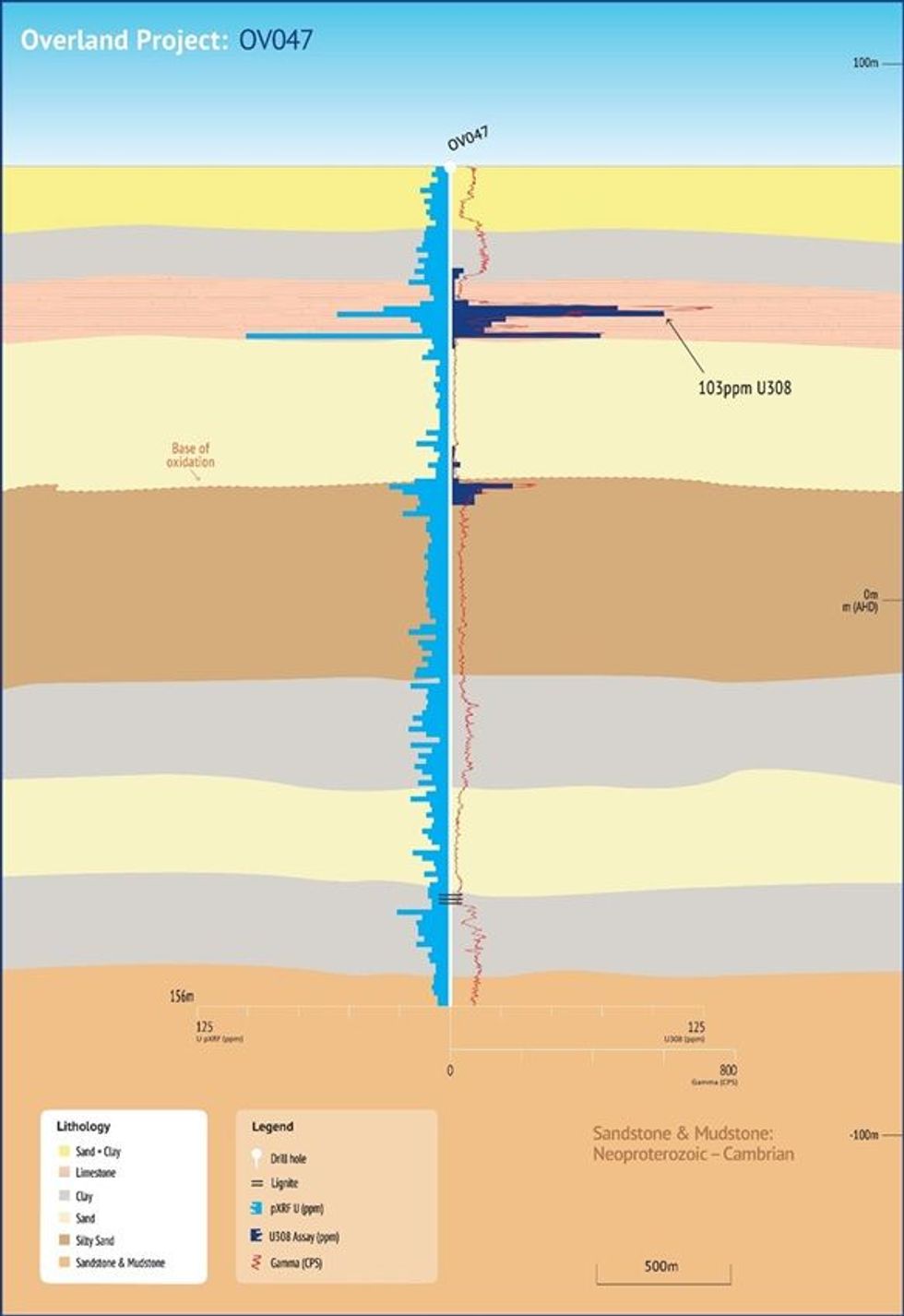 Figure 2: Strip log displaying drill hole OV047 lithology, natural gamma responses (cps), pXRF uranium responses (ppm U) and chemical assay results (ppm U3O8)
The assay results conform with down hole gamma responses and in-field pXRF measurements for contained uranium in OV047. This provides continued confidence that these immediate field- based measurements can guide drill hole targeting at Overland.
Now supported by these recent assays and significant uranium intersections, follow-up drilling of OV047’s anomalous gamma and pXRF uranium readings in shallow carbonate-cemented sediments, point to the potential for a widespread continuation of calcrete hosted uranium mineralisation.
The follow-up drilling, consisting of nine drill holes targeting the shallow carbonate-cemented sediments, have consistently confirmed anomalous gamma and pXRF uranium responses1. The discovery remains open in all directions for calcrete-hosted uranium mineralisation. The mineralisation spans an extensive area, with a potential strike length stretching dozens of kilometres along the modern drainage profile and a width exceeding one kilometre.
The follow up drilling was conducted at 100 to 600 metre spacings to depths of up to 42 metres, with anomalous zones occurring between 20 and 32 metre depths (Figure 1: section A-A’ ).
Initial indications of a shallow uranium occurrence at Target 1 of EL6678 came in drill hole OV047, which intersected a 6 metre interval containing anomalous gamma and pXRF uranium responses. Gamma responses peaked at 741 counts per second (cps), with maximum pXRF uranium response of 105ppm uranium in OV047. Subsequent drilling has provided further evidence of this style of mineralisation, with gamma responses peaking at 1,010cps in hole OV050 and additional anomalous pXRF uranium values exceeding 50ppm occurring in holes OV050 and OV053. The identified anomalous zones range from two to six metres thick.
Mineralogical assessments of hole OV047 drill cuttings through scanning electron microscope (SEM) and micro XRF analysis indicate that uranium is hosted in the secondary calcite cementation of both the limestone and the sandy sediments in this setting. Indicative uranium levels of up to ~350ppm uranium have been detected in the calcite cement infilling these sediments. The uranium within the calcite cement was identified by analysing samples with a Bruker M4 Tornado Plus μXRF instrument operated by Adelaide Microscopy at the University of Adelaide2.
This shallow sedimentary uranium mineralisation in secondary carbonate cementation is similar to Namibia’s surficial uranium deposits, as found at Paladin Energy’s Langer Heinrich mine or Deep Yellow’s Tumas project. Similar calcrete-hosted deposits are also found in Western Australia at Cameco’s Yeelirrie deposit and Toro Energy’s Wiluna project.
Click here for the full ASX Release
This article includes content from Australian Rare Earths, licensed for the purpose of publishing on Investing News Australia. This article does not constitute financial product advice. It is your responsibility to perform proper due diligence before acting upon any information provided here. Please refer to our full disclaimer here.