November 28, 2022
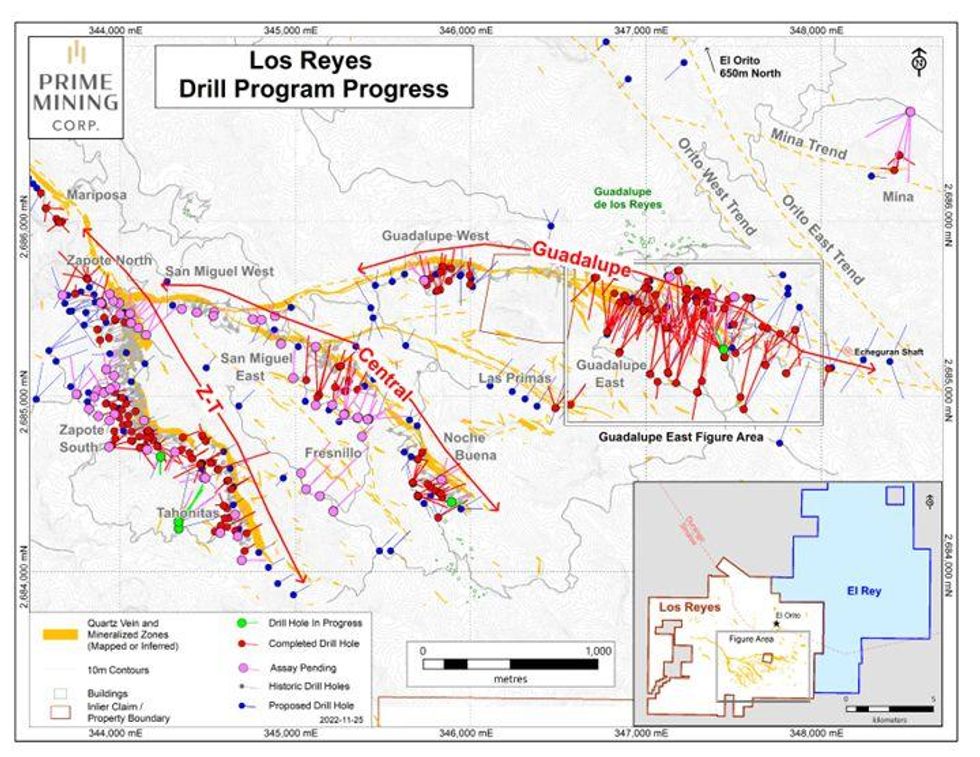
Prime Mining Corp. (“Prime” or the “Company”) (TSX-V: PRYM, OTCQB: PRMNF, Frankfurt: 04V3) announces additional assay results from its recently completed Phase 2 drill program. Today’s results are from the Guadalupe area where Prime continues to delineate and expand the multi-million-ounce Los Reyes high-grade gold-silver deposit. Los Reyes and its three known gold-silver deposit areas (Guadalupe, Z-T and Central), has a mineralized footprint of over 15 square kilometres and is located in a highly prospective, 500-year old mining-friendly district of Sinaloa, Mexico.
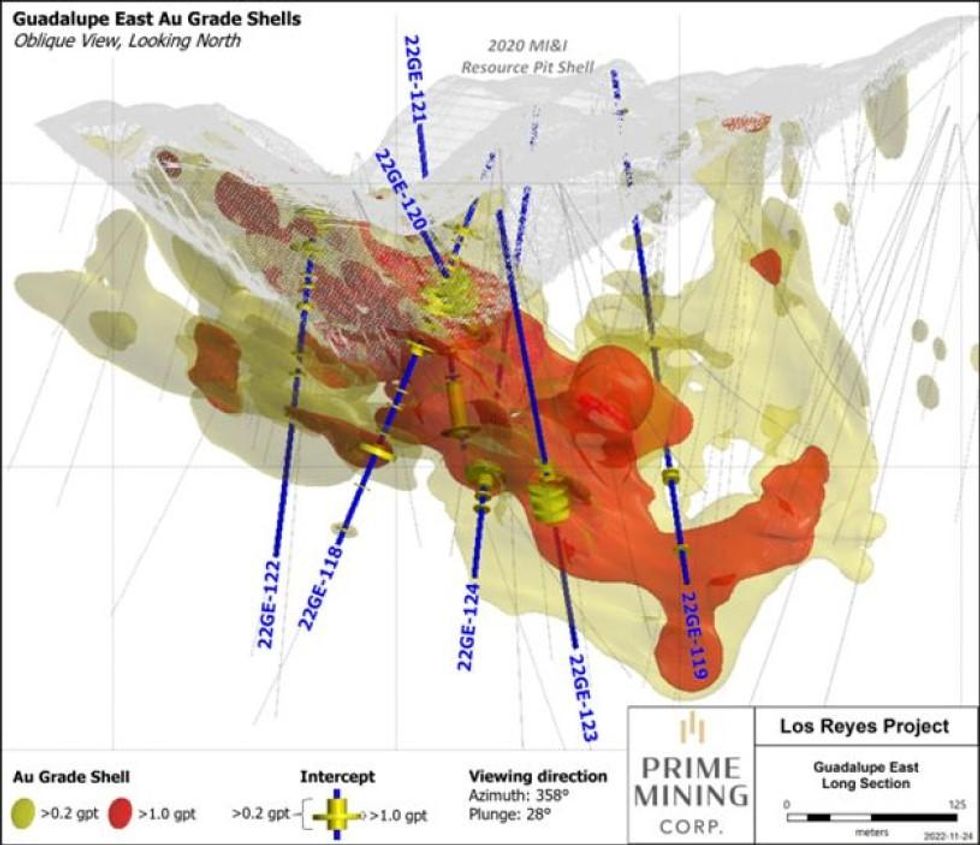
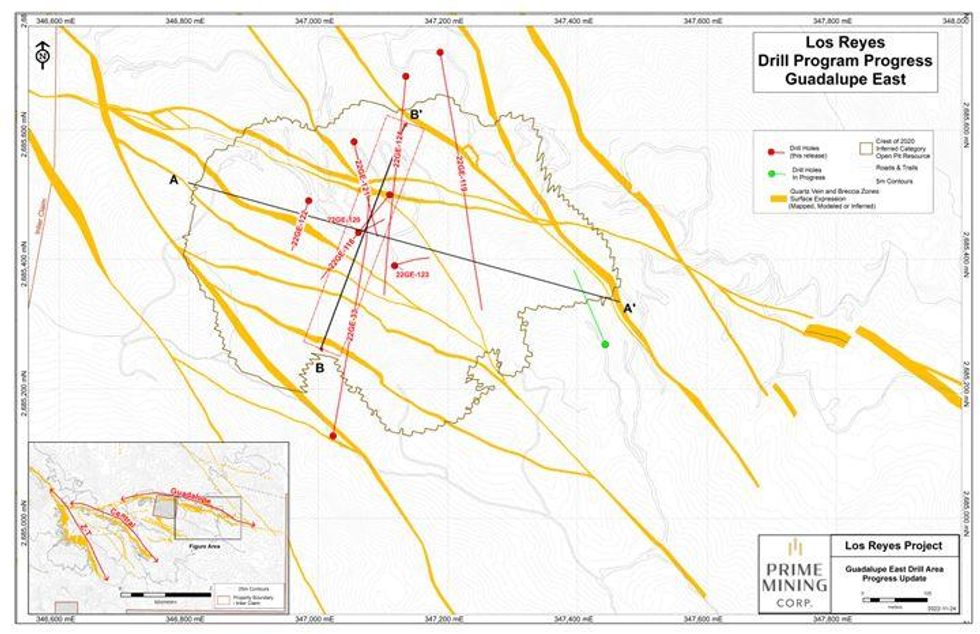
Today’s results are from seven drill holes in the main Guadalupe deposit.
HIGHLIGHT GUADALUPE DRILL INTERCEPTS:
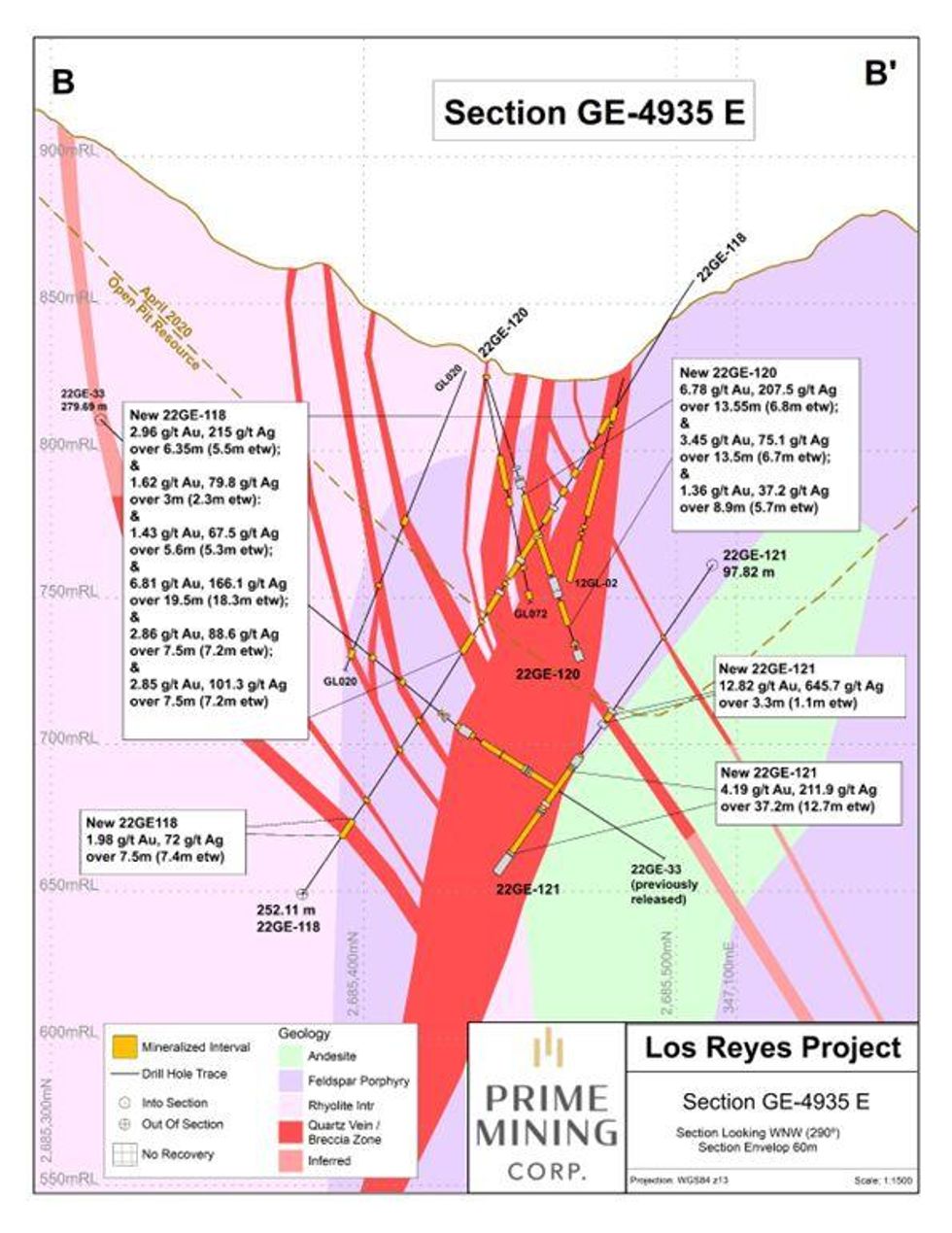
- 6.8 gpt Au and 166 gpt Ag over 19.5 m (18.3 m estimated true width or “etw”) in hole 22GE-118
- 12.8 gpt Au and 646 gpt Ag over 3.3 m (1.1 m etw), and 4.2 gpt Au and 212 gpt Ag over 37.2 m (12.7 m etw) in hole 22GE-121
- 8.8 gpt Au and 289 gpt Ag over 7.9 m (5.6 m etw), including 33.2 gpt Au and 1,072 gpt Ag over 2.0 m (1.4 m etw) in drill hole 22GE-122
- 6.8 gpt Au and 208 gpt Ag over 13.6 m (6.8 m etw) in hole 22GE-120
Drilling continues to encounter bonanza and high-grade intercepts at Guadalupe with additional remarkable gold and silver values being intercepted in the Estaca Vein. Additionally, outside of the main Estaca Vein, drilling is delineating a cluster of mineralized vein splays within the main Guadalupe deposit. It is anticipated that these results will further expand resources at Guadalupe.
Chief Executive Officer, Daniel Kunz commented, “We are very excited about the progress we have made in the Phase 2 drill program. Our exploration team has improved the structural modelling demonstrably, which has resulted in a more targeted and accurate drill program. As a result, the number of wide, high-grade intercepts we are seeing in our results has increased. Our recent drilling, specifically at Guadalupe East, has intersected multiple thick, high-grade gold and silver veins. These new veins are increasing the high-grade zones both within and outside of the known mineralized envelope. We will continue to target these high-grade structures as they remain open along strike and at depth. As we work towards delivering a resource estimate in the first half of next year, we are excited about the increasing contribution of these bonanza grade veins at Los Reyes.”
Scott Smith, EVP Exploration added: “Drill holes 22GE-118, 120, and 122 intersected impressive Estaca Vein Splays. Continued drilling success in these vein assemblages will add high-grade ore tonnes and reduce pit waste-to-ore ratios at Guadalupe. Holes 22GE-121, 123 and 124 intersected the main Estaca Vein itself approximately 150 m further along strike and down dip of the April 2020 resource pit limit. Hole 22GE-120 also went on to intercept the Estaca Vein after passing through the splays.”
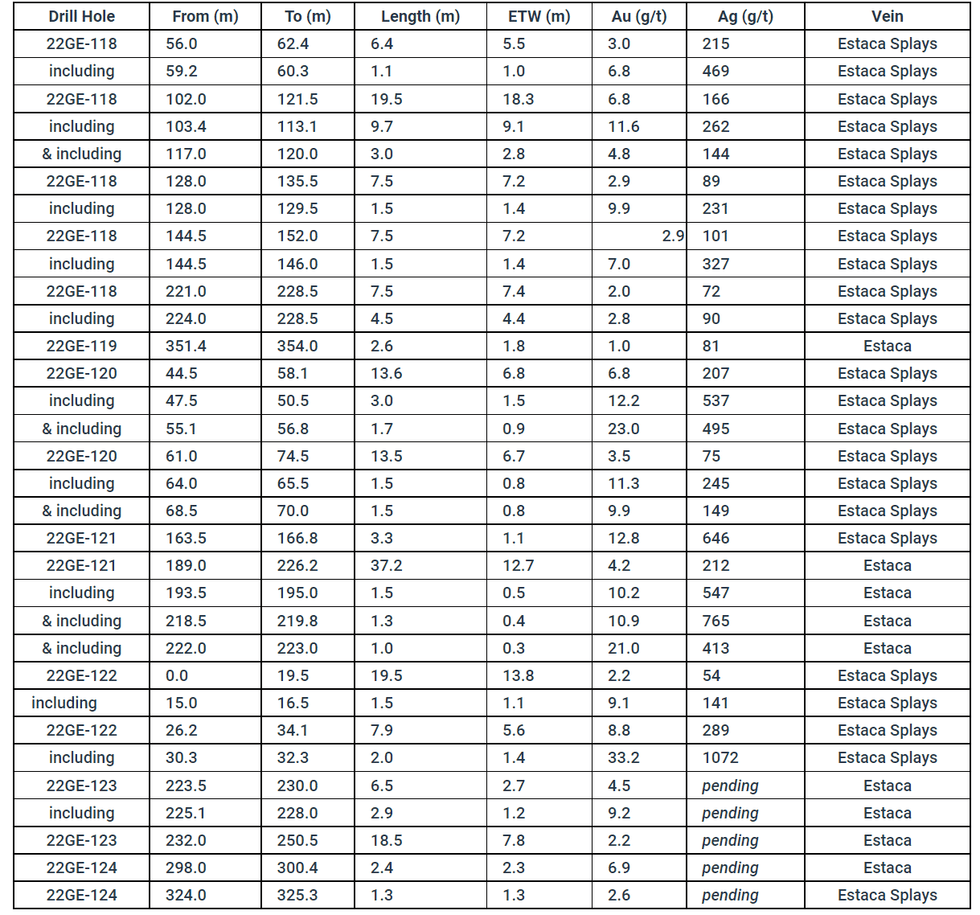
Today’s results highlight recent success in expanding the Guadalupe deposit and are shown in the Significant Intercepts Table below.
Phase 2 drilling was completed on October 31. In total, 74,216 metres were drilled in 259 holes with zero lost-time injuries or material safety incidents. Combined with Phase 1 and on-going drilling, Prime has now drilled over 100,000 metres in over 400 holes. Further details of the Phase 2 drilling results will be released as they become available.
Phase 3 drilling began in November. There are currently five rigs operating at site with drilling focused largely on resource expansion. Prime currently anticipates the release of an updated NI 43-101 resource estimate by mid-2023. The updated resource will include all Phase 1 and Phase 2 results, plus some initial results from the ongoing Phase 3 drilling program.

SIGNIFICANT INTERCEPTS TABLE FROM RECENT DRILLING AT GUADALUPE:
Link 1 – PDF Figures
Link 2 – PDF Drill Hole Tables
Guadalupe Drilling Results and Interpretation
In addition to the significant intercepts shown above, Prime has released the full current assay table for the Guadalupe area (Link 2 above). While some of the holes included in that table are more exploratory in nature, holes targeting the key mineralized vein structures in Guadalupe continue to indicate potential high-grade, high-margin resource expanding ounces characteristic of the Guadalupe area. Included in these results are intersections of various structures, including previous underground workings. Where previous workings or stopes have encountered what has been interpreted as backfill material, these segments have been included in the table and identified as such in the ‘Vein’ column and will be excluded from future reported resource inventories and will not influence interpolated resource block grades. Highlights and significant intercepts shown above only include what has been interpreted as in situ material, and do not include any assayed backfill material. “Pending” silver grades in the Significant Intercepts table above indicate that part of the composites may have assayed over 100 gpt and follow-up ‘over-limit’ test results have not been received.
QA/QC Protocols and Sampling Procedures
Drill core at the Los Reyes project is drilled in predominately HQ size (63.5 millimetre “mm”), reducing to NQ or BQ size ranges (47.6 mm and 36.5 mm respectively) when required. Drill core samples are generally 1.50 m long along the core axis with allowance for shorter or longer intervals if required to suit geological constraints. After logging intervals are identified to be sampled and split, and one half is submitted for assay. RC drilling returns rock chips and fines from a 133.35 mm diameter tricone bit. The returns are homogenized and split into 2 halves, with one half submitted for analysis and the other half stored.
Sample QA/QC measures include unmarked certified reference materials, blanks, and field duplicates as well as preparation duplicates are inserted into the sample sequence and make up approximately 8% of the samples submitted to the laboratory for each drill hole.
Samples are picked up from the Project by the laboratory personnel and transported to their facilities in Durango or Hermosillo Mexico, for sample preparation. Sample analysis is carried out by Bureau Veritas and ALS Labs, with fire assay, including over limits fire assay re-analysis, completed at their respective Hermosillo, Mexico laboratories and multi-element analysis completed in North Vancouver, Canada. Drill core sample preparation includes fine crushing of the sample to at least 70% passing less than 2 mm, sample splitting using a riffle splitter, and pulverizing a 250-gram split to at least 85% passing 75 microns.
Gold in diamond drill core is analyzed by fire assay and atomic absorption spectroscopy of a 30 g sample (code FA430 or Au-AA23). Multi-element chemistry is analyzed by 4-Acid digestion of a 0.25-gram sample split (code MA300 or ME-ICP61) with detection by inductively coupled plasma emission spectrometer for a full suite of elements.
Gold assay techniques FA430 and Au-AA23 have an upper detection limit of 10 ppm. Any sample that produces an over-limit gold value via the initial assay technique is sent for gravimetric finish via method FA-530 or Au-GRA21. Silver analyses by MA300 and ME-ICP61 have an upper limit of 200 ppm and 100 ppm, respectively. Samples with over-limit silver values are re-analyzed by fire assay with gravimetric finish FA530 or Au-GRA21.
Both Bureau Veritas and ALS Labs are ISO/IEC accredited assay laboratories. Drill core assay results range from below detection to 200.0 gpt gold and 4,955.0 gpt silver.
Qualified Person
Scott Smith, P.Geo., Executive Vice President of Exploration, is a qualified person for the purposes of National Instrument 43-101 and has reviewed and approved the technical content in this news release.
Additional Notes
Metres is represented by “m”; “etw” is Estimated True Width and is based on drill hole geology or comparisons with other on-section drill holes; “Au” refers to gold, and “Ag” refers to silver; “gpt” is grams per metric tonne; some figures may not sum due to rounding; Composite assay grades presented in summary tables are calculated using a Au grade minimum average of 0.20 gpt or 1.0 gpt as indicated in “Au Cut-off” column of Summary Tables. Maximum internal waste included in any reported composite interval is 3.00 m. The 1.00 gpt Au cut-off is used to define higher-grade “cores” within the lower-grade halo.
About the Los Reyes Gold and Silver Project
Los Reyes is a rapidly evolving high-grade, low sulphidation epithermal gold-silver project located in Sinaloa State, Mexico. Historic operating results indicate that an estimated 1 million ounces of gold and 60 million ounces of silver were recovered from five separate operations at Los Reyes between 1770 and 1990. Prior to Prime’s acquisition, recent operators of Los Reyes had spent approximately US$20 million on exploration, engineering, and prefeasibility studies. The Project remains underexplored and holds potential for additional discovery and resource expansion.
Since acquiring Los Reyes in 2019, Prime has spent approximately US$30 million on direct exploration activities and has completed two phases of comprehensive drilling totaling over 100,000 m. Results to date suggest the three known main deposit areas, Guadalupe, Central and Z-T, are larger than previously reported. Potential also exists for new discoveries outside of the currently defined resource areas.
About Prime Mining
Prime is managed by an ideal mix of successful mining executives, strong capital markets personnel and experienced local operators all focused on unlocking the full potential of the Los Reyes Project. The Company has a well-planned capital structure with a strong management team and insider ownership.
ON BEHALF OF THE BOARD OF DIRECTORS
Daniel Kunz
Chief Executive Officer
For further information, please contact:
Daniel Kunz
Chief Executive Officer and Director
Prime Mining Corp.
1307 S. Colorado Ave.
Boise, Idaho 83706
Telephone: +1 (208) 926-6379 office
email: daniel@primeminingcorp.ca
Scott Hicks
Executive Vice President
Prime Mining Corp.
710 – 1030 West Georgia Street
Vancouver, BC, V6E 2Y3
Telephone: +1 (604) 428-6128 office
email: scott.hicks@primeminingcorp.ca
Neither the TSX Venture Exchange nor its Regulation Services Provider (as that term is defined in policies of the TSX Venture Exchange) accepts responsibility for the adequacy or accuracy of this release.
Forward Looking Information
This news release contains certain “forward-looking information” and “forward-looking statements” within the meaning of Canadian securities legislation as may be amended from time to time, including, without limitation, statements regarding the perceived merit of the Company’s properties, including additional exploration potential of Los Reyes, potential quantity and/or grade of minerals, the potential size of the mineralized zone, metallurgical recoveries, and the Company’s exploration and development plans in Mexico. Forward-looking statements are statements that are not historical facts which address events, results, outcomes, or developments that the Company expects to occur. Forward-looking statements are based on the beliefs, estimates and opinions of the Company’s management on the date the statements are made, and they involve several risks and uncertainties. Certain material assumptions regarding such forward-looking statements were made, including without limitation, assumptions regarding the price of gold, silver and copper; the accuracy of mineral resource estimations; that there will be no material adverse change affecting the Company or its properties; that all required approvals will be obtained, including concession renewals and permitting; that political and legal developments will be consistent with current expectations; that currency and exchange rates will be consistent with current levels; and that there will be no significant disruptions affecting the Company or its properties. Consequently, there can be no assurances that such statements will prove to be accurate and actual results and future events could differ materially from those anticipated in such statements. Forward-looking statements involve significant known and unknown risks and uncertainties, which could cause actual results to differ materially from those anticipated. These risks include, but are not limited to: risks related to uncertainties inherent in the preparation of mineral resource estimates, including but not limited to changes to the cost assumptions, variations in quantity of mineralized material, grade or recovery rates, changes to geotechnical or hydrogeological considerations, failure of plant, equipment or processes, changes to availability of power or the power rates, ability to maintain social license, changes to interest or tax rates, changes in project parameters, delays and costs inherent to consulting and accommodating rights of local communities, environmental risks, title risks, including concession renewal, commodity price and exchange rate fluctuations, risks relating to COVID-19, delays in or failure to receive access agreements or amended permits, risks inherent in the estimation of mineral resources; and risks associated with executing the Company’s objectives and strategies, including costs and expenses, as well as those risk factors discussed in the Company's most recently filed management's discussion and analysis, as well as its annual information form dated April 22, 2022, available on www.sedar.com. Except as required by the securities disclosure laws and regulations applicable to the Company, the Company undertakes no obligation to update these forward-looking statements if management’s beliefs, estimates or opinions, or other factors, should change.


PRYM:CA
The Conversation (0)
1h
Editor's Picks: Gold Knocks Out Inflation-Adjusted High, Silver Breaks US$42
Gold's record-setting price run continued this week, with yet another new all-time high in the books. Silver also fared well, breaking US$42 per ounce.
According to Bloomberg, gold has now also surpassed its inflation-adjusted all-time high of US$850 per ounce, which it set more than 45 years ago on January 21, 1980. The news outlet notes that at the time the US was dealing with currency issues, inflation and recession concerns.
These are problems that sound all too familiar today. This week brought the release of the latest US consumer price index (CPI) data, which shows a 0.4 percent month-on-month increase for the all-items index — that's ahead of estimates and the most since the start of 2025.
Meanwhile, core CPI, which excludes the food and energy categories, was up 0.3 percent from July. On an annual basis, core CPI was up 3.1 percent, while overall CPI rose 2.9 percent.
US producer price index (PPI) data also came out this week.
The index, which measures costs at a wholesale level, showed an unexpected 0.1 percent month-on-month decrease for August; the result was the same for core PPI.
Attention is now shifting to the US Federal Reserve's next meeting, which is set to run from September 16 to 17. For weeks now the central bank has been widely expected to cut interest rates, and experts believe this week's CPI and PPI numbers support that idea.
“Today’s CPI may appear to offset yesterday’s PPI, but it wasn’t hot enough to distract the Fed from the softening jobs picture. That translates into a rate cut next week — and, likely, more to come" — Ellen Zentner, Morgan Stanley Wealth Management
CME Group's (NASDAQ:CME) FedWatch tool now shows odds of 93.9 percent for a 25 basis point cut, while the likelihood of a 50 basis point reduction stands at 6.1 percent.
Bullet briefing — Mining majors in mega M&A, Newmont to exit TSX
Anglo, Teck to merge in US$53 billion deal
Anglo American (LSE:AAL,OTCQX:AAUKF) and Teck Resources (TSX:TECK.A,TSX:TECK.B,NYSE:TECK) announced that they plan to merge in a US$53 billion transaction.
The new entity, which the companies say will be one of the world's largest copper producers, will have assets in Canada, the US, Latin America and Southern Africa.
Its primary listing will be in London, but its headquarters will be in Canada — a commitment that Teck CEO Jonathan Price told BNN Bloomberg will be "perpetual." In a bid to safeguard its critical minerals sector, Canada said last year that it will only greenlight foreign takeovers of large critical minerals miners in "exceptional circumstances."
The companies expect annual pre-tax synergies of about US$800 million by the end of the fourth year following the completion of the arrangement.
Experts say the zero-premium, all-share tie up is the second largest mining deal ever, and the biggest in more than a decade. It comes not long after other high-profile M&A attempts involving both companies — Teck rejected a bid from (LSE:GLEN,OTC Pink:GLCNF) in 2023, and Anglo turned down an offer from BHP (ASX:BHP,NYSE:BHP,LSE:BHP) last year.
Newmont to delist from TSX
While the Anglo-Teck deal puts Canada front and center, major miner Newmont (TSX:NGT,NYSE:NEM,ASX:NEM) is backing away from the northern nation. The company said it has applied to voluntarily delist its shares from the TSX amid low volumes.
Newmont also said the move will help boost administrative efficiency and reduce expenses. The firm has faced increasing costs since acquiring Newcrest Mining in 2023, and sources familiar with the matter recently told Bloomberg that it's looking to lower costs by around 20 percent.
Newmont will retain its primary listing in New York, as well as listings in Australia and Papua New Guinea. Its TSX delisting is expected to be effective on September 24.
Barrick to sell Hemlo for US$1.09 billion
Also making a move away from Canada this week was Barrick Mining (TSX:ABX,NYSE:B), which has agreed to sell its Hemlo gold mine to Carcetti Capital (TSXV:CART.H) for US$1.09 billion.
Located in Ontario, Hemlo has operated for 30 years, producing over 21 million ounces of gold during that time. The sale comes as Barrick divests non-core assets and pivots toward copper.
The company put Hemlo up for sale earlier this year, and in July was rumored to be selling the operation to Discovery Silver (TSX:DSV,OTCQX:DSVSF); that deal ultimately didn't pan out.
Carcetti will be renamed Hemlo Mining once the transaction closes, and is expected to uplist from the TSX Venture Exchange's NEX Board. Its backers include Robert Quartermain, who is known for leading SSR Mining (TSX:SSRM,NASDAQ:SSRM) and Pretium Resources.
Want more YouTube content? Check out our expert market commentary playlist, which features interviews with key figures in the resource space. If there's someone you'd like to see us interview, please send an email to cmcleod@investingnews.com.
And don't forget to follow us @INN_Resource for real-time updates!
Securities Disclosure: I, Charlotte McLeod, hold no direct investment interest in any company mentioned in this article.
Keep reading...Show less
6h
Admission to Trading on the OTCQB Market
Hamak Gold Limited (LSE: HAMA / OTCQB: HASTF), a company combining traditional gold exploration in West Africa with a Digital Asset Treasury Management strategy, is pleased to announce that the Company's shares have been admitted to trading on the OTC Venture Market ("OTCQB") in the United States, under the symbol "HASTF". No new Ordinary Shares have been issued by the Company for this parallel trading of its shares.
The purpose of the listing of shares on the OTCQB is to broaden the Company's exposure to the North American investor markets and to increase trading liquidity in a drive to deliver shareholder value.
The OTCQB is a middle-tier market for entrepreneurial and development U.S. and International companies, and is recognised by the Securities and Exchange Commission ("SEC") as an established public market.
Nick Thurlow, Executive Chairman of Hamak Gold, commented:
"We are pleased to announce approval from the Financial Industry Regulatory Authority for Hamak to list on the OTCQB market. This is an important first step in a larger U.S. strategy designed to widen the investor base for Hamak."
For further information you are invited to view the Company's website at www.hamakgold.com or please contact:
Hamak Gold Limited Nick Thurlow Karl Smithson | n.thurlow@hamakgold.com k.smithson@hamakgold.com |
Peterhouse Capital Limited (Corporate Broker) Yellow Jersey PR Annabelle Wills | +44 (0) 20 7469 0930 +44 (0) 20 3004 9512 |
About Hamak Gold Limited
Hamak Gold Limited (LSE: HAMA) is a UK listed company focussed on gold exploration in Africa and with a strategy of pursuing a BTC/ crypto treasury management policy. Through its LSE main board listing investors underweight crypto can get professional exposure to this asset class.
Important Notice
The Company maintains some of its treasury reserves and surplus cash in Bitcoin, a form of cryptocurrency. The Company is not authorised or regulated by The Financial Conduct Authority (FCA) and Bitcoin investments are generally not subject to regulaton by the FCA or otherwise in the United Kingdom. Neither the Company nor investors in the Company's shares are protected by the UK's Financial Ombudsman Service or the Financial Services Compensation Scheme.
However the FCA considers Bitcoin investments to be high-risk. The value of Bitcoin can go up as well as down, leading to fluctuations in the value of the Company's Bitcoin holdings, and the Company may not be able to realise its Bitcoin holdings for the same amount it paid to acquire them, or even for the value the Company currently attributes to its Bitcoin positions.
The Company's Board of Directors have identified the following risks in relation to the holding of Bitcoin, which are not exhaustive:
- The value of Bitcoin can be highly volatile, with its value falling as quickly as it rises. Investors in Bitcoin must be prepared to lose all money invested.
- The Bitcoin market is largely unregulated. There is a risk of losing money due to factors such as cyber-attacks, financial crime, and counterparty failure.
- The Company may not be able to sell its Bitcoin at will. The ability to sell Bitcoin depends on various factors, including the supply and demand in the market at the relevant time. Operational failings such as technology outages, cyber-attacks, and comingling of funds could cause unwanted delays.
- Cryptoassets carry a perception of fraud, money laundering, and financial crime.
An investment in the Company is not an investment in Bitcoin itself, but prospective investors in the Company are encouraged to conduct their own research before investing and should be aware that they will have indirect exposure to the high-risk nature of cryptoassets, including their volatility, and could therefore sustain large or total losses of their investment.
Keep reading...Show less
7h
Barrick’s Plan to Sell Hemlo Mine for US$1 Billion Marks Canadian Exit
Barrick Mining (TSX:ABX,NYSE:B) has agreed to sell its Hemlo gold mine in Ontario for up to US$1.09 billion, transferring one of Canada’s most storied gold operations to a new owner and continuing Barrick’s shift away from non-core assets.
The company announced on Thursday (September 11) that Carcetti Capital (TSXV:CART.H,LSE:ORUG), which will be renamed Hemlo Mining (HMC), will acquire the mine under terms that include US$875 million in cash, US$50 million in HMC shares, and as much as US$165 million in contingent payments tied to future gold prices and production.
Barrick president and chief executive Mark Bristow said that the sale is part of the company’s ongoing capital allocation approach, noting that proceeds will help bolster the company’s balance sheet and fund returns to shareholders.
“The sale of Hemlo at an attractive valuation marks the close of Barrick’s long and successful chapter at the mine and underscores our disciplined focus on building value through our Tier One gold and copper portfolio,” Bristow said.
Hemlo, located near Marathon, Ontario, has produced more than 25 million ounces of gold over three decades of continuous operation.
Once hailed as a cornerstone of Canadian gold production, the mine transitioned from open-pit to underground operations in 2020. Its future will now rest with HMC, a vehicle backed by a group of well-known industry investors and leaders.
The incoming HMC board will include Robert Quartermain, founder of Pretium Resources (TSX:PVG) and former CEO of SSR Mining Inc. (NASDAQ:SSRM,TSX:SSRM), who played a key role in the original discovery of Hemlo while at Teck Resources (TSX:TECK.B,NYSE:TECK,OTC:TCKRF).
The company will also be led by Jason Kosec, named incoming CEO, and supported by a consortium that includes Wheaton Precious Metals (TSX:WPM,NYSE:WPM) and Orion Mine Finance.
To finance the acquisition, HMC has secured a US$1 billion package comprised of US$400 million in gold streaming from Wheaton, US$415 million in equity, and US$200 million in debt. Wheaton will also take up to US$50 million of the equity raise.
“Hemlo offers a unique opportunity to add immediate, accretive gold ounces from a politically stable jurisdiction, backed by a long history of production and a capable operating team,” Wheaton CEO Randy Smallwood said in a company press release.
Under the streaming agreement, Wheaton will initially purchase 13.5 percent of Hemlo’s payable gold until 181,000 ounces are delivered, after which the rate will fall to 9 percent for another 157,330 ounces, and then to 6 percent for the remainder of the mine’s life.
Wheaton’s attributable production is expected to average around 20,000 ounces annually for the first decade and more than 17,000 ounces annually over the life of mine, which is forecast to extend for at least 14 years.
For Barrick, the sale continues a multi-year effort to trim smaller, less profitable operations in favor of large, long-life assets that meet its “Tier One” criteria.
Earlier this year, the company also divested its stakes in Donlin and Alturas, bringing expected gross proceeds from non-core asset sales in 2025 to more than US$2 billion.
While Barrick emphasized that Canada remains an important exploration jurisdiction, the Hemlo deal effectively ends its role as a mine operator in its home country.
Reports of a potential sale had circulated since mid-2024, spurring rumors that Barrick was in advanced talks with Discovery Silver (TSX:DSV,OTCQX:DSVSF) to divest Hemlo.
While those discussions did not result in a deal, Thursday’s announcement confirms the company’s intent to fully exit the Canadian mining landscape.
Don't forget to follow us @INN_Resource for real-time news updates!
Securities Disclosure: I, Giann Liguid, hold no direct investment interest in any company mentioned in this article.
Keep reading...Show less
11 September
Top 5 Australian Mining Stocks This Week: Zenith Minerals Strikes Gold at Red Mountain
Welcome to the Investing News Network's weekly round-up of the top-performing mining stocks listed on the ASX, starting with news in Australia's resource sector.
Companies focused on a mix of minerals and resources once again form this week’s top stocks list, including ones searching for gold, rutile, graphite, lithium and oil.
Significant news, including broad mineralisation discoveries and new acquisitions, drove the top performers this week, which you can learn more about in the list below.
Looking at the bigger picture, Australian lithium stocks took a hit this week following the announcement of Chinese battery giant Contemporary Amperex Technology's (SZSE:300750,HKEX:3750) reported production restart at its Jianxiawo lithium mine in Yichun. Lithium prices and mining companies had previously been lifted in mid-August after the mine was suspended.
Market and commodities price round-up
The S&P/ASX 200 (INDEXASX:XJO) posted a 0.75 percent decrease this week, opening at 8,871.20 on Monday (September 8) and closing at 8,805.00 on Thursday (September 11).
As for precious metals, gold increased 1.3 percent increase in US dollars, going from US$3,586.27 per ounce on Monday to US$3,632.87 by the close of Australian trading on Thursday. The metal also saw an increase in Australian dollars, climbing 0.5 percent from AU$5,468.95 to AU$5,496.45 over the same period.
Silver ended the period flat in US dollars, starting on Monday and closing on Thursday at US$41.07, but fell 0.77 percent in Australian dollars, moving from AU$62.63 to AU$62.15.
Top ASX mining stocks this week
How did ASX mining stocks perform against this backdrop?
Take a look at this week’s five best-performing Australian mining stocks below as the Investing News Network breaks down their operations and why these companies are up this week.
Stocks data for this article was retrieved at 4:00 p.m. AEST on Thursday (September 11) using TradingView's stock screener and reflects price movements between Monday and Thursday. Only companies trading on the ASX with market capitalisations greater than AU$10 million are included. Mineral companies within the non-energy minerals, energy minerals, process industry and producer manufacturing sectors were considered.
1. Zenith Minerals (ASX:ZNC)
Weekly gain: 83.33 percent
Market cap: AU$31.77 million
Share price: AU$0.11
Zenith Minerals is an exploration company based in West Perth, Australia. Previously focused on lithium, this year the company has pivoted strategically to focus on gold at its Red Mountain and Dulcie gold projects. It still owns three lithium projects across its portfolio, alongside one zinc project.
Pending the release of significant news, Zenith requested a trading halt on Tuesday (September 9), and normal trading recommenced Thursday alongside its release.
That day, Zenith announced the first gold assay results from its Red Mountain gold project in Queensland. The results from its 2025 drilling campaign included one core that intersected a broad mineralized gold zone, extending 139.7 metres at an average grade of 1.05 grams per tonne gold. The interval, which started at a depth of 214.9 metres, included semi-massive sulphide mineralisation. Further assays are expected in the coming weeks.
Zenith added that it is preparing to start a fully funded 9,000 to 12,000 metre reverse circulation drilling program at its Dulcie gold project in Western Australia by the end of September.
Shares of the company gained significantly once trading recommenced, closing at AU$0.11 on Thursday.
At the start of the week, the company announced a share sale facility of unmarketable parcels under a value of AU$500 based on a share price of AU$0.06. The 1,233 shareholders with these small holdings can opt out by October 20, but otherwise the company will purchase the shares back automatically.
2. Fortuna Metals (ASX:FUN)
Weekly gain: 81.82 percent
Market cap: AU$13.11 million
Share price: AU$0.10
Fortuna Metals is an exploration company focused on rutile-graphite projects in Malawi following acquisition news this week. Its portfolio also includes rare earth and base metal assets in Western Australia and South Australia. The company changed its name from Lanthanein Resources last month.
Fortuna announced the acquisition agreement for the Mkanda and Kampini rutile-graphite projects on Thursday. The projects sit south of Sovereign Metals’ (ASX:SVM) Kasiya rutile and flake graphite deposit.
“The projects cover some of the most prospective geology outside of Kasiya, which hosts the world’s largest rutile and second largest flake graphite resource,” CEO Tom Langley commented. The mineral rutile is a high-grade source of titanium.
In its acquisition presentation, the company shared next steps, including data review and Phase 1 soil sampling and hand auger drilling, for which results are expected in Q4. Further exploration at identified targets will begin in 2026.
Fortuna requested a trading halt on Wednesday pending the acquisition news, which it released during pre-market trading Thursday. Its share price spiked to AU$0.125 at Thursday’s open and closed at a weekly high of AU$0.10.
3. IRIS Metals (ASX:IR1)
Weekly gain: 70.33 percent
Market cap: AU$32.39 million
Share price: AU$0.155
US-focused IRIS Metals is a hard-rock lithium explorer and developer that is currently advancing near-term production through its Beecher and Tin Mountain lithium projects on private land in the Black Hills of South Dakota. The company aims to develop a hub-and-spoke model in the state, with multiple mines and centralised processing.
Adding to its holdings in the state, the company said on Wednesday that it acquired a portfolio of private lands and federal mineral claims in the region from Rapid Critical Metals (ASX:RCM). The acquisition includes the Ingersoll project, which hosts the past-producing Bob Ingersoll lithium-beryllium mine. IRIS intends to start drilling at the Ingersoll project towards the end of 2025.
“Combined with our Beecher, Tin Mountain and Edison projects, (Ingersoll) establishes a robust foundation for IRIS’ near-term lithium production ambitions and enhances our exposure to critical minerals such as beryllium and tantalum,” US Operations President Matt Hartmann stated.
He added that private land ownership is strategically advantageous as it positions IRIS as “the leading lithium explorer in the region.” The acquisition brought the company’s private land holdings to over 41 hectares.
Shares of the company climbed to AU$0.14 by Wednesday’s close and closed even higher Thursday at AU$0.155.
4. Red Sky Energy (ASX:ROG)
Weekly gain: 66.67 percent
Market cap: AU$27.11 million
Share price: AU$0.005
Established in 2001, Red Sky Energy is an oil and gas exploration company headquartered in Melbourne.
Its flagship asset is its wholly owned Killanoola oil project in Otway Basin, South Australia, which covers an area of 17.5 square kilometres and has recorded rates of 300 barrels per day.
On Thursday, Red Sky Energy reported that construction has commenced at Killanoola’s KN2 well site following approval from the South Australian Department for Energy and Mining (DEM).
Drilling and completion costs for the KN2 well are being 75 percent funded by Condor Energy Services, Chawla Group and VB Energy through a farm-in agreement. Once complete, the companies will hold a 45 percent working interest in the well, and Red Sky will retain 55 percent.
Completion of construction is expected within the next two weeks, with initial activities including the removal and stockpiling of topsoil. The company added that installation of the access gate and fencing will follow after construction is complete.
Red Sky Energy shares climbed on the news, closing at AU$0.005 on Thursday.
5. Resources & Energy Group (ASX:REZ)
Weekly gain: 45 percent
Market cap: AU$20.93 million
Share price: AU$0.029
Resources & Energy Group is a gold explorer and miner headquartered in Sydney.
It is currently performing small-scale gold production at its East Menzies gold project in Western Australia, which is located 130 kilometres north of Kalgoorlie and consists of over 50 tenements.
The company performed its second gold doré pour in Q2, with 34.14 ounces of gold minted at the Perth Mint.
On Tuesday, Resources & Energy Group announced that an amendment to its mining proposal for the Maranoa deposit at East Menzies has been approved, meaning it can construct eight additional vat leach cells with combined processing capacity of 40,000 tonnes of ore. The approval allows the company to move from small-scale trial to full-scale vat leach production at the deposit.
“Ultimately, cash flow from production will directly support resource drilling, exploration, and further development across the entire East Menzies gold project. This marks the beginning of a new growth phase for REZ,” Managing Director J. Daniel Moore said.
Shares of Resources & Energy Group climbed through the week after the announcement, closing at AU$0.029 on Thursday.
Don’t forget to follow us @INN_Australia for real-time news updates!
Securities Disclosure: I, Gabrielle de la Cruz, hold no direct investment interest in any company mentioned in this article.
Keep reading...Show less
11 September
Newmont to Exit Toronto Stock Exchange as Cost Cuts Deepen
Newmont (TSX:NGT,NYSE:NEM,ASX:NEM) is preparing to withdraw from the Toronto Stock Exchange later this month, the latest in a string of moves to streamline operations and rein in costs following its US$15 billion takeover of Newcrest Mining in 2023.
The Denver-based miner said Wednesday it has applied for a voluntary delisting of its common shares from the TSX, effective at the close of trading on September 24.
The company cited “low trading volumes” on the Canadian exchange and said the decision is expected to “improve administrative efficiency and reduce costs for the benefit of Newmont’s shareholders.”
Newmont’s shares will continue to trade on the New York Stock Exchange, where it maintains its primary listing, as well as on the Australian Securities Exchange and the Papua New Guinea Stock Exchange under the ticker symbol NEM.
Rising costs and restructuring plans
Newmont’s all-in sustaining costs reached record levels earlier this year, eroding profits even as bullion prices hit all-time highs above US$3,500 an ounce in April and remained above US$3,300 through most of the summer.
The company has acknowledged that its cost base has outpaced peers. In the second quarter, Newmont’s costs were nearly 25 percent higher than those of Agnico Eagle Mines, a Canadian rival considered one of the industry’s leanest producers.
Costs have also risen more than 50 percent over the past five years, driven by higher energy, labor, and material prices, as well as integration expenses tied to Newcrest’s operations.
Chief Executive Officer Tom Palmer told investors in July that Newmont was pursuing additional measures to lower its expenses.
Behind the scenes, Newmont has been preparing for more aggressive measures.
People familiar with the matter told Bloomberg News that management has set an internal target to lower costs by as much as US$300 per ounce, or roughly 20 percent.
Meeting that benchmark could require thousands of layoffs across the company’s global workforce of about 22,000, excluding contractors.
While Newmont has not disclosed the scope of planned reductions, some employees have already been informed of redundancies, according to the report. Managers have also been briefed on potential curbs to long-term incentive programs as part of a broader restructuring.
A company spokesperson confirmed earlier this year that Newmont launched a cost and productivity improvement program in February.
Alongside cost cutting, Newmont has moved swiftly to divest non-core assets acquired in the Newcrest deal.
Since late 2024, the company has sold multiple Canadian operations: the Eleonore mine for about US$795 million, the Musselwhite mine in Ontario for $850 million, and its stake in the Porcupine operations for US$425 million.
The asset sales are intended not only to cut debt but also to sharpen focus on higher-margin operations, particularly in North America and Australia.
Despite higher costs, Newmont shares have surged 95 percent this year, followed by also announcing a US$3 billion share repurchase program in July.
Don't forget to follow us @INN_Resource for real-time news updates!
Securities Disclosure: I, Giann Liguid, hold no direct investment interest in any company mentioned in this article.
Keep reading...Show less
11 September
ESG Headwinds Threaten to Shake Global Gold Industry: Report
Gold miners are under intensifying scrutiny over their environmental and social footprints as progress in cutting emissions was overshadowed by worsening sustainability risks in 2024.
The findings of the latest Gold ESG Focus 2025 review highlight a sector struggling to reconcile profitability with the global shift toward climate accountability and responsible resource use.
The report’s message is blunt: ESG performance is no longer a reputational add-on but a determinant of who secures financing, project permits, and social license.
Investors are increasingly benchmarking miners against frameworks like the UN Sustainable Development Goals and the Global Reporting Initiative, and weak performance is translating into financial and political risks.
Carbon reductions but intensity climbs
For the first time in a decade, aggregate scope 1 and 2 emissions among leading producers fell below 30,000 kilotons of carbon dioxide equivalent, a 2 percent year-on-year drop. This reflects efficiency drives such as ventilation-on-demand systems, mine electrification, and greater use of renewables.
Yet the picture is less rosy when viewed per ounce of gold. Emissions intensity rose 3 percent in 2024 as lower ore grades forced miners to process more rock for the same yield.
This dynamic of absolute cuts but worsening intensity illustrates why gold mining is considered a “hard-to-abate” sector in global climate policy. Even as miners electrify fleets and decarbonize grids, declining ore quality means each ounce is increasingly carbon and energy-heavy.
The dilemma makes the industry’s net-zero commitments harder to achieve without the use of disruptive technologies such as hydrogen-powered trucks or low-carbon processing.
Energy lags, water risks sharpen in stressed regions
Energy use remained uneven. Average intensity stabilized at 9.3 gigajoules per ounce, but this was still nearly one-third higher than a decade ago.
Renewables only supplied 10 percent of sector electricity—far below levels in industries like steel or power utilities. Rollouts in the US and Australia showed glimpses of progress, but most African and Latin American projects remain tethered to fossil-heavy grids.
Meanwhile, water use fell slightly in absolute terms, but intensity rose as recycling slipped from 72 to 70 percent.
The uneven results matter because many mines operate in arid regions or near farming communities. Disputes over water have already delayed or derailed projects from Chile to West Africa, and the report warns that miners who fail to improve efficiency risk escalating conflicts with host communities.
Waste climbs as grades fall
While waste rock and tailings surged in 2024, pushing waste intensity to its highest level in a decade, another lateral issue driving up emissions intensity emerged: declining ore grades.
With more earth moved for less gold, the environmental footprint widens even when overall production holds steady.
Furthermore, the constant use of cyanide means community trust remains fragile after past related disasters.
Some miners have turned to circular-economy initiatives, such as recycling textiles, plastics, or scrap metals to improve optics, but the scale pales in comparison to the millions of tons of mine waste generated annually.
Biodiversity and land pressure
Mining’s land footprint declined modestly last year but remains far above 2015 levels.
More alarming is the rise in threatened species near mining sites, up 16 percent to 628. This trend is colliding with a surge in “nature-positive” regulations worldwide.
The EU, for instance, is moving toward mandatory biodiversity disclosures, and insurers are beginning to price ecosystem risks into coverage.
China’s rising footprint
The inclusion of Zijin Mining Group (OTC Pink:ZIJMF,HKEX:2899,SHA:601899) and Shandong (SHA:600547) among the world’s top 15 producers signals China’s growing sway in the global ESG debate.
Zijin's emissions were the highest of any single company, while its waste rock output—nearly a billion tons—was double Barrick Mining's (TSX:ABX,NYSE:B), one of the world’s largest mining firms.
At the same time, it reported some of the largest community payments and socio-economic investments, suggesting a state-driven emphasis on balancing extractive impact with local benefits.
Shandong, by contrast, reported lower totals but high intensity figures and weaker disclosure. For Western investors, this lack of comparability complicates ESG assessments.
A reckoning point
The Gold ESG Focus 2025 review depicts an industry struggling to hold gains on emissions while backsliding on its sustainability goals.
With financing, permits, and public trust increasingly tied to ESG performance, miners face mounting pressure to show results beyond targets.
In 2025 and beyond, the report emphasizes that gold’s future will be defined as much by how responsibly it is mined as by how much of it is produced.
Don’t forget to follow us @INN_Resource for real-time news updates!
Securities Disclosure: I, Giann Liguid, hold no direct investment interest in any company mentioned in this article.
Keep reading...Show less
Latest News
Latest Press Releases
Related News
TOP STOCKS
American Battery4.030.24
Aion Therapeutic0.10-0.01
Cybin Corp2.140.00