The Conversation (0)

VANCOUVER, BC / ACCESS Newswire / April 22, 2026 / Kalo Gold Corp. (TSXV:KALO,OTC:KLGDF)(OTCID:KLGDF)(FSE:9M51) ("Kalo" or the "Company") reports results from ongoing exploration at Wainikoro, located approximately 5 km west of Aurum Prime within its 100%-owned Vatu Aurum Project, Fiji. Drill hole VA26-DH19 intersected interpreted bladed carbonate textures - observations consistent with the upper levels of a boiling-stage, low-sulphidation epithermal system - within kilometre-scale arsenic-in-soil anomalies along the Nubu Graben.
Two exploration diamond drill holes (VA26-DH18 and VA26-DH19), together with trenching and systematic soil geochemistry, have defined kilometre-scale structural corridors at Wainikoro along the Nubu Graben and associated splay structures. Certified Fire Assay results for both holes are pending. Integrated with an airborne magnetic and radiometric survey now mobilized, these observations are advancing Wainikoro toward drill-ready targets for follow-up drilling. Wainikoro is emerging as a key component of the Company's broader exploration strategy across the Vatu Aurum Project, where multiple structurally controlled targets are being advanced systematically along a 40 km gold corridor.
| KEY HIGHLIGHTS
|
Wainikoro: Two Exploration Drill Holes Complete; Kilometre-Scale Epithermal Targets Defined
Exploration at Wainikoro has delineated multiple arsenic-in-soil anomalies associated with historical magnetic low features, interpreted to represent zones of hydrothermal alteration and fluid flow along the Nubu Graben and associated splay structures. These features are characteristic of low-sulphidation epithermal systems, where hydrothermal fluids alter host rocks and create pathways for mineralization. Two exploration drill holes were completed to advance the geological model, improve understanding of system scale, and provide context for the airborne geophysical survey. A total of 11,251 soil samples have been collected to date at Wainikoro with more than 7,500 additional samples planned with grids illustrated in Figures 3 and 4.
Refining Targets Through Integrated Exploration
Wainikoro has been advanced with systematic soil geochemistry, trenching, and first-pass drilling - consistent with the Company's strategy of defining drill-ready targets through systematic surface exploration.
Wainikoro is a laterally extensive, structurally controlled low-sulphidation epithermal system - a target geometry that is defined globally through wide-spaced, surface-led exploration (mapping, geochemistry, trenching, geophysics), with drilling deployed to test corridors at depth. The Qiriyaga Complex is a vertically zoned, diatreme-hosted target where drilling is designed to test architectural depth toward an interpreted feeder zone at approximately 395 metres. The two programs are stage-appropriate to different target geometries.
The Company is applying a disciplined, data-led approach at Wainikoro and across the entire Vatu Aurum Project. Ongoing work integrates geological, geochemical, geophysical, and structural datasets - including LiDAR-derived lineation mapping, which has highlighted zones of dilation and fluid focusing on fault intersections and flexures - to refine targeting before advancing to more capital-intensive drilling. Upcoming surface work will include systematic stream sediment and soil sampling, trenching, and geological mapping to define drill-ready targets. In parallel, the high-resolution airborne magnetic survey will commence shortly, with the survey helicopter now in camp. No further drilling will be completed on the Project until the magnetic survey is complete, and the resulting data have been integrated into the exploration model.
CEO Commentary
Terry L. Tucker, P.Geo., President and CEO of Kalo Gold, commented:
"Wainikoro is behaving the way a large epithermal system should behave at this stage of exploration. We have kilometre-scale arsenic anomalies at surface and now textural evidence in drill core that DH19 has intersected the upper levels of a boiling zone.
Over the coming months, pending Fire Assay results and the airborne magnetic survey will define where we drill next. Our surface-led approach is working: it is focusing capital on the most prospective structural corridors across a 40 km gold corridor that is, stage by stage, revealing itself."
Detailed Geological Information
KRN: Drillhole VA26-DH19
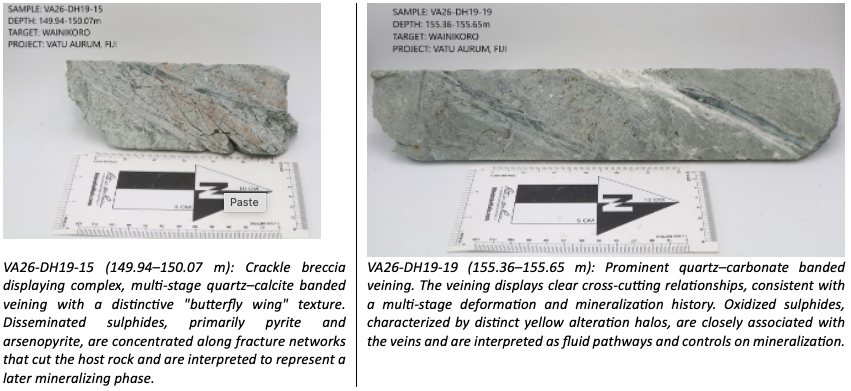
Drillhole VA26-DH19 (270.6 m) was completed at the eastern extent of the KRN target (Figures 1 and 3), intersecting brecciated andesitic volcanics with quartz veining and sulphide mineralization within a >1 km arsenic-in-soil anomaly, above 20 ppm As contour, along a Nubu Graben-related fault. detectORE™ soil values reach 1,640 dU (~1.64 g/t Au) and trench results include 1.73 g/t Au from hydrothermal breccia and 32 m @ 0.56 g/t Au (including 12 m @ 1.0 g/t Au) (historical trench TR17-5K05*). Core logging defines a multi-stage paragenetic sequence:
Early iron oxide veining
Main-stage quartz-carbonate veining
Interpreted bladed carbonate, now replaced by quartz and sulphide pseudomorphs (sulphide characterization pending confirmation)
Sulphide mineralization, includes arsenic-bearing phases
The presence of interpreted bladed carbonate is consistent with boiling and pressure fluctuations - key processes associated with gold deposition in epithermal systems. Elevated arsenic and antimony with low base metals support the interpretation that drilling intersected the upper levels of a vertically zoned epithermal system. Samples have been submitted for QEMSCAN (Quantitative Evaluation of Minerals by Scanning Electron Microscopy). Assays are pending. (*see NR 27 October 2025)
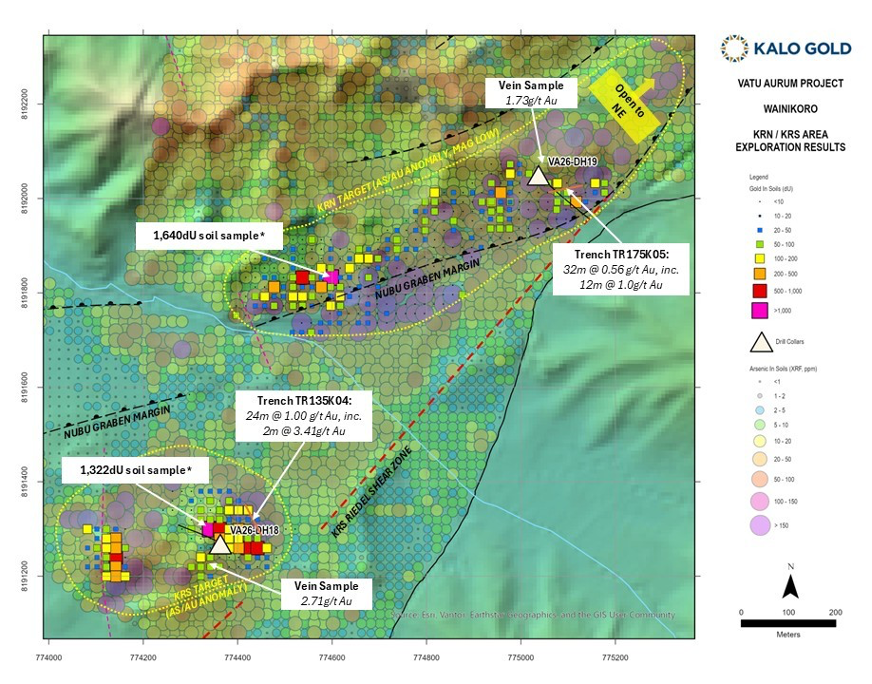
Figure 1: KRN - KRS Targets
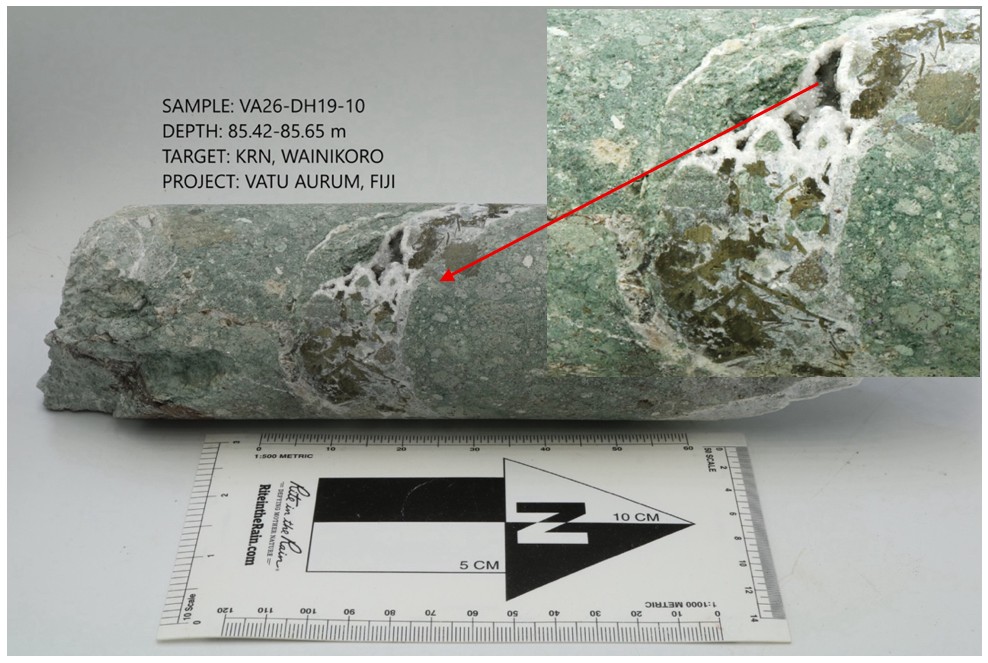
VA26-DH19-10: Open-spaced quartz-carbonate vein hosted within a polymictic, chlorite-altered breccia. Interpreted bladed carbonate (calcite), partially replaced by quartz and sulphide pseudomorphs, post-date initial vein formation and are consistent with boiling and pressure fluctuations during hydrothermal fluid flow. Open-space (vuggy) textures with euhedral crystal growth indicate open-channel deposition along a dilational structure.
KRS: Drillhole VA26-DH18
KRS is located approximately 750 m southwest of KRN along a splay structure interpreted to represent a parallel structural corridor, provisionally interpreted as a Riedel shear within the same hydrothermal system (pending structural confirmation from the planned high-resolution airborne magnetic survey). The target area is characterized by a series of low, dome-shaped hills, interpreted to represent zones of intense silicification and hydrothermal alteration which have increased resistance to erosion.
Trenching returned 24 m @ 1.0 g/t Au (including 2 m @ 3.41 g/t Au) (historical trench TR13-5K04*). Soil geochemistry defines a coincident arsenic-in-soil anomaly directly associated with both trench-hosted mineralization and anomalous gold values, detectORE™ screening values up to 1,322 dU (~1.32 g/t Au), reinforcing the prospectivity of the target.
Drillhole VA26-DH18 (245.7 m) intersected polymictic breccias, quartz-carbonate veining, and sulphide mineralization consistent with a hydrothermal system. Assays are pending (*see NR 27 October 2025).
Expanding Target Pipeline
Additional targets continue to emerge across Wainikoro:
NRC (Figure 2), approximately 1.5 km northwest of KRN: 1000 m by 530 m arsenic-in-soil anomaly with rock grab samples up to 0.6 g/t Au; follow-up fieldwork ongoing to expand the geological understanding of this target
WKW: additional 300m by 200m arsenic-in-soil anomaly follow-up work ongoing
Navialoa (NAG): expanding soil coverage over a magnetic low identified in regional historical TMI airborne geophysics and a possible circular feature in LiDAR
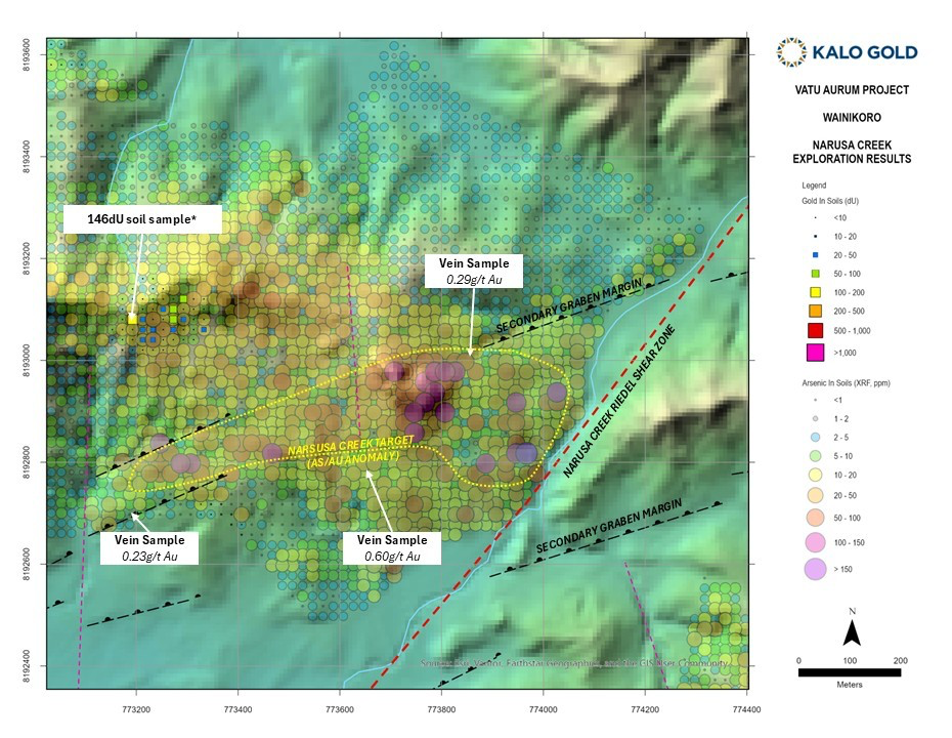
Figure 2: NRC Target
Structural Controls and System Interpretation
Integration of LiDAR, geophysics, and mapping has refined the structural model highlighting dilation zones at structural intersections - where N-S to NW-SE faults intersect the NE-trending Nubu Graben. These create localized areas of dilation and structural complexity which is a key control on fluid flow.
The combination of:
interpreted boiling-related textures (bladed carbonate)
multi-stage sulphide mineralization with evident arsenic enrichment
strong structural controls on fluid flow
widespread hydrothermal alteration and brecciation
NE-SW trending graben architecture (Nubu Graben)
cross-cutting N-S to NW-SE structures
flexures and fault intersections that create zones of dilation
These observations support the interpretation of a structurally controlled epithermal system. VA26-DH19 is interpreted to have intersected the upper levels of this epithermal system.
Next Steps
Receipt and interpretation of Fire Assay results (VA26-DH18 and DH19)
Additional trenching across priority structural targets
Expansion of soil geochemistry
A high-resolution airborne magnetic and radiometric survey is now mobilized and will provide critical data to refine the structural framework and its connection to the broader Vatu Aurum corridor.
Continued integration of geological, geochemical, and geophysical datasets to refine drill targeting
Taken together, these activities will continue advancing the geological model at Wainikoro and refining drill targeting and advancing priority targets toward drill testing through the remainder of 2026.
Technical Notes on detectORE™ Gold Screening Results
This news release references gold (Au) values reported in detectORE™ Units ("dU"), generated using the detectORE™ field-based gold analysis system developed by Portable PPB Pty Ltd. dU values represent a semi-quantitative, ppb-equivalent measure of leachable gold response and are used for exploration screening purposes only. They are not a direct measure of total gold content and are not equivalent to certified Fire Assay results. Accordingly, dU results are not used to estimate Mineral Resources or Mineral Reserves.
Internal validation work conducted by the Company in 2025 on 824 samples from the Vatu Aurum Project demonstrated a strong correlation between dU values and certified Fire Assay results (Pearson R = 0.98 for drill core; R = 0.96 for trench samples). Soil dU results have not been directly validated against Fire Assay. While a positive relationship exists, it is variable across different ranges and may be influenced by lithology, mineralogy, and sample preparation. Any approximate equivalence (e.g., ~1,000 dU ≈ ~1 g/t Au) is provided for contextual reference only and should not be relied upon for grade estimation. For full details, refer to the Company's news release dated 24 February 2026.
Drill Collar Locations
Hole ID | Target | Easting (WGS84) | Northing (WGS84) | Azimuth | Dip | Total Depth (m) |
VA26-DH18 | KRS | 774363 | 8191271 | 315 | 65 | 245.7 |
VA26-DH19 | KRN | 775037 | 8192052 | 145 | 55 | 270.6 |
Coordinates reported on WGS84 / UTM Zone 60S.
Qualified Person
The technical information in this news release was prepared, reviewed, and approved by Andrew Randell, P.Geo., CEO and Principal Geoscientist of SGDS-Hive, Technical Director of the Vatu Aurum Project, and a Qualified Person as defined by NI 43-101. Mr. Randell is independent of the Company and has verified the data disclosed, having conducted multiple site visits (2023-2026) and direct supervision of the exploration program.
Quality Assurance / Quality Control
Soil samples were collected under qualified geological supervision following industry-standard protocols. XRF analysis was performed on site using calibrated portable analyzers. detectORE™ screening data is QA/QC managed through Portable PPB's pLIMS system, including calibration verification, reference materials, blanks and duplicates. Drill core from VA26-DH18 and VA26-DH19 will be securely shipped to ALS Limited (Australia) for analysis by Au-AA25 (30 g Fire Assay, AAS Finish). ALS is accredited by NATA to ISO/IEC 17025 and is independent of the Company and the Qualified Person.
About Kalo Gold Corp.
Kalo Gold Corp. is a gold exploration company advancing the 100%-owned Vatu Aurum Project (Special Prospecting Licences 1511 and 1464), a 367 km² land package on Vanua Levu, Fiji, located in a preserved volcanic back-arc setting. The Company's work is focused on a northeast-trending corridor of low-sulphidation epithermal gold targets extending from Matailabasa in the southwest to Nayaroyaro in the northeast. Exploration across the corridor - including at the flagship Aurum Prime area and Wainikoro (incorporating the KRN, KRS and NRC targets) - has defined multiple structurally controlled gold targets supported by drilling, trenching, and soil geochemistry. The Company is systematically advancing high-confidence targets toward discovery.
Kalo Gold Corp. is headquartered in Vancouver, British Columbia, and is listed on the TSX Venture Exchange (KALO), the OTCID Market (KLGDF), and the Frankfurt Stock Exchange (9M51). For further information, visit www.kalogoldcorp.com.
On behalf of the Board of Directors of Kalo Gold Corp.
Terry L. Tucker, P.Geo.
President and Chief Executive Officer
Kevin Ma, CPA, CA
Executive Vice President, Capital Markets and Director
For further information: info@kalogoldcorp.com | www.kalogoldcorp.com
Neither the TSX Venture Exchange nor its Regulation Services Provider (as that term is defined in the policies of the Exchange) accepts responsibility for the adequacy or accuracy of this press release.
Cautionary Statement Regarding Forward-Looking Information
This news release contains "forward-looking statements" and "forward-looking information" within the meaning of applicable Canadian securities laws. Forward-looking statements can often be identified by the use of words such as "will", "may", "should", "could", "would", "anticipate", "believe", "estimate", "expect", "intend", "plan", "potential", "continue", "target", "scheduled", and similar expressions, or statements that certain events or conditions "will", "may", or "could" occur.
Forward-looking statements in this news release include, but are not limited to: (i) the timing, scope, and results of planned exploration at Wainikoro and the broader Vatu Aurum Project, including receipt and interpretation of pending certified Fire Assay results from VA26-DH18 and VA26-DH19; (ii) the interpretation that arsenic-in-soil anomalies, magnetic lows, and the Nubu Graben and associated splay structures reflect hydrothermal fluid pathways with potential for gold mineralization at depth; (iii) the interpretation that bladed carbonate pseudomorphs observed in drill core are consistent with boiling conditions during hydrothermal activity, pending QEMScan confirmation at Intertek Kamloops; (iv) the interpretation that drilling to date has intersected the upper levels of a vertically zoned epithermal system, with potential for stronger mineralization at depth and along strike; (v) the interpretation of a 40 km NE-trending gold-in-drainage corridor connecting Wainikoro to Aurum Prime; (vi) the interpretation that KRN and KRS represent parallel structural corridors within the same hydrothermal system, including the provisional interpretation of a Riedel shear zone at KRS; (vii) plans to complete a high-resolution airborne magnetic and radiometric survey and to expand soil, stream sediment, and trench programs across the Wainikoro Prospect; and (viii) the Company's ability to secure financing, permits, and regulatory approvals required to advance exploration on the Vatu Aurum Project.
Forward-looking statements are based on a number of assumptions that the Company considers reasonable but which may prove to be inaccurate, including: that pending Fire Assay results will be received from ALS Laboratories within anticipated timelines; that QEMScan analysis at Intertek Kamloops will be completed and will inform the mineralogical interpretations stated above; that the Company will be able to fund and execute the planned exploration programs; that permits, tenure, and licences will remain in good standing; that there will be no adverse change in the political, regulatory, or operational environment in Fiji, including potential fuel shortages; and that commodity prices and capital markets conditions will support continued exploration.
Forward-looking statements are subject to known and unknown risks and uncertainties that may cause actual results, performance, or achievements to differ materially from those expressed or implied, including: exploration and drilling risk; the risk that detectORE™ dU screening results may not be confirmed by certified Fire Assay (detectORE™ dU values are semi-quantitative screening estimates and are not equivalent to quantitative gold grades; soil dU results have not been directly validated against Fire Assay); the risk that geological, geochemical, geophysical, and structural interpretations may change with additional data; permit, tenure, and title risk; risks of operating in Fiji, including fuel supply, logistics, and currency risk; dependence on key personnel; environmental, health, and safety risk; financing and dilution risk; and commodity price volatility. References to Aurum Prime (QC1) are for geological context only and no inference should be drawn that mineralization demonstrated at Aurum Prime will be present at Wainikoro. Readers are cautioned not to place undue reliance on forward-looking statements.
The Company does not undertake any obligation to update or revise any forward-looking statements, whether as a result of new information, future events, or otherwise, except as required by applicable securities laws. Readers are directed to the Company's continuous disclosure filings available on SEDAR+ at www.sedarplus.ca, including its most recent Management's Discussion and Analysis, for a more complete discussion of the risks affecting the Company and its business.
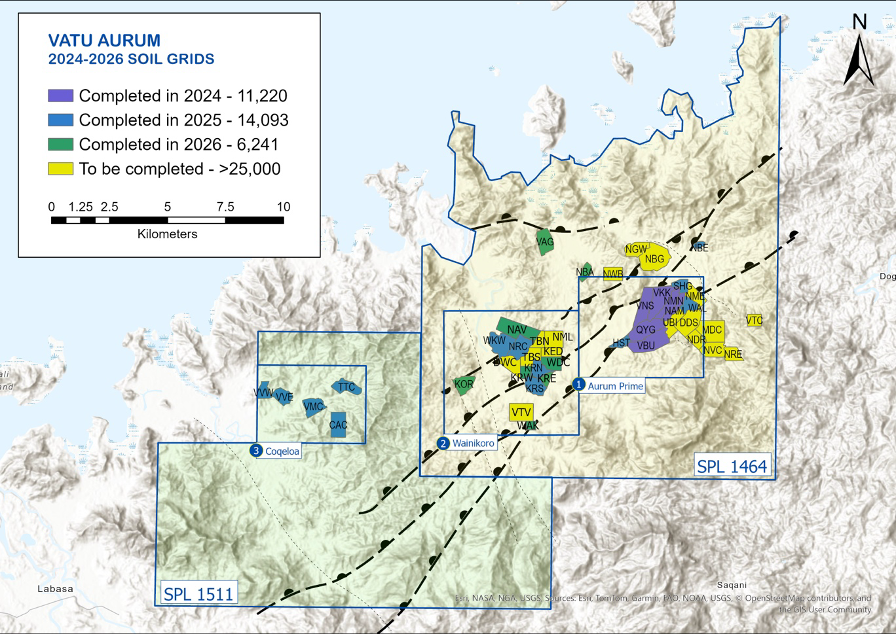
Figure 3: Vatu Aurum Project target areas with soil grids
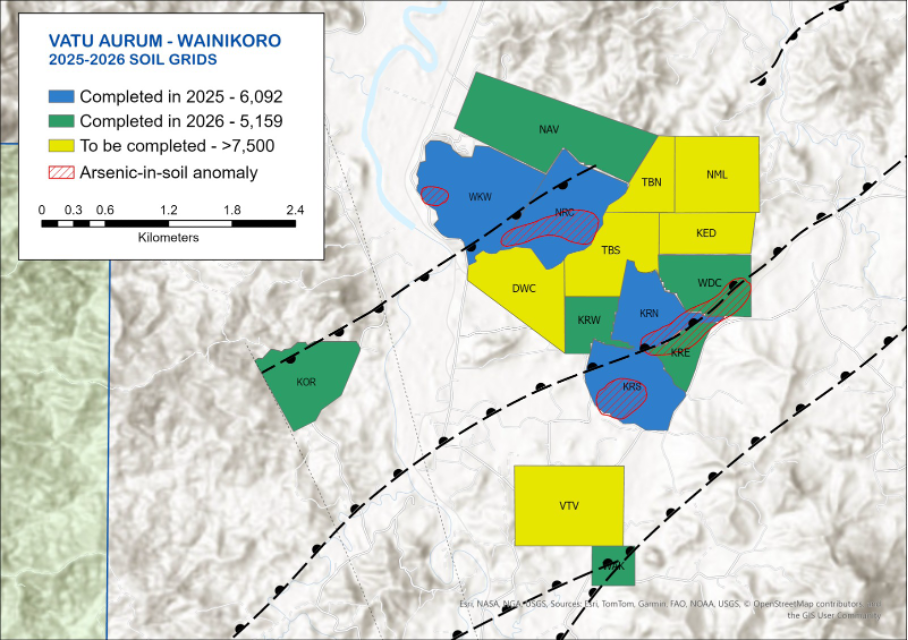
Figure 4: Wainikoro target areas with soil grids and As in soil
SOURCE: Kalo Gold Corp.
News Provided by ACCESS Newswire via QuoteMedia