Resource Investing
![Charlotte McLeod]() Jul 21, 2026 08:45PM
Jul 21, 2026 08:45PM
"It's interesting times, but I'm feeling really positive about the rest of the year," said Chris King of OTC Markets Group.
With an eye for detail and over a decade of experience covering the mining and metals sector, Charlotte is passionate about bringing investors accurate and insightful information that can help them make informed decisions.
She leads the Investing News Network's video and event coverage, and guides a team of writers reporting on niche investment markets.
"It's interesting times, but I'm feeling really positive about the rest of the year," said Chris King of OTC Markets Group.
Chris King, senior vice president, corporate services, at OTC Markets Group, shares his takeaways on H1 trends in the mining sector.
He also breaks down how the OTC works, honing in on the exchange's different tiers and explaining when an OTC listing may make sense for a company.
Click here to register for the OTC's upcoming events.
Don't forget to follow us @INN_Resource for real-time updates!
Securities Disclosure: I, Charlotte McLeod, hold no direct investment interest in any company mentioned in this article.
With an eye for detail and over a decade of experience covering the mining and metals sector, Charlotte is passionate about bringing investors accurate and insightful information that can help them make informed decisions.
She leads the Investing News Network's video and event coverage, and guides a team of writers reporting on niche investment markets.
Steve Barton, host of In It To Win It, weighs in on the recent price declines in gold and silver, outlining the odds for their next moves. He also discusses uranium, saying that current levels represent a strong entry point for investors.
"I think this bet is a slam dunk. I think this is a really, really good bet," he said.
Don't forget to follow us @INN_Resource for real-time updates!
Securities Disclosure: I, Charlotte McLeod, hold no direct investment interest in any company mentioned in this article.
"The best place to find a new mine is right next to an existing mine."
GoldInxs Mining (TSXV:INXS,OTCQB:INXGF) President and CEO Nick Michael says that idea is why the company is exploring its flagship Fishpot property in Central BC.
Speaking to the Investing News Network at the Precious Metals Summit in Beaver Creek, Colorado, Michael said Fishpot is in the same mineral belt as Artemis Gold's (TSXV:ARTG,OTCQX:ARGTF) Blackwater mine and Evolution Mining's (ASX:EVN,OTCPL:CAHPF) optioned Clisbako property.
The company says only 378 meters in two holes have been drilled historically on the 5,509 hectare property. Since acquiring Fishpot, GoldInxs has built a geologic model using geophysics, geochemistry, airborne magnetics and a recently completed 3D induced polarization survey.
Michael said a drill program of about 2,000 meters will start in October.
"Success for us would be a 2,000 meter drilling program that's completed, that proves that we have continuous mineralization at depth and also validates our geologic model as it stands today," he said.
He described the company's approach as "targeting first and drilling second."
"We're not drilling looking for a great intercept that we can quickly go out and broadcast to the world," Michael said. "What we are interested in instead is collecting information, valuable information, and learning about this deposit."
Watch the full interview with GoldInxs President and CEO Nick Michael above.
With an eye for detail and over a decade of experience covering the mining and metals sector, Charlotte is passionate about bringing investors accurate and insightful information that can help them make informed decisions.
She leads the Investing News Network's video and event coverage, and guides a team of writers reporting on niche investment markets.
Don Durrett of GoldStockData.com shares his updated gold and silver price outlook, as well as how his portfolio is focused given the current environment.
"You have this unbelievable opportunity here — the leverage is just somewhat crazy," he said.
Don’t forget to follow us @INN_Resource for real-time updates!
Securities Disclosure: I, Charlotte McLeod, hold no direct investment interest in any company mentioned in this article.
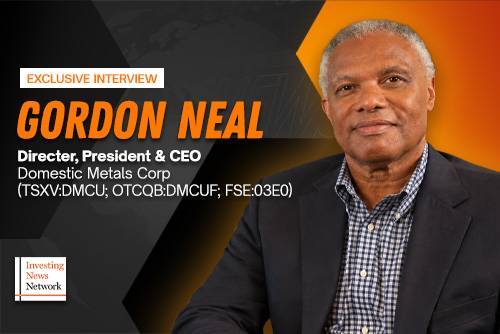
Domestic Metals (TSXV:DMCU,OTCQB:DMCUF,FWB:03E0) President and CEO Gordon Neal discussed the drill program now underway at the Smart Creek project in Montana.
Speaking with the Investing News Network at the Precious Metals Summit in Beaver Creek, Neal emphasized that Rio Tinto's (ASX:RIO,NYSE:RIO,LSE:RIO) best hole at Smart Creek returned 109.73 meters at 0.75 percent copper.
The company is drilling at an angle to test its interpretation that the mineralization is a dipping structure.
Domestic Metals is earning up to a 60 percent interest in the project through an option agreement with Rio Tinto.
Watch the full interview with Domestic Metals President and CEO Gord Neal above.
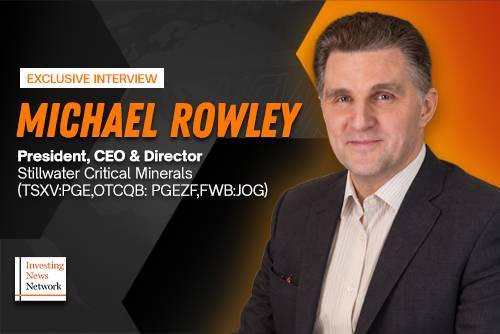
Stillwater Critical Minerals (TSXV:PGE,OTCQB:PGEZF) President and CEO Michael Rowley announced that the company upgraded the mineral resource for its flagship Stillwater West project.
The company's August 2026 mineral resource estimate more than doubles the inferred resource and adds a maiden indicated resource of 29.4 million tonnes grading 0.38 percent total nickel equivalent. The inferred resource totals 805.1 million tonnes grading 0.34 percent total nickel equivalent.
"The model is working," Rowley said at the Precious Metals Summit in Beaver Creek. Next, the company plans to convert inferred pounds and ounces to indicated and build out metallurgy, engineering and community studies.
Rowley said the polymetallic mix of nickel, copper, cobalt, platinum-group metals, gold and chromium gives the company flexibility through commodities cycles. He added that strategic investor Glencore (LSE:GLEN,OTCPL:GLCNF) has "written three checks in three years."
Watch the full interview with Stillwater Critical Minerals President and CEO Michael Rowley above.
With an eye for detail and over a decade of experience covering the mining and metals sector, Charlotte is passionate about bringing investors accurate and insightful information that can help them make informed decisions.
She leads the Investing News Network's video and event coverage, and guides a team of writers reporting on niche investment markets.